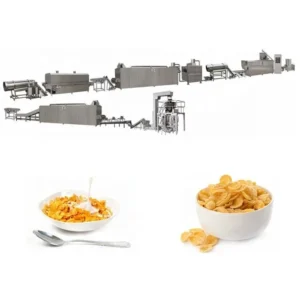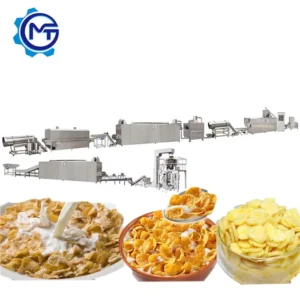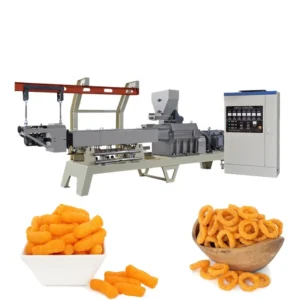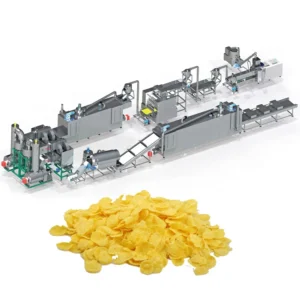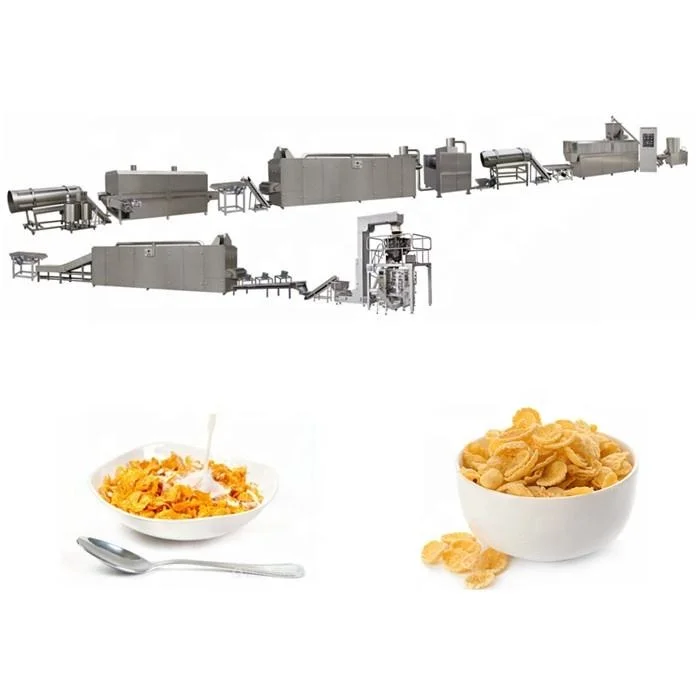
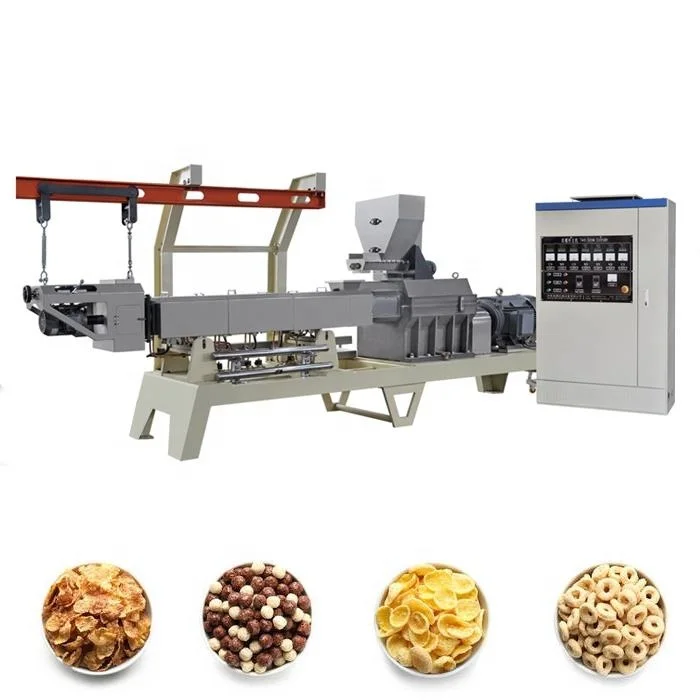
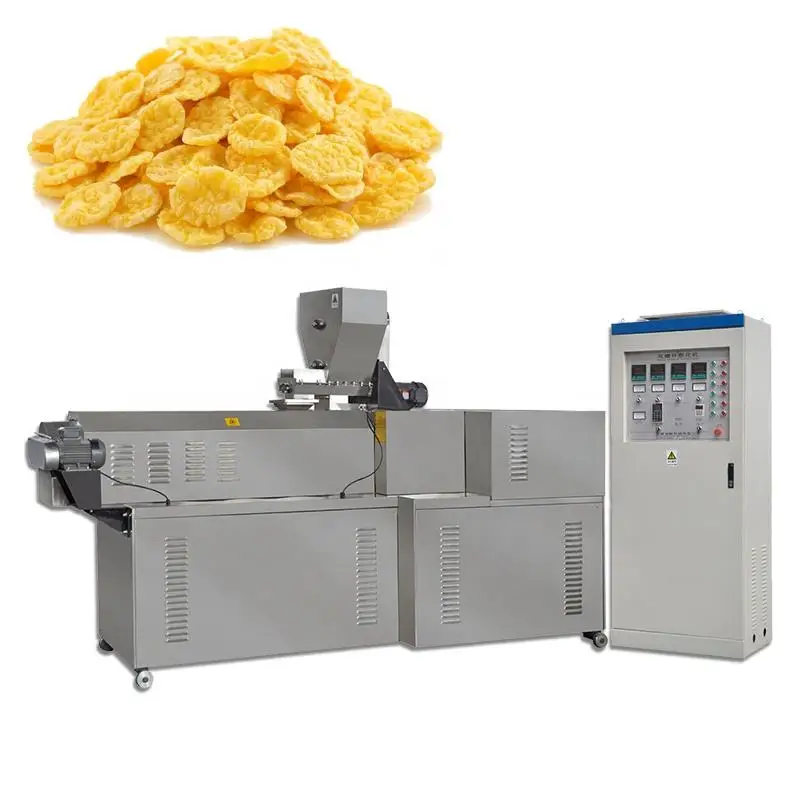
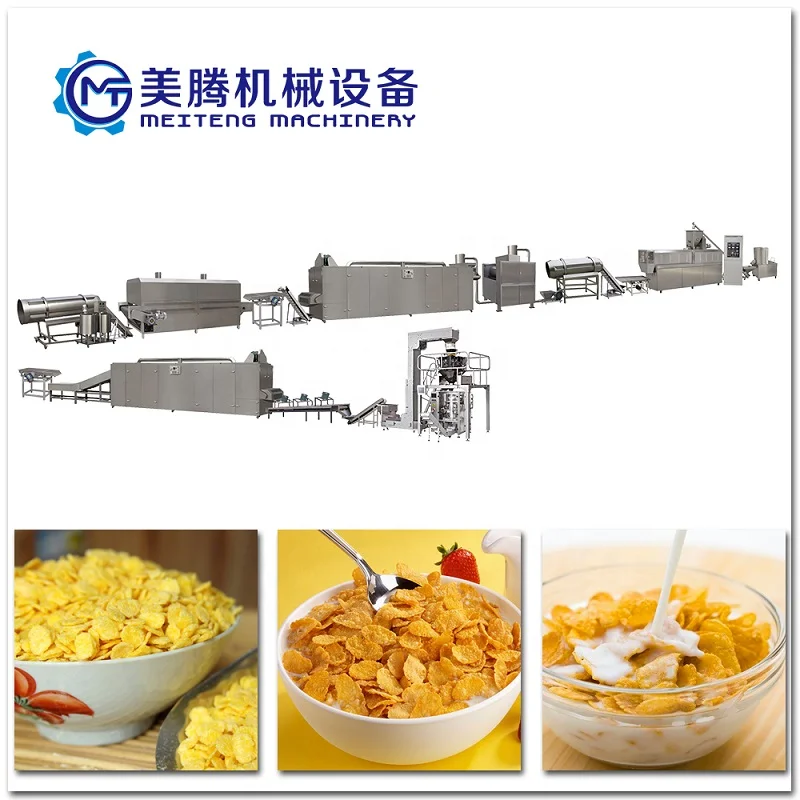
MT70 / MT85 / MT75 Corn Flakes Breakfast Cereal Production Line, Twin-Screw Extrusion, PLC & MCC Control — engineered as a complete turnkey project from batching through extrusion, flaking, roasting, coating and packing, with throughput matched at every station to eliminate line bottlenecks. Screw configuration and die design are specified to your grain formulation, whether corn, oat, wheat or barley, and mould interchangeability supports multiple cereal shapes from a single extruder platform.
- Hydraulic double-roller flaking machine with infrared temperature control ensures uniform flake thickness and consistent product density
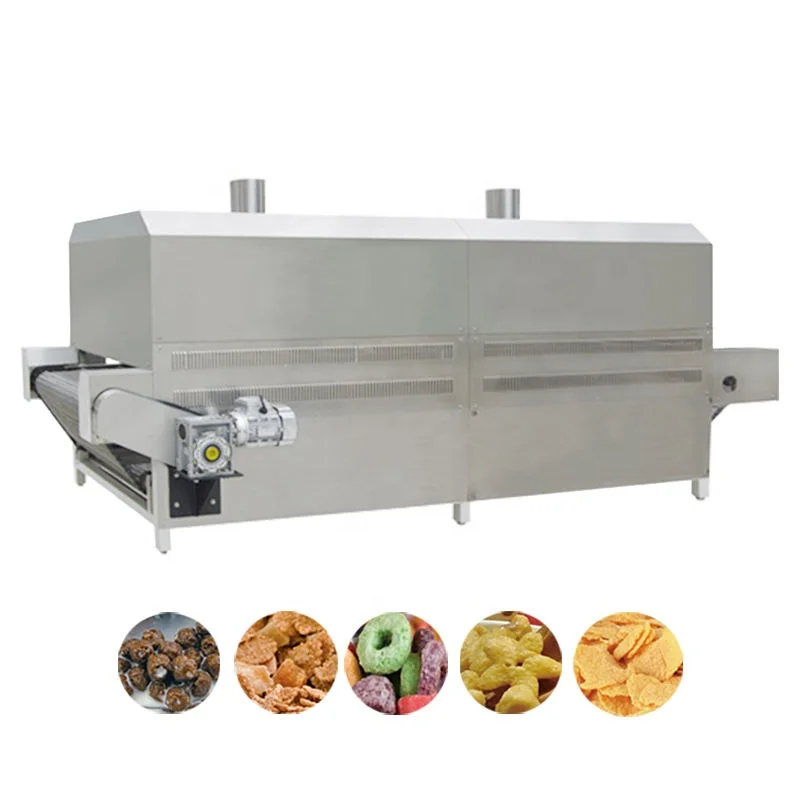
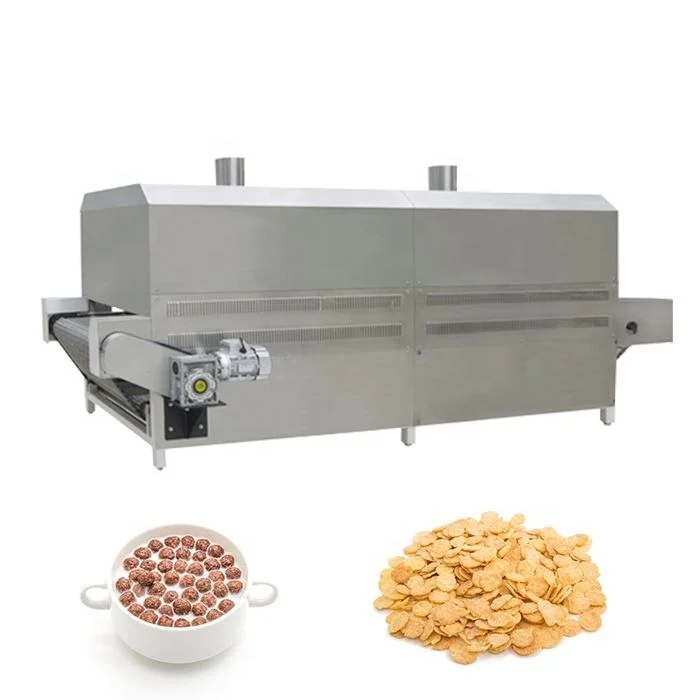
- Hot air roasting oven with dual circulating fans and cyclone dust removal delivers precise temperature profiling for the surface crispness the market expects
- In-house testing workshop runs trial production on your actual raw material before shipment, with a full trial run report provided
- Custom factory layout, on-site installation, commissioning and operator training included to ensure the line meets your production target from day one
Description
Whole-Line Throughput Balancing — we configure every station from mixing to packing around your specific grain formulation, so the flaker, dryer and roaster never starve or choke the extruder.
Technical Specifications
| Parameter | Value |
|---|---|
| Product Type | Breakfast Cereal Corn Flakes Production Line |
| Model | MT70 / MT85 / MT75 |
| Extruder Type | Twin Screw |
| Installed Power | MT70: 160 kW; MT85: 190 kW; MT75: 210 kW |
| Power Consumption | MT70: 120 kW; MT85: 140 kW; MT75: 150 kW |
| Output Capacity | MT70: 150–200 kg/h (basis not stated in source — confirm raw material and moisture); MT85: 300–400 kg/h (basis not stated in source); MT75: 300–500 kg/h (basis not stated in source) |
| Overall Dimensions (L×W×H) | MT70: 41 × 1.5 × 2.2 m; MT85: 43 × 1.5 × 3.2 m; MT75: 45 × 1.5 × 3.5 m |
| Flaking Machine | PLC control, hydraulic double-roller system, dual motors for independent roller drive, infrared sensor temperature regulation |
| Dryer Heating Source | Gas or Electric (configurable) |
| Hot Air Roasting Oven | Vibrating pan, reconciliation burner, dual circulating fans, cyclone dust removal |
| Coating System | Double tumble sugar melter, elevator, coating drum, spraying nozzle |
| Control System | PLC and MCC across line stations |
| Raw Materials | Corn, rice, wheat, oat, barley powder |
| Final Product Shapes | Ball, tube, stick, ring, fruit loop, star, wheel, flower, heart (via extruder die change) |
| Certification | CE, ISO |
Application Suitability
| Application | Material or Output |
|---|---|
| Natural corn flakes for retail breakfast cereal market | Corn grits and corn flour blends |
| Sugar-coated corn flakes with glaze finish | Corn base with sucrose or syrup coating |
| Oat and multigrain breakfast rings | Oat flour blended with wheat or rice powder |
| Fortified breakfast cereal for institutional nutrition programmes | Grain powder premixed with vitamin and mineral sachets |
| Variety shaped cereal snacks (star, heart, fruit loop) | Rice, wheat and corn flour with die interchange |
Why "Nominal Line Capacity" Rarely Survives Your First Production Day
A breakfast cereal corn flakes production line turnkey only holds its rated output when every station is scaled to the same actual throughput on your grain blend.
Most quotations list the extruder as the capacity anchor. In practice, the flaker, dryer and roasting oven each have their own throughput limits, and those limits shift with the moisture content, starch composition and particle size of the material you actually feed in. I spent two weeks on-site in the Middle East re-tuning screw combinations and moisture curves because the buyer’s oat-blended flour behaved nothing like the corn starch baseline used during line sizing [NEED_CITE: moisture and starch behaviour differences between corn, oat and wheat during twin-screw extrusion]. The breakfast cereal corn flakes production line turnkey you specify on paper must match the cereal you will actually bag.
Station-by-Station Throughput Matching
The breakfast cereal corn flakes production line turnkey runs through mixing, extruding, flaking, drying, hot air roasting, optional sugar coating, cooling and packing. If the dryer cannot remove moisture fast enough, the roaster receives product that is too wet, and the final crispness specification fails. Our layout calculations start from the buyer’s target bag weight and daily shift length, then work backward to size each station with margin rather than assuming a single extruder figure covers everything.
Screw and Die Configuration Tied to Your Grain Blend
Twin-screw extrusion behaviour changes noticeably when you move from pure corn grits to an oat or barley blend. The screw combination, barrel temperature profile and die geometry must be specified against the actual formulation. We record the screw configuration and die selection for each buyer’s recipe so that replacement wear parts reproduce the same expansion and density [NEED_CITE: twin-screw extrusion screw element arrangement for starch gelatinisation control]. Interchangeable dies on the platform let you switch between rings, balls, tubes and star shapes without a second extruder.
Reading the Power and Footprint Data
Installed power across the three models ranges from 160 kW to 210 kW, with running consumption lower at 120 kW to 150 kW. That gap reflects the heating cycles and motor start-up peaks typical in extrusion and roasting. The line footprint stretches to 45 m in length for the MT75, so factory planning must account for the full run including the cooling conveyor and packing table, not just the extruder bay. Gas or electric dryer options change both the utility connection and the ventilation requirement, a decision that should be settled before the line ships rather than during commissioning.
The Hidden Cost of Mismatched Stations
When a flaker is undersized relative to the extruder, the ribbon of extruded dough backs up, cools below the plastic range, and the flakes shatter instead of pressing flat. When the roasting oven is too small, product queues in the dryer and picks up excess moisture that the coating drum cannot handle. These failures do not show up during a factory test on generic material [NEED_CITE: flaking temperature window and its effect on cereal sheet integrity]. They appear on the first full shift with the buyer’s own recipe, and the fix often means replacing a station rather than adjusting settings.
Why Source the Whole Line from One Supplier
Throughput calculations cover every station, not just the extruder, so the breakfast cereal corn flakes production line turnkey is sized as one system. Screw and die configurations are recorded against the buyer’s grain formulation before production begins. The in-house testing workshop runs trial batches on customer-supplied raw material so that expansion, flake density and roasting behaviour are verified before the line ships. Factory layout is drawn to the buyer’s actual floor dimensions rather than a generic template. MCC and PLC control panels are wired and labelled to the buyer’s local voltage and language requirement, confirmed in writing before assembly starts.
Documentation & Verification
- Line layout and capacity calculation matched to your daily output target and shift pattern
- Trial run report on your corn, oat or wheat formulation confirming flake density and expansion
- Screw and die configuration record tied to your specific grain blend and target shape
- Electrical schematic with voltage and frequency locked to your site supply standard
- CE declaration of conformity and ISO certificate for customs and regulatory filing
Installation, Commissioning & Support
- Floor space reservation based on the 41–45 m line length plus cooling and packing zones
- Dedicated power circuit sized to the MT75 peak draw of 210 kW with local voltage confirmation
- MCC and PLC panel pre-wired and labelled in the operator’s language before dispatch
- On-site screw combination adjustment and moisture curve tuning during first production shift
- Flaking roller and extruder screw wear parts list supplied with recommended replacement intervals
Before You Request a Quote
To size the line correctly we need the grain formulation you will run, the target daily output in kilograms, and your factory floor dimensions including ceiling height. Confirm the local voltage and frequency standard so the MCC panel can be wound and the heating elements specified accordingly. If you have an existing mixer or packing machine that must integrate with the new line, send the make and model so we can match the interface.
Frequently Asked Questions
Q: How is line capacity verified on my specific raw material rather than a generic test medium?
A: Before shipment, we run trial production in our testing workshop using your actual corn, oat or wheat blend. The trial covers extrusion expansion, flake pressing behaviour and roasting response. A written report documents flake density, moisture at each station and final crispness so you can compare results against your product specification before the line leaves the factory.
Q: What is the phased installation and commissioning schedule for a complete line?
A: Equipment is positioned and anchored first, then electrical and gas connections are made to the MCC panel. Commissioning proceeds station by station, starting with the mixer and extruder, then the flaker and dryer. Final tuning of screw combination, barrel temperature and roasting profile happens during continuous production runs with your operators present.
Q: How are extruder, flaker, dryer and roaster throughput matched to prevent bottlenecks?
A: Layout and capacity calculations start from your target bag weight and shift length. Each station is sized with margin above the extruder output so that moisture removal in the dryer and heat transfer in the roaster keep pace even when the raw material absorbs water differently than the test baseline.
Q: What factory utility planning is required before the equipment arrives?
A: You need a dedicated electrical circuit matching the installed power rating at your local voltage and frequency, a gas supply line if the dryer and roaster are gas-fired, adequate ventilation for moisture exhaust from the dryer, and a level concrete floor spanning the full line length plus space for cooling conveyors and packing tables.
Q: What operator training and wear parts support are included?
A: On-site training covers extruder start-up and shut-down, screw combination changes for different cereal shapes, flaker roller gap adjustment and PLC screen navigation. A wear parts list identifies screws, dies and flaking rollers with replacement intervals, and spare sets can ship with the line or be dispatched separately when stock runs low.
Related products
-
1000 Lbs Automatic Corn Flakes Production Line Mixer Breakfast Cereal Corn Flakes Production Line
¥45,000.00 Select options This product has multiple variants. The options may be chosen on the product page -
New High Efficiency Electric Corn Flakes Production & Manufacturing Machine
¥7,500.00 Select options This product has multiple variants. The options may be chosen on the product page -
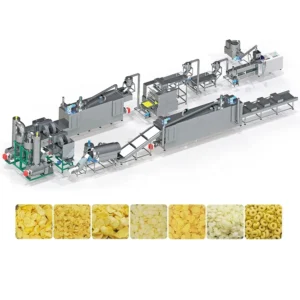
Whole Grain Choco Hoop Crunchy Wheat Cereal Ring Fruit Loops Snacks Extruder Machine /breakfast Cereals Corn Flakes Production
¥48,000.00 Select options This product has multiple variants. The options may be chosen on the product page -
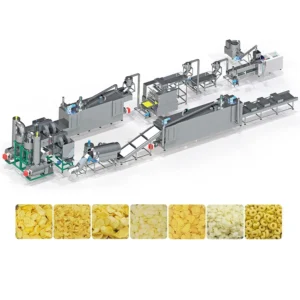
Automatic Cornflakes Making Machine Corn Flakes Breakfast Cereals Processing Production Line
¥500.00 Select options This product has multiple variants. The options may be chosen on the product page