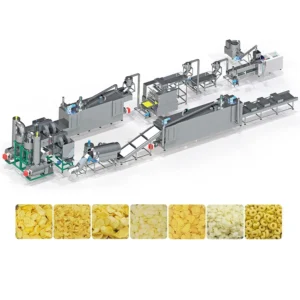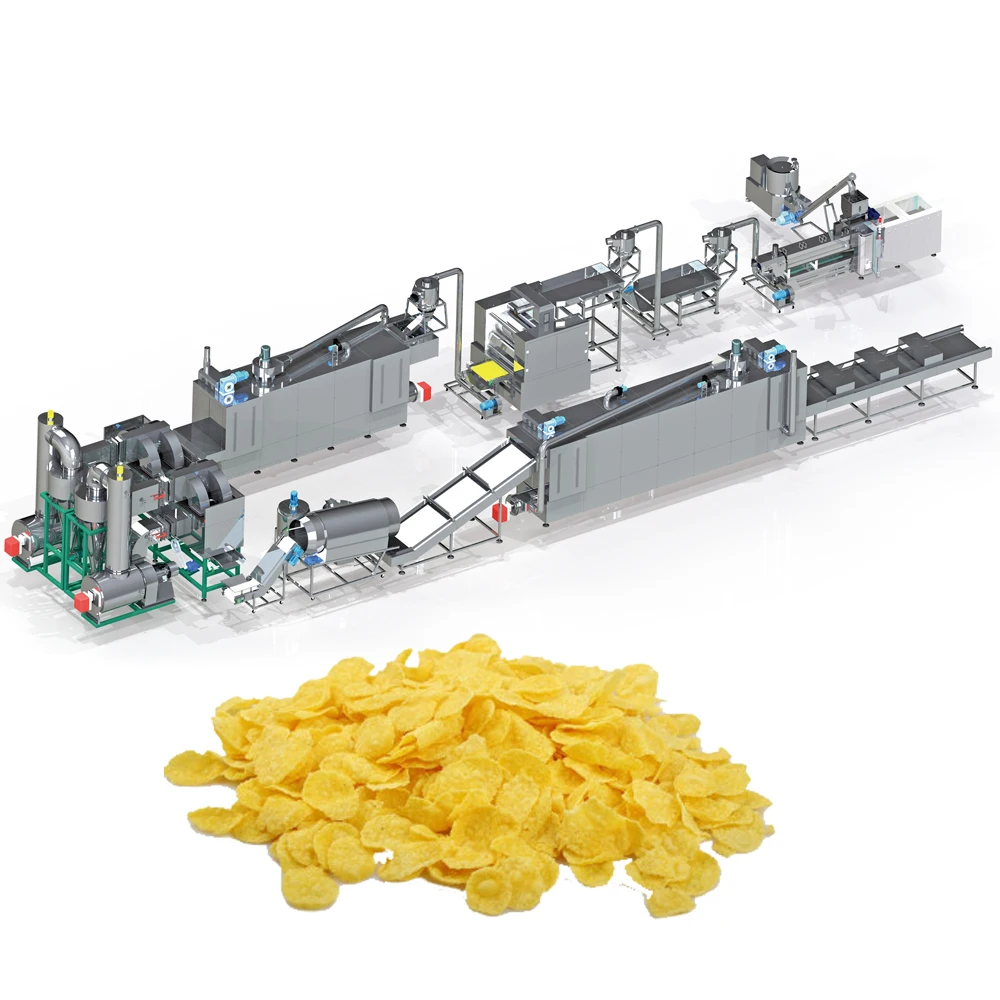
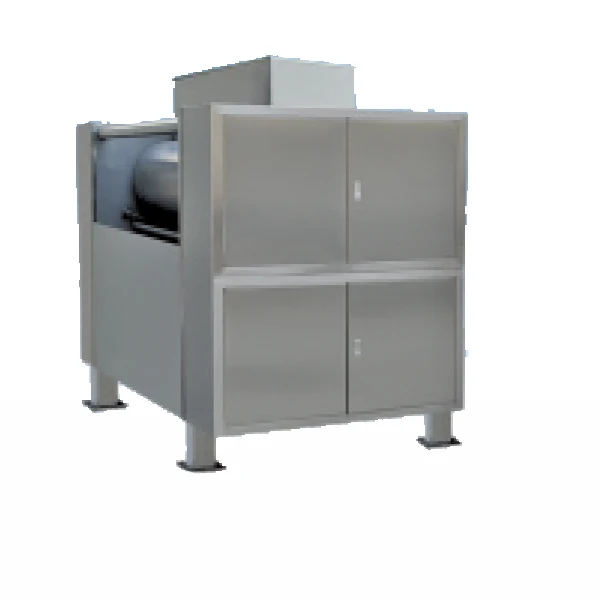


MT70 / MT85 / MT75 Corn Flakes Production Line, Twin-Screw Extrusion, PLC Control — configured for natural and sugar-coated breakfast cereals from corn, rice, wheat, oat and barley powders, with multiple shape options via die change.
- Stations cover mixing, extruding, flaking, drying, hot air roasting, coating, cooling and packing, with throughput matched across every section to avoid bottlenecks.
- Layout and utility planning are customized to your factory dimensions, with screw configuration specified to your formulation for target flake density and texture.
Trial runs on your raw material in our testing workshop validate capacity and product quality before shipment, supported by complete documentation from layout to maintenance manuals.
Description
Integrated line throughput matching — Every station in this corn flakes production line is calculated against the others so extruder output, flaker capacity, dryer residence time, and roasting oven throughput all align to your actual formulation rather than to nominal nameplate figures.
Technical Specifications
| Parameter | Value |
|---|---|
| Product Type | Corn Flakes Production Line |
| Model | MT70 / MT85 / MT75 |
| Extruder Type | Twin-screw |
| Installed Power | MT70 — 160 kW; MT85 — 190 kW; MT75 — 210 kW |
| Power Consumption | MT70 — 120 kW; MT85 — 140 kW; MT75 — 150 kW |
| Output Capacity | MT70 — 150–200 kg/h (basis not stated in source — confirm raw material / moisture); MT85 — 300–400 kg/h (basis not stated in source — confirm raw material / moisture); MT75 — 300–500 kg/h (basis not stated in source — confirm raw material / moisture) |
| Overall Dimensions (L×W×H) | MT70 — 41 × 1.5 × 2.2 m; MT85 — 43 × 1.5 × 3.2 m; MT75 — 45 × 1.5 × 3.5 m |
| Extruder Working Systems | Feeding, extruding, cutting, heating, gearing, controlling |
| Screw Feature | Automatic lubricating and cooling; wear-resistant screw material |
| Flaking Machinery | Hydraulic double-roller system; dual independent motors; infrared sensor temperature control |
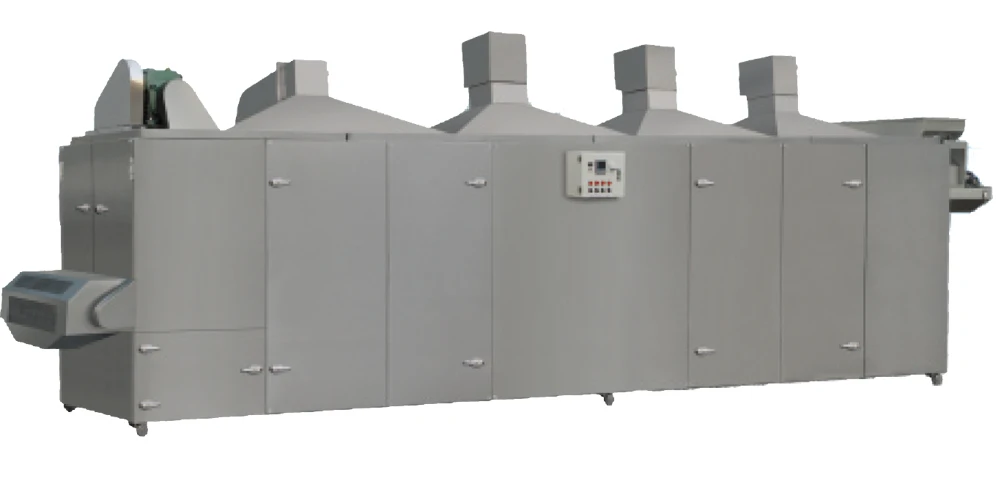
| Dryer Heating Source | Gas or Electric (configurable) |
| Hot Air Roasting Oven | Vibrating pan; high-temperature spraying tubes; conciliation burner; dual circulating fans; cyclone dust removal |
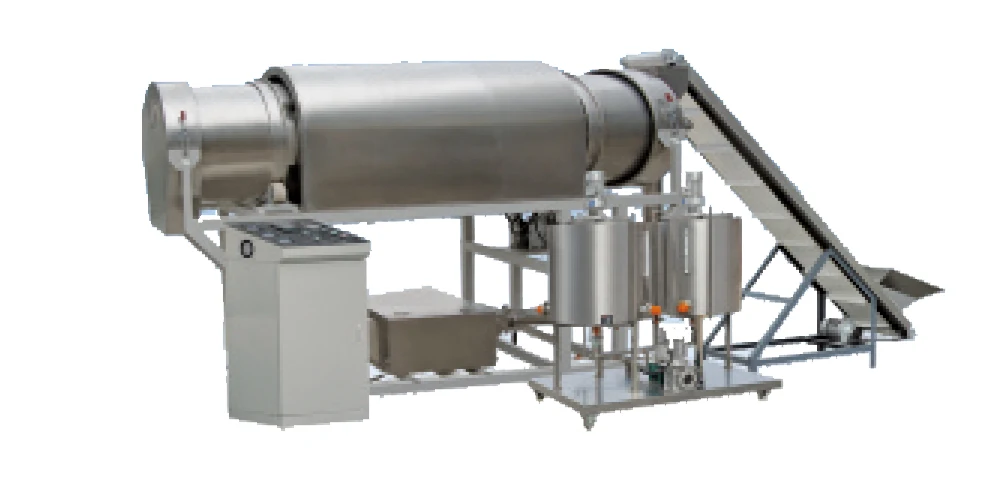
| Coating System | Double tumble sugar melting; elevator; coating drum; spraying nozzle |
| Control System | PLC (flaking machinery); MCC and PLC available |
| Line Configuration (Natural) | Mixing → Extruding → Flaking → Drying → Hot Air Roasting → Cooling → Packing |
| Line Configuration (Sugar Coated) | Mixing → Extruding → Flaking → Drying → Hot Air Roasting → Sugar Spraying → Sugar Coating → Drying → Cooling → Packing |
| Voltage & Frequency | Customized to local supply |
| Layout | Customized to factory dimensions |
| Assembly State | Complete production line, fully automatic |
| Standards | CE certified; ISO certified |
Application Suitability
| Application | Material or Output |
|---|---|
| Natural corn flakes production | Corn powder, corn grits |
| Sugar-coated breakfast cereal | Corn, rice, wheat, oat, barley powder blends |
| Multi-shape extruded cereal | Same base materials; shapes include ball, tube, stick, ring, fruit loop, star, wheel, flower, heart via die change |
| Fortified breakfast cereal lines | Cereal powder blends with added nutritional premix |
| Dual-format production (natural + coated) | Single extrusion platform feeding both finishing paths |
Why a Turnkey Corn Flakes Production Line Must Address Station-to-Station Throughput Before Anything Else
A line is only as fast as its slowest station, and nominal extruder output means nothing if the flaker, dryer, or roasting oven cannot keep pace.
In breakfast cereal projects, the most common failure I see is not a bad extruder — it is a mismatched line. One station quoted at a nominal capacity that cannot hold that output on the buyer’s actual raw material creates a cascade: flakes pile up before the dryer, moisture content drifts, roasting becomes uneven, and entire batches get rejected. [NEED_CITE: throughput mismatch consequences in cereal extrusion lines] The corn flakes production line turnkey approach eliminates this by calculating throughput at every station — mixing, extruding, flaking, drying, roasting, coating, cooling, and packing — against your specific recipe and target flake density before any steel is cut.
How Station Matching Defines Line Layout and Footprint
When planning a corn flakes production line turnkey project, the physical layout is driven by throughput balance. The extruder pushes cooked dough to the flaker, which must compress it to a precise thickness before the product enters the dryer. If the dryer belt speed or residence time falls short, wet flakes reach the roasting oven and blister unevenly. Every dimension in the line — from the 41-meter footprint of the MT70 to the 45-meter span of the MT75 — reflects a calculated sequence of processing stages where no station waits idle and no station is overwhelmed.
Twin-Screw Extrusion Behaviour with Cereal Formulations
The twin-screw extruder in this line handles the cooking, gelatinisation, and forming of the cereal dough in a single continuous process. Screw configuration and barrel temperature profile are set to the buyer’s raw material blend — a high-corn recipe behaves differently from an oat-heavy or multi-grain formulation in terms of viscosity, starch gelatinisation rate, and expansion at the die. [NEED_CITE: twin-screw extrusion behaviour across cereal starch profiles] The automatic lubricating and cooling function on the extruder supports continuous running without unplanned shutdowns, which matters when a full line depends on steady upstream feed.
Reading the Specifications Through a Process Engineering Lens
The installed power figures — 160 kW for the MT70, 190 kW for the MT85, and 210 kW for the MT75 — reflect the thermal and mechanical energy needed to cook and form cereal dough at their respective throughput ranges. Power consumption values are lower, indicating that not all systems draw peak load simultaneously. The flaking machinery uses a hydraulic double-roller system with dual independent motors, which means each roller can be adjusted separately for gap and speed — critical when flake thickness must stay consistent across varying dough moisture. Infrared sensor temperature control on the flaker rolls prevents the dough from sticking or tearing during compression. The hot air roasting oven relies on two separate circulating fans and a cyclone dust removal device to maintain even heat distribution and remove fines, which directly affects surface blistering and the final crispness that consumers expect from breakfast cereal. PLC control across the flaking station ensures that roller pressure and speed remain repeatable across production runs, reducing batch-to-batch variation.
The Cost of Skipping Throughput Verification
When a breakfast cereal line is assembled from separate vendors without a single party owning the throughput calculation, the consequences surface after installation. Flakes arrive at the roasting oven too moist or too dry. The sugar coating drum receives product faster than it can tumble evenly, leaving clumps. Cooling conveyors back up because the upstream dryer releases product in surges rather than a steady flow. [NEED_CITE: post-installation line imbalance in cereal processing] These problems are expensive to fix because they require mechanical modifications — longer dryer belts, larger cooling conveyors, additional buffer hoppers — rather than simple parameter adjustments.
Why Procuring the Full Line from One Source Matters Here
Every station in this corn flakes production line turnkey system — from the batching and mixing stage through extrusion, flaking, drying, roasting, sugar coating, cooling, and packing — is specified under a single supplier so throughput is matched by design rather than negotiated between vendors. The screw configuration and die design are set to the buyer’s raw material and target flake shape, whether that is a classic flat flake or a fruit loop ring. An in-house testing workshop allows trial runs on your actual raw material before shipment, so product development starts before the line arrives at your facility rather than after. Electrical schematics are confirmed against your local voltage and frequency before production begins, avoiding commissioning delays. The MT70, MT85, and MT75 models span a range of output capacities, allowing selection based on your actual production target rather than forcing a one-size compromise.
Documentation & Verification
- Line layout and capacity calculation showing throughput at every station from mixing to packing
- Screw and die configuration record matched to your cereal formulation and target flake shape
- Trial run report on your raw material conducted in the testing workshop before dispatch
- Electrical schematic with voltage, frequency, and control language confirmed to your local supply
- CE declaration of conformity and ISO certificate included with shipment documentation
- Operation and maintenance manual with wear parts list specific to your line configuration
Installation, Commissioning & Support
- Foundation and utility planning based on the line’s 41–45 meter footprint and 1.5 meter width requirement
- Dedicated power circuits sized to the MT70/MT85/MT75 installed power range of 160–210 kW
- On-site assembly of extruder, flaker, dryer, and roasting oven with station-to-station alignment verification
- PLC and MCC control system commissioning with operator language set to your preference
- Twin-screw and flaker roller training covering screw configuration changes and hydraulic gap adjustment
- Wear parts list covering screws, dies, and flaker roller surfaces with recommended replacement intervals
What to Include in Your Inquiry
When requesting a quotation for this corn flakes production line turnkey system, providing your raw material formulation and target flake specification — natural or sugar-coated, flat flake or shaped cereal — allows an accurate station-by-station capacity calculation. Your factory floor dimensions and ceiling height determine the line layout, particularly the dryer and roasting oven configuration. Confirming your local voltage, frequency, and preferred control language up front prevents electrical redesign during production.
Frequently Asked Questions
Q: How is the line capacity verified against my specific raw material and recipe formulation?
A: Before shipment, your raw material is run through the twin-screw extruder in the in-house testing workshop. The trial run produces actual flakes using your formulation, and the results — including throughput, flake density, and surface quality — are documented in a trial run report. Capacity figures quoted for the MT70, MT85, or MT75 are then validated against your recipe rather than left as generic nameplate values.
Q: How do you match throughput between extruder, flaking, drying and roasting stations to avoid bottlenecks?
A: Each station is calculated against the others during the layout proposal stage. The flaker roller speed, dryer belt length and residence time, and roasting oven capacity are all sized to handle the extruder output for your specific formulation. This matching is documented in the line layout and capacity calculation provided with your quotation.
Q: What voltage, frequency and control language options are confirmed before production begins?
A: Electrical schematics are prepared after confirming your local voltage and frequency. The PLC and MCC control systems are configured with your preferred operator language. This confirmation happens during the specification review stage, before the line enters production, so no electrical modifications are needed at commissioning.
Q: Can I run a trial on my own raw material in your testing workshop before the line ships?
A: Yes. The in-house testing workshop is equipped to run your actual raw material through the twin-screw extruder and downstream stations. The trial run verifies screw configuration, die selection, and flaking parameters against your target product. You receive the trial run report before the line is packed for shipment.
Q: What is the installation, commissioning and operator training process for a complete turnkey line?
A: Engineers arrive on-site for station-by-station assembly, utility connection, and control system commissioning. Operator training covers extruder screw changes, flaker hydraulic adjustment, roasting oven temperature profiling, and PLC operation. A wear parts list with recommended replacement schedules is provided so your maintenance team can plan ongoing consumable orders.
Related products
-
1000 Lbs Automatic Corn Flakes Production Line Mixer Breakfast Cereal Corn Flakes Production Line
¥45,000.00 Select options This product has multiple variants. The options may be chosen on the product page -

MT Cocoa Flour Puffed Breakfast Cereal Production Line-High Large Capacity Multi-Fuel (Steam/Gas/Electric) New Shandong Origin
¥8,000.00 Select options This product has multiple variants. The options may be chosen on the product page -
Automatic 500kg/h Corn Flakes Making Machine New Condition High Productivity Sweet Breakfast Cereal Processing Line From Factory
¥8,500.00 Select options This product has multiple variants. The options may be chosen on the product page -

200kg/h Breakfast Cereal Extruder Making Machine Hot Sale Corn Flake Production Line
¥30,000.00 Select options This product has multiple variants. The options may be chosen on the product page