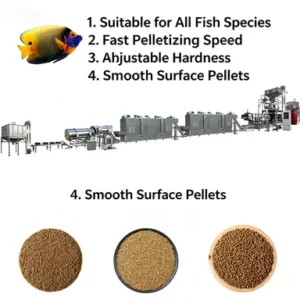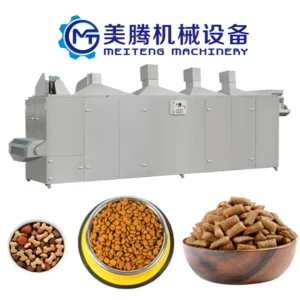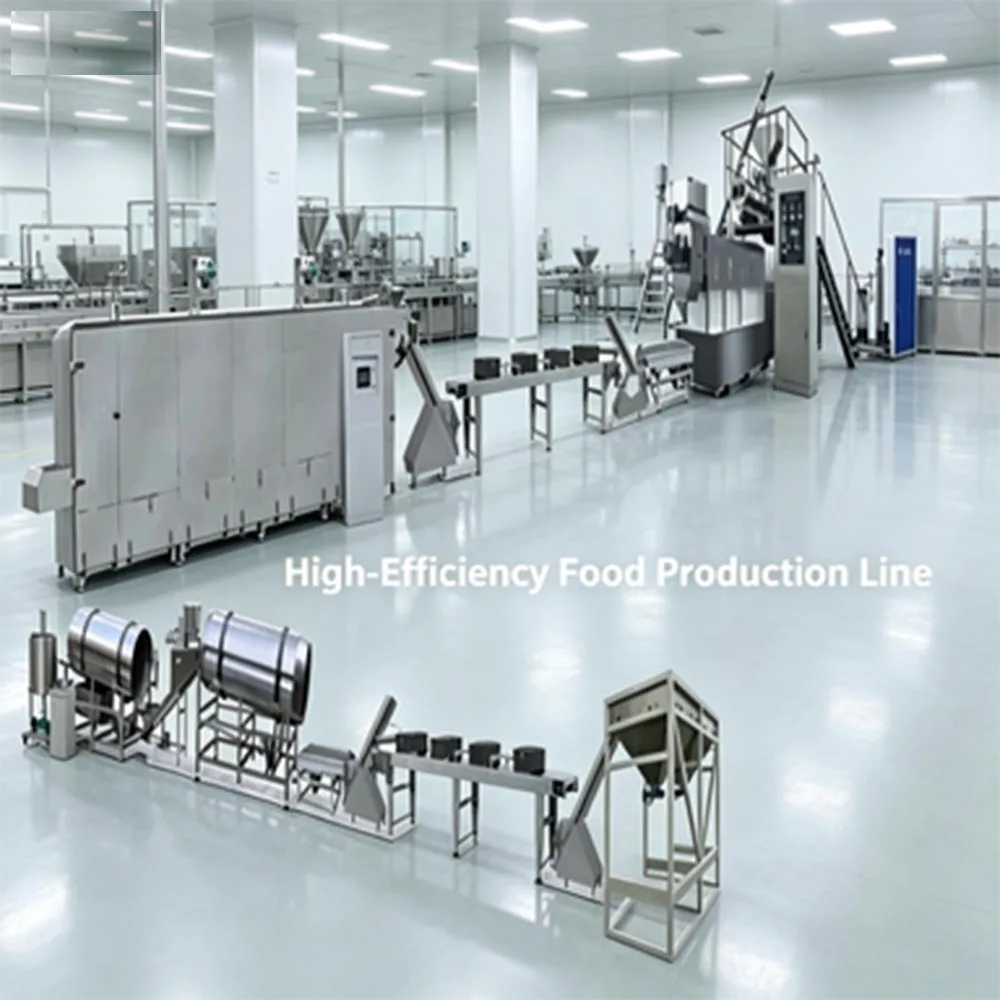


Floating Fish Feed Production Line, Twin-Screw Extruder, 0.5–12mm Pellet Range — engineered as a complete turnkey layout where every station from batching through extrusion, drying, coating and packing is throughput-matched to eliminate bottlenecks common in multi-vendor assemblies.
- Twin-screw configuration and die design specified to your raw material formulation, ensuring consistent floating pellet density across growth stages
- Stainless steel contact materials and fully automatic PLC-controlled operation for continuous, food-grade production
- In-house trial runs on your raw material before shipment, with documented screw and die configuration records delivered alongside the line
Description
Screw and die configuration matched to your raw material — Every floating fish feed production line we configure starts with your formulation, not a generic template.
Technical Specifications
| Parameter | Value |
|---|---|
| Product Type | Floating Fish Feed Production Line |
| Extruder Type | Twin Screw |
| Output Capacity | 500 kg/h (basis not stated in source — confirm raw material formulation / moisture content) |
| Pellet Size Range | 0.5 mm to 12 mm |
| Line Stations | Feeding, mixing, extruding, pelletizing |
| Structure Material | Stainless Steel (main parts) |
| Automation Level | Fully automatic, whole-process operation |
| Control System | Simple control panel (source value — verify against manufacturer catalog) |
| Standards | CE (based on company profile, not explicitly stated in source content — verify against manufacturer catalog) |
Application Suitability
| Application | Material or Output |
|---|---|
| Small and medium-scale aquaculture operations | Floating fish feed pellets from fish meal, corn flour, soybean meal, and vitamin premixes |
| Ornamental fish feed production (goldfish, koi) | Highly pigmented, slow-sinking or floating micro-pellets from 0.5 mm |
| Diversified feed across fish growth stages | Fingerling to grow-out formulations adjusted via die changes from 0.5 mm to 12 mm |
| Turnkey feed plant construction projects | Integrated batching-to-packing line with throughput-matched auxiliary stations |
When "500 kg/h Floating Fish Feed Production Line" Hides the Real Output
Nominal capacity means nothing unless verified on your actual formulation.
A floating fish feed production line rated at a specific throughput on paper often behaves differently once your raw material hits the barrel. High-fiber ingredients, unusual fat ratios, or non-standard moisture levels can collapse expansion, reduce pellet buoyancy, and cut real output significantly. I have walked onto sites where the extruder was running at barely half the quoted rate because the screw configuration was copied from a standard build instead of being matched to the customer’s recipe [NEED_CITE: impact of raw material formulation on twin-screw extruder throughput]. The result is a line that technically works but never reaches the numbers your business plan depends on.
Barrel Temperature Profiling for Consistent Expansion
Maintaining uniform gelatinisation across the barrel length is what separates floating pellets that hold their density from ones that sink after packaging. The twin-screw extrusion system in this floating fish feed production line allows operators to adjust temperature zones along the barrel, matching the thermal profile to the starch content of each formulation. This control matters especially when switching between a high-corn fingerling diet and a protein-dense grow-out recipe within the same shift.
Die Geometry and Pellet Buoyancy Control
The die plate determines more than diameter — it governs the pressure release rate at the moment of extrusion, which directly controls expansion ratio. A 0.5 mm ornamental pellet needs a fundamentally different die land length than a 12 mm grow-out pellet. Getting this wrong is one of the most common reasons floating feed sinks in the pond [NEED_CITE: die design influence on extruded pellet density and buoyancy]. Our configuration process records the die specification against your target product so replacements are always matched.
Why L/D Ratio Matters for Your Formulation
The length-to-diameter ratio of the extruder screws defines how long material stays inside the barrel under shear and heat. A formulation heavy in raw starch needs a longer residence time for complete gelatinisation; a high-fat recipe requires less. The twin-screw setup here accommodates screw element rearrangement, allowing the effective L/D behavior to be tuned when you adjust recipes seasonally or introduce alternative protein sources such as insect meal or single-cell protein.
What Happens When Stations Are Mismatched
A line is only as fast as its slowest station. If the dryer capacity falls short of the extruder output, wet pellets pile up, stick together, and spoil before they reach the coating drum. I have seen entire batches lost because the cooling conveyor could not keep pace with a coater running at full speed [NEED_CITE: throughput balancing across extrusion line stations]. This is why throughput calculations must account for every transfer point, not just the extruder nameplate.
Why Procurement Should Start with the Formulation
Sourcing a Floating Fish Feed Production Line turnkey from a single supplier means every station — mixer, extruder, dryer, coater, packer — is specified together. The line layout and capacity calculation document you receive before order confirmation shows the calculated throughput at each station based on your raw material, eliminating the guesswork of assembling equipment from separate vendors. Screw and die configurations are recorded for your target pellet, not pulled from a generic catalog.
Documentation & Verification
- Line layout drawing with station-by-station throughput matched to your formulation
- Screw configuration record specifying element arrangement for your target pellet density
- Trial run report on your raw material conducted in the testing workshop before dispatch
- Electrical schematic confirming voltage, frequency, and control language for your market
- Operation and maintenance manual covering die changeover and screw element replacement
Installation, Commissioning & Support
- Foundation plan detailing load points for the twin-screw extruder and auxiliary stations
- Dedicated power circuit specification matching the extruder motor rating and heater zones
- On-site assembly supervision covering barrel alignment and screw element insertion sequence
- First-run parameter logging including barrel temperatures, screw speed, and feed rate
- Operator training on die changeover procedure for switching between 0.5 mm and 12 mm pellets
- Wear parts list identifying screw elements, die plates, and cutter bearings for reorder planning
Preparing Your Inquiry
To receive a line proposal that reflects real production conditions, share your target raw material formulation, desired pellet size range, and daily output requirement. Include your facility voltage and frequency so the electrical design matches local standards before manufacturing begins. If you have existing upstream milling or downstream packing equipment, note the interface points so the layout accounts for integration.
Frequently Asked Questions
Q: How is the output capacity verified, and on what raw material formulation is it based?
A: The rated capacity depends on your specific formulation, moisture content, and pellet size. We run a trial in our testing workshop using your raw material before shipment and document actual throughput. The trial run report becomes your reference for commissioning, so you know the line’s real capability before installation.
Q: How do you match screw configuration and die design to our target pellet?
A: Our engineers review your raw material data sheet and target pellet specification — size, density, floatation requirement — then select screw element geometry and die land dimensions accordingly. This configuration is recorded in your project documentation, ensuring replacement parts always match your product rather than a generic default.
Q: Is a trial run performed before shipment, and what does it cover?
A: Yes. We process your raw material through the extruder in our testing workshop and document expansion ratio, pellet density, floatation performance, and actual throughput. The trial run report is shared with you before dispatch, allowing recipe adjustments to be made in the factory rather than on your production floor after installation.
Q: How is throughput balanced across all line stations?
A: Every station — mixer, extruder, dryer, coater, cooler, and packer — is specified based on the same capacity calculation. The line layout document shows calculated throughput at each transfer point, so no single station creates a bottleneck that limits overall output.
Q: What electrical and control options are confirmed before production?
A: Voltage, frequency, plug type, and control panel language are confirmed during the specification stage. The electrical schematic included in your documentation package reflects these choices, preventing commissioning delays caused by mismatched power supply or unfamiliar interface language at the site.
Related products
-
300-600kg/h Capacity Multi-Species Fish Feed Processing Line to Produce Fish Food
¥45,000.00 Select options This product has multiple variants. The options may be chosen on the product page -
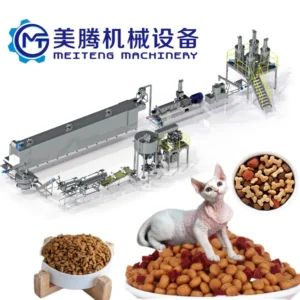
MT70 100-200kg/h Dog & Cat Pet Food Processing Line with 380V 50Hz Three Phase Power
¥35,000.00 Select options This product has multiple variants. The options may be chosen on the product page -
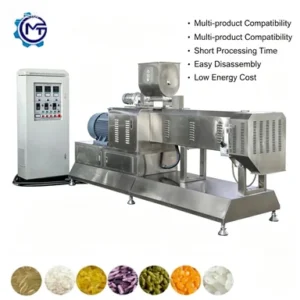
Durable Stainless Steel Twin Screw Extruder Floating Sinking Aquatic Fish Feed Processing Production Equipment
¥65.00 Select options This product has multiple variants. The options may be chosen on the product page -
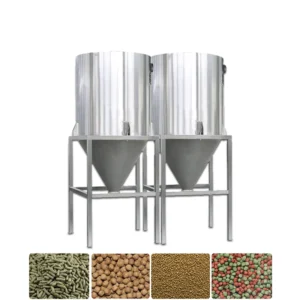
In Stock Pet Feed Production Line / Dog Cat Food Extrusion Machine
¥9,500.00 Select options This product has multiple variants. The options may be chosen on the product page