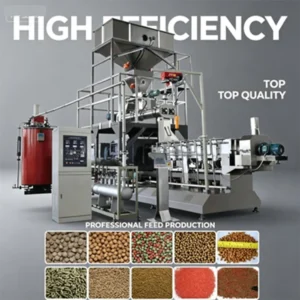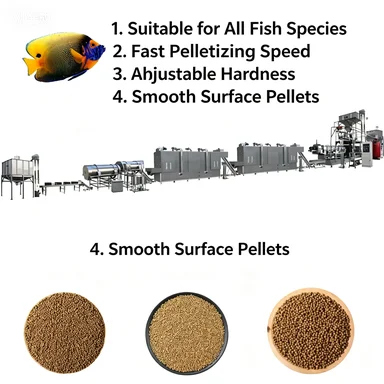
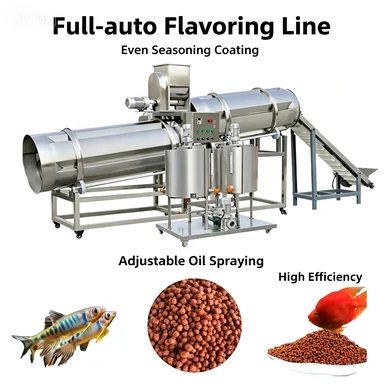



Twin Screw Aquatic Feed Extrusion Line, 0.5–12mm Pellet Range, PLC Controlled — engineered as a turnkey project with throughput matched across feeding, mixing, extruding and pelleting stations. Screw configuration and die design are specified to the buyer’s raw material formulation, ensuring target float or sink density is achieved from the first run. Compact integrated layout reduces footprint while maintaining full automation for continuous aquaculture feed production. Delivered with line layout documentation and a trial run report on your actual raw material before shipment.
Description
Throughput-Matched Turnkey Integration — every station from feeding to packing is engineered against the buyer’s actual formulation and target pellet density, not a generic nameplate figure.
Technical Specifications
| Parameter | Value |
|---|---|
| Product Type | Twin Screw Aquatic Feed Extrusion Production Line |
| Output Capacity | 500 kg/h floating fish feed pellets (basis not stated in source — confirm raw material formulation, moisture content, pellet diameter) |
| Pellet Size Range | 0.5 mm to 12 mm (adjustable via die and screw configuration) |
| Screw Type | Twin screw |
| Control System | Available with PLC or simple control panel |
| Main Structure Material | Stainless steel on food-contact surfaces |
| Automation Level | Fully automatic continuous operation |
| Integrated Line Stations | Feeding, mixing, extruding, pelletizing |
| Layout | Compact integrated footprint |
Application Suitability
| Application | Material or Output |
|---|---|
| Floating fingerling feed | Soybean meal, fish meal, starch binders — 0.5–2 mm pellets with low bulk density for surface feeding |
| Sinking grow-out pellets | Higher protein formulations with adjusted moisture — 4–8 mm pellets for bottom-feeding species |
| Shrimp and crustacean feed | Fine-grind raw material blends requiring tight pellet durability and water stability |
| Catfish and tilapia nutrition programs | Corn-soy base with vitamin premix — variable pellet diameter across growth stages |
What "500 kg/h" Actually Means on Your Raw Material
Capacity is a function of formulation, moisture, and pellet geometry — not a fixed label on the nameplate.
I have walked into feed mills where the extruder was rated for a certain hourly output on a supplier’s test formula, but the moment the buyer switched to their local soybean meal and fish meal ratio, expansion dropped and throughput fell sharply. The dryer then had to work longer cycles, and the whole line backed up. An aquatic feed extrusion production line turnkey project only performs when every station is calculated against the specific raw material behaviour and target pellet specification the buyer will actually run. [NEED_CITE: relationship between raw material protein content and extrusion expansion rate]
Layout and Station Sequencing for Continuous Flow
A turnkey aquatic feed line is not just an extruder with supporting equipment bolted around it. The feeding station must deliver consistent mass flow into the mixer, the mixer must discharge at a rate the extruder can accept without surging, and the extruder output must align with downstream drying and coating capacity. When any single station runs faster or slower than the others, the result is either idle time or product backlog — both of which distort the effective capacity of the aquatic feed extrusion production line turnkey installation.
Utility Planning Before Equipment Arrives
Power supply, steam generation, water access, and compressed air all need to be mapped during the layout phase, not discovered on installation day. Twin screw extruders in this class draw significant current during start-up, and the drying stage may require dedicated steam circuits. Coordinating utility infrastructure as part of the overall project scope prevents the delays that occur when a feed mill has to rewire or reroute piping after the equipment is already on the floor. [NEED_CITE: industrial electrical supply standards for food processing installations]
Reading the Specs That Matter for Pellet Quality
The twin screw configuration allows operators to adjust shear intensity and residence time by changing screw element arrangement, which directly controls starch gelatinisation and therefore pellet density — the difference between a pellet that floats and one that sinks. The 0.5 mm to 12 mm pellet size range is achieved through die plate selection, but the actual forming quality at each diameter depends on moisture content at the barrel and the temperature profile across zones. Stainless steel contact surfaces resist the corrosive environment created by fish meal and mineral premixes, maintaining hygiene standards through daily washdown cycles without surface degradation.
The Cost of Skipping the Trial Run
Lines shipped without a trial run on the buyer’s actual raw material often require weeks of adjustment after installation. Screw configurations that work on one formulation may produce uneven expansion or poor pellet durability on another. When floating feed sinks or sinking feed floats, the market rejects it regardless of the nutritional analysis — and reconfiguring screws and dies on-site, without the factory testing workshop nearby, extends the commissioning period considerably. [NEED_CITE: feed pellet durability and water stability requirements for aquaculture markets]
Why Source the Full Line as One Project
Throughput calculations are documented across every station, so the mixer, extruder, dryer, and packing line are matched to a stated formulation rather than assembled from separate vendor nameplates. Screw configuration and die design are specified to the buyer’s raw material and target pellet size before production begins. The in-house testing workshop runs trial batches on customer-supplied raw material, generating a report that confirms pellet density, float or sink behaviour, and forming rate before the line ships. Electrical schematics, voltage, and control language are confirmed to the installation site, avoiding commissioning delays. Pre-sales engineering consultation carries through to on-site installation, operator training, and ongoing wear parts support.
Documentation & Verification
- Line layout drawing showing throughput matching between feeding, mixing, extruding, and pelleting stations
- Trial run report on customer-supplied raw material confirming pellet density and float-sink behaviour
- Screw configuration and die design record matched to buyer’s formulation and target pellet diameter
- Electrical schematic with voltage, frequency, and control language confirmed to installation site
- Factory test record documenting pre-shipment performance on specified raw material
Installation, Commissioning & Support
- Compact integrated layout planned against buyer’s floor space and utility connection points
- Dedicated power circuit sizing confirmed for twin screw extruder start-up current draw
- Line arrives in modular sections for staged assembly matching site readiness
- PLC control parameters set during commissioning against buyer’s formulation and pellet target
- Operator training covers screw element changes and die plate swaps for pellet size adjustment
- Wear parts list provided with recommended replacement intervals for screws and dies
What to Include in Your Inquiry
Share your target pellet specification — diameter, float or sink requirement, and the species or growth stage it serves. Provide your raw material formulation or at minimum the primary protein and starch sources with typical moisture levels. Confirm your workshop dimensions, local voltage and frequency, and preferred control language so the layout and electrical design can be prepared before production starts.
Frequently Asked Questions
Q: How is the stated line capacity verified against my actual formulation?
A: The 500 kg/h figure references floating fish feed pellets but does not specify a formulation or moisture baseline. Before shipment, we run your raw material in the testing workshop and document actual throughput, pellet density, and forming rate so the capacity figure is tied to your specific recipe and pellet diameter.
Q: How are throughput rates matched between stations to prevent bottlenecks?
A: Each station — feeding, mixing, extruding, pelleting — is calculated against the same formulation and target output. The layout document shows the mass flow rate at every point, ensuring the mixer discharges at a rate the extruder can accept and that downstream drying can handle the extruder’s actual output.
Q: What utility infrastructure is required, and when is it planned?
A: Power supply capacity, steam circuits for drying, water access, and compressed air are mapped during the layout phase. The electrical schematic confirms voltage, frequency, and circuit requirements so your facility can prepare utility connections before the line arrives for installation.
Q: How does commissioning proceed from installation to first production run?
A: The schedule covers staged assembly, utility connection verification, screw and die configuration confirmation against your formulation, test runs with operator observation, and training on daily operation including screw element changes and die swaps for different pellet sizes.
Q: Can one line produce both floating and sinking pellets?
A: Yes. Floating versus sinking behaviour is controlled by adjusting screw configuration, barrel temperature profile, and moisture content to change expansion and density. The twin screw system allows these adjustments within the same line, and die plate selection covers the full 0.5 mm to 12 mm pellet range.
Related products
-
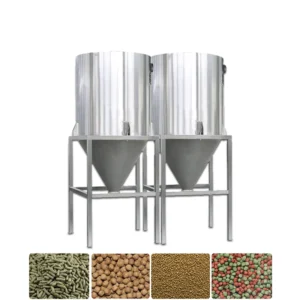
In Stock Pet Feed Production Line / Dog Cat Food Extrusion Machine
¥9,500.00 Select options This product has multiple variants. The options may be chosen on the product page -
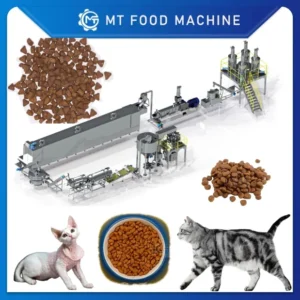
MT100 Brand 1.5-2.0t/h PLC Controlled Multi-Species Cat Food Processing Line
¥45,000.00 Select options This product has multiple variants. The options may be chosen on the product page -
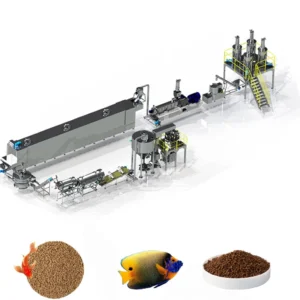
Automatic Fish Feed Production Line Machine Floating Sinking Pellet Manufacturing High Capacity Energy Saving Design
¥9,500.00 Select options This product has multiple variants. The options may be chosen on the product page -
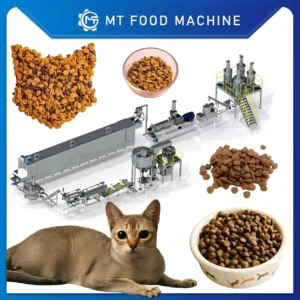
200-250kg/h Capacity PLC Controlled Multi-Species Dog Food Processing Line with MT-70 Extruder
¥35,000.00 Select options This product has multiple variants. The options may be chosen on the product page