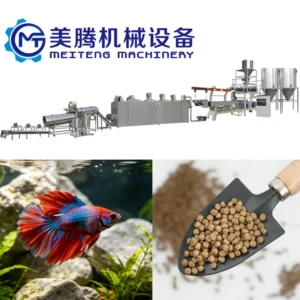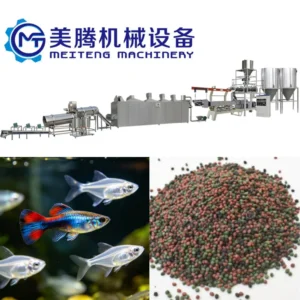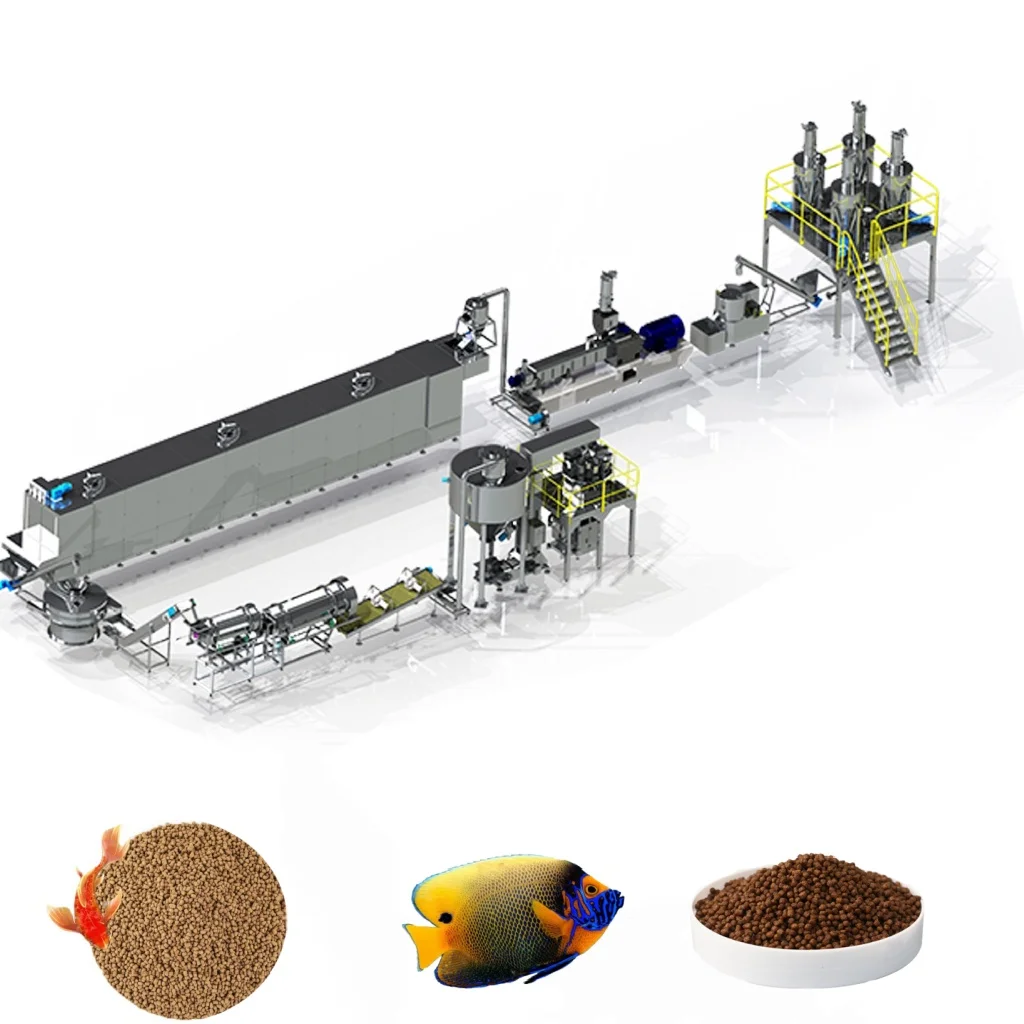



Fish Feed Production Line, 380V, Stainless Steel, Full-Automatic Operation — engineered as a complete turnkey project from batching through extrusion, drying, coating, and packing. Every station is throughput-matched to eliminate bottlenecks, with screw and die configuration specified for both floating and sinking pellet density targets. Phased installation planning, on-site commissioning, and operator training ensure the line performs to specification from day one.
- Floating and sinking pellet capability in one line
- Customizable settings across all stations
- Trial run on buyer’s raw material before shipment
- Electrical schematic and voltage confirmed to local grid
Description
Integrated Line Engineering — Every station from mixing through extrusion, drying, and coating is throughput-matched to the actual recipe and target pellet density, not assembled from standalone catalogs.
Technical Specifications
| Parameter | Value |
|---|---|
| Product Type | Fish Feed Production Line |
| Voltage | 380V (basis not stated in source — confirm frequency & phase) |
| Material | Stainless Steel (food-contact zones) |
| Control System | Full-Automatic Operation |
| Pellet Type | Floating and Sinking |
| Customizable Settings | Adjusts production according to needs |
| Output Capacity | To be confirmed based on raw material, pellet size, and moisture content |
Application Suitability
| Application | Material or Output |
|---|---|
| Floating fish feed pellet production | Fish meal, soybean meal, starch-based binders formulated for buoyancy |
| Sinking fish feed pellet production | High-protein formulations with denser ingredient ratios for bottom-feeding species |
| Aquatic feed manufacturing for aquaculture operations | Catfish, tilapia, and shrimp feed across varying pellet diameters |
Why the "Nominal Capacity" Trap Catches Aquafeed Buyers Off Guard
A fish feed production line turnkey project lives or dies on what happens when your actual formula hits the barrel.
Most capacity figures quoted during inquiry stages are based on a generic reference material — often a standard corn-starch blend at a specific moisture level. When a buyer switches to a high-protein aquafeed formulation with different gelatinisation behaviour, the extruder may not hold that output. Screw configuration, die geometry, and barrel temperature profile all interact with the raw material’s starch-protein ratio. I have walked onto sites where the extruder was running well below the contracted rate simply because nobody tested the customer’s recipe before the line shipped. The dryer then runs half-empty, the coating drum cycles underfilled, and the whole line operates at a fraction of what was planned. [NEED_CITE: starch gelatinisation behaviour in high-protein extrusion formulations]
The fish feed production line turnkey approach described here starts with your formula, not a catalog number. Throughput matching across every station — mixer, extruder, dryer, flavouring drum, cooler, packer — is calculated against your specific ingredient profile and target pellet specification before any steel is cut.
Phased Layout Planning and Utility Alignment
Building a complete aquatic feed facility means coordinating extrusion with upstream batching and downstream drying within a single floor plan. The fish feed production line turnkey layout accounts for material flow direction, utility drop points for steam and compressed air, and the footprint each station occupies relative to its neighbours.
When a line is engineered as one project rather than purchased as individual machines, the conveyor lengths, dryer residence time, and coating drum cycle are all calculated together. This prevents the common situation where an extruder pushes product faster than the dryer can handle, forcing the operator to slow the entire line down. [NEED_CITE: industrial dryer residence time calculation for extruded feed pellets]
Floating Versus Sinking Pellet Control Within One Line
Producing both floating and sinking pellets on the same line requires more than swapping a die plate. The screw configuration, barrel temperature profile, and moisture addition at the preconditioner all shift between the two product types. Floating pellets demand higher expansion — meaning more starch gelatinisation and greater steam injection — while sinking pellets need denser compression and lower barrel temperatures.
A line engineered as a single project can include quick-changeover screw elements and documented parameter sets for each pellet type, so operators switch recipes without trial-and-error downtime.
Screw Configuration, Die Geometry, and Pellet Density
The twin-screw extrusion process relies on the interaction between screw element arrangement, die opening size, and raw material moisture to determine final pellet density. A longer residence time in the barrel — achieved through specific screw pitch and stagger angle selections — increases starch gelatinisation, which directly affects expansion at the die face.
Stainless steel construction in food-contact zones maintains consistent heat transfer across production runs, reducing batch-to-batch variation. The full-automatic control system allows operators to store and recall parameter sets for different pellet diameters and formulations, keeping the output within specification whether producing floating catfish feed or sinking shrimp pellets. Die design is matched to the target pellet size and the formulation’s expansion characteristics, rather than a generic opening used across all products.
The Hidden Cost of Undersized Downstream Stations
An extruder that runs at full capacity while the dryer operates at its limit creates a constraint that no amount of extruder tuning can fix. The line stalls at the dryer, product queues up, moisture levels drift, and pellet quality degrades before it even reaches the coating drum.
I have seen producers lose significant production time because the flavouring drum cycle was calculated for a different throughput than what the extruder actually delivered. These mismatches rarely show up in individual machine quotations — they only appear once the line is running together. [NEED_CITE: throughput mismatch consequences in multi-stage food processing lines]
Why Procure the Complete Line from One Source
Every station from batching to packing is engineered under one supplier, so conveyor speeds, dryer capacity, and coating drum volume are calculated against each other before fabrication.
Screw configuration and die design are specified to the buyer’s raw material and target pellet type, not copied from a generic build. The in-house testing workshop runs your actual formula before shipment, producing a trial report that documents pellet density, floatability, and output rate under real conditions. Pre-sales consultation covers line layout, utility planning, and phased installation scheduling. Electrical schematics and voltage specifications are confirmed against the buyer’s local grid before the control panels are wired.
Documentation & Verification
- Line layout showing throughput matching between extruder, dryer, and coating stations
- Screw and die configuration record matched to your floating or sinking pellet target
- Trial run report on your actual raw material verifying pellet density before dispatch
- Electrical schematic with voltage and frequency confirmed to your local grid standard
- Factory test record documenting full line operation prior to shipment
Installation, Commissioning & Support
- Floor plan and utility drop layout provided for 380V power supply and steam connections
- Full-automatic control system configured with operator language confirmed before wiring
- Stainless steel contact surfaces inspected and cleaned during on-site assembly
- Extruder screw elements and die plates verified against your recipe during commissioning
- Parameter sets for floating and sinking pellet production loaded into the control system
- Wear parts list covering screws, dies, and seals supplied with initial spare set
What to Prepare Before Requesting a Line Quotation
To size a fish feed production line turnkey project accurately, share your target pellet type (floating, sinking, or both), the ingredient formulation with approximate protein and starch ratios, and the pellet diameter range you intend to produce.
Include your facility’s available floor space and ceiling height, local voltage and frequency, and whether you need the line phased into an existing operation or built as a new standalone facility. If you have a raw material sample available, sending it for a trial run allows the screw configuration and dryer settings to be locked in before the line ships.
Frequently Asked Questions
Q: How is line capacity verified before delivery?
A: Capacity is confirmed through a trial run using your actual raw material in the testing workshop. The resulting report documents pellet output rate, density, and floatability under your specific formulation, rather than a generic reference material.
Q: How do you match throughput between the extruder, dryer, and coating stations?
A: Each station is sized during the layout phase based on your target output and pellet specification. Conveyor speeds, dryer residence time, and coating drum volume are calculated together so no single station becomes a bottleneck.
Q: What does the phased installation schedule cover?
A: The schedule sequences mechanical installation, utility connections, electrical commissioning, and production trials. Each phase has defined checkpoints so facility preparation stays aligned with equipment arrival.
Q: Which voltage and control options are confirmed before shipment?
A: The buyer’s local voltage, frequency, and phase are confirmed during specification. The control system language and interface are set before the panels are wired, preventing delays during on-site commissioning.
Q: How are both floating and sinking pellets produced on the same line?
A: The screw configuration includes quick-changeover elements, and the control system stores separate parameter sets for each pellet type. Barrel temperature, moisture addition, and die selection are adjusted according to documented recipes.
Related products
-
Premium Pet Food Processing Equipment Dog Cat Feed Making Machine
¥9,500.00 Select options This product has multiple variants. The options may be chosen on the product page -
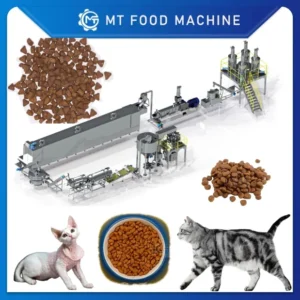
MT100 Brand 1.5-2.0t/h PLC Controlled Multi-Species Cat Food Processing Line
¥45,000.00 Select options This product has multiple variants. The options may be chosen on the product page -
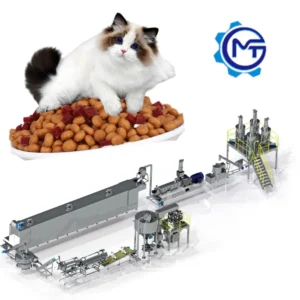
MT70 200-250kg/h Dog Cat Pet Food Processing Line 380V 50HZ Three Phase 45KW
¥35,000.00 Select options This product has multiple variants. The options may be chosen on the product page -
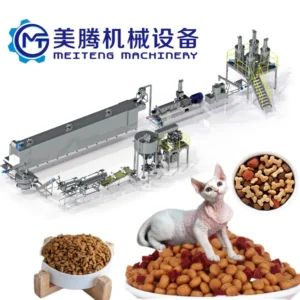
MT70 100-200kg/h Dog & Cat Pet Food Processing Line with 380V 50Hz Three Phase Power
¥35,000.00 Select options This product has multiple variants. The options may be chosen on the product page