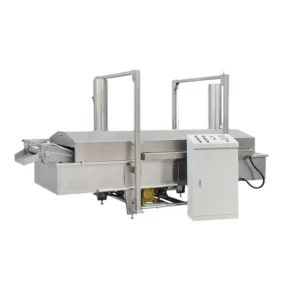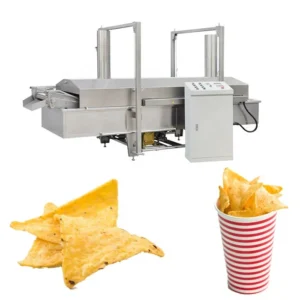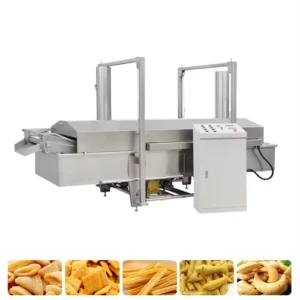


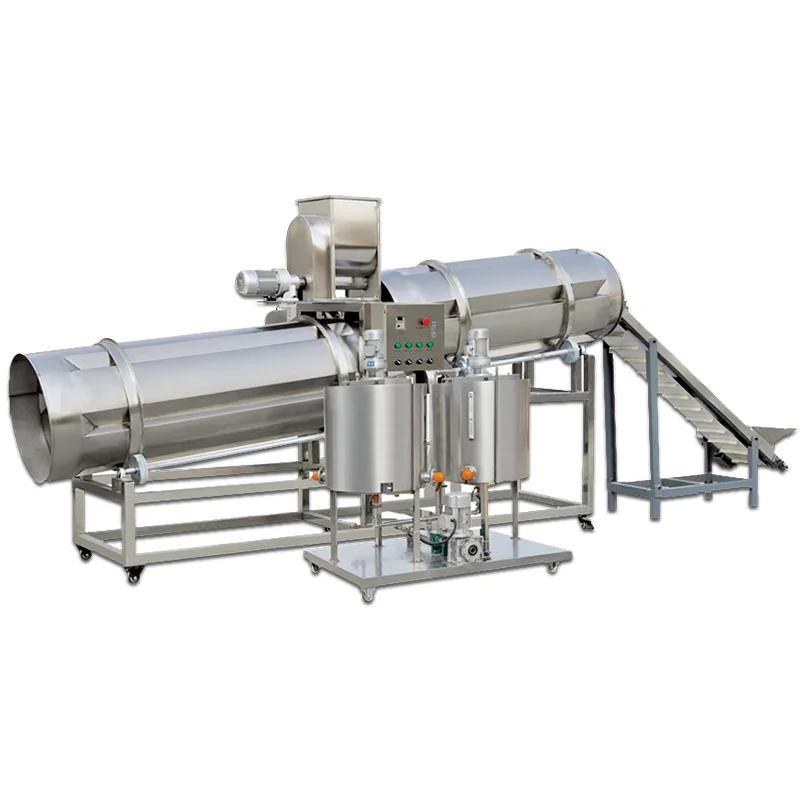
Continuous Deep Fryer, 380V, PLC Control, 304 Stainless Steel — integrated into a complete snack frying line with throughput matched across extruder, dryer, fryer and packing stations. Double-layer mesh belt with stepless speed regulation ensures consistent frying time, while continuous oil filtration extends oil service life. Turnkey scope includes layout design, in-house trial runs on your raw material, and on-site commissioning with operator training.
Description
Integrated frying and de-oiling stations matched to extruder throughput — every segment of the snack line is sized to the same capacity target so the fryer never waits on upstream equipment or creates downstream backlog.
Technical Specifications
| Parameter | Value |
|---|---|
| Product Type | Continuous Deep Fryer |
| Rated Power (kW) | 2.6 kW (conveying/control) / 60 kW (heating) |
| Voltage & Frequency | 380V / 50Hz |
| Control System | PLC |
| Overall Dimensions (L×W×H) | 6700 × 2200 × 1200 mm |
| Net Weight | 2000 kg |
| Oil Capacity | 320 L |
| Output Capacity | 100–1000 kg/h (basis to be confirmed) |
| Heating Method | Electric heating or Gas heating |
| Construction Material | Food-grade 304 stainless steel |
| Belt Type | Upper and lower double-layer mesh belt with frequency conversion |
| Oil Filtration | Continuous oil circulation filtration system |
| Slag Discharge | Bottom slag discharge system |
| Lifting System | Automatic lifting for upper hood and mesh belt |
| Warranty | 1 Year |
| Assembly State | Fully assembled |
| Standards | CE, ISO |
Application Suitability
| Application | Material or Output |
|---|---|
| Fried extruded snacks | Corn, rice, wheat-based extrudates from twin-screw lines |
| Pellet snack production | 2D/3D pellet chips requiring controlled fry time |
| Breakfast snack chips | Potato or starch-based slurry sheets |
| Protein snack variants | Soy or legume-based extruded pieces added to existing lines |
| Pet food treat lines | Fried kibble or treat formats as a variant product |
Why Throughput Matching Matters More Than Fryer Capacity Alone
A fryer rated higher than the extruder upstream wastes energy on empty belt space, while one rated lower forces the entire line to run at its pace.
Snack lines frequently fail at the frying stage not because the fryer breaks down, but because the stations around it were never designed as a single system. The extruder pushes out more volume than the mesh belt can carry, or the de-oiling station cannot keep up with wet product exiting the oil bath. In these cases, operators spend shifts clearing jams rather than running product [NEED_CITE: line throughput balancing principles for continuous food processing]. The turnkey snack frying line approach starts with the extruder capacity and works backward through every station to ensure the continuous frying machine production line moves as one unit.
Layout Planning Across Extrusion and Frying Stations
Turnkey project contractors evaluating a snack line must confirm that the fryer footprint aligns with the dryer output feeding it and the flavouring drum receiving from it. The 6700 mm length of this unit accommodates a residence time range suitable for most extruded snack densities, but the actual fry time depends on product moisture entering the oil bath and the target final moisture. A continuous frying machine production line only holds its target output when every conveyor between stations is sized for peak flow, not average flow.
Oil Management and Product Consistency Over Long Runs
The continuous oil circulation filtration system removes particulate matter that would otherwise carbonize and darken subsequent batches. Over a multi-shift run, this filtration maintains a stable acid value, meaning the product colour and flavour remain consistent from the first hour to the last. The double-layer mesh belt prevents lightweight pellet snacks from floating to the surface and receiving uneven heat exposure, which is a common cause of mixed colour in the packing stage [NEED_CITE: oil degradation rates in continuous industrial frying]. The PLC controls the belt speed through frequency conversion, allowing operators to dial in residence time for each product format without mechanical adjustments.
Reading the Specification Sheet for Real Output
The 100–1000 kg/h capacity range spans an order of magnitude because actual throughput depends entirely on the product type, incoming moisture, and required fry time. A dense pellet chip requiring extended oil immersion will move through at a fraction of the rate of a thin extruded crisp. The 60 kW heating element must recover temperature between product loads, and recovery rate varies with oil volume and product thermal mass. Buyers comparing fryers on nominal capacity alone will find that real-world output diverges significantly from the label once their specific recipe enters the oil. Voltage confirmation at 380V/50Hz must be matched to the buyer’s facility supply before the heating circuit is finalized.
What Happens When the Frying Station Is Undersized
A fryer that cannot match extruder output forces operators to either slow the upstream line or let product accumulate on holding conveyors where it cools and absorbs ambient moisture. Both scenarios degrade final product texture and increase breakage at packing [NEED_CITE: moisture reabsorption effects on fried snack shelf life]. When the de-oiling station downstream is also mismatched, excess surface oil carries through to the flavouring drum, causing seasoning to clump rather than coat evenly. These problems do not show up during a brief factory test with generic material; they emerge over sustained production on the buyer’s actual recipe.
Sourcing the Full Line from One Equipment Supplier
Throughput matching across extruder, dryer, fryer, and packing stations is handled in the layout phase rather than left to on-site adjustment. Screw configuration and die design for the upstream extruder are specified alongside the fryer belt speed and oil temperature profile, so the product entering the oil has the correct moisture and density. An in-house testing workshop runs the buyer’s raw material through the complete sequence before shipment, producing a trial run report that confirms the line holds target output on that specific recipe. Electrical schematics and PLC language are confirmed against local standards before the control cabinet is wired. Documentation covers the full line rather than individual machines, reducing the contractor’s coordination burden during installation.
Documentation & Verification
- Line layout drawing with throughput matched across extruder, dryer, fryer, and packing stations
- Trial run report on buyer’s raw material conducted in testing workshop before dispatch
- Electrical schematic with voltage, frequency, and PLC language confirmed to site supply
- Screw and die configuration record linked to the product entering the fryer
- Operation and maintenance manual covering mesh belt tensioning and filtration element replacement
- CE declaration of conformity and ISO certificate for the complete processing line
Installation, Commissioning & Support
- Floor space allocation for 6700 mm fryer length plus upstream and downstream conveyors
- Dedicated electrical circuit sized for 60 kW heating load plus conveying motor draw
- Unit arrives fully assembled requiring utility connection and belt alignment verification only
- First-run parameter setting for oil temperature, belt speed, and filtration cycle timing
- Operator training on mesh belt removal and automatic hood lifting for daily cleaning
- Wear parts list covering mesh belts, heating tubes, and filtration elements with replacement intervals
Information Needed for Line Proposal
To configure a turnkey snack line that includes this frying station, the project team needs the target product format, raw material composition, and required daily output. Facility details including available floor length, ceiling height, and local voltage and frequency determine the final layout. Confirming whether the existing upstream extrusion line will be retained or replaced affects how the fryer integrates with material flow.
Frequently Asked Questions
Q: How is frying line throughput matched to extruder and dryer capacity?
A: The line layout starts with the extruder output on your specific raw material, then sizes the dryer, fryer belt speed, and de-oiling station to the same flow rate. Each station is calculated so product moves continuously without accumulation or starvation between them, preventing bottlenecks that would otherwise force the entire line to run below capacity.
Q: What frying time range is available and how is it adjusted?
A: Frying time is controlled through frequency conversion on the mesh belt, providing stepless speed regulation. The actual residence time required depends on product density, incoming moisture from the dryer, and target final moisture. The PLC stores recipes for different product formats, allowing operators to switch between them without manual recalibration.
Q: Can a trial run be done on our raw material before shipment?
A: The testing workshop runs your actual raw material through the extrusion, drying, and frying sequence to confirm output rate, product colour, and texture. A trial run report documents the screw configuration, die selection, fryer temperature, and belt speed that achieved target specifications. This data transfers directly to your site during commissioning.
Q: What electrical and control confirmations are made before shipment?
A: The buyer’s local voltage, frequency, and preferred PLC language are confirmed before the control cabinet is wired. The electrical schematic reflects these specifications, and the heating circuit is configured accordingly. This prevents delays at commissioning caused by mismatched supply or control interfaces that require on-site rewiring.
Q: What on-site support is included for installation and startup?
A: Engineers oversee placement, utility connection, and first-run parameter setting on your raw material. Operator training covers daily cleaning procedures using the automatic hood lifting system, mesh belt inspection, and filtration element replacement. A wear parts list with replacement intervals is provided so the first maintenance cycle can be planned before consumables run out.
Related products
-
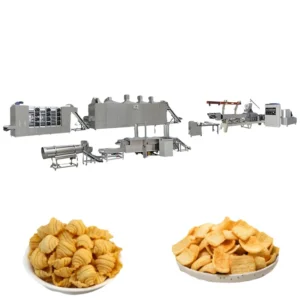
New Doritos Chips Frying Equipment Machine Automatic Tortilla Corn Chips Making Line Portable High Productivity
¥100.00 Select options This product has multiple variants. The options may be chosen on the product page -

Electric Heating Fried Puffed Food Production Line – Salad Sticks Making Equipment
¥65.00 Select options This product has multiple variants. The options may be chosen on the product page -
Orion TURTLE CHIPS Snack Puffing Machinery Internet Celebrity Puffed Four-layer Crispy Production Line
¥65.00 Select options This product has multiple variants. The options may be chosen on the product page -
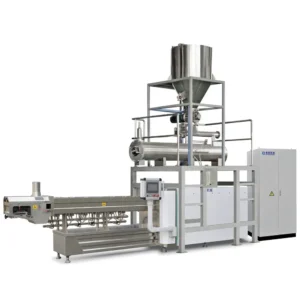
New Automatic 150-200kg/h Nimko Fried Pasta Snacks & Kurkure Making Machine Food Grade Stainless Steel High Productivity
¥8,585.00 Select options This product has multiple variants. The options may be chosen on the product page