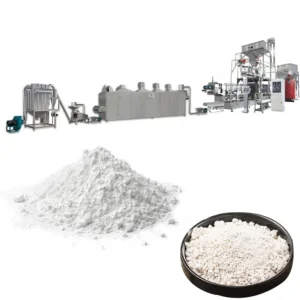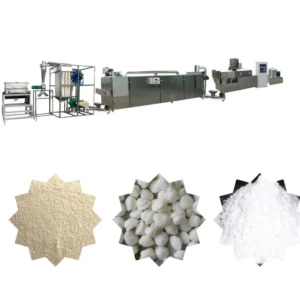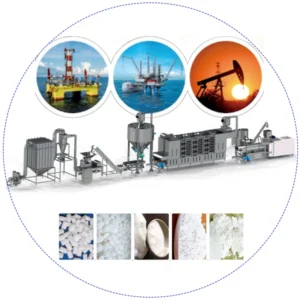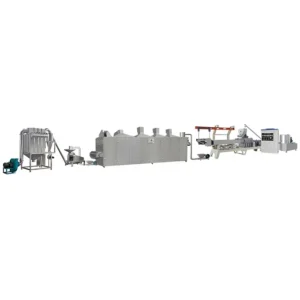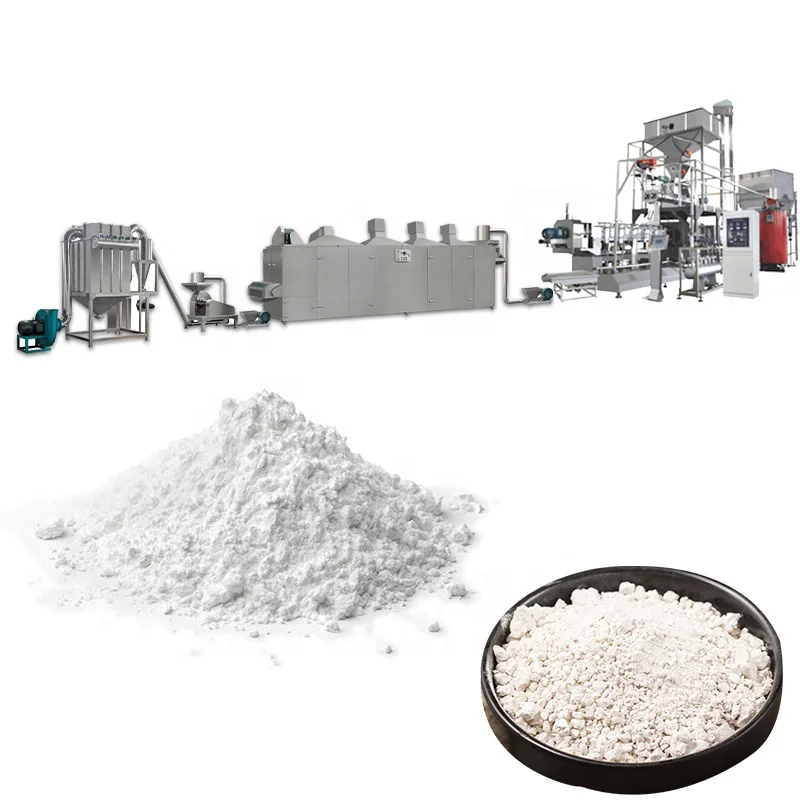
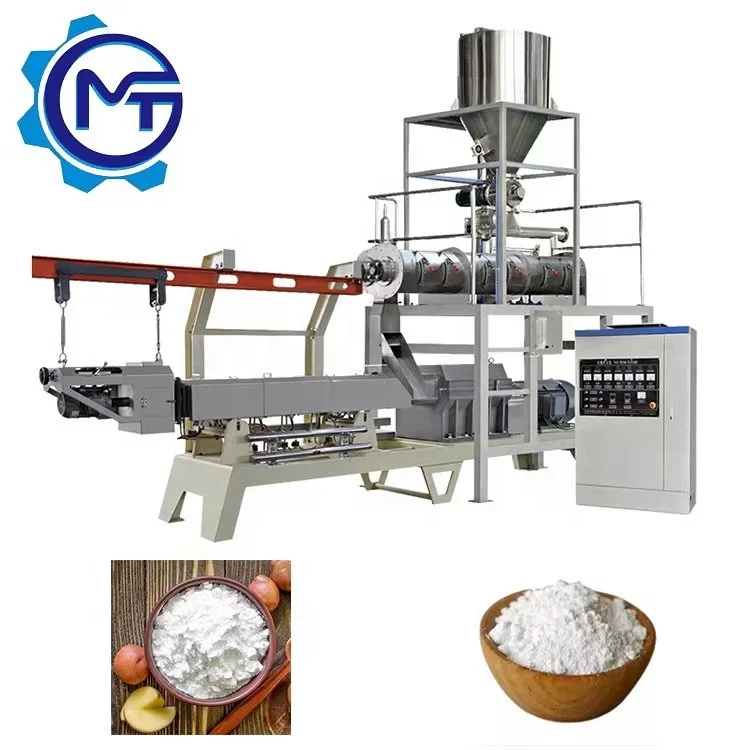

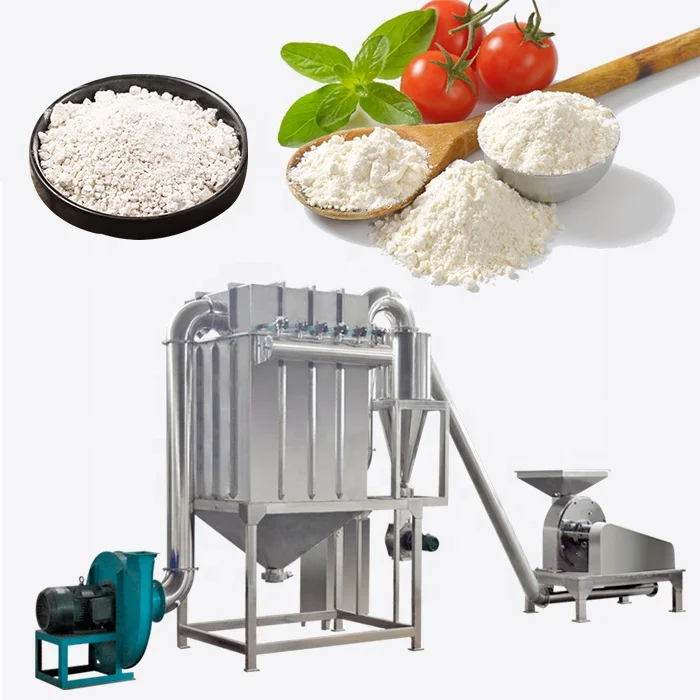

Modified Starch Processing Line, Twin-Screw Extruder, 304 Stainless Steel Contact Parts — throughput-matched from batching through extrusion, drying, conditioning to grinding under one supplier.
- Screw configuration and barrel temperature profile specified to your raw starch and target modification degree
- Multiple energy options for dryer and extruder heating, configurable to local utility conditions
Trial run on your actual starch raw material conducted in our testing workshop before shipment, with full configuration report delivered.
Description
Integrated Line Engineering — Every station from batching to grinding is throughput-matched under one supplier, eliminating the bottleneck risks that arise when extruders, dryers and conveyors are sourced from separate vendors.
Technical Specifications
| Parameter | Value |
|---|---|
| Product Type | Modified Starch Processing Line |
| Extruder Type | Twin-screw extruder |
| Capacity Range | 80–500 kg/h (basis not stated in source — confirm raw material, moisture content and degree of modification) |
| Raw Materials | Wheat flour, corn starch, potato starch |
| Energy Options | Electricity, gas, diesel, or steam |
| Power Consumption | approx. 100 kW (electric heating); approx. 50–60 kW (gas or diesel heating) (rated or peak not specified in source) |
| Voltage & Frequency | Three-phase 380V/50Hz; Single-phase 220V/50Hz (customizable to local voltage) |
| Control System | PLC |
| Frame Material | Stainless steel 201 |
| Contact Material | Food-grade stainless steel 304 |
| Mixer Motor | 4.0 kW |
| Mixer Dimensions | 1.2 × 0.9 × 1.4 m |
| Mixer Batch Output | 3.0–4.0 kg per batch (source value — verify against manufacturer catalog) |
| Screw Conveyor Motor | 1.1 kW |
| Screw Conveyor Dimensions | 2.5 × 0.6 × 2.3 m |
| Screw Conveyor Output | 0–150 kg/h (source value — verify against manufacturer catalog) |
| Line Sequence | Mixer → Screw Conveyor → Twin Screw Extruder → Shift → Air Conveyor → Dryer → Air Conveyor → Conditioning → Conveyor → Grinder |
| Assembly State | Complete line, modular stations |
| Certification | CE |
Application Suitability
| Application | Material or Output |
|---|---|
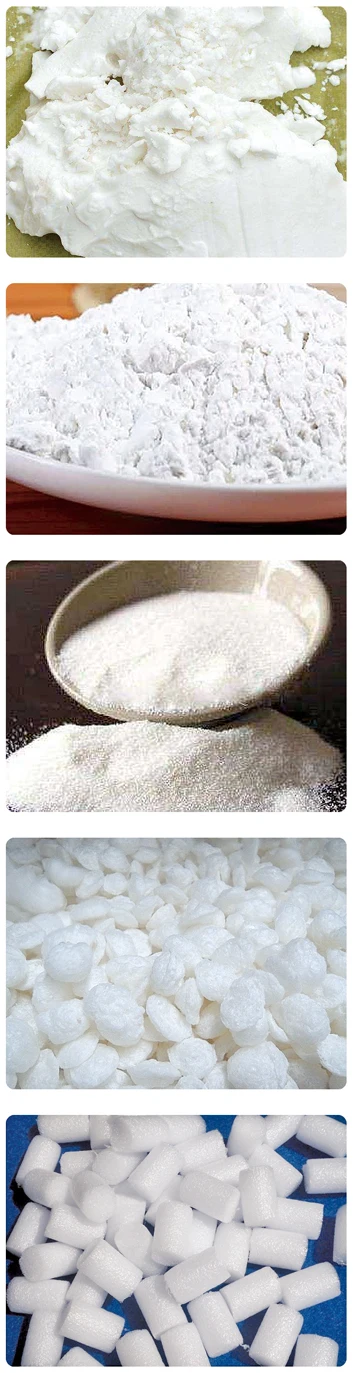
| Food-grade modified starch for bakery and sauce thickening | Corn starch, wheat flour |
| Pregelatinised starch for instant food and nutrition powders | Potato starch, corn starch |
| Industrial adhesive starch for paper and corrugated board | Wheat flour, corn starch |
| Denatured starch for textile and drilling fluid applications | Potato starch, corn starch |
| Cold-water-swelling starch for confectionery and dairy | Corn starch, wheat flour |
Why Nominal Capacity Figures Mislead Starch Buyers
A modified starch processing line turnkey proposal that quotes a single capacity number without specifying the raw material and target modification degree is a proposal that has not been engineered for your production reality.
Capacity must be validated against your exact starch feedstock and the gelatinisation or denaturation endpoint your market requires.
I spent years watching lines arrive at overseas plants only to discover that the throughput achieved on the factory test floor had nothing to do with what happened when local raw materials went into the hopper. Corn starch behaves differently from potato starch inside a twin-screw barrel — the gelatinisation temperature, the shear sensitivity, the moisture absorption rate all shift. A line that runs smoothly on one feedstock can choke, surge or produce out-of-spec viscosity on another [NEED_CITE: starch gelatinisation behaviour across botanical sources]. The capacity number on the quotation is meaningless unless it was derived from a trial that used your material.
Matching Screw Configuration to Starch Modification Targets
The twin-screw extruder sits at the centre of any modified starch processing line turnkey installation, and its screw configuration determines whether you achieve partial gelatinisation, full pregelatinisation, or chemical denaturation. Barrel temperature profiles must align with the specific thermal properties of your starch source — potato starch gelatinises at a different threshold than corn starch, and the screw element arrangement must account for that difference. A generic screw build copied from a snack food application will not deliver the controlled shear and residence time that starch modification demands.
Balancing Throughput Across Every Line Station
The extruder does not operate in isolation. The mixer must feed consistently, the screw conveyor must transfer at a rate the extruder can accept, and the dryer must remove moisture fast enough to prevent the downstream conditioning and grinding stations from backing up. When these stations are sourced from different vendors, each one optimises for its own rated output, and the result is a line where the weakest link dictates actual throughput. A modified starch processing line turnkey project designed as one integrated system avoids this mismatch by calculating material flow at every transfer point before production begins [NEED_CITE: throughput balancing methodology in multi-station food processing lines].
What the Specifications Mean for Your Production
The twin-screw configuration is essential here because modified starch processing demands precise control over shear, temperature and residence time — single-screw extruders cannot deliver the mixing intensity required for uniform gelatinisation across varied starch sources. Food-grade stainless steel 304 on all product-contact surfaces ensures compliance with food safety standards whether you are producing starch for bakery applications or industrial adhesives. The PLC control system allows operators to store and recall recipes, so switching between corn starch and potato starch production does not require manual recalibration of every barrel zone. Multiple energy options — electricity, gas, diesel or steam — mean the dryer and extruder heating can be configured to match whatever utility infrastructure is available at your facility, which matters significantly in regions where three-phase power supply is unreliable or where steam boilers are already installed on-site.
The Hidden Cost of Underspecifying Your Line
Buyers who accept a line proposal without confirming screw configuration, dryer capacity and voltage requirements upfront often discover the gaps during commissioning. An extruder paired with an undersized dryer creates a bottleneck that forces the entire line to run below its potential output. Incorrect voltage or frequency specification delays commissioning while transformers are sourced or control panels are rewired. A screw and die set designed for one starch type will produce inconsistent modification when the buyer switches to a different feedstock, generating off-spec product that must be reprocessed or discarded [NEED_CITE: common commissioning failures in starch extrusion installations]. These problems are not equipment defects — they are specification failures that could have been resolved during the engineering phase.
Why Engineering the Whole Line Under One Roof Matters
Every station on this modified starch processing line is designed and assembled by the same engineering team, so throughput calculations account for material behaviour at each transfer point rather than relying on individual equipment nameplate ratings. Screw configurations are specified to your raw material and target modification degree, not pulled from a generic catalog. The in-house testing workshop conducts trial runs on your actual starch before the line ships, so gelatinisation temperature, viscosity and expansion characteristics are confirmed before installation begins. Pre-sales consultation covers line layout, utility planning and phased installation scheduling, and on-site commissioning includes operator training on recipe management through the PLC interface. Documentation delivered with the line includes screw and die configuration records, electrical schematics and trial run reports — the technical trail that your quality team needs for traceability.
Documentation & Verification
- Line layout drawing showing station placement and material flow path for your facility footprint
- Capacity calculation sheet referencing your specific starch raw material and target modification degree
- Screw and die configuration record matched to your gelatinisation or denaturation specification
- Trial run report on your raw material documenting temperature, viscosity and throughput data
- Electrical schematic with confirmed voltage, frequency and PLC language for your local grid
- CE declaration of conformity covering the complete integrated line assembly
Installation, Commissioning & Support
- Foundation requirements calculated from total line weight and dryer vibration characteristics
- Dedicated three-phase power circuit sized for the 100 kW electric heating load or gas supply connection
- Modular station delivery allowing phased assembly in facilities with limited access or ceiling height
- First-run parameter setting on your starch raw material with PLC recipe storage for repeat production
- Operator training covering screw element inspection, barrel temperature adjustment and emergency shutdown
- Wear parts list specifying replacement intervals for screws, dies and conveyor components
What We Need to Engineer Your Line
To configure a modified starch processing line that actually performs at the capacity your business plan requires, we need to understand your production context. Tell us which starch raw materials you will process, what modification degree or end-product specification your market demands, and what utility conditions — voltage, frequency, available fuel sources — exist at your installation site. If you have existing upstream or downstream equipment that this line must integrate with, share those details as well so the layout can account for material transfer points.
Frequently Asked Questions
Q: How is line capacity verified against my specific starch raw material and target modification degree?
A: Before shipment, your actual raw material is processed through the twin-screw extruder and full line sequence in the in-house testing workshop. Temperature profiles, screw speed, moisture input and throughput are recorded at each station. The trial run report documents gelatinisation behaviour, viscosity results and achievable output, so the capacity figure you receive reflects your material rather than a generic benchmark.
Q: What screw configuration and barrel temperature profile is specified for pregelatinised versus chemically modified starch?
A: Pregelatinised starch requires a screw arrangement that maximises shear and heat transfer to achieve full granule disruption, with barrel zones set above the gelatinisation threshold of your specific starch source. Chemically modified starch may demand lower shear with precise reagent mixing zones. Each configuration is documented in the screw and die record delivered with the line.
Q: How is throughput balanced between the extruder, dryer, and conditioning stations to avoid bottlenecks?
A: Material flow is calculated at every transfer point during the layout engineering phase. The dryer capacity is matched to the moisture removal requirement at the extruder’s actual output rate, and the conditioning and grinding stations are sized to handle the dried product volume. No station is selected from a standalone catalog without verifying its fit within the integrated sequence.
Q: What voltage, frequency, and control language options are confirmed before production?
A: Your local grid specification is confirmed during the quotation stage. The electrical schematic is then drawn for your exact voltage and frequency, and the PLC interface language is set to your operator’s preference. This confirmation is documented before manufacturing begins, preventing commissioning delays caused by electrical mismatches.
Q: Is a trial run on my raw material performed before shipment, and what does the report include?
A: Yes. The testing workshop runs your starch through the complete line sequence and records barrel temperature at each zone, screw speed, moisture content at entry and exit, throughput rate and final product viscosity. The report is delivered before dispatch so you can review the results and request parameter adjustments if needed.
Related products
-
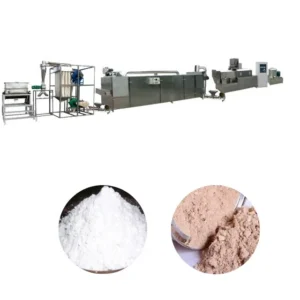
Big Capacity Modified Starch Industrial Use and Food Additives
¥50.00 Select options This product has multiple variants. The options may be chosen on the product page -
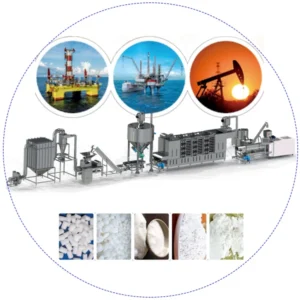
Automatic Pregelatinized Starch Processing Machine – Large-Scale New Condition Modified Starch Production Line
¥65.00 Select options This product has multiple variants. The options may be chosen on the product page -
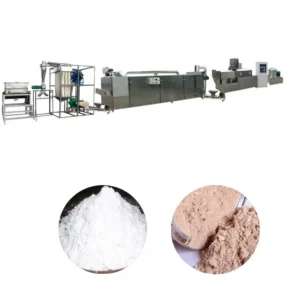
Automatic Modified Starch Making Machine Oil Drilling Starch Processing Production Line
¥30.00 Select options This product has multiple variants. The options may be chosen on the product page -
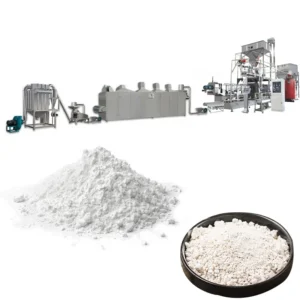
API Standard Pregelatinized Starch Line for Oilfield Drilling Fluid. High Yield Modified Starch Equipment
¥65.00 Select options This product has multiple variants. The options may be chosen on the product page