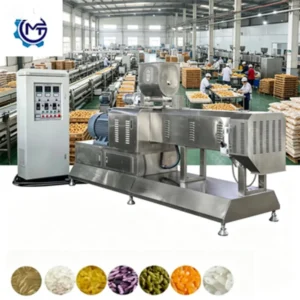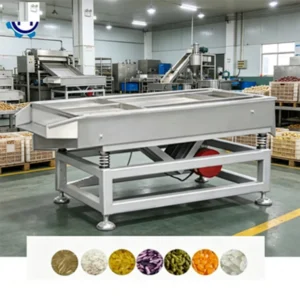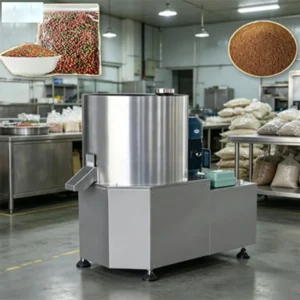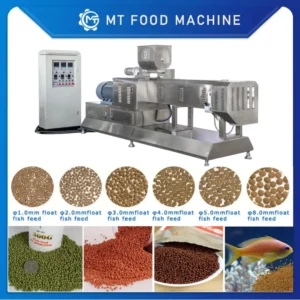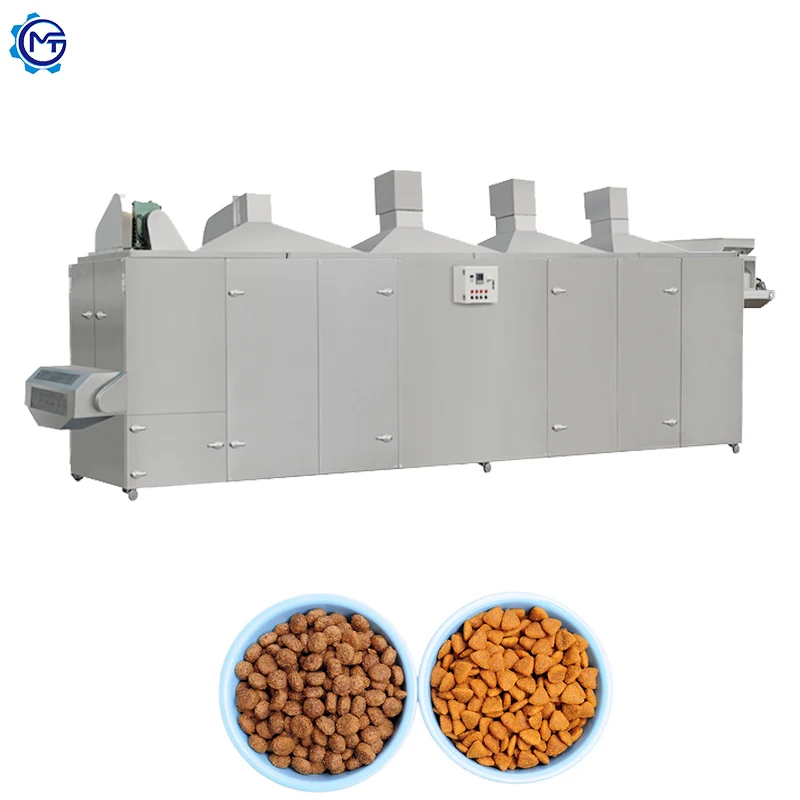


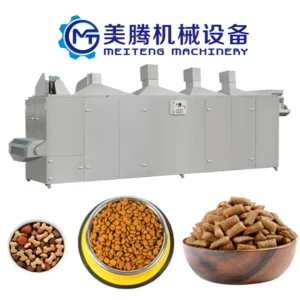
Pet Food Extrusion Production Line, up to 3 tons per hour output capacity, twin-screw configuration — designed as a complete turnkey project covering batching, extrusion, drying, coating, cooling, and packing stations.
- Screw configuration and die design matched to buyer’s raw material formulation and target kibble density, ensuring expansion control across dog food, cat food, and aquatic feed applications
- Pre-shipment trial runs conducted in the in-house testing workshop using customer’s actual raw material before delivery
Backed by integrated line throughput matching across every station, detailed screw and die configuration records provided with each shipment, and on-site installation with operator training included.
Description
Throughput matched across every station — a complete pet food extrusion line from batching to packing where the dryer and cooler are sized to the actual moisture load, not the brochure capacity.
Technical Specifications
| Parameter | Value |
|---|---|
| Product Type | Pet Food Extrusion Production Line |
| Output Capacity | Up to 3 tons per hour (basis not stated in source — confirm raw material formulation, moisture content and kibble size) |
| Applications | Dry dog and cat kibble; floating and sinking aquatic feed for fish |
| Screw Type | To be confirmed (single or twin screw based on application) |
| Control System | Available with PLC and MCC configuration |
| Voltage & Frequency | Configurable to target market electrical standard |
| Warranty | 1-year |
| Process Documentation | Process flow drawing included |
Application Suitability
| Application | Material or Output |
|---|---|
| Dry kibble production for dogs and cats | Meat meal, corn, wheat, soy and vitamin premix formulations |
| Floating aquatic feed for fish | High-starch formulations requiring controlled expansion |
| Sinking aquatic feed for fish | High-protein formulations requiring dense pellet structure |
| Multi-product pet food facility | Lines configured for rapid changeover between kibble sizes and densities |
What "3 Tons per Hour" Leaves Out About Your Actual Recipe
Nominal capacity means nothing when your raw material refuses to cooperate.
Many pet food lines are quoted on a standard corn or wheat formula, then shipped to a buyer whose recipe uses 40% fresh meat slurry or a high-fat aquatic feed blend. The extruder might push product through the die, but the downstream dryer cannot remove the extra moisture in the time allowed, and the kibble arrives at the packaging station carrying enough residual water to mold inside the bag within days [NEED_CITE: moisture migration and mold growth in packaged kibble]. I saw this happen on a project where the dryer was specified for the extruder’s nominal output rather than the actual water load, and the entire first shipment had to be recalled. That failure is why a pet food production line turnkey proposal must start with your specific formulation, not a generic benchmark.
How Screw Geometry Controls Your Kibble Density
The screw configuration inside the barrel determines how much shear and heat your raw material receives before it reaches the die. For a floating fish feed, the screws must generate enough mechanical energy to fully gelatinise the starch and trap steam bubbles in the pellet matrix as it exits. For a dense sinking pellet or a high-meat dog kibble, the screw profile is adjusted to reduce expansion and produce a firmer bite. On a pet food production line turnkey project, these screw elements are selected and documented before the machine is built, so the configuration matches your exact target product rather than a default setting.
Why the Dryer and Cooler Must Be Sized to the Extruder’s Real Output
The extruder adds water through steam injection and ingredient moisture, and the dryer must remove it within a fixed residence time. If the extruder processes a high-moisture meat-based recipe, the water load entering the dryer can be substantially higher than a grain-based recipe at the same mass flow rate. A dryer sized only for the nominal throughput will leave the kibble above safe water activity levels, leading to spoilage or texture breakdown during storage [NEED_CITE: water activity thresholds for shelf-stable dry pet food]. The cooler downstream faces the same mismatch: if kibble enters at a higher temperature because the dryer ran out of capacity, the cooler cannot bring it to packaging temperature, and condensation forms inside the bag. Every station on the line must be calculated against the actual process conditions, not the nameplate rating.
Reading the Specification Sheet Against Your Production Reality
The output capacity listed above is measured under conditions that may not match your formulation, so treat it as a starting point for discussion rather than a guaranteed figure. The control system options — PLC with MCC — give you automated recipe management and motor protection, which matters when you run multiple kibble shapes and need repeatable batch-to-batch results. Voltage and frequency must be locked to your facility’s supply before production begins; a 50 Hz motor running on 60 Hz power will overspeed the screw, changing the shear profile and the product texture entirely. The one-year warranty covers the mechanical and electrical components, but the wear parts — screws, barrels, dies — are consumables whose replacement schedule depends on the abrasiveness of your ingredients, particularly bone meal and mineral premixes.
The Hidden Cost of Skipping the Trial Run
When an extruder ships without a trial run on your actual raw material, product development begins after installation, on your factory floor, with your production schedule waiting. Screw adjustments that should have been resolved in the manufacturer’s testing workshop now consume days of live production time, burning raw material and labour while the line sits idle [NEED_CITE: typical commissioning delays without pre-shipment trials]. Die changes, moisture adjustments and dryer temperature profiles all need to be validated before the machine leaves the factory, not after it arrives at your facility and your launch deadline is slipping.
Why Procurement Teams Source This Line Here
The entire line from batching through extrusion, drying, coating, cooling and packing comes from a single supplier, which means throughput is matched at every junction rather than assembled from independent vendors who each guarantee only their own station. Screw and die configurations are specified to your raw material and target product density, with the configuration record delivered alongside the machine. An in-house testing workshop allows trial runs on your actual ingredients before shipment, so the kibble you see in the test report is the kibble you will produce on day one. Pre-sales consultation includes line layout and utility planning, and on-site installation covers commissioning, operator training and ongoing maintenance support. CE and ISO certification documentation is available at the line level, supporting import compliance in regulated markets [NEED_CITE: CE machinery directive requirements for food processing equipment].
Documentation & Verification
- Line layout drawing showing station spacing and utility connection points for your facility footprint
- Screw and die configuration record matching your raw material formulation and target kibble density
- Trial run report produced on your ingredients in the testing workshop before dispatch
- Electrical schematic with voltage and frequency confirmed to your local supply standard
- Wear parts list with part numbers for screws, barrels and dies to simplify reordering
Installation, Commissioning & Support
- Foundation and floor loading plan based on the total line weight and vibration profile of the extruder and dryer
- Dedicated electrical circuit sized to the confirmed PLC and MCC power draw at your site voltage
- Pre-assembled modules shipped with numbered connection points to reduce on-site assembly time
- First-run parameter logging during commissioning to establish baseline settings for each recipe
- Operator training covering screw changes, die swaps and daily cleaning procedures for food-grade contact surfaces
- Wear parts supply schedule aligned with your production volume to prevent unplanned downtime
What We Need to Build Your Line Proposal
To configure a pet food production line turnkey system for your facility, share your target product type — kibble size, shape and density — along with the raw material formulation you plan to run, including moisture content and protein-to-starch ratio. Provide your local voltage, frequency and control language preference so the electrical and PLC packages are specified correctly before production. Let us know your available floor space and ceiling height, and whether you need the line to integrate with existing upstream batching or downstream packing equipment.
Frequently Asked Questions
Q: How do you confirm the line capacity on our specific raw material?
A: We run a trial in our testing workshop using your actual formulation, measuring throughput, kibble density and moisture content at each station. The results are documented in a trial run report that shows the achievable output under your recipe conditions, not a generic benchmark.
Q: How are the extruder, dryer and coating drum balanced to avoid bottlenecks?
A: Each station is sized based on the mass flow and moisture load leaving the previous one. The dryer residence time is calculated against the water added during extrusion, and the coating drum volume is matched to the kibble flow rate and fat absorption target.
Q: Which screw configuration works best for floating fish feed versus dense dog kibble?
A: Floating feed requires a screw profile that maximises starch gelatinisation and steam entrapment for expansion at the die. Dense kibble uses a configuration that reduces shear and limits expansion. The correct set is determined during the trial run on your formulation.
Q: What does the pre-shipment trial run actually cover?
A: The trial includes running your raw material through the extruder, dryer and cooler, measuring product density, moisture and temperature at each stage. You receive the trial run report and can review the results before the line ships to your facility.
Q: How is installation and operator training handled on site?
A: Our engineers supervise mechanical assembly, electrical connection and first-run commissioning at your facility. Operator training covers daily operation, recipe changeover, screw and die replacement, and cleaning procedures specific to the food-grade contact surfaces on your line.
Related products
-
MT70 100-200kg/h Dog & Cat Pet Food Processing Line with 380V 50Hz Three Phase Power
¥35,000.00 Select options This product has multiple variants. The options may be chosen on the product page -
2-3t/h High Capacity Multi-Species Fish Feed Processing Line to Produce Fish Food
¥55,000.00 Select options This product has multiple variants. The options may be chosen on the product page -
MT Brand 450-550kg/h PLC Controlled Multi-Species Pet Food Processing Line
¥40,000.00 Select options This product has multiple variants. The options may be chosen on the product page -
MT85 500kg/h Multi-Purpose Pet Food Processing Line for Dogs Cats Birds Fish & More-380V 50Hz Three Phase 45KW
¥65,000.00 Select options This product has multiple variants. The options may be chosen on the product page