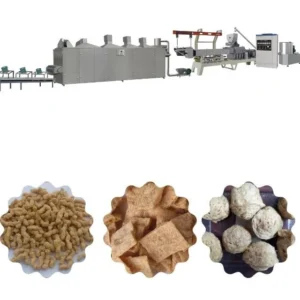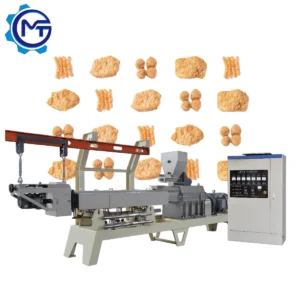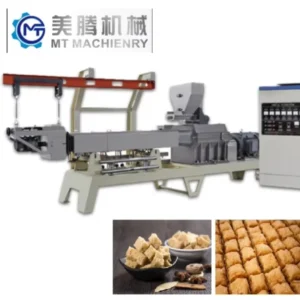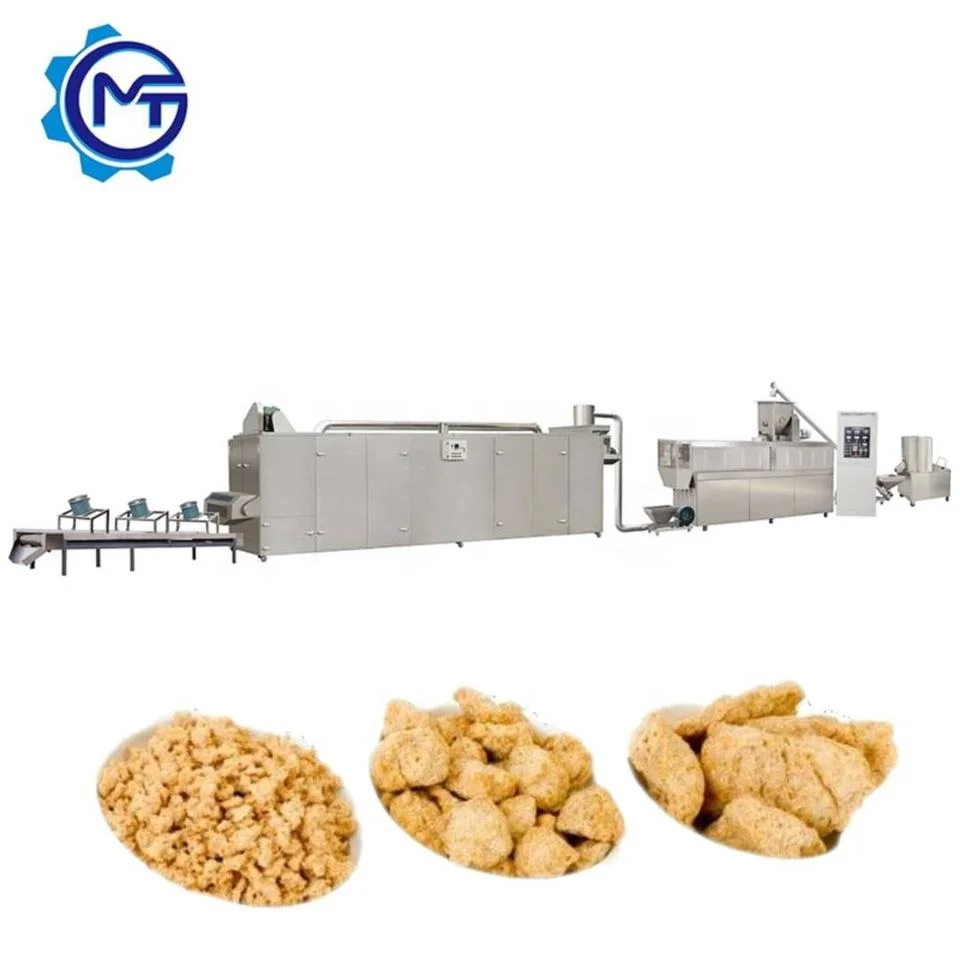


MT65 / MT70 / MT85 Textured Soy Protein Extrusion Line, Twin-Screw, Stainless Steel Construction — complete turnkey processing from mixing through extrusion, drying, cooling, and packing.
- Screw and die configuration specified to your soybean meal or peanut meal raw material and target fiber texture
- Throughput matched across every station to prevent downstream bottlenecks
- In-house trial runs on your actual raw material before shipment confirm fiber structure and output
Description
Matched Throughput Across Every Station — line layout engineered so extrusion, drying, and cooling capacities align with the buyer’s actual soybean meal moisture and protein content, not a generic nameplate figure.
Technical Specifications
| Parameter | Value |
|---|---|
| Product Type | Textured Soy Protein Extrusion Line |
| Model | MT65 / MT70 / MT85 |
| Extruder Type | Twin-screw (Double Screw Extruder) |
| Installed Power | MT65: 85 kW; MT70: 120 kW; MT85: 195 kW |
| Real Power Consumption | MT65: 65 kW; MT70: 90 kW; MT85: 165 kW |
| Output Capacity | MT65: 150–200 kg/h (basis not stated in source); MT70: 200–300 kg/h (basis not stated in source); MT85: 600–800 kg/h (basis not stated in source) |
| Overall Dimensions (L×W×H) | MT65: 18000×1300×2300 mm; MT70: 20000×1500×2400 mm; MT85: 24000×3500×4300 mm |
| Powder Mixer Tank Volume | 150 kg |
| Powder Mixer Rotary Speed | 385 rpm |
| Powder Mixer Power | 4 kW |
| High-Temperature Roaster Effective Belt Length | 3.5 m |
| Roaster Far Infrared Heater Power | 3.9 kW × 24 |
| Roaster Gas Consumption | 6.8 m³ (basis to be confirmed) |
| Material of Construction | Stainless steel (food-grade contact, 304) |
| Line Stations | Raw material preparation → Mixing → Conveying → Extrusion → Conveying → Drying → Cooling → Packing |
| Control System | PLC / MCC control (availability to be confirmed per market) |
| Standards | CE; ISO |
| Warranty | 1 year complete warranty; lifetime maintenance service |
Application Suitability
| Application | Material or Output |
|---|---|
| Textured soy protein (TVP) / soy meat production | Low-temperature soybean meal, peanut meal |
| Plant-based meat alternatives with fibrous, chewy texture | Soy-based and legume-based protein blends |
| Intermediate ingredient for ham, sausage, canned and quick-frozen foods | TVP chunks, granules, and strips |
| Small-to-medium scale commercial production | Self-owned enterprises and food ingredient suppliers |
Why Nominal Line Capacity Rarely Matches Actual Output on Soy Meal
The gap comes from stations downstream of the extruder that were never sized for the real moisture load and fiber density your raw material produces.
Most textured soy protein production line turnkey quotations list the extruder’s maximum throughput as if it were the line’s throughput. In reality, soybean meal with lower protein content absorbs water differently inside the barrel, exits the die at a higher moisture level, and demands longer residence time in the dryer. When the roaster belt and cooling conveyor were specified against a generic output figure rather than your actual material behavior, the dryer becomes the bottleneck and the whole line slows to a fraction of the quoted number [NEED_CITE: throughput bottleneck in multi-station extrusion lines]. I have seen this on-site more than once — the extruder is running fine, but wet product piles up at the dryer infeed because nobody matched the stations against the buyer’s real soy meal.
Throughput Matching from Mixing Through Packing
A Textured Soy Protein Production Line turnkey project only performs when every station passes product at the same rate. The powder mixer here runs at 385 rpm with a 150 kg tank, feeding the extruder at a controlled rate. The high-temperature roaster, with a 3.5 m effective belt length and 24 far-infrared heater elements, must have enough belt area to carry the extruder’s actual discharge volume without product stacking. The cooling machine then brings the dried TVP to ambient temperature before packing. If any one of these stations is undersized, the line’s real output drops — regardless of what the extruder nameplate says.
Screw and Die Configuration Against Your Raw Material
The twin-screw extruder’s job in TVP production is to generate shear and heat that align protein molecules into a fibrous, meat-like structure. The screw element arrangement — how many conveying sections, kneading blocks, and reverse elements — must be chosen based on the protein content and particle size of the soybean meal or peanut meal you actually source. A screw profile designed for high-protein isolate will over-shear low-protein meal, destroying fiber formation and producing a crumbly, unsellable output [NEED_CITE: screw configuration impact on texturized protein fiber structure]. Die geometry then controls the expansion ratio and chunk density. This is why running a trial on the buyer’s specific raw material before shipment is not optional — it is the only way to lock the screw and die combination that your market’s product specification demands.
Reading the Specs That Actually Matter
The installed power figures — 85 kW for MT65, 120 kW for MT70, 195 kW for MT85 — represent the total connected load across every motor and heater on the line, not what the meter reads during steady-state production. Real power consumption runs lower (65 kW, 90 kW, 165 kW respectively), which is the number your electrical engineer needs for sizing transformers and cable runs. The roaster’s gas consumption of 6.8 m³ must be confirmed against your local gas type and supply pressure before the burner jets are drilled; wrong orifice sizing leads to uneven drying and scorched product on one side of the belt. Stainless steel 304 construction across food-contact zones is standard for hygiene compliance in most export markets, and the overall line footprint — up to 24 m long for the MT85 — dictates your facility’s clear-span bay width and floor drain placement.
The Hidden Cost of Skipping Station-by-Station Verification
When a buyer accepts a line quoted only on extruder capacity, the downstream mismatch does not surface until installation day. The dryer cannot keep up, so operators slow the extruder feed to match — meaning you paid for a machine that never runs at its designed output. Worse, inconsistent drying leaves moisture pockets inside TVP chunks, leading to microbial spoilage complaints from your customers weeks after delivery [NEED_CITE: moisture variation and shelf life in textured vegetable protein]. Reworking the dryer or adding a second pass costs more than specifying the correct belt length and heater arrangement during the initial line layout.
Why Sourcing This Line Here Makes Sense
Every station on this Textured Soy Protein Production Line turnkey is specified under one supplier, so throughput calculations are reconciled internally before the layout reaches your desk — not stitched together from separate vendors who each quote their own machine in isolation. The in-house testing workshop runs your actual soybean meal or peanut meal through the twin-screw extruder before shipment, producing a trial report that confirms fiber structure, chunk density, and real output. Screw and die configurations are recorded against your specific material, not copied from a generic build. Electrical schematics are drawn with your target market’s voltage and frequency confirmed before production begins, avoiding the on-site rewiring delays that plague unconfirmed orders.
Documentation & Verification
- Line layout drawing with throughput calculation at each station against your soybean meal spec
- Trial run report on your actual raw material confirming fiber texture and output rate
- Screw and die configuration record matched to your target TVP chunk density
- Electrical schematic with voltage and frequency confirmed for your facility
- CE declaration of conformity and ISO certificate
- Operation and maintenance manual with wear parts list
Installation, Commissioning & Support
- MT85 line requires a clear-span bay of at least 24 m length and 4.3 m ceiling height for the drying section
- Power supply must accommodate up to 195 kW installed load with dedicated circuit breakers per station
- Roaster gas supply requires confirmed gas type and pressure for correct burner jet sizing
- On-site commissioning includes parameter tuning against your local raw material batch
- Operator training covers screw element swap procedures and die cleaning protocols
- Wear parts list provided with first-order spare screws and die plates
What to Include in Your Inquiry
To size this textured soy protein extrusion line correctly, share your raw material specification — soybean meal protein content, particle size, and source — along with the target TVP chunk dimensions and density your customers expect. Confirm your facility’s available floor space and ceiling height, the local voltage and frequency standard, and whether you need the control interface in a specific language. If you want a trial run on your actual material before shipment, send a representative sample batch so the screw profile and dryer settings can be locked before the line ships.
Frequently Asked Questions
Q: How is actual line capacity confirmed for my raw material?
A: Capacity depends on your soybean meal’s protein content and moisture behavior inside the barrel. We run your actual raw material through the extruder in our testing workshop, measure the discharge rate and moisture at the die, and then verify that the roaster belt length and cooling conveyor can handle that specific throughput. The trial report documents these figures before you approve shipment.
Q: How are screw and die elements selected for my product?
A: Screw element arrangement — conveying sections, kneading blocks, and reverse elements — is chosen based on your soybean meal or peanut meal protein level and the fiber texture your market requires. Die geometry controls chunk expansion and density. We finalize both during the trial run on your sample material and record the configuration for future reference and spare parts reordering.
Q: What utility connections does the line require?
A: The full line needs electrical supply sized to the model’s installed power, a gas connection for the roaster confirmed for local gas type and pressure, and water supply for the mixer. Specific utility requirements vary by model and target market, so we confirm voltage, frequency, and gas specification during the line layout phase before any equipment is built.
Q: Can I visit the testing workshop before placing the order?
A: Yes. We encourage buyers to send raw material samples — or visit in person — so the trial run uses the exact soybean meal or peanut meal you will run in production. The trial covers fiber structure, chunk density, and throughput, and the results are documented in a report that forms part of your order documentation package.
Related products
-
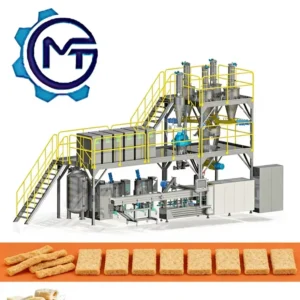
High Capacity Soy Protein Vegetarian Meat Processing Line
¥9,500.00 Select options This product has multiple variants. The options may be chosen on the product page -
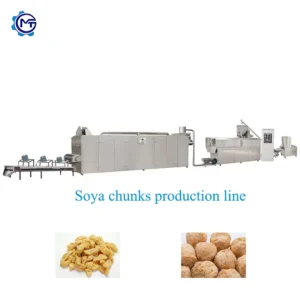
Soybean Protein Making Machine Automatic Soy Chunk Production Line
¥30.00 Select options This product has multiple variants. The options may be chosen on the product page -
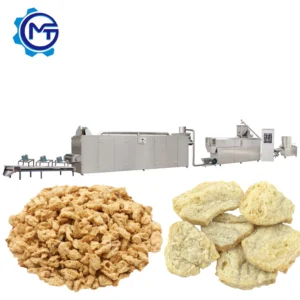
Meat Taste Textured Soybean Protein Processing Machine Vegetable Protein Soy Meat Making Machine
¥8,650.00 Select options This product has multiple variants. The options may be chosen on the product page -
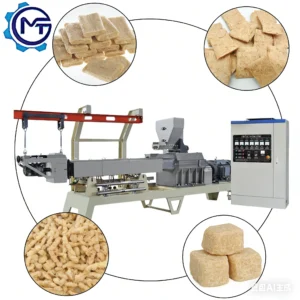
High Moisture Vegetarian Meat Extrusion Machine
¥9,500.00 Select options This product has multiple variants. The options may be chosen on the product page