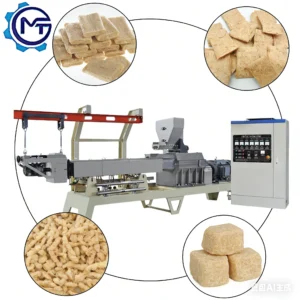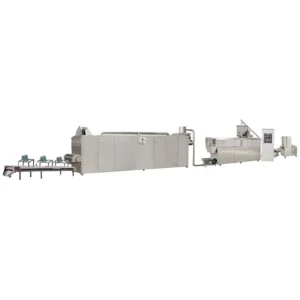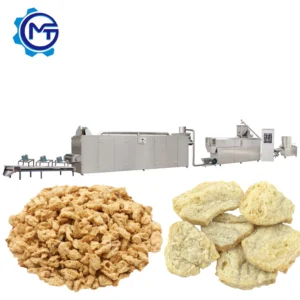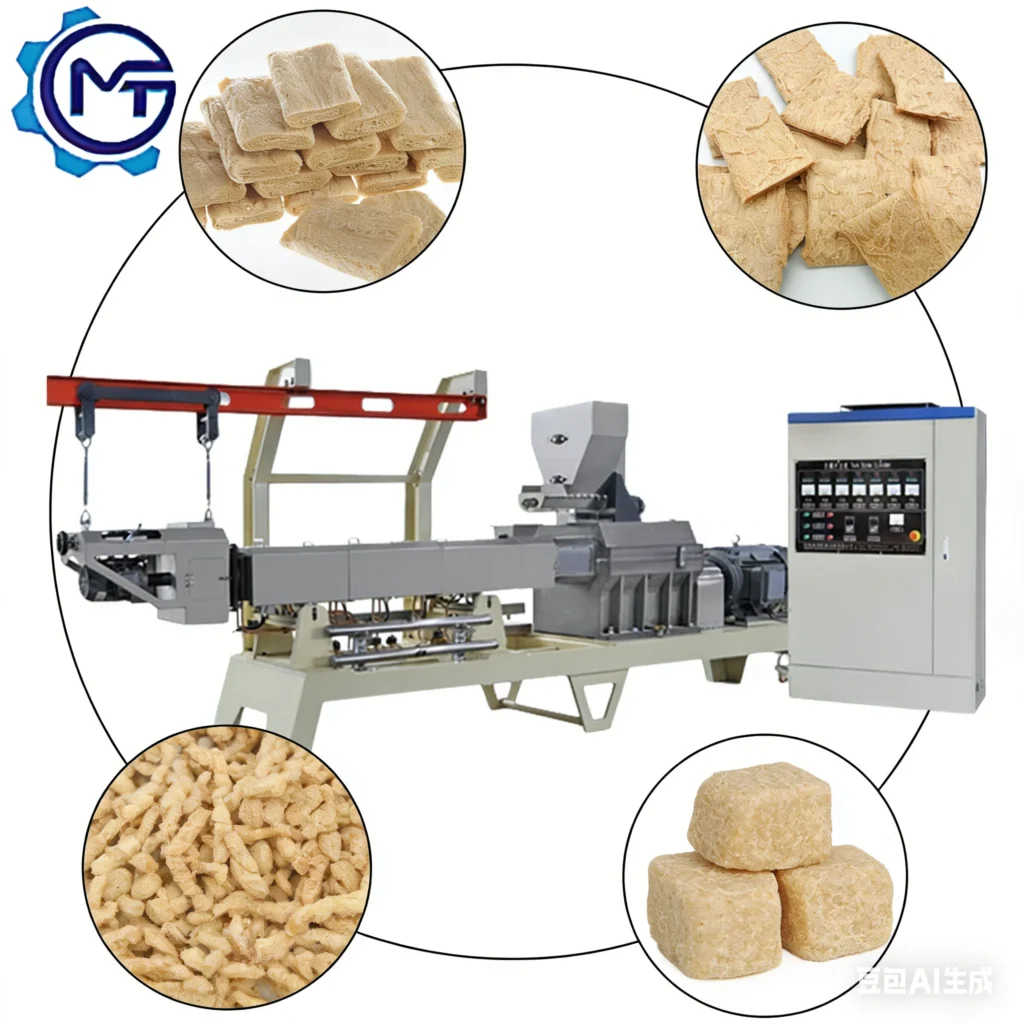


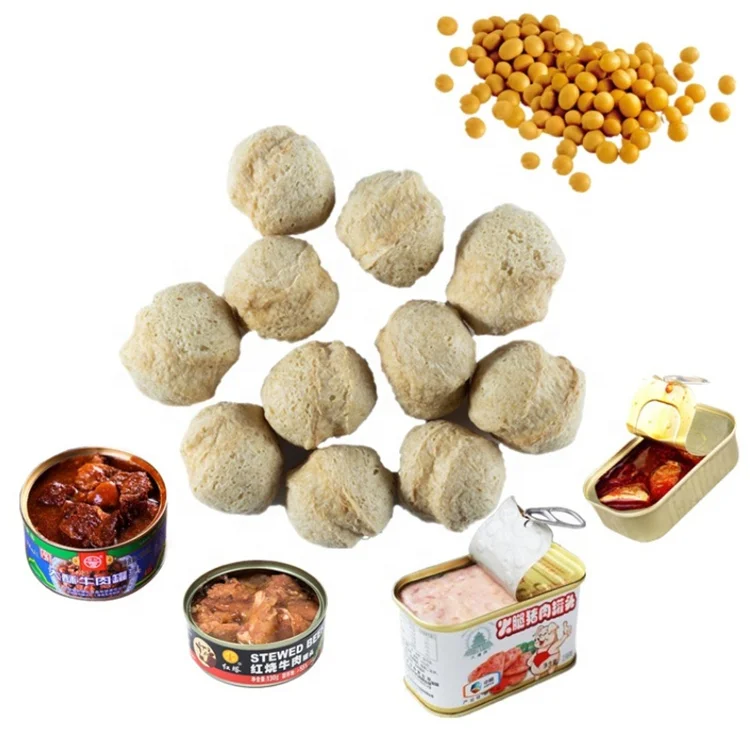
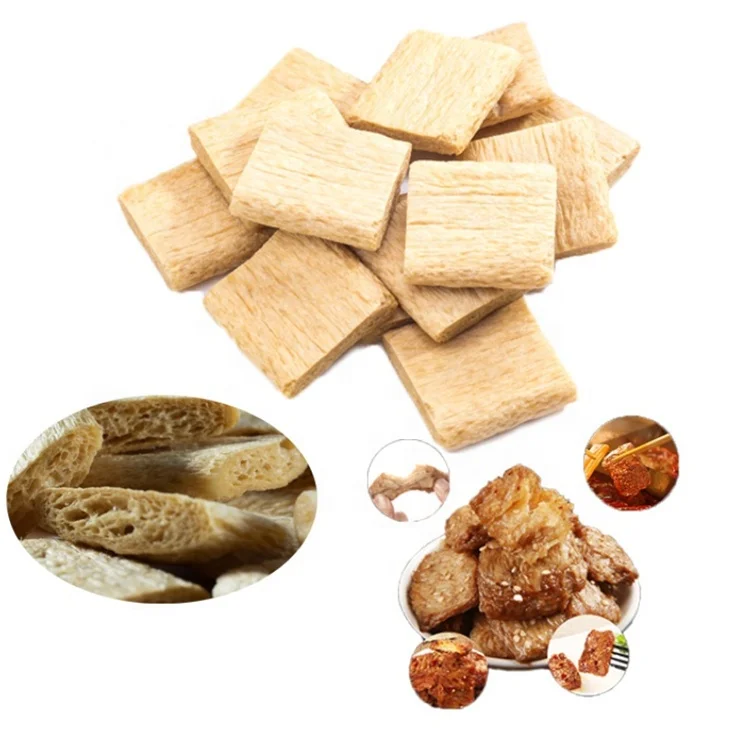
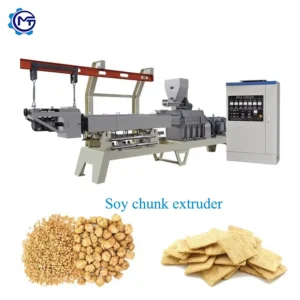
MT65, MT70, MT75, MT85 Twin Screw Extruder for Textured Vegetable Protein Production Line, CE & ISO certified — configured for defatted soya flour and low-temperature soya flakes.
- Twin-screw extrusion with interchangeable dies for TVP nuggets, chunks, and granules; screw configuration matched to raw material and target fibre structure
- Multi-layer dryer with selectable fuel, gas, or electric heat source; line stations throughput-matched from mixer through cooling
- Complete turnkey layout from batching to packing under one supplier, with in-house trial runs on your raw material before shipment
Description
Whole-line throughput matching — Every station from batching to cooling is sized to the extruder’s real output on your raw material, not a generic nameplate figure.
Technical Specifications
| Parameter | Value |
|---|---|
| Product Type | Twin Screw Extruder for Textured Vegetable Protein (TVP) Production Line |
| Model | MT65 / MT70 / MT75 / MT85 |
| Screw Type | Twin-screw |
| Installed Power | 84 kW (MT65) / 160 kW (MT70) / 190 kW (MT75) / 210 kW (MT85) |
| Power Consumption | 59 kW (MT65) / 120 kW (MT70) / 140 kW (MT75) / 140 kW (MT85) |
| Output Capacity | 100–150 kg/h (MT65) / 150–200 kg/h (MT70) / 150–200 kg/h (MT75) / 250–300 kg/h (MT85) (basis not stated in source — confirm raw material specification, moisture content, and target TVP format) |
| Main Motor Power | 22 kW / 30 kW / 45 kW (basis to be confirmed per model) |
| Overall Dimensions (L×W×H) | 40,000×1,200×2,200 mm (MT65) / 41,000×1,500×2,200 mm (MT70) / 43,000×1,500×3,200 mm (MT75) / 45,000×1,500×3,500 mm (MT85) |
| Rotary Cutting Motor | 0.75 kW |
| Feeding Motor | 0.75 kW |
| Mixer Capacity | 20–30 kg / 70–80 kg / 170–180 kg |
| Mixer Power | 4 kW / 7.5 kW / 15 kW |
| Mixer Construction | Stainless steel 304 mixing ruler, carbon steel shelf |
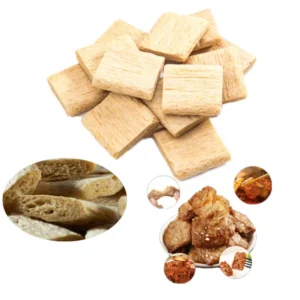
| Die Configuration | Interchangeable moulds for TVP / soya nuggets / soya chunks |
| Line Stations | Mixer → Screw Conveyor → Twin Screw Extruder → Air Conveyor → Multi-layer Dryer → Cooling Machine |
| Dryer Heat Source | Fuel / gas / electricity (selectable) |
| Dryer Drive | Double pitch roller chain drive, round-trip drying |
| Certifications | CE (since 2014), ISO certified |
| Lead Time | 15–35 working days after receiving deposit |
Application Suitability
| Application | Material or Output |
|---|---|
| Textured vegetable protein (TVP / TSP) production | Defatted soya flour, low-temperature soya flakes |
| Soya nuggets and soya chunks for food service | Defatted soya flour with adjustable moisture and die configuration |
| Plant-based meat analogue base material | Soya flour, soybean dregs, peanut dregs blended with starch carriers |
| Protein-fortified meat extender products | Blends of defatted soya flour and cereal starch at varied ratios |
Why "Nominal Capacity" Fails the Moment Your Raw Material Hits the Barrel
A textured vegetable protein production line turnkey is only as honest as the trial run performed on your actual defatted soya flour or soya flakes before it leaves the factory.
I once watched a TVP project stall for two full weeks because the extruder screw and die were configured for soy protein isolate while the buyer was running soy protein concentrate. The fibre structure collapsed on the first day — layers tore apart instead of pulling into strands. Parameters had to be rebuilt from scratch on-site, with the buyer losing raw material and production time every shift. That kind of mismatch never shows up in a brochure capacity number [NEED_CITE: common causes of fibre structure failure in TVP extrusion]. When a textured vegetable protein production line turnkey is quoted without confirming your specific protein content, particle size, and moisture baseline, the rated output is a guess.
Screw Configuration Dictates Fibre Formation
The twin-screw design in the MT series allows operators to rearrange screw elements and adjust the compression ratio to match the protein content and particle size of the incoming material. For defatted soya flour, a higher-shear configuration develops the fibrous matrix, while soya flakes with larger particle size benefit from a gentler compression zone to prevent premature gelatinisation before the die. The die plate geometry then controls expansion direction, which is what gives TVP chunks their layered, meat-like tear. Getting this combination right on a textured vegetable protein production line turnkey is not something you confirm from a data sheet — it requires running the material through the barrel and examining the output structure under controlled conditions.
Dryer Sizing Prevents Downstream Bottlenecks
The multi-layer dryer uses a double pitch roller chain drive for round-trip drying across multiple passes, which extends residence time without increasing the machine footprint. Heat source selection — fuel, gas, or electricity — depends on local utility costs and the moisture reduction target for the specific TVP format being produced. A nugget format with higher initial moisture needs longer dwell time than a fine granule, and if the dryer is undersized relative to the extruder output, product backs up at the air conveyor and the entire line slows to the dryer’s real throughput. Every station on this line is matched to the same capacity band so that the extruder does not outrun the dryer or the cooling machine.
Reading the Power and Dimension Data
The installed power across the MT65 to MT85 range scales from 84 kW to 210 kW, reflecting the increasing barrel volume and main motor requirement as throughput rises. Power consumption figures sit noticeably below installed power — this gap represents the thermal and mechanical headroom available when processing denser raw material blends or when the barrel requires sustained heating across multiple zones [NEED_CITE: typical power consumption profiles for twin-screw food extruders]. Overall line length extends from 40 m to 45 m across the four models, which includes the mixer, screw conveyor, extruder, air conveyor, dryer, and cooling machine. Buyers planning a textured vegetable protein production line turnkey installation need to verify ceiling height as well — the MT75 and MT85 lines reach 3.2 m and 3.5 m respectively, which affects overhead clearance for maintenance access and ventilation ducting.
The Cost of Generic Screw and Die Builds
When an extruder ships with a screw configuration copied from a standard template rather than matched to the buyer’s actual defatted soya flour or soya flakes, the consequences accumulate quietly. Fibre density falls outside what the downstream buyer expects, forcing the producer to blend in more expensive soy protein isolate to compensate. Die wear accelerates because the compression ratio was never calibrated for the material’s abrasiveness. Operators spend shifts adjusting barrel temperatures and moisture addition to chase a texture the hardware was never set up to deliver [NEED_CITE: impact of incorrect screw configuration on TVP fibre quality]. These costs do not appear on the purchase order, but they show up in every batch that fails the customer’s tear test.
Why Buyers Source This Line Here
The line is engineered as a complete system from one supplier, meaning the mixer capacity, extruder output, dryer residence time, and cooling throughput are all calculated against the same target rather than assembled from mismatched vendor quotes. Screw and die configurations are specified after reviewing the buyer’s raw material data sheet, not pulled from a generic build library. The in-house testing workshop runs the buyer’s actual defatted soya flour or soya flakes through the extruder before shipment, producing a trial run report that documents fibre structure, density, and real output. Pre-sales consultation covers line layout, utility planning, and phased installation scheduling. Electrical schematics confirm voltage, frequency, and control language before production begins, eliminating commissioning delays caused by mismatched power supply or unreadable HMI screens.
Documentation & Verification
- Line layout and capacity calculation showing matched throughput at every station for your TVP format
- Trial run report on your defatted soya flour or soya flakes confirming fibre structure and density
- Screw and die configuration record specific to your raw material and target nugget or chunk size
- Electrical schematic with voltage, frequency, and control language confirmed before production starts
- Factory test record documenting barrel temperature profile and motor load during pre-shipment run
Installation, Commissioning & Support
- Foundation and floor loading plan based on the 40–45 m line footprint and 1,200–1,500 mm width
- Dedicated power circuit sized to the 84–210 kW installed power range with confirmed voltage and frequency
- Extruder barrel and screw assembly verification on-site after transport in sectional shipping configuration
- First production run with barrel temperature and moisture parameters set to your trial run report baseline
- Operator training covering screw element rearrangement and die changeover for different TVP formats
- Wear parts list including screws, dies, and cutter blades with lead times for the first replacement cycle
Before You Request a Quote
To size the right model and configure the screw and die set accurately, we need your raw material specification — protein content, particle size, and moisture level of the defatted soya flour or soya flakes you plan to run. Share your target TVP format (nuggets, chunks, or granules), daily output requirement, and available workshop dimensions including ceiling height. Confirm your local voltage, frequency, and preferred control language so that electrical design starts correctly from the outset.
Frequently Asked Questions
Q: How is line capacity verified on my specific raw material before shipment?
A: Your defatted soya flour or soya flakes are run through the extruder in the in-house testing workshop before dispatch. The trial produces a documented report covering fibre structure, product density, and measured output under controlled barrel temperature and moisture conditions. This confirms the textured vegetable protein production line turnkey delivers on your material, not just a generic benchmark.
Q: How are extruder, dryer, and cooler throughput matched to avoid bottlenecks?
A: Each station is sized to the same capacity band based on the selected model. The dryer residence time is calculated against the extruder’s real output and the moisture reduction target for your TVP format. The cooling machine is then matched to the dryer discharge rate, preventing product accumulation at any single point in the line.
Q: What voltage, frequency, and control language options are confirmed before production?
A: Electrical schematics are reviewed and confirmed with the buyer before manufacturing begins. Voltage, frequency, and phase are set to match the destination facility’s power supply, and the control interface language is specified so that operators can read the HMI from day one without translation delays during commissioning.
Q: What does on-site installation, commissioning, and operator training include?
A: Engineers assemble the extruder barrel and screw set on-site, verify all station connections, and run the first production batch using the parameters established during the factory trial. Operators are trained on screw element rearrangement, die changeover, dryer temperature adjustment, and routine maintenance intervals for the specific model installed.
Q: How are spare wear parts such as screws and dies supplied for the first replacement cycle?
A: A wear parts list is provided with the documentation package, identifying screws, dies, and cutter blades specific to your configuration. Replacement parts are manufactured to the same specification as the original set, and lead times are confirmed at the time of line purchase so that the first replacement cycle does not interrupt production scheduling.
Related products
-
New Condition Soybean Protein Machine for Soy Chunks Production Textured Vegetable Protein Production Line
¥30.00 Select options This product has multiple variants. The options may be chosen on the product page -
Textured Soy Protein Production Line for Vegetarian Meat Nugget Manufacturing
¥8,238.27 Select options This product has multiple variants. The options may be chosen on the product page -
Textured Soybean Protein Extruder Plant Protein Processing Production Line TVP Making Machine
¥30.00 Select options This product has multiple variants. The options may be chosen on the product page -
High-yield Soybean Protein Automated Production Line Single Screw Extruder for TVP
Price range: ¥20.00 through ¥30.00 Select options This product has multiple variants. The options may be chosen on the product page