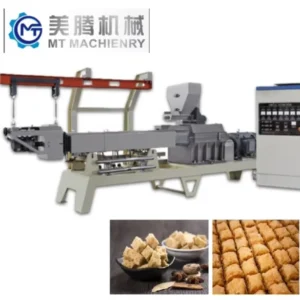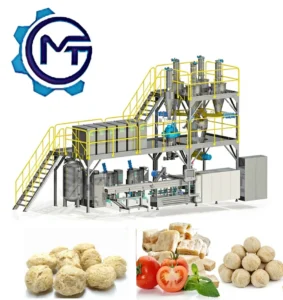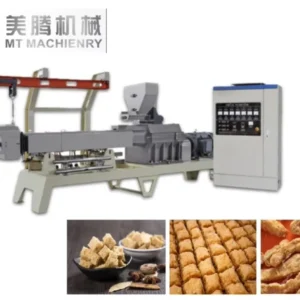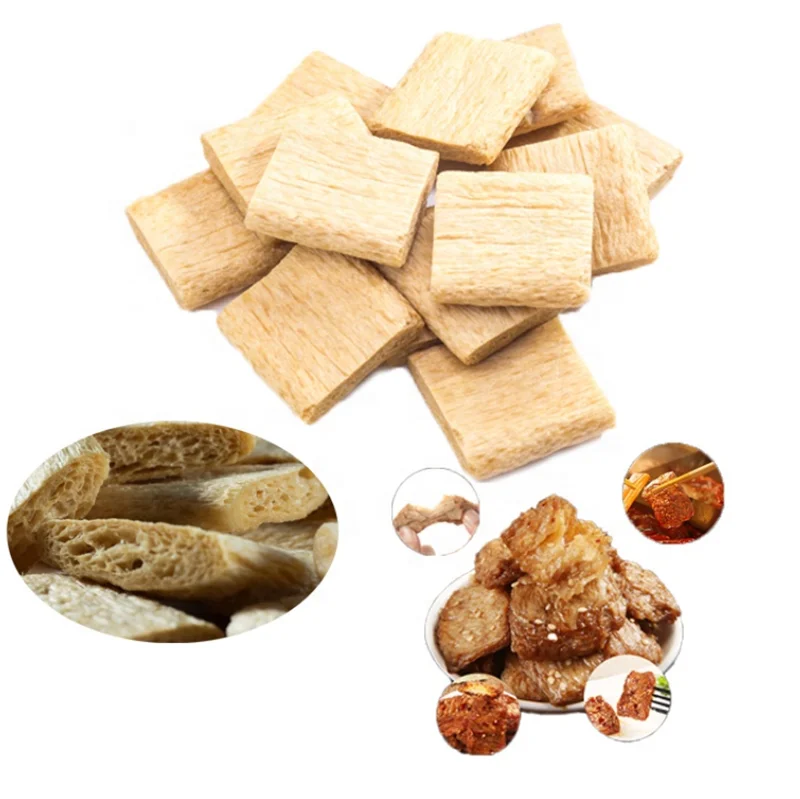
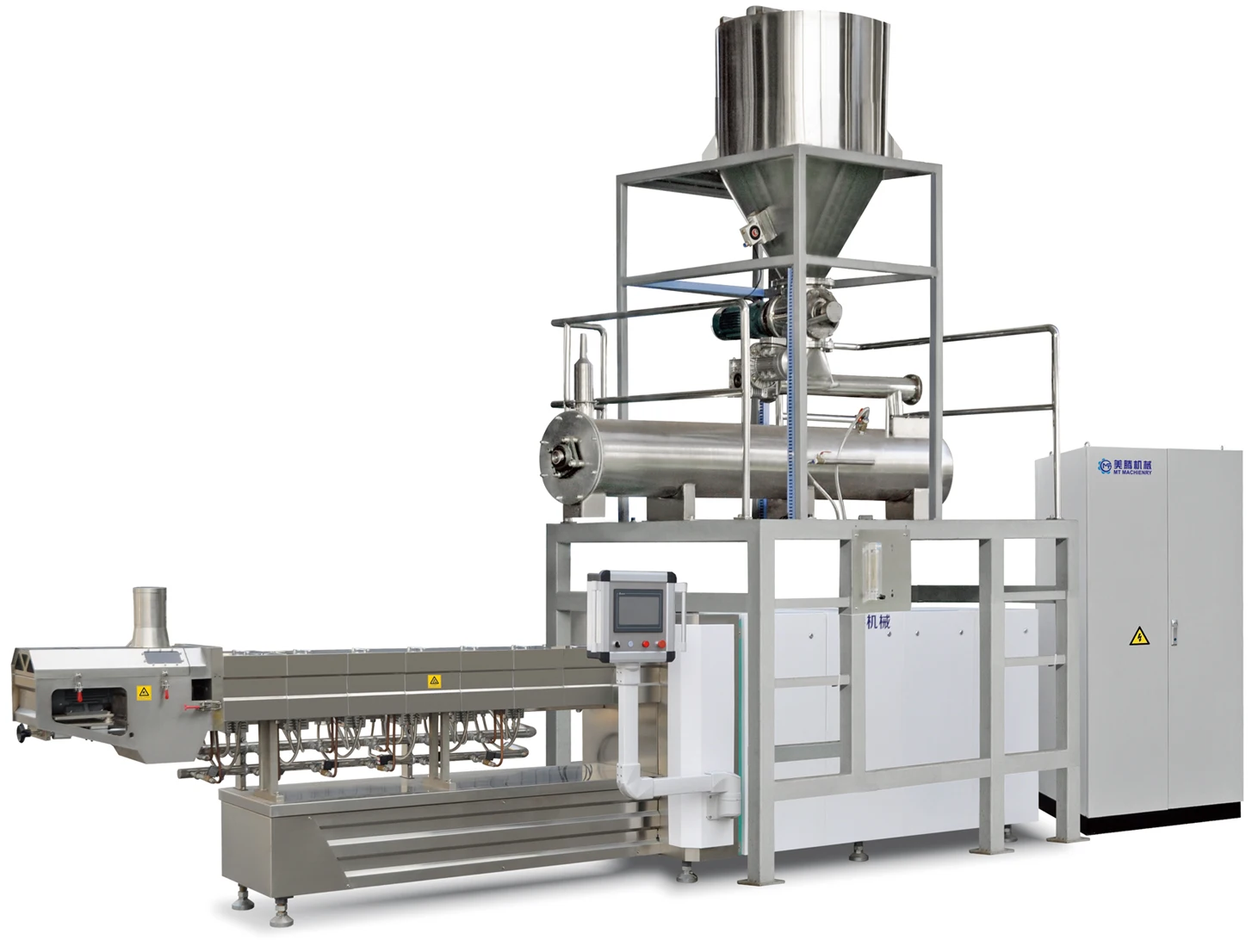
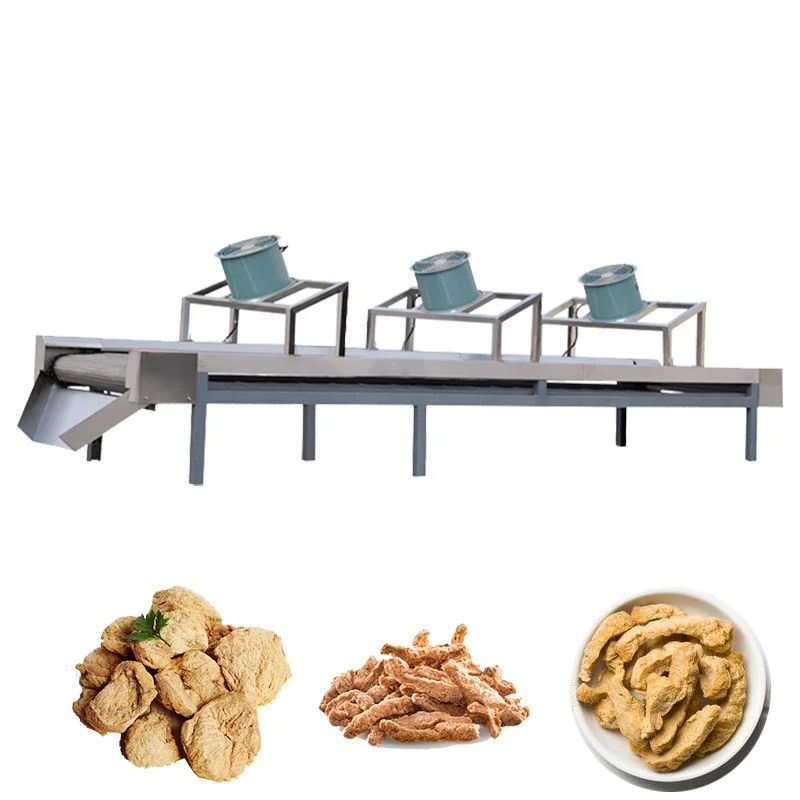
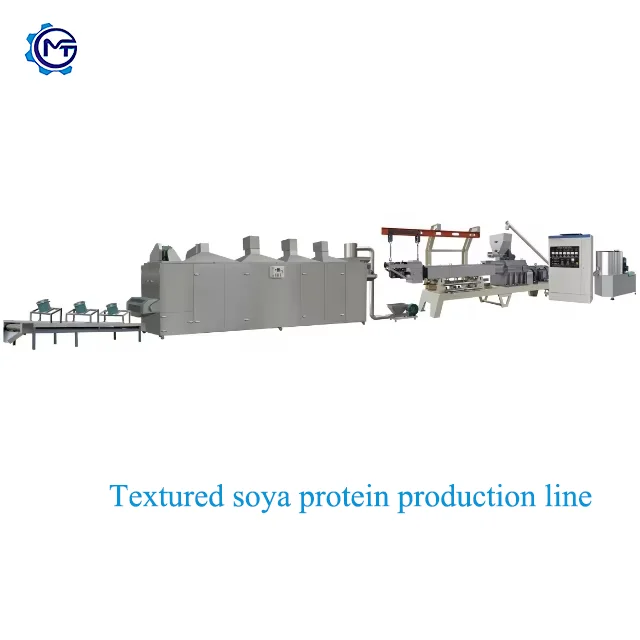
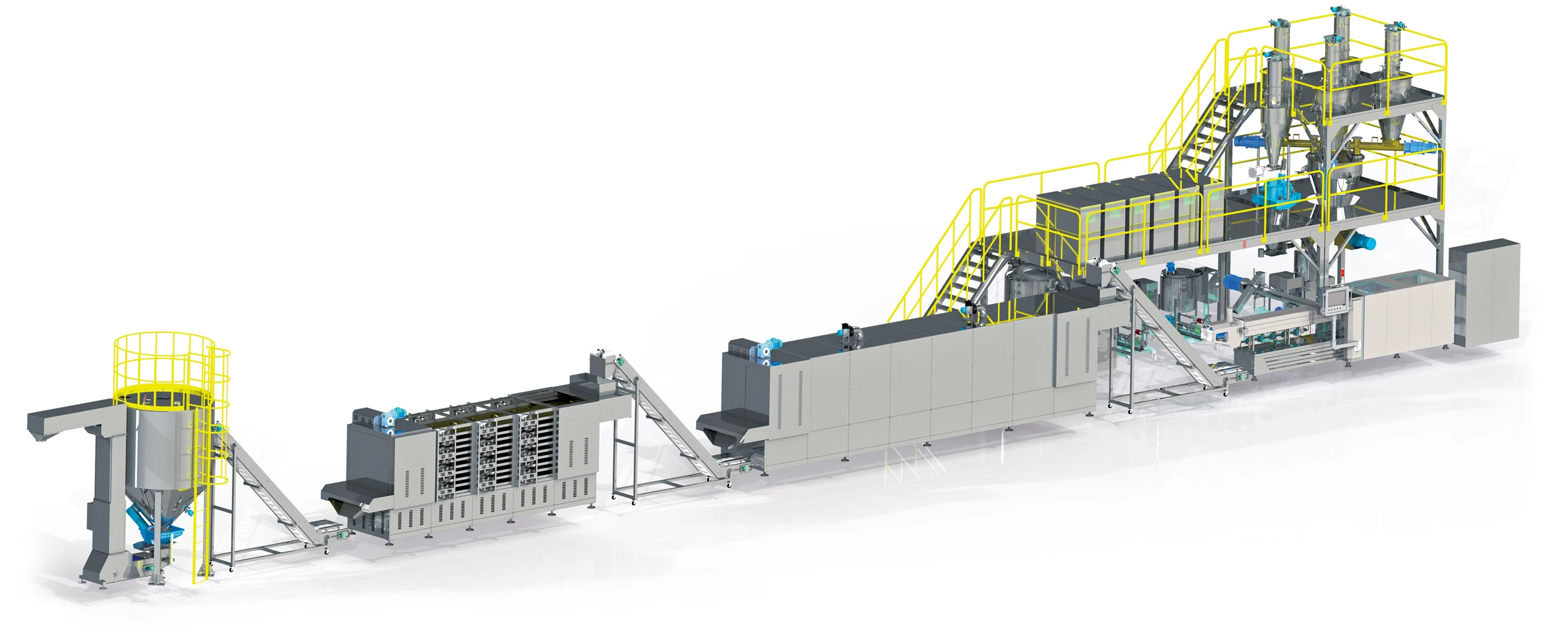
MT65 Textured Vegetable Protein Production Line, Twin-Screw Extruder, Stainless Steel Construction — engineered for soybean and peanut meal texturization with screw configuration and die design matched to raw material characteristics and target fibre structure.
- Line throughput matched across mixer, extruder, dryer and cooler stations to eliminate bottlenecks
- Three extruder models available to align line scale with production targets
Backed by in-house trial runs on customer raw material before shipment, complete line layout with capacity calculation, and on-site commissioning with operator training.
Description
Whole-line throughput matching — every station from mixer to cooler is calculated against your raw material and target TVP density before production starts.
Technical Specifications
| Parameter | Value |
|---|---|
| Product Type | Textured Vegetable Protein (TVP) Production Line |
| Model Options | MT65 / MT70 / MT85 |
| Screw Type | Twin-screw |
| Installed Power | MT65 — 85 kW; MT70 — 120 kW; MT85 — 195 kW |
| Real Power Consumption | MT65 — 65 kW; MT70 — 90 kW; MT85 — 165 kW |
| Output Capacity | MT65 — 150–200 kg/h (basis not stated in source); MT70 — 200–300 kg/h (basis not stated in source); MT85 — 600–800 kg/h (basis not stated in source) |
| Overall Dimensions (L×W×H) | MT65 — 18000 × 1300 × 2300 mm; MT70 — 20000 × 1500 × 2400 mm; MT85 — 24000 × 3500 × 4300 mm |
| Line Stations | Raw material preparation → Mixing → Conveying → Extrusion → Conveying → Drying → Cooling → Packing |
| Powder Mixer Tank Volume | 150 kg |
| Powder Mixer Rotary Speed | 385 rpm |
| Powder Mixer Power | 4 kW |
| High-temperature Roaster Effective Belt Length | 3.5 m |
| High-temperature Roaster Heater Array | 3.9 kW × 24 far infrared units |
| Construction Material | Stainless steel across all stations |
| Warranty | 1 year complete line |
| Standards | CE certified; ISO certified |
Application Suitability
| Application | Material or Output |
|---|---|
| Plant-based meat for sausage and ham | Low-temperature soybean meal, textured into fibrous chunks |
| Vegetarian meat for canned food | Peanut meal or soy-peanut blends, high-moisture extrusion |
| Fast-food and quick-frozen TVP portions | Soy protein concentrate, die-cut to target geometry |
| Fortified meat analogues for institutional nutrition | Blended legume meals with added micronutrient premix |
What "Line Capacity" Leaves Out When Stations Are Sourced Separately
A TVP extruder rated at a given throughput will underperform the moment its dryer cannot keep pace with the wet extrudate leaving the die.
The most frequent failure I see on textured vegetable protein production line projects is a throughput mismatch between stations. The extruder pushes product at its rated output, but the roaster belt is too short or the cooling unit too small, forcing the operator to slow the screw speed and run the whole line below its design point. I once watched a buyer spend weeks troubleshooting a fibre structure problem that turned out to be moisture still trapped inside the kibble because the dryer was undersized for the actual extruder feed rate [NEED_CITE: common throughput mismatch in multi-vendor extrusion lines]. When every station comes from a different vendor, nobody takes responsibility for the bottleneck.
Screw Configuration Dictates Fibre Structure, Not Just Output
The twin-screw extruder is where raw soybean meal transforms into the layered, fibrous texture buyers expect in plant-based meat. The screw profile, barrel temperature zones, and die geometry must all be set to the specific protein content and moisture level of the incoming meal. A configuration tuned for standard defatted soy flour will produce a crumbly, non-fibrous extrudate when fed high-protein isolate. That is why the screw and die record is generated after reviewing the buyer’s raw material certificate of analysis, not copied from a generic build sheet.
Why Dryer Belt Length and Heater Array Matter More Than You Think
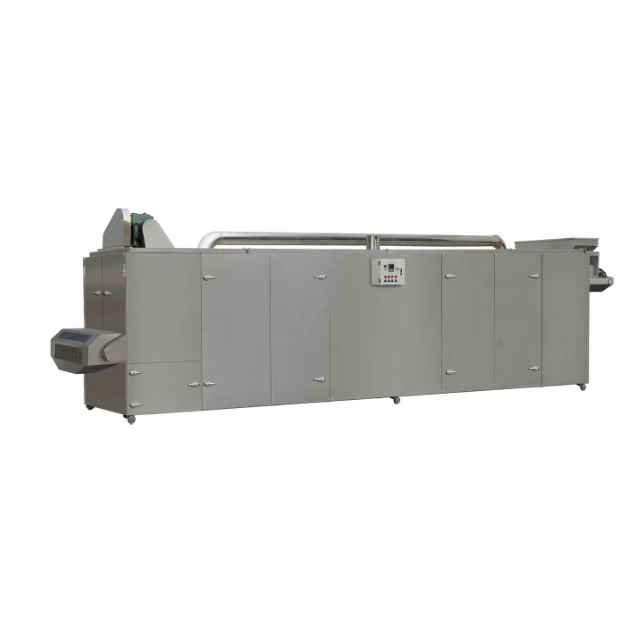
The high-temperature roaster on this line carries a 3.5 m effective belt length with 24 far infrared heater units. Wet TVP leaving the die typically holds moisture well above the stable storage threshold, and insufficient drying causes both microbiological risk and a collapsed fibre structure during cooling. Belt length determines residence time; heater count determines energy input uniformity across the belt width. If the roaster is sized only for the nominal extruder output rather than the actual wet mass flow, the centre of the belt will carry product that is still damp inside while the edges over-dry [NEED_CITE: moisture gradient issues in belt-type food dryers]. Matching dryer capacity to real extruder throughput is a calculation, not a guess.
Reading the Power and Dimension Data Across Three Line Sizes
The MT65, MT70, and MT85 share the same station sequence but scale in installed power from 85 kW to 195 kW and in line footprint from 18 m to 24 m in length. Real power draw — 65 kW, 90 kW, and 165 kW respectively — reflects the actual motor load during steady-state extrusion of soy-based material, which is what your electrical infrastructure must sustain continuously. The roaster alone draws over 93 kW from its far infrared array, meaning total plant power requirement substantially exceeds the extruder figure alone. Dimension data determines building length, utility trench routing, and whether the cooling machine can be positioned in-line or at a right angle. Selecting a model means matching not just hourly output but the physical and electrical envelope of your facility.
The Cost of Skipping a Pre-Shipment Trial Run
Buyers who accept delivery without a trial on their own raw material often discover during commissioning that the fibre structure, bulk density, or colour does not match their market specification. Rewriting the screw configuration and barrel temperature profile on-site, with production schedules already promised to downstream customers, is far more expensive than occupying a testing workshop for a few days before the machine leaves the factory. I have seen operators spend entire nights re-tuning barrel zones on a TVP line because the original settings were based on a different supplier’s soybean meal [NEED_CITE: raw material variability in soy protein extrusion]. A trial run report with the buyer’s actual lot eliminates that risk.
Why Procurement From a Single Line Supplier Changes the Equation
Throughput calculation covers every station — mixer output at 300–600 kg/h, extruder real power draw, roaster belt speed, cooler capacity — so no single unit chokes the rest. Screw and die configuration is specified against the buyer’s soybean or peanut meal certificate of analysis, not taken from a standard library. An in-house testing workshop allows trial runs on customer raw material before the line is crated, generating a documented report that travels with the shipment. Stainless steel construction across all stations simplifies food-grade compliance audits. Pre-sales engineering consultation, on-site installation, commissioning, and ongoing maintenance are handled by the same team that built the line, removing the blame-shifting that plagues multi-vendor projects.
Documentation & Verification
- Line layout and capacity calculation showing throughput at every station
- Screw and die configuration record matched to your soybean meal specification
- Trial run report produced on your raw material before dispatch
- Electrical schematic with voltage and frequency confirmed for your market
- CE declaration of conformity and ISO certificate for the complete line
- Wear parts list covering screws, dies, and roaster belt components
Installation, Commissioning & Support
- MT85 footprint of 24 m × 3.5 m requires clear building length and level concrete floor
- Total connected load across extruder and 93 kW roaster demands dedicated switchgear and circuit sizing
- Line ships in modular sections; on-site assembly includes belt alignment and barrel coupling
- First-run parameter setting covers screw speed, barrel zone temperatures, and die pressure
- Operator training addresses moisture adjustment, die changeover, and roaster belt tracking
- Wear parts inventory includes replacement screw elements and die plates for the first changeover cycle
What to Prepare Before Requesting a Quotation
Share the certificate of analysis for your soybean meal or peanut meal, including protein content and particle size distribution, so the screw profile can be matched before the design phase. Confirm your target daily output and the shift pattern you plan to run, as this determines whether the MT70 or MT85 fits your volume. Provide the available floor plan with ceiling height, plus local voltage and frequency, so the electrical schematic is finalised before production begins.
Frequently Asked Questions
Q: How is line throughput verified across mixer, extruder, dryer and cooler to prevent bottlenecks?
A: Each station’s capacity is calculated against the target extruder output on your specific raw material. The mixer batch cycle time, extruder real power draw, roaster belt residence time, and cooler capacity are cross-checked so no station forces the rest to slow down. A line layout document with these figures accompanies the quotation.
Q: How is screw configuration matched to my soybean meal or peanut meal?
A: We review your raw material certificate of analysis — protein content, moisture, particle size — and select screw element geometry, barrel zone count, and die aperture accordingly. The configuration record is documented and can be adjusted after the pre-shipment trial if the extrudate fibre structure needs refinement.
Q: Can a trial run be conducted on my raw material before shipment?
A: Yes. The in-house testing workshop runs your actual soybean or peanut meal through the extruder and roaster. The trial report records screw speed, barrel temperatures, moisture content, extrudate fibre structure, and bulk density, and is shipped with the line for your commissioning reference.
Q: How are voltage, frequency and control language confirmed before production?
A: During the specification confirmation stage, your local electrical standard and preferred control interface language are locked into the electrical schematic. This prevents the common delay where a line arrives with the wrong motor rating or an unreadable HMI screen, which otherwise pushes commissioning back by weeks [NEED_CITE: voltage and frequency standards by export market].
Q: What does the installation and commissioning schedule include?
A: On-site assembly covers station positioning, utility connections, and belt alignment. Commissioning includes first-run parameter tuning on your raw material and operator training on daily start-up, moisture adjustment, and die changeover. A phased schedule is agreed before shipment so your building readiness matches the arrival date.
Related products
-
Automatic TVP Vegetarian Meat Manufacturing Plant
¥9,500.00 Select options This product has multiple variants. The options may be chosen on the product page -
Small Multifunctional Textured Soy Protein Machine – Soy Protein Production Line – Vegetarian Meat Processing Equipment
¥65.00 Select options This product has multiple variants. The options may be chosen on the product page -

Vegetarian Meat Floss Production Line with Twin Screw
¥9,500.00 Select options This product has multiple variants. The options may be chosen on the product page -
Twin Screw Extruder for Textured Vegetable Protein (TVP)
¥9,500.00 Select options This product has multiple variants. The options may be chosen on the product page