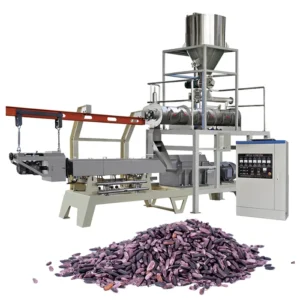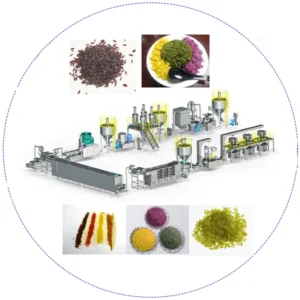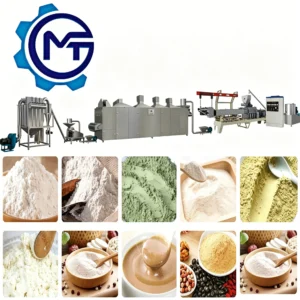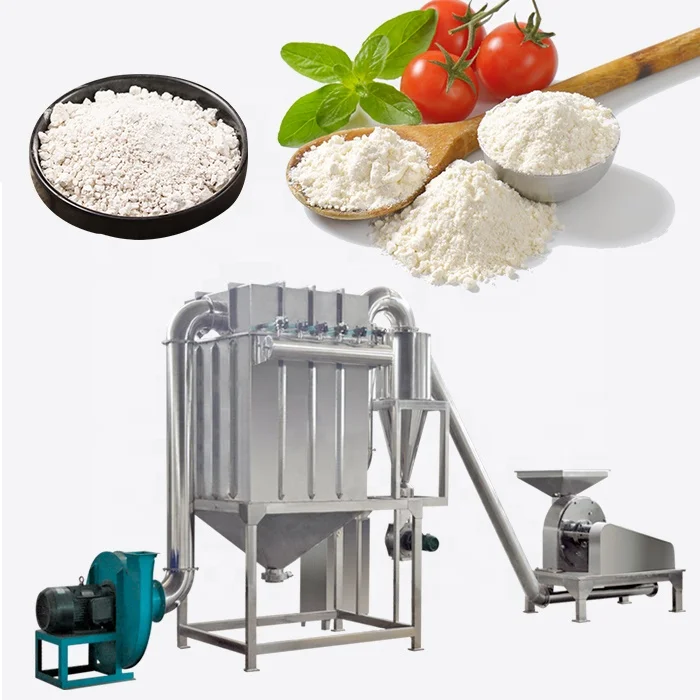
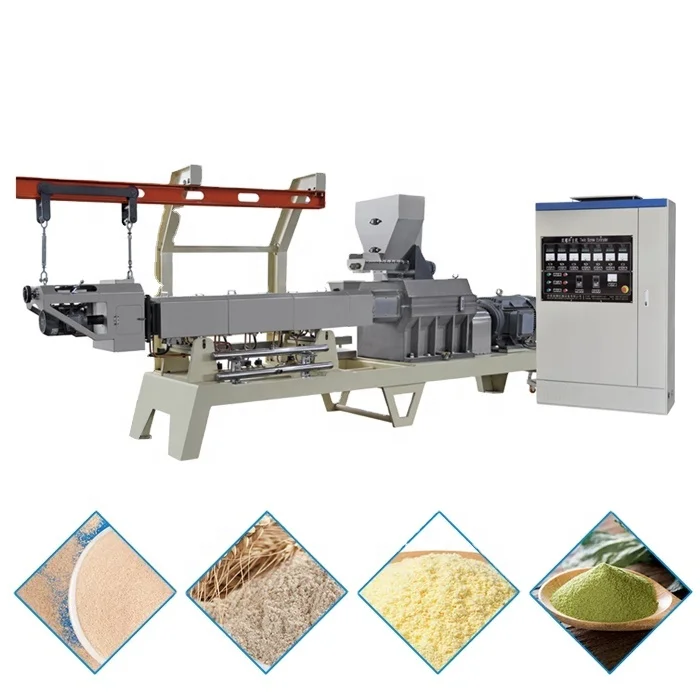
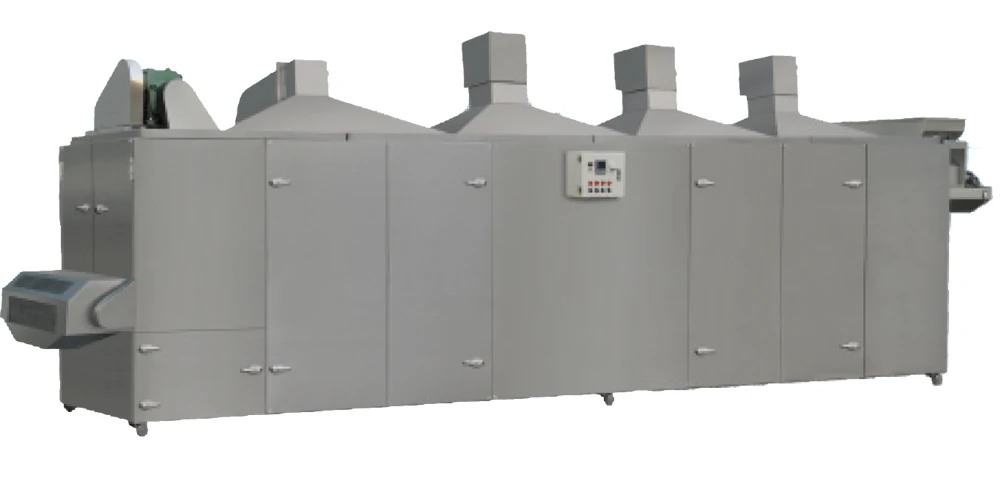
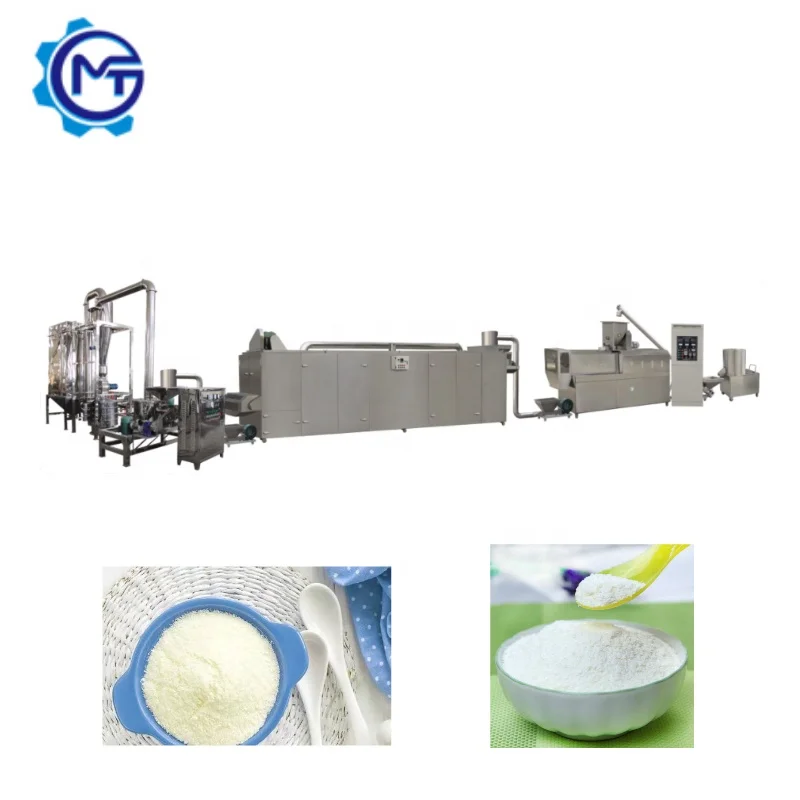


MT65 / MT70 / MT85 Nutritional Powder Processing Line, Twin-Screw Extrusion, Stainless Steel — engineered for baby food, infant cereal, and fortified powder production with integrated mixing, extrusion, roasting, milling, and packing stations. Screw configuration and barrel profile adjust to your specific grain formulation for controlled gelatinisation and powder density. Every line is throughput-matched across stations and trialled on your raw material before shipment.
- CE & ISO certified with 1-year warranty and lifetime maintenance
- In-house testing workshop confirms output and product specification pre-delivery
- Complete turnkey layout from one supplier eliminates cross-vendor bottlenecks
Description
Integrated Line Engineering — Every station from powder mixer to air conveyor and roaster is throughput-matched under one supplier, eliminating the bottlenecks that typically arise when a nutritional powder line is assembled from separate vendors.
Technical Specifications
| Parameter | Value |
|---|---|
| Product Type | Nutritional Powder Processing Line |
| Extruder Models Available | MT65, MT70, MT85 |
| Screw Configuration | Twin-screw |
| Installed Power (Line) | MT65: 85 kW; MT70: 120 kW; MT85: 195 kW |
| Real Power Consumption (Line) | MT65: 65 kW; MT70: 90 kW; MT85: 165 kW |
| Extruder Main Motor | 30 kW |
| Overall Dimensions (L×W×H) | MT65: 18000×1300×2300 mm; MT70: 20000×1500×2400 mm; MT85: 24000×3500×4300 mm |
| High-Temperature Roaster Far Infrared Heater | 3.9 kW × 24 units |
| Roaster Belt Effective Length | 3.5 m |
| Powder Mixer Tank Volume | 150 kg per batch |
| Powder Mixer Rotary Speed | 385 rpm |
| Construction Material | Stainless steel (304 for main contact parts) |
| Control System | Automated PLC/MCC (configurable) |
| Warranty | 1 year with lifetime maintenance service |
Application Suitability
| Application Scenario | Typical Raw Material or Output |
|---|---|
| Infant rice cereal and multi-grain baby food production | Rice flour, corn, oats, pre-cooked starches |
| Fortified porridge and nutritional drink powder blending | Soybean, sesame, grain blends with micronutrient additives |
| Modified starch for industrial use | Corn starch, cassava starch for textile and papermaking applications |
| Instant breakfast and weaning food manufacturing | Multi-grain formulations requiring controlled gelatinisation |
What the "Rated Capacity" on a Nutritional Powder Line Often Ignores
The output a nutritional powder processing line turnkey project delivers on paper rarely survives contact with your actual grain formulation and moisture content.
I spent two weeks on a factory floor in Southeast Asia watching a line stall because the buyer approved it based on a laboratory small-batch trial. When the pre-gelatinised starch hit the extruder at production scale, batch viscosity fluctuated, feeding became unstable, and moisture at the dryer exit exceeded specification every shift. The extruder was rated for a certain throughput, but that figure assumed a specific raw material behaviour that the buyer’s formulation did not replicate [NEED_CITE: raw material viscosity impact on extruder feeding stability]. A nutritional powder processing line turnkey project must be validated on your exact formulation before the equipment leaves the factory.
Screw Configuration Matched to Starch Gelatinisation Behaviour
The twin-screw extruder at the core of this nutritional powder processing line turnkey system allows screw element arrangement and barrel temperature profiling to be adjusted for the specific gelatinisation characteristics of your grain blend. Rice-based infant cereal demands a different shear and residence time profile than a soybean-fortified porridge mix. The configuration is specified during the trial phase, not copied from a generic build.
Throughput Matching Across Every Station
A roaster belt effective length of 3.5 m with 24 far-infrared heater elements provides the drying capacity to keep pace with the extruder output. When stations are sourced from separate vendors, the dryer often becomes the constraint, forcing the extruder to run below its capability or causing moisture to accumulate at the milling stage. This nutritional powder processing line turnkey configuration is designed so that mixer batch cycle, extruder throughput, roaster dwell time, and air conveyor transfer rate all align [NEED_CITE: throughput matching principles in food extrusion lines].
Power and Thermal Load Specifications
The line real power consumption ranges from 65 kW on the MT65 configuration to 165 kW on the MT85, with the roaster gas consumption rated at 6.8 m³ per hour. These figures determine your utility infrastructure requirements. The powder mixer operates at 385 rpm with a 150 kg tank volume and a 10-minute batch cycle, meaning the mixing station can supply the extruder continuously without creating a feed gap. Understanding these thermal and electrical loads before installation prevents the situation where a facility’s existing transformer or gas line cannot support the line at full operation.
The Cost of Skipping a Pre-Shipment Trial Run
When a nutritional powder line ships without a documented trial on the buyer’s raw material, the entire product development process shifts to the installation phase. Operators learn screw speed and temperature curves through trial and error on production-grade volumes, wasting raw material and delaying market launch. Density, gelatinisation degree, and final powder moisture all depend on formulation-specific parameters that cannot be reliably predicted from a laboratory sample alone [NEED_CITE: pilot scale to production scale variance in extrusion processing].
Why Source the Complete Line From One Supplier
The powder mixer, air conveyor, twin-screw extruder, high-temperature roaster, and downstream milling stations are engineered as a single system. Throughput calculations are documented across every station, not estimated independently. Screw and die configurations are recorded for your specific formulation. The in-house testing workshop runs your raw material before shipment, producing a trial report that confirms output and powder specification. On-site commissioning includes operator training on the exact control parameters validated during that trial. Voltage, frequency, and control language are confirmed against your facility’s electrical standard before production begins.
Documentation & Verification
- Line layout showing throughput calculation for mixer, extruder, roaster, and milling stations
- Trial run report on your grain formulation confirming gelatinisation degree and powder density
- Screw and die configuration record matched to your target product specification
- Electrical schematic with voltage and frequency confirmed for destination market
- CE declaration of conformity and ISO certificate for export documentation
- Operation and maintenance manual with wear parts list for screw and barrel elements
Installation, Commissioning & Support
- Foundation and floor space planned around MT85 overall length of 24000 mm and height of 4300 mm
- Dedicated electrical circuit sized to 195 kW installed power for the MT85 configuration
- Roaster gas supply line rated for 6.8 m³ per hour consumption verified before commissioning
- PLC control language and HMI interface configured to operator preference before power-on
- Spare screw elements and die plates supplied with initial wear parts package
- Mixer bearing and seal inspection schedule set at 10-minute batch cycle intervals
What We Need to Configure Your Line
Provide the specific grain or starch formulation you intend to process, including moisture content and any micronutrient additives. Confirm your facility voltage, frequency, and preferred control language. Share your target daily output and available floor space so the line layout can be calculated against the appropriate MT65, MT70, or MT85 configuration. If you require a trial run on your raw material before commitment, send a sample batch to the testing workshop.
Frequently Asked Questions
Q: How is line output verified on my specific raw material and formulation?
A: Your grain blend is processed through the twin-screw extruder and roaster in the in-house testing workshop before shipment. A trial run report documents the actual throughput, powder density, gelatinisation degree, and moisture content at the roaster exit, confirming the nutritional powder processing line turnkey system meets your product specification on your exact formulation.
Q: How are extruder, dryer, and milling stations throughput-matched?
A: Each station is selected based on capacity calculation across the complete line. The roaster belt length and heater array are sized to handle the extruder output, and the powder mixer batch cycle is timed to maintain continuous feed. This prevents the bottleneck that occurs when stations are assembled from separate vendors without integrated throughput planning.
Q: What voltage, frequency, and control language options are confirmed before production?
A: Your facility electrical standard and operator language preference are confirmed during the specification phase, before production begins. The electrical schematic is prepared to match your local voltage and frequency, and the PLC or MCC control interface is configured accordingly, preventing commissioning delays caused by incompatible power supply or unreadable HMI screens.
Q: Can the same twin-screw platform produce both nutritional powder and modified starch?
A: Yes. The twin-screw extruder configuration is adjustable. Screw element arrangement, barrel temperature profile, and die selection are changed to shift between infant cereal production and modified starch processing for industrial applications. The nutritional powder processing line turnkey platform supports both product categories without requiring a separate extruder purchase.
Q: What does on-site installation, commissioning, and operator training include?
A: Engineers set the line according to the documented layout, verify utility connections against the confirmed electrical and gas specifications, and run production trials using the parameters validated in the pre-shipment test. Operators are trained on screw speed, temperature curves, and batch timing specific to your formulation, with wear part replacement procedures covered before handover.
Related products
-
Hygienic Stainless Steel Infant Rice Powder Processing Line Automatic 500kg/h Capacity PLC Controlled
¥9,500.00 Add to cart -
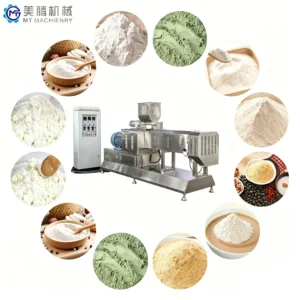
150-500kg/h Twin Screw Extruder Baby Rice Flour Making Machine
¥9,500.00 Select options This product has multiple variants. The options may be chosen on the product page -

Industrial Automatic 500kg/h Baby Cereal Nutrition Powder Extruder Manufacturing Process Line
¥8,238.27 Add to cart -
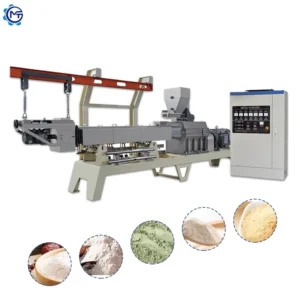
CE cerelac Instant Baby Food Porridge Making Machine Production Line
¥35,000.00 Select options This product has multiple variants. The options may be chosen on the product page