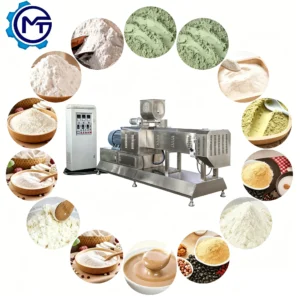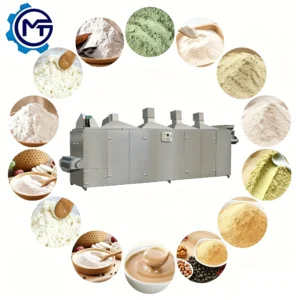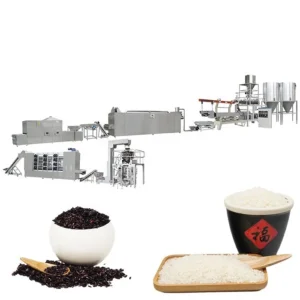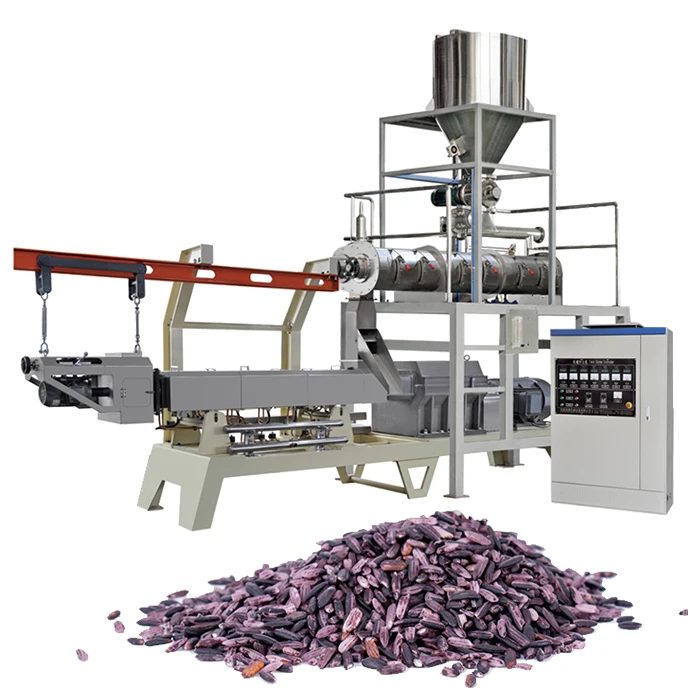


MT65 / MT70 / MT85 / MT75 / MT95 Fortified Artificial Rice Production Line, Twin-Screw Extrusion, PLC/MCC Control — engineered for complete nutritional rice processing from mixing through extrusion to packing.
- Screw configuration and die design matched to your raw material formula and target kernel density, with moisture and shear controlled across barrel zones for consistent starch gelatinisation
- In-house testing workshop validates output on your actual broken rice, corn, and micronutrient blend before shipment, supported by line layout, trial run report, and full electrical documentation for your market
Description
Matched Throughput Stations — Every segment from batching to packing is calculated against the same raw material moisture and target kernel density, so no single unit chokes the output of the upstream extruder.
Technical Specifications
| Parameter | Value |
|---|---|
| Product Type | Fortified Artificial Rice Production Line |
| Available Models | MT65 / MT70 / MT85 / MT75 / MT95 |
| Extruder Type | Twin-screw |
| Control System | PLC / MCC |
| Production Procedure | Mixing → Extruding → Vibrating → Low Temperature Drying → Cooling → High Temperature Roasting → Cooling → Packing |
| Basic Material Compatibility | Broken rice, corn, millet, wheat, oats, buckwheat, bean, starch, vitamins and minerals |
| MT65 Installed Power | 85 kW |
| MT65 Power Consumption | 60 kW |
| MT65 Capacity | 80–100 kg/h (basis to be confirmed with actual raw material and moisture content) |
| MT65 Dimensions | 28 × 1.2 × 2.2 m |
| MT70 Installed Power | 120 kW |
| MT70 Power Consumption | 85 kW |
| MT70 Capacity | 100–120 kg/h (basis to be confirmed with actual raw material and moisture content) |
| MT70 Dimensions | 30 × 1.5 × 2.2 m |
| MT85 Installed Power | 235 kW |
| MT85 Power Consumption | 165 kW |
| MT85 Capacity | 200–300 kg/h (basis to be confirmed with actual raw material and moisture content) |
| MT85 Dimensions | 34 × 3.5 × 4.3 m |
| MT75 Installed Power | 180 kW |
| MT75 Power Consumption | 135 kW |
| MT75 Capacity | 300–500 kg/h (basis to be confirmed with actual raw material and moisture content) |
| MT75 Dimensions | 32 × 3.5 × 4.3 m |
| MT95 Installed Power | 260 kW |
| MT95 Power Consumption | 195 kW |
| MT95 Capacity | 800–1000 kg/h (basis to be confirmed with actual raw material and moisture content) |
| MT95 Dimensions | 36 × 3.5 × 4.3 m |
| Certification | CE |
Application Suitability
| Application | Material or Output |
|---|---|
| Nutritional fortified rice production | Broken rice and corn blended with vitamin and mineral premix |
| Artificial rice kernel extrusion | Rice flour, millet flour, buckwheat starch blends |
| Micronutrient-fortified food processing | Wheat and oat base with iron, zinc, and B-vitamin additions |
| Instant rice production | Pre-gelatinised starch and bean flour mixtures |
Why "Quoted Capacity" Rarely Survives the First Production Run
A capacity figure without a raw material baseline is a guess, not a specification.
I remember a project where a buyer sourced a line based on a nominal throughput number, only to find that their actual formula — heavy on buckwheat and bean flour — absorbed moisture differently than the standard rice flour used for the factory test. The extruder ran fine, but the dryer could not pull enough moisture from the denser kernels, and the whole line backed up within two days of commissioning. That mismatch between test material and production material is one of the most common reasons a fortified artificial rice production line turnkey project under-delivers on day one [NEED_CITE: twin-screw extrusion behaviour across varying starch compositions]. When the raw material profile is not baked into the layout calculation from the start, every downstream station becomes a bottleneck.
How Turnkey Line Integration Eliminates Station Mismatches
A Fortified Artificial Rice Production Line turnkey project involves at least eight distinct processing stages — mixing, extruding, vibrating separation, low temperature drying, cooling, high temperature roasting, secondary cooling, and packing. When each station is sourced independently, the dryer manufacturer sizes their unit based on assumed moisture content while the extruder vendor quotes throughput on a different formula. We calculate every station against the same raw material data sheet, ensuring the dryer handles the actual moisture load the twin-screw extruder delivers, and the roaster capacity matches the cooled kernel flow rate rather than an optimistic projection.
Layout Planning That Accounts for Your Factory Floor
The physical arrangement of a complete line matters as much as the individual machine specifications. A 34-meter-long MT85 configuration needs clear material flow paths between the vibrating separator and the drying oven, adequate space for the cooling conveyors, and a packing station positioned to receive finished kernels without cross-contamination risk. We produce a full line layout drawing that maps utility drops — steam, compressed air, electrical feed — to each station, so the civil and electrical contractors can rough in connections before equipment arrives. Phased installation scheduling coordinates foundation work with delivery sequencing, preventing crates from sitting exposed on an unfinished floor [NEED_CITE: industrial food line installation sequencing practices].
Reading the Spec Sheet: What the Numbers Actually Mean
The twin-screw configuration is central to this line because it provides the shear and residence time needed to fully gelatinise starch from mixed grain flours while distributing micronutrient premix evenly through the barrel. Single-screw extruders of comparable size struggle with high-fibre formulations like buckwheat and bean blends, producing kernels with inconsistent density. The PLC and MCC control architecture allows operators to set and recall barrel temperature profiles, screw speed, and feeder rates for each formula, maintaining batch-to-batch consistency across shifts. The low temperature drying stage removes surface moisture gently to prevent case hardening, while the subsequent high temperature roasting develops the characteristic texture and cooking behaviour of artificial rice kernels. Total installed power across the range spans from 85 kW on the MT65 to 260 kW on the MT95, and buyers should verify their transformer capacity and dedicated circuit sizing against the specific model selected before placing an order.
The Hidden Cost of Skipping Pre-Shipment Trial Runs
When a line ships without being tested on the buyer’s actual formula, the entire product development cycle moves to the installation site. I spent four days in a humid workshop adjusting barrel zones and die clearance because the client’s grain premix behaved nothing like our standard test flour. Commissioning delays push back revenue start dates, and repeated trial batches consume raw material that was budgeted for saleable production [NEED_CITE: cost of unplanned commissioning extensions in food extrusion projects]. A factory trial run on the buyer’s own raw material before the crate is sealed catches these variables early — screw wear patterns, die pressure, and drying curve — while adjustments still cost hours instead of days.
Why Procurement Through This Project Channel Works
Every station from the batching mixer to the packing scale is specified under a single responsibility, so throughput matching is engineered rather than negotiated between separate vendors. Screw configuration and die geometry are documented against your raw material data sheet and target kernel specification before production begins. The in-house testing workshop runs your actual formula through the extruder and records moisture loss, kernel density, and texture before the line is approved for shipment. Pre-sales engineering covers line layout, utility planning, and phased commissioning schedules, while post-installation support includes operator training on the PLC interface and a documented wear parts schedule for screws, dies, and dryer belts. CE declaration of conformity accompanies every line for import compliance in regulated markets.
Documentation & Verification
- Line layout drawing with throughput calculation across all eight processing stations
- Screw and die configuration record matched to your grain and micronutrient formula
- Trial run report on your raw material including kernel density and moisture data
- Electrical schematic with confirmed voltage and frequency for your local grid
- CE declaration of conformity and ISO certificate for customs and regulatory filing
- Operation and maintenance manual with illustrated wear parts replacement procedures
Installation, Commissioning & Support
- Foundation and utility layout provided for line lengths up to 36 m, with load points marked for each extruder and dryer module
- Power supply confirmation including total connected load from 60 kW to 195 kW depending on model, with dedicated circuit recommendations
- Equipment ships in sectioned modules sized for standard container loading, with reassembly sequence documented per station
- On-site commissioning covers barrel temperature profiling, screw speed tuning, and dryer curve adjustment against your formula
- Operator training on PLC interface language, recipe recall, and alarm response procedures for each processing stage
- Wear parts list with replacement intervals for twin-screw elements, die plates, and dryer conveyor belts
What We Need to Scope Your Line Accurately
To build a layout and quotation that holds up on your production floor, share your target grain formulation including the percentage of each flour component and the micronutrient premix loading rate. Confirm the finished kernel size and cooking texture you need, along with your daily output target in kilograms. Let us know the available floor space dimensions, ceiling height, and the local voltage and frequency standard so we can size motors and control panels before the electrical design begins.
Frequently Asked Questions
Q: How is line capacity calculated and what raw material assumptions are used?
A: Capacity is modelled against a specific raw material blend, moisture percentage, and target kernel density. We ask buyers to submit their formula and a representative sample so the extruder throughput and dryer residence time are calculated on actual data rather than generic starch assumptions. The figures in the specification table are reference ranges that shift with material behaviour.
Q: What does phased installation and commissioning look like for a full line?
A: Installation follows a sequenced plan where foundation and utility rough-in happen before equipment arrives. Extruder and dryer modules are positioned first, then downstream cooling and packing stations are connected. Commissioning proceeds station by station, starting with dry runs, then wet trials using your formula, adjusting temperature zones and screw speed until target kernel specifications are met.
Q: How do you prevent bottlenecks between the extruder and the dryer?
A: Both units are sized against the same material data sheet. We calculate the moisture load the twin-screw extruder introduces into the kernel and match dryer belt length, air temperature, and residence time to remove that specific load. Throughput is balanced so neither station queues product or runs idle during steady-state production.
Q: What operator training and maintenance support comes with the line?
A: Training covers PLC recipe management, barrel temperature adjustment, screw speed control, and alarm diagnostics. Operators learn wear inspection routines for screw elements and die plates. A documented maintenance schedule lists replacement intervals for high-wear components, and spare parts kits can be included with the initial shipment to cover the first production cycles.
Q: How is screw configuration chosen for a specific fortified rice formula?
A: Screw element arrangement — kneading blocks, conveying sections, and reverse elements — is designed around the gelatinisation behaviour of your grain blend and the dispersion requirement of the micronutrient premix. Higher fibre content demands different shear profiles than pure rice flour. We test your sample in the workshop and record the configuration that produces the target kernel density and texture.
Related products
-

Organic Gluten Free Baby Rice Nutrition Powder Automatic 500kg/h Production Processing Line
¥8,238.27 Add to cart -
500kg/h Automatic PLC Controlled Nutrition Baby Food Extruder Machine for Rice Cereal Processing
¥9,500.00 Add to cart -
Automatic Iron Fortified Baby Rice Cereal Nutrition Powder Making Machine 500kg/h PLC Controlled
¥8,238.27 Add to cart -

High Productivity New Condition Safe Healthy and Nutritious Baby Food Meal Replacement Powder Production Line
¥30.00 Select options This product has multiple variants. The options may be chosen on the product page