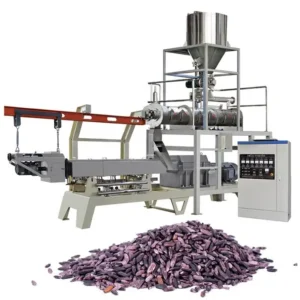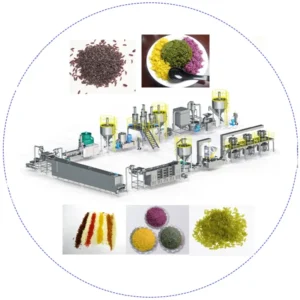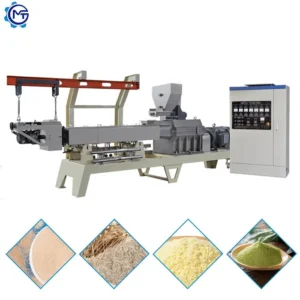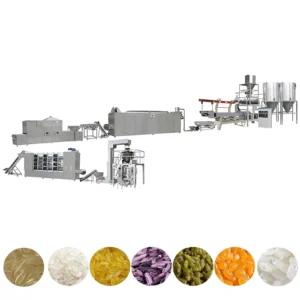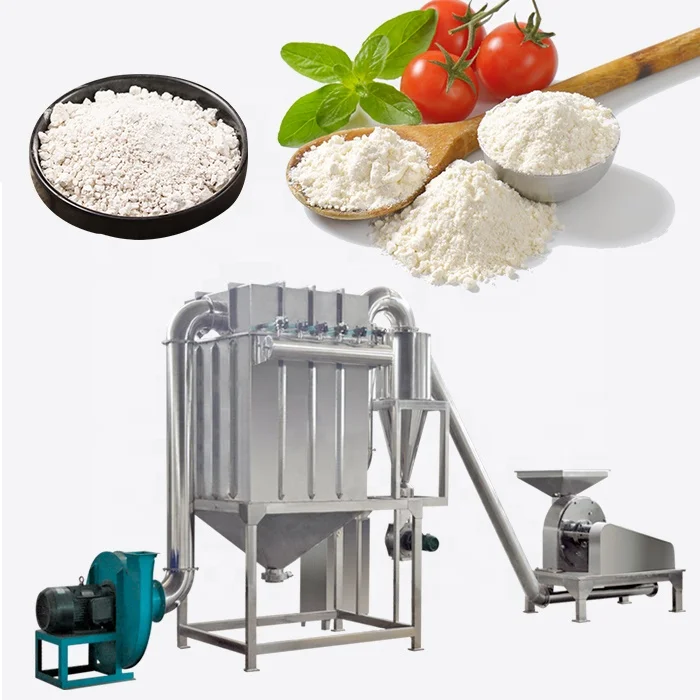
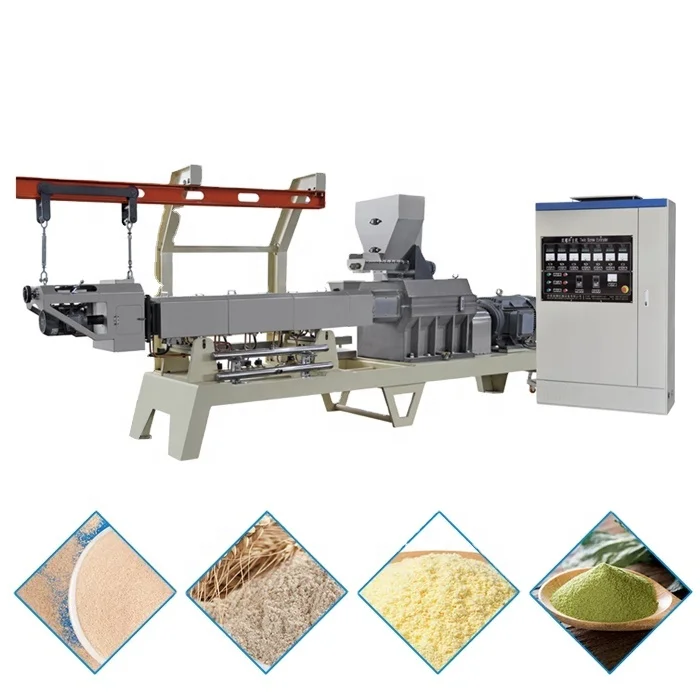
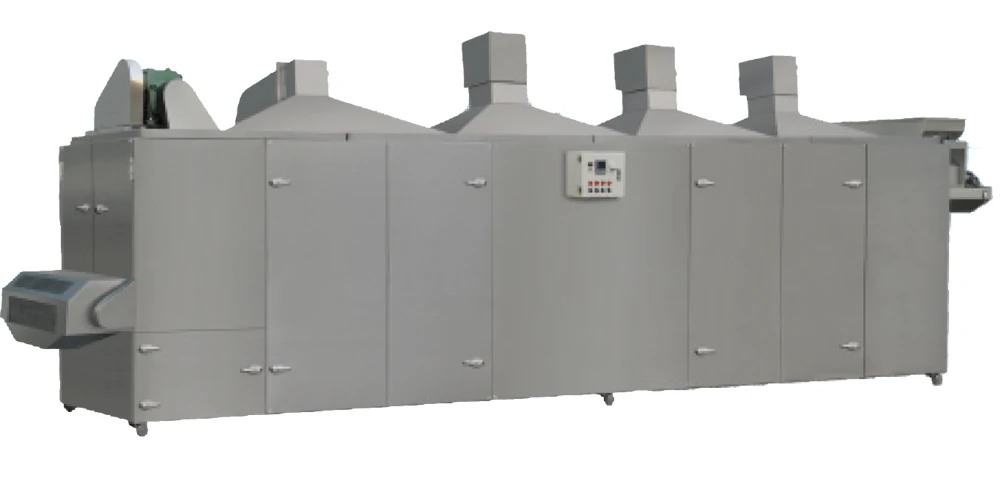
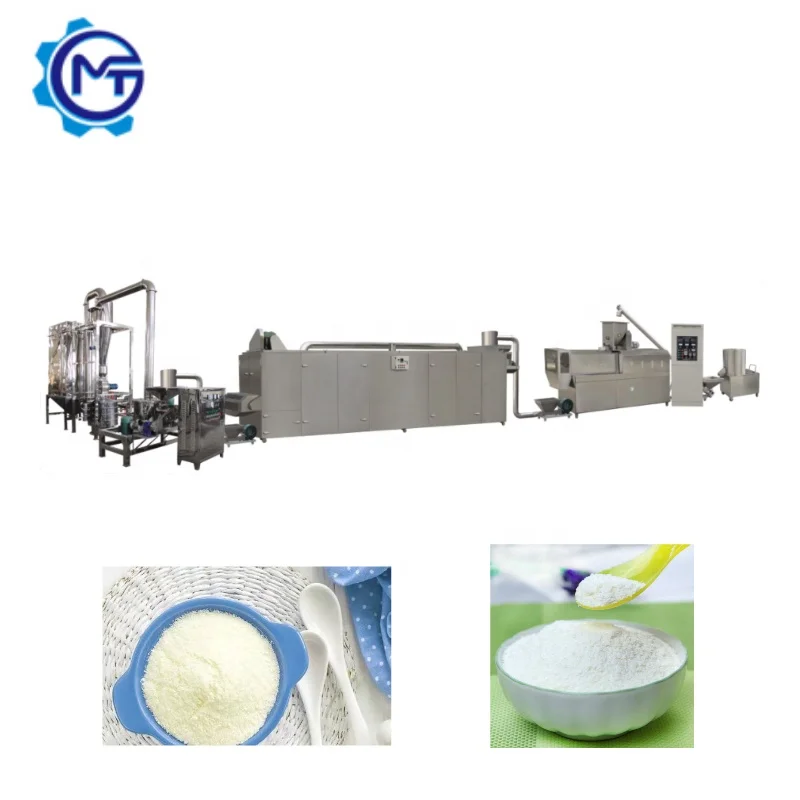


MT65 Nutritional Powder Processing Line, Twin-screw Extruder, PLC & MCC Control — throughput-matched from batching through extrusion, roasting, milling to packing. Screw configuration and die design are specified to your raw material and target gelatinisation level, with barrel temperature profile tuned for consistent powder density and starch modification. Full-line automation keeps moisture, shear and expansion under control across every station. In-house trial runs on your actual raw material validate output before shipment, supported by complete line layout documentation and on-site commissioning.
- Food-grade stainless steel contact parts throughout
- CE and ISO certified production
- Applications: baby food powder, grain-based nutritional powder, modified starch
Description
Single-Source Line Engineering — every station on this nutritional powder line is throughput-matched from the same supplier, so the extruder, roaster, and mixer never fight each other for capacity.
Technical Specifications
| Parameter | Value |
|---|---|
| Product Type | Nutritional Powder Processing Line |
| Model | MT65 / MT70 / MT85 |
| Installed Power | 85 kW (MT65) / 120 kW (MT70) / 195 kW (MT85) |
| Real Power Consumption | 65 kW (MT65) / 90 kW (MT70) / 165 kW (MT85) |
| Output Capacity | 150–200 kg/h (MT65, basis not stated in source — confirm raw material / moisture) / 200–300 kg/h (MT70, basis not stated in source) / 600–800 kg/h (MT85, basis not stated in source) |
| Overall Dimensions (L×W×H) | 18000×1300×2300 mm (MT65) / 20000×1500×2400 mm (MT70) / 24000×3500×4300 mm (MT85) |
| Screw Type | Twin-screw |
| Control System | PLC and MCC |
| Material of Construction | Stainless steel (food-grade contact parts) |
| Assembly State | Complete line (batching → extrusion → drying → milling → mixing → packing) |
| Certification | CE, ISO |
Application Suitability
| Application | Material or Output |
|---|---|
| Infant and baby food production | Rice powder, porridge powder, fortified cereal blends |
| Grain-based nutritional powders | Corn, beans, sesame paste powder, soybean powder |
| Modified starch processing | Pregelatinised starch for textile, food, papermaking, and industrial use |
Why Nominal Capacity Numbers Fail on Nutritional Powder Lines
A line rated on one formula can stall completely when your actual blend has higher viscosity or different moisture content.
I once saw a nutritional powder processing line turnkey project stall in commissioning because the extruder was sized for standard rice flour, but the customer’s fortified infant formula contained heavy vitamin premixes and fat powders that changed the rheology inside the barrel. The extruder could not feed consistently, the downstream roaster sat idle burning gas, and the whole line produced below its nameplate rate. That is the gap between a catalogue number and a working plant. Sizing must happen against the material you actually intend to run, not a benchmark starch [NEED_CITE: material rheology impact on extruder throughput].
Matching Every Station to the Same Throughput Target
A nutritional powder processing line turnkey project involves more than the extruder. The powder mixer must batch fast enough to keep the extruder fed, the high-temperature roaster must handle the moist extrudate without creating a backlog, and the air conveyor must move material between stations without bridging or blockage. When each station is sourced from a different vendor, throughput mismatches appear only during commissioning. This line is engineered as a single system, so the mixer output, extruder capacity, and roaster belt speed are all calculated against the same target.
Screw Configuration as a Process Variable, Not a Catalogue Choice
The twin-screw extruder in this line does not ship with a generic screw profile. The screw elements and die geometry are selected based on the buyer’s raw material composition, target gelatinisation degree, and final powder density. A baby rice powder requires a different shear profile and residence time compared to a modified starch for industrial use. The barrel temperature zones and moisture injection points are then tuned to match. This is where extrusion engineering separates a working line from one that produces off-spec powder on day one [NEED_CITE: screw element selection for starch gelatinisation].
Reading the Specs That Actually Matter
The MT65 draws 65 kW in real operation against 85 kW installed, which tells a buyer about motor headroom and peak load behaviour rather than just nameplate figures. The high-temperature roaster uses far infrared heaters rated at 3.9 kW each across 24 elements, giving precise zone control over the drying curve — critical when infant powder must reach a specific residual moisture without scorching. The powder mixer runs at 385 rpm with a 150 kg tank volume and a 10-minute batch cycle, meaning its effective hourly output depends on how that cycle aligns with the extruder feed rate. These relationships define whether the line runs continuously or in stop-start batches.
The Hidden Cost of Undersized Downstream Equipment
When the roaster or milling station cannot keep pace with extruder output, the extruder must be throttled back. Operators reduce feed rate to prevent material pile-up, which then drops barrel fill level and changes the shear and temperature profile inside the extruder. The powder leaves with inconsistent gelatinisation, variable particle size after milling, and batch-to-batch density drift. This is rarely diagnosed as a line balancing problem — it shows up as a quality complaint from the buyer’s customer [NEED_CITE: extruder starvation effects on product consistency].
What This Line Delivers as a Single-Source Project
The line layout and capacity calculation are produced against your specific raw material and target output before quotation. Screw and die configuration is documented per your product specification, not copied from a standard build. A trial run on your actual raw material takes place in the in-house testing workshop before the line ships, so process parameters are established before installation begins. Electrical schematics, voltage confirmation, and control language are verified against your site conditions prior to production. CE and ISO documentation supports customs clearance and local regulatory compliance.
Documentation & Verification
- Line layout and capacity calculation matched to your raw material and target output
- Screw and die configuration record documented per your product specification
- Trial run report on your raw material before shipment
- Electrical schematic and voltage confirmation for your site
- CE declaration of conformity and ISO certificate for customs and compliance
- Operation and maintenance manual with wear parts list
Installation, Commissioning & Support
- Floor plan provided based on the 18 m to 24 m line length depending on model selected
- Power supply matched to installed capacity ranging from 85 kW to 195 kW with dedicated circuit planning
- PLC and MCC control language confirmed to operator preference before commissioning
- Trial run parameters transferred directly to on-site startup, reducing first-run waste
- Twin-screw and die wear parts list supplied with recommended first replacement schedule
- Ongoing maintenance support available after commissioning and operator training
What We Need to Size Your Line Correctly
Share the exact raw material composition you intend to run, including any vitamin premixes, fat powders, or specialty grains. Tell us your target daily output and the shift pattern you plan to operate. Confirm your site voltage, frequency, and preferred control language so the MCC and PLC are configured before the line leaves the factory.
Frequently Asked Questions
Q: How is throughput verified across every station on the line?
A: Each station — mixer, extruder, roaster, milling, packing — is calculated against the same target capacity based on your raw material properties. A trial run in the testing workshop confirms that material flows between stations without bottlenecks or starvation before the line is approved for shipment.
Q: Can you run a trial on our specific raw material before we commit?
A: Yes. The in-house testing workshop runs your actual raw material through the twin-screw extruder with the proposed screw and die configuration. The trial run report documents output rate, product density, gelatinisation level, and moisture content so you can verify performance before shipment.
Q: How do you match screw configuration to our target powder?
A: Screw elements and die geometry are selected based on your raw material composition, required gelatinisation degree, and final powder density. Barrel temperature zones and moisture settings are then tuned during the trial run and documented in the configuration record supplied with the line.
Q: What electrical and control details are confirmed before production?
A: Voltage, frequency, and phase are confirmed against your site supply. The PLC and MCC control language is set to your operator preference. Electrical schematics are provided for review, ensuring the line can be commissioned without delays caused by mismatched power or unfamiliar interface language.
Related products
-

Automatic Instant Powder Production Line Nutritional Powder Extruder Machine
¥10,000.00 Select options This product has multiple variants. The options may be chosen on the product page -
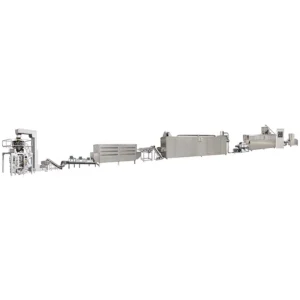
High Productivity New Condition Nutritious Baby Food Meal Replacement Powder Production Line
¥30.00 Select options This product has multiple variants. The options may be chosen on the product page -
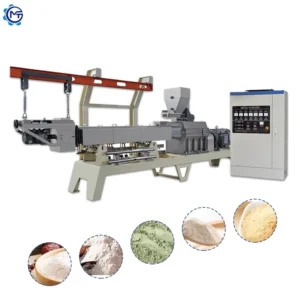
CE cerelac Instant Baby Food Porridge Making Machine Production Line
¥35,000.00 Select options This product has multiple variants. The options may be chosen on the product page -
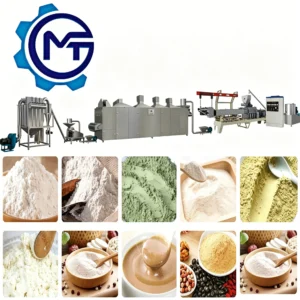
Organic Gluten Free Baby Rice Nutrition Powder Automatic 500kg/h Production Processing Line
¥8,238.27 Add to cart