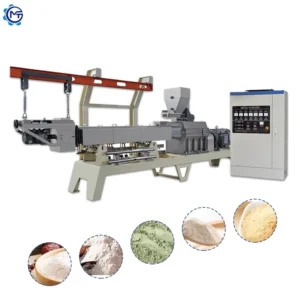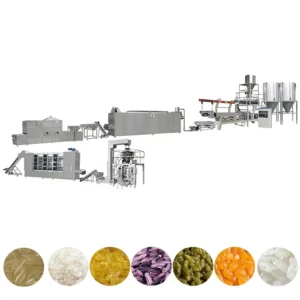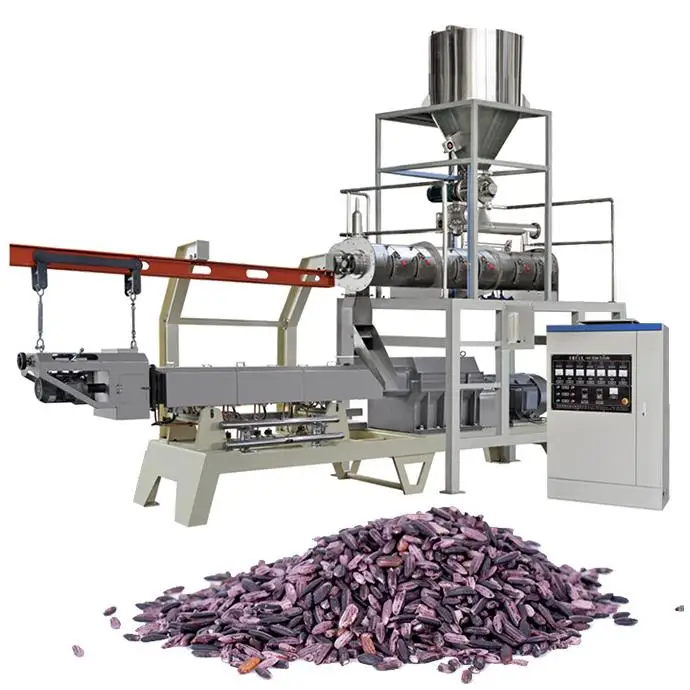


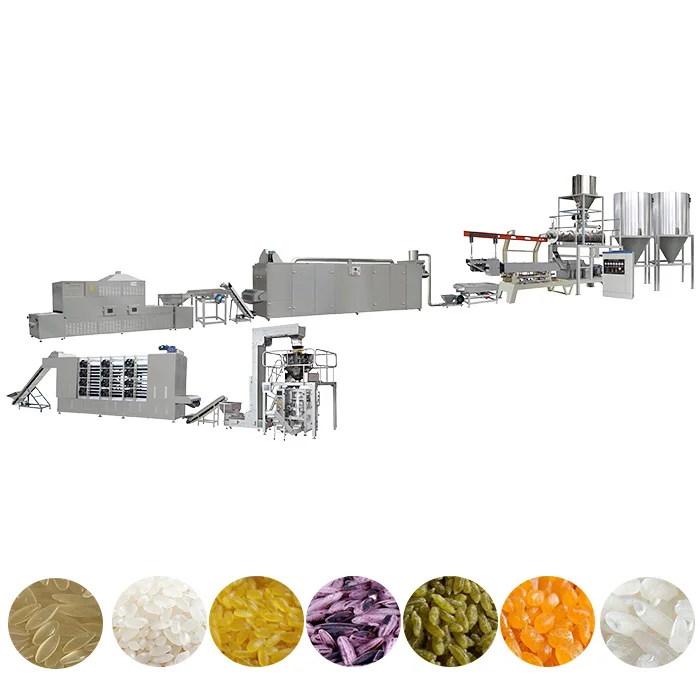
MT65 / MT70 / MT75 / MT85 / MT95 Twin-Screw Fortified Rice Production Line — complete turnkey system from mixing through extrusion, drying, cooling, to packing.
- Throughput-balanced stations engineered as one integrated line, eliminating bottlenecks between extruder and dryer
- Screw configuration and die design matched to your specific grain blend and target kernel density
- Circulation drying with variable mesh belt speed for consistent moisture control
One turnkey project from layout and capacity calculation through in-house trial runs on your raw material, on-site commissioning, and operator training.
Description
Integrated Line Engineering — every station from batching to packing is throughput-matched on paper before metal is cut, so the extruder never starves the dryer and the cooler never backs up the packing scale.
Technical Specifications
| Parameter | Value |
|---|---|
| Product Type | Nutritional Fortified Rice Production Line |
| Available Models | MT65 / MT70 / MT75 / MT85 / MT95 |
| Extruder Type | Twin-screw (single or double screw feeding system available depending on material) |
| MT65 Installed / Consumed Power | 85 kW / 60 kW |
| MT70 Installed / Consumed Power | 120 kW / 85 kW |
| MT75 Installed / Consumed Power | 180 kW / 135 kW |
| MT85 Installed / Consumed Power | 235 kW / 165 kW |
| MT95 Installed / Consumed Power | 260 kW / 195 kW |
| MT65 Capacity | 80–100 kg/h (basis not stated in source — confirm raw material formulation and moisture content) |
| MT70 Capacity | 100–120 kg/h (basis not stated in source — confirm raw material formulation and moisture content) |
| MT75 Capacity | 300–500 kg/h (basis not stated in source — confirm raw material formulation and moisture content) |
| MT85 Capacity | 200–300 kg/h (basis not stated in source — confirm raw material formulation and moisture content) |
| MT95 Capacity | 800–1000 kg/h (basis not stated in source — confirm raw material formulation and moisture content) |
| MT65 Overall Dimensions | 28 × 1.2 × 2.2 m |
| MT70 Overall Dimensions | 30 × 1.5 × 2.2 m |
| MT75 Overall Dimensions | 32 × 3.5 × 4.3 m |
| MT85 Overall Dimensions | 34 × 3.5 × 4.3 m |
| MT95 Overall Dimensions | 36 × 3.5 × 4.3 m |
| Control System | Frequency speed control with high automation; PLC/MCC available upon configuration |
| Lubrication & Cooling | Automatic lubricating and cooling system |
| Drying Oven Heating Source | Electric or gas |
| Drying Method | Circulation drying with frequency motor-controlled mesh belt speed |
| Line Stations | Mixing → Extruding → Vibrating → Low temperature drying → Cooling → High temperature roasting → Cooling → Packing |
| Compatible Raw Materials | Broken rice, corn, millet, wheat, oats, buckwheat, bean, starch; vitamin and mineral additives |
Application Suitability
| Application | Material or Output |
|---|---|
| Fortified rice for institutional nutrition programmes | Broken rice flour blended with vitamin and mineral premix |
| Artificial rice from grain by-products | Crushed broken rice, rice bran, and starch binders |
| Multi-grain nutritional rice | Millet, buckwheat, oat, and corn flour blends |
| Specialty coloured rice kernels | Purple sweet potato flour mixed with rice flour |
| High-protein extruded rice analogues | Bean flour and starch formulations with protein isolates |
Why "Nominal Capacity" Rarely Survives First Contact With Your Raw Material
The extruder does not read the brochure; it reads the starch, the moisture, and the fibre.
A capacity figure quoted on a standard white-rice formulation tells you nothing about what happens when you feed the machine a sticky purple sweet potato blend or a high-fibre buckwheat mix. I have stood on commissioning floors in East Africa watching a line rated for one output choke at half that rate because the flour gelatinisation window was completely different from the test material. The extruder barrel pressures spike, the die face builds up, and the kernels crack as they exit. [NEED_CITE: starch gelatinisation behaviour across different grain flours in twin-screw extrusion]
The problem is rarely a single machine. When the extruder slows down, the downstream dryer receives less material and overshoots the moisture target, and the packing station sits idle. A fortified rice production line turnkey project only works when throughput is calculated against the buyer’s actual formulation, not a catalogue reference.
Matching Every Station So the Line Actually Runs at Rate
The most common layout mistake in artificial rice projects is treating each machine as an independent purchase. The extruder is selected by model number, the dryer by belt length, and the packing scale by bag weight — and nobody verifies that the three agree on kilograms per hour under the buyer’s specific recipe. On this line, mixing batch size, extruder screw speed range, dryer belt speed, and packing rate are all calculated from a single capacity target before the layout drawing leaves the engineering desk.
That throughput balance is what separates a line that runs at nameplate from one that constantly stalls for manual adjustments. When the vibrating feeder delivers kernels to the low-temperature dryer at the same rate the dryer can evaporate moisture, the product enters the high-temperature roasting zone at a consistent moisture level, which is what gives the final kernel its structural integrity.
Screw Configuration and Die Design Are Part of the Line, Not Afterthoughts
A twin-screw extruder on a nutritional rice line has a different job from the same hardware on a puffed snack line. The screw elements must generate enough shear to gelatinise the starch fully — typically requiring barrel temperatures and moisture levels specific to the flour blend — without generating so much expansion that the kernel puffs instead of holding a dense, rice-like shape. [NEED_CITE: screw element arrangement and residence time for dense rice analogue extrusion]
Die design controls kernel geometry, but it also controls back-pressure inside the barrel. A formulation that flows easily may need a die with smaller or fewer apertures to maintain the pressure the screws require for proper starch conversion. That is why screw configuration and die selection are documented per project, matched to the buyer’s target product and raw material rather than carried over from a generic build.
Reading the Power and Drying Specs for What They Actually Mean
Installed power across the MT65 through MT95 range scales with barrel volume and screw torque, but consumed power is the figure that lands on your electricity bill. The gap between installed and consumed power reflects the peak torque reserve needed when a stiffer formulation passes through the barrel — a line running high-fibre or high-protein flour will sit closer to the installed figure than one running pure rice starch.
The drying section uses a circulation process with a frequency-controlled mesh belt, which means belt speed is adjustable independently of the extruder output rate. This matters because different formulations exit the die at different moisture levels; a corn-heavy recipe may need a slower belt and longer dwell than a pure broken-rice recipe. The option for electric or gas heating on the drying oven lets the line match whatever energy cost structure makes sense at the buyer’s facility. [NEED_CITE: energy source selection for industrial drying ovens by regional utility cost]
Full-line frequency speed control keeps every motor synchronised to a single production rate, and the PLC/MCC option centralises that control into one panel so operators are not walking the length of the line to adjust individual drives.
The Hidden Cost of a Mismatched Line Layout
When the dryer capacity falls short of the extruder output, partially dried kernels pile up in the cooling conveyor, stick together, and crack during roasting. I have seen entire trial batches scrapped because the downstream equipment was quoted to a generic standard while the extruder was pushing product from a formulation the dryer could not handle. The buyer then faces the choice of running the extruder at half speed — defeating the purpose of the investment — or adding a second dryer as a costly retrofit into a layout that was never designed for one.
Voltage mismatches cause a different kind of delay. A line wired for 380V/50Hz that arrives at a 440V/60Hz facility cannot be commissioned until transformers or replacement motors are sourced locally, and that downtime sits on the contractor’s schedule, not the supplier’s. [NEED_CITE: electrical standard differences across export markets for industrial machinery]
What the Turnkey Scope Actually Covers
Line-wide throughput calculation — every station is sized against a single agreed capacity figure derived from the buyer’s raw material, not a catalogue maximum.
In-house test workshop trial — the buyer’s actual flour blend is run through the extruder and die combination before the line ships, so screw configuration and die aperture are confirmed against real behaviour, not assumed.
Electrical and control matching — voltage, frequency, and control language are confirmed in writing before production begins, so the panel that arrives on site matches the facility supply.
On-site installation and commissioning — engineers oversee unpacking, assembly, utility connection, first-run parameter setting, and operator training, staying until the line holds stable output on the buyer’s material.
Ongoing wear-parts supply — screws, dies, and mesh belt sections are documented in the spare-parts list so replacements are available when the first changeover is due.
Documentation & Verification
- Line layout drawing with throughput calculation for every station against your formulation
- Screw and die configuration record matched to your specific flour blend and target kernel
- Trial run report on your raw material conducted in the testing workshop before dispatch
- Electrical schematic confirming voltage, frequency, and control language for your facility
- Factory test record with photos and running parameters documented before packing
- Operation and maintenance manual with wear-parts list and replacement intervals
Installation, Commissioning & Support
- Foundation plan provided showing floor loading for the full line footprint up to 36 m length
- Dedicated power circuit sizing based on confirmed installed power and voltage at your site
- Modular station delivery allowing phased unloading in facilities with limited door height
- First-run parameter setting on your raw material during on-site commissioning by our engineers
- Operator training covering screw speed adjustment, dryer belt speed, and PLC interface navigation
- Wear-parts list supplied at handover with screw and die replacement intervals defined
Before You Send an Inquiry
To prepare a line layout that actually fits your production target, we need your raw material formulation and expected moisture content, your target daily output in kilograms, the available floor space and ceiling height in your production hall, and the local voltage and frequency standard. If you have existing upstream milling or downstream packing equipment that this line must integrate with, include the make and interface specifications so the throughput match extends beyond our scope.
Frequently Asked Questions
Q: How is line capacity verified against my specific raw material formulation?
A: We run your actual flour blend through the selected extruder and die combination in our in-house testing workshop before the line ships. The trial records barrel pressure, motor load, and kernel integrity at the die exit, and the screw configuration is adjusted if the results deviate from target. You receive a trial run report with the shipment.
Q: What voltage, frequency, and control language options are confirmed before production?
A: Before production begins, we confirm your facility supply voltage and frequency in writing, along with the operator language for the PLC interface and any alarm text. The electrical schematic is issued for your approval so the panel arriving on site matches your local standard without needing field modification.
Q: How are extruder, dryer, and packing stations balanced to avoid bottlenecks?
A: Every station is sized from a single capacity figure derived from your formulation’s moisture and density profile. The extruder screw speed range, dryer belt length and speed, and packing scale rate are all calculated to agree, so no single station forces the rest of the line to idle or accumulate backlog.
Q: Can I run a trial on my raw material in your testing workshop before shipment?
A: Yes, the trial is a standard step in the sales process, not an optional extra. You send a representative sample of your flour blend, we configure the screw and die to your target kernel specification, and we document the results. If the formulation needs adjustment, we report that before the line is finalised.
Q: What does on-site installation and commissioning include?
A: Our engineers supervise unpacking, station placement per the approved layout, utility connections, and first-run parameter tuning on your raw material. The scope covers operator training on the control panel, screw speed and dryer belt adjustments, and a handover meeting with your maintenance team covering wear-part replacement schedules.
Related products
-

Organic Gluten Free Baby Rice Nutrition Powder Automatic 500kg/h Production Processing Line
¥8,238.27 Add to cart -
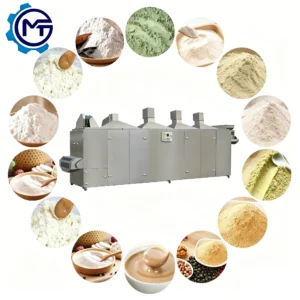
Full Automatic Complete Baby Food Nutrition Powder Porridge Processing Production Line for Infant Nutrition Factory
¥9,500.00 Add to cart -
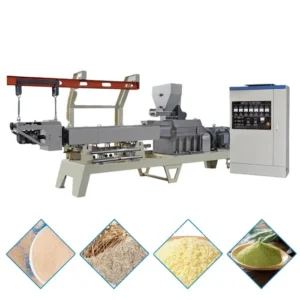
Industrial Instant Corn Paste Production Line Nutritional Powder Processing Equipment Meal Replacement Nutrition Powder Machine
¥65.00 Select options This product has multiple variants. The options may be chosen on the product page -
Commercial Stainless Steel Baby Rice Powder Grinding Mixing Machine
¥8,238.27 Select options This product has multiple variants. The options may be chosen on the product page