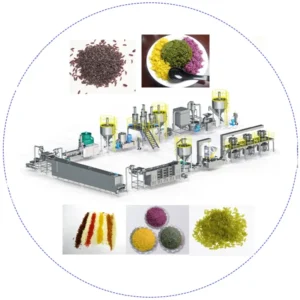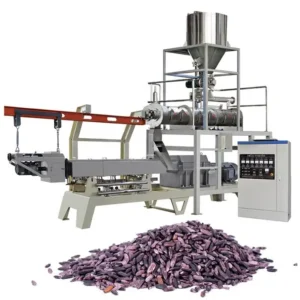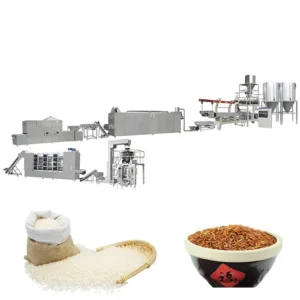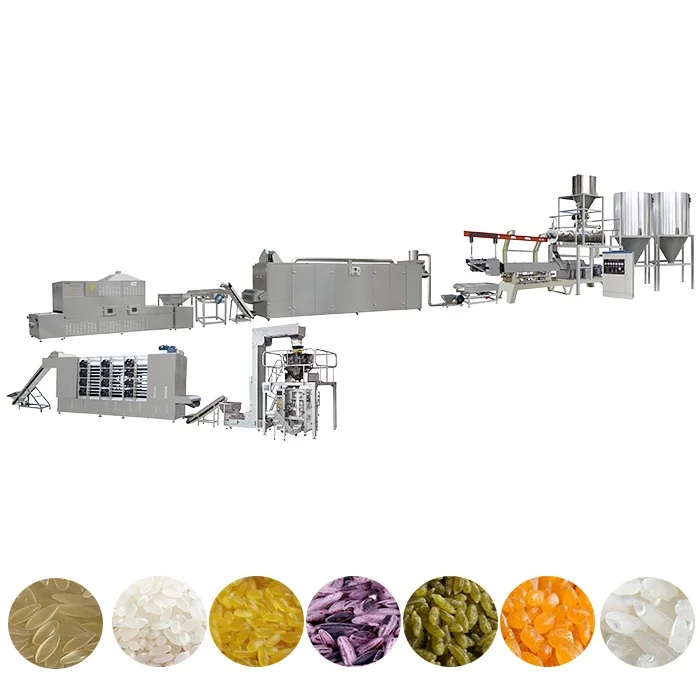


MT65 / MT70 / MT85 Nutritional Rice Processing Line, Twin-Screw, PLC & MCC Control — designed for fortified and artificial rice production from rice, millet, buckwheat and similar grains.
- Complete turnkey line from mixing through extrusion and shaping, with throughput matched across every station
- Screw configuration and die design specified to your grain blend and target rice density, with interchangeable moulds for multiple formats
As a turnkey project supplier, we deliver the full line layout, utility planning and on-site commissioning so capacity is balanced end-to-end before your first production run.
Description
Throughput-Matched Line Design — Every station from batching through shaping is balanced to your actual grain formulation, eliminating the bottlenecks that plague lines assembled from separate vendors.
Technical Specifications
| Parameter | Value |
|---|---|
| Product Type | Nutritional Artificial Rice Processing Line |
| Model | MT65 / MT70 / MT85 |
| Extruder Type | Twin-screw |
| Power Consumption | MT65 — 60 kW; MT70 — 85 kW; MT85 — 165 kW |
| Output Capacity | MT65 — 70–100 kg/h (basis not stated in source); MT70 — 100–120 kg/h (basis not stated in source); MT85 — 200–300 kg/h (basis not stated in source) |
| Overall Dimensions (L×W×H) | MT65 — 28000×1200×2200 mm; MT70 — 30000×1500×2200 mm; MT85 — 34000×3500×4300 mm |
| Control System | PLC and MCC |
| Line Stations | Mixing → Screw Conveying → Extrusion → Shaping |
| Mixer Motor | 4.0 kW |
| Mixer Batch Output | 3.0–4.0 kg/time |
| Mixer Dimensions | 1.2×0.9×1.4 m |
| Screw Conveyor Motor | 1.1 kW |
| Screw Conveyor Throughput | 0–150 kg/h |
| Screw Conveyor Dimensions | 2.5×0.6×2.3 m |
| Die Configuration | Interchangeable moulds for multiple rice shapes |
| Raw Materials | Rice, millet, black rice, buckwheat, fortified with vitamins, protein and minerals |
| Certification | CE |
| Assembly State | Complete line from batching through shaping |
Application Suitability
| Application | Material or Output |
|---|---|
| Fortified nutritional rice production | Rice and millet base with added vitamins, protein and minerals |
| Golden rice and artificial rice | Rice flour blended with beta-carotene and micronutrient premix |
| Buckwheat and multigrain rice | Buckwheat, black rice and mixed coarse grain formulations |
| Purple potato and specialty rice | Purple potato starch blended with grain flour |
| Instant and quick-cook rice | Pre-gelatinised starch base for fast-food enterprises |
What "Rated Capacity" Actually Means for a Nutritional Rice Processing Line Turnkey
Capacity numbers only matter when tied to your specific grain blend and moisture content.
Many producers discover too late that a line quoted at a nominal output cannot sustain that rate on their actual formulation. High-protein or high-fibre grain blends behave differently inside the barrel than the standard rice flour used for benchmark trials. The screw configuration, barrel temperature profile and die geometry all shift when the feedstock changes, and a nutritional rice processing line turnkey that was never tested on your real material will spend weeks in commissioning chasing the right texture and density [NEED_CITE: raw material variability in twin-screw extrusion]. I watched this play out on a nutritional powder project in Mexico where the client’s feedstock ran considerably higher in protein than our trial material — the barrel profile was wrong, product clumped, and the extruder bottlenecked the entire line for two weeks.
Balancing Every Station Around Your Grain Formulation
A nutritional rice processing line turnkey succeeds or fails on whether throughput is matched across every station. The mixer must deliver batches at a rate that keeps the screw conveyor and extruder fed without flooding either. On the MT series, the mixer produces 3.0–4.0 kg per batch and the screw conveyor handles up to 150 kg/h, both sized to match the extruder’s intake window. When one station runs faster or slower than the rest, you get either starvation or surge — both of which destroy product consistency and waste raw material.
Screw Configuration and Die Design Specified to Your Target Rice Shape
The twin-screw extruder at the heart of this line does not use a generic screw profile. The screw elements are arranged and the die geometry selected based on your raw material composition and the rice kernel shape you need. Interchangeable moulds allow production of standard fortified rice, elongated basmati-style grains, or rounded short-grain formats on the same extruder platform. Barrel temperature zones are profiled to manage starch gelatinisation and expansion so that each kernel holds its shape through drying and cooking [NEED_CITE: starch gelatinisation behaviour in multi-grain extrusion].
Reading the Power and Dimension Specs for Real Installation Planning
The step from the MT65 at 60 kW to the MT85 at 165 kW reflects not just motor size but the thermal and mechanical energy required to gelatinise denser, higher-fibre grain blends at greater throughput. The MT85 footprint at 34000×3500×4300 mm demands considerably more floor space and ceiling height than the MT65 at 28000×1200×2200 mm, which affects utility routing and building preparation. PLC and MCC control gives operators repeatable process parameters — barrel zone temperatures, screw speed and feed rate — so that batch-to-batch variation stays within specification regardless of shift changes or operator experience level.
The Cost of Skipping a Pre-Shipment Trial Run
When an extruder arrives without having run your actual grain blend, the commissioning phase becomes an expensive product development exercise. Barrel profiles are adjusted blindly, dies are swapped repeatedly, and the shaping station sits idle while the extruder catches up. Weeks of lost production and off-spec output pile up before the line stabilises [NEED_CITE: commissioning delays from untested raw material in food extrusion lines]. The financial impact extends beyond downtime — inconsistent rice density and shape in early production runs can damage brand credibility with retail and institutional buyers who expect uniform product from day one.
Why Source the Complete Line from One Supplier
A single supplier responsible for every station from mixing to shaping means throughput is calculated end-to-end rather than assembled from mismatched vendor quotes. Screw configuration and die design are specified against your raw material, not copied from a generic build. An in-house testing workshop allows trial runs on your actual grain blend before the line ships, so product development happens on our floor, not yours. The PLC and MCC control architecture is integrated across all stations, avoiding the communication gaps that arise when control systems are sourced separately. Pre-sales engineering covers line layout, utility planning and phased installation scheduling, with on-site commissioning and operator training included in the project scope.
Documentation & Verification
- Line layout and capacity calculation showing throughput balance across mixer, extruder and shaping stations
- Screw and die configuration record matched to your grain blend and target rice shape
- Trial run report on your raw material performed in the testing workshop before dispatch
- Electrical schematic with voltage, frequency and control language confirmed for your market
- CE declaration of conformity covering the complete line assembly
- Operation and maintenance manual with wear parts list specific to your configuration
Installation, Commissioning & Support
- Floor plan review against the MT85 footprint of 34000×3500×4300 mm to confirm building clearance and utility routing
- Dedicated electrical circuit sized for the selected model’s power consumption, from 60 kW to 165 kW
- Assembly and alignment of all stations from mixing through shaping on prepared foundations
- Barrel temperature profiling and screw speed calibration using your grain formulation during commissioning
- Operator training on PLC and MCC interface covering recipe management and fault response
- Wear parts list covering screws, dies and mixer blades with recommended replacement intervals
Preparing Your Line Specification
To size the right model and configure the line accurately, share your primary grain materials and any fortification premix ratios, along with your target daily output and preferred rice kernel shape. Include your facility’s voltage and frequency standard, available floor space and ceiling height, and whether you need the control interface in a specific language. If you have existing upstream or downstream equipment such as dryers or packaging systems, let us know so we can match interface points. We also recommend sending a sample of your raw material for a trial run in the testing workshop before we finalise the screw and die configuration.
Frequently Asked Questions
Q: How is the line’s output capacity verified against my specific grain formulation?
A: We run your actual raw material in the in-house testing workshop before shipment. The trial records throughput, barrel temperature profile and product density, so the capacity figure you receive reflects your grain blend and moisture level rather than a generic benchmark.
Q: How is throughput balanced between the mixer, extruder and shaping stations?
A: Each station is sized during the line configuration phase so that the mixer batch rate, screw conveyor feed rate and extruder intake are synchronised. This prevents starvation or surge, both of which cause density and shape variation in the finished rice kernels.
Q: What voltage, frequency and control language are confirmed before production?
A: During the specification stage we collect your facility’s electrical standard and preferred operator language. The electrical schematic and PLC interface are configured accordingly, so the line powers up correctly on arrival without requiring on-site rewiring or software changes.
Q: Can a trial run be performed on my raw material before shipment?
A: Yes. We require a sample of your grain blend and fortification premix for a trial in our testing workshop. The resulting report documents screw configuration, die selection and process parameters, giving you confidence that the line will produce on-spec rice from the first day of commissioning.
Q: What installation and operator training are included?
A: On-site installation covers station placement, utility connection and mechanical alignment. Commissioning includes barrel profiling and die tuning on your material. Operator training covers the PLC and MCC interface, recipe storage, routine maintenance and wear part replacement procedures.
Related products
-

High Precision Automatic 500kg/h Baby Food Nutrition Powder Rice Extrusion Processing Line
¥8,238.27 Add to cart -

Fully Automatic 500kg/h Baby Cereal Nutrition Powder Extrusion Drying Line with PLC Control
¥9,500.00 Add to cart -

Automatic Instant Powder Production Line Nutritional Powder Extruder Machine
¥10,000.00 Select options This product has multiple variants. The options may be chosen on the product page -

Hygienic Stainless Steel Infant Rice Powder Processing Line Automatic 500kg/h Capacity PLC Controlled
¥9,500.00 Add to cart