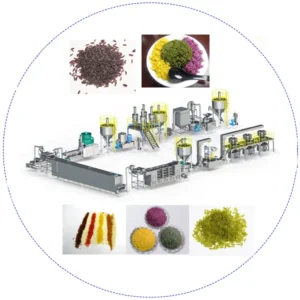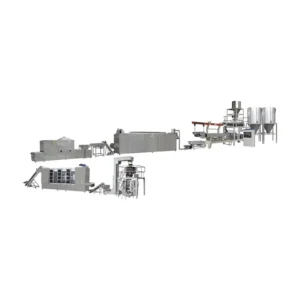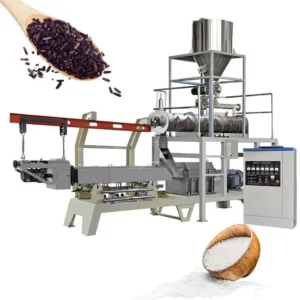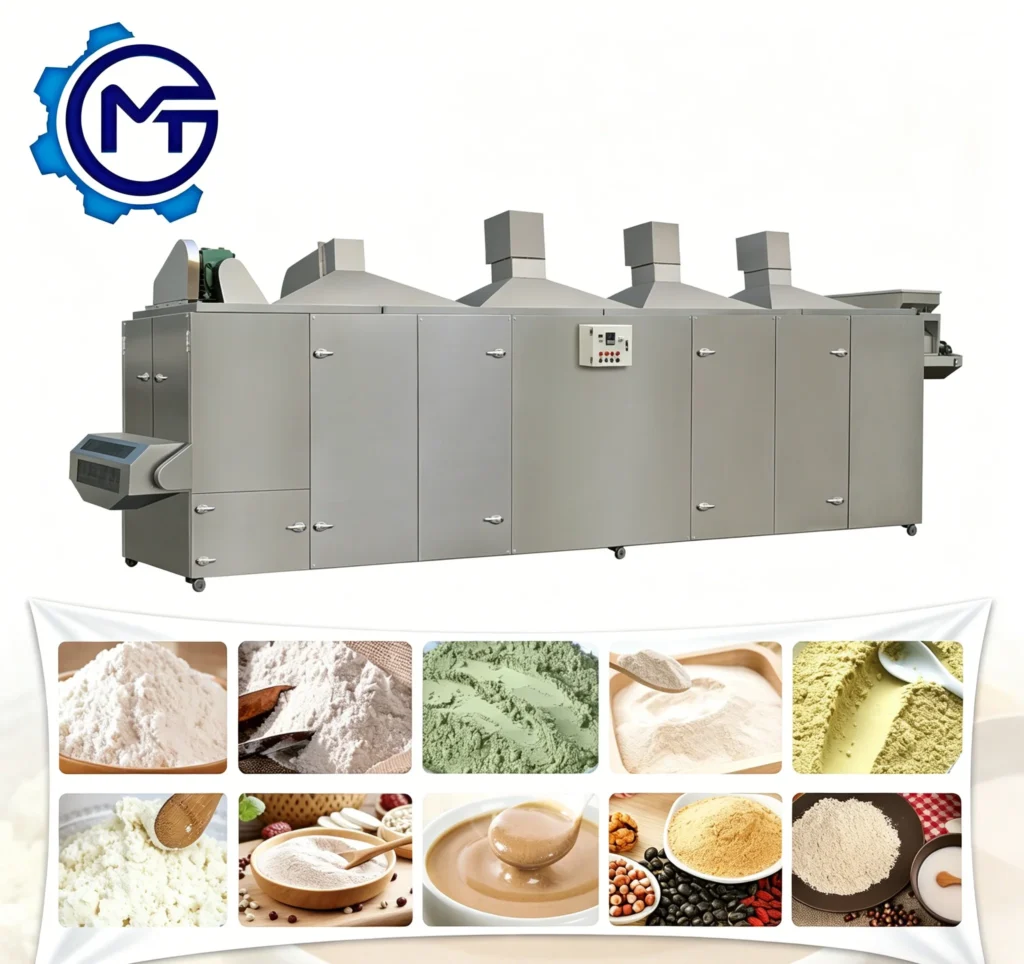


Baby Food Nutrition Powder Extrusion Processing Line, 200-500 kg/h, Food-Grade 304 SS — engineered as a complete turnkey project where every station from mixing through extrusion, drying, milling, and packing is throughput-matched to eliminate bottlenecks. Twin-screw configuration, die geometry, and barrel temperature profile are specified to your grain formulation, ensuring consistent gelatinisation, particle size, and powder density across diverse recipes.
- Full line integration under one supplier with station-to-station capacity balance verified before shipment
- Trial runs on your actual raw material in our testing workshop validate real-world output prior to delivery
- Electrical schematics, voltage, and control language confirmed to your target market before production
Description
Turnkey Integration — Every station from batching to packing is throughput-matched under one supplier, eliminating the bottleneck gaps that plague multi-vendor nutritional powder lines.
Technical Specifications
| Parameter | Value |
|---|---|
| Product Type | Baby Food Nutrition Powder Extrusion Processing Line |
| Output Capacity | 200–500 kg/h (basis not stated in source — confirm raw material / moisture / formulation) |
| Construction Material | Food-Grade 304 Stainless Steel (all product contact surfaces) |
| Heat Source Options | Electric / Gas / Steam (configurable to site utilities) |
| Control System | Touch Control Panel with Digital System |
| Automation Level | Full Automatic |
| Line Stations | Baking Ovens, Mixers (full station breakdown to be confirmed per line layout) |
| Screw Type | To be confirmed (single or twin screw based on formulation) |
| Voltage & Frequency | To be confirmed per target market |
| Overall Dimensions | To be confirmed per line configuration |
| Warranty | 1 Year |
| After-Sales Service | Overseas Engineer Service Available |
Application Suitability
| Application | Material or Output |
|---|---|
| Infant nutrition powder production | Rice flour, corn, beans blended with whey protein, vitamins, iron-zinc micronutrients |
| Fortified nutritional porridge processing | Multi-grain formulations including millet, sorghum, soy, and maize |
| Grain-based food powder manufacturing | Rice, corn, oats, and various cereal grains milled to target particle size |
| Institutional feeding programme supply | Standardised caloric and micronutrient density per batch specification |
What "Rated Capacity" Leaves Out About Nutritional Powder Lines
A nameplate figure means nothing until your actual formulation runs through the screws.
I spent two weeks on a factory floor in West Africa watching a baby food nutrition powder extrusion production line turnkey stall on its first day. The line was quoted at a comfortable output figure, but the customer’s recipe included whey protein isolate and iron-zinc premix blended into a rice base. The moment those proteins hit the barrel, gelatinisation temperature shifted, the powder clumped going into the dryer, and the sieves blocked within the hour [NEED_CITE: gelatinisation behaviour of protein-fortified grain blends under twin-screw shear]. Capacity numbers generated on plain corn grits do not survive contact with a real nutritional formulation. That is why trial runs on the buyer’s actual raw material, moisture content, and micronutrient premix are the only honest way to validate throughput before the crate leaves the factory.
Throughput Matching Across Every Station
A baby food nutrition powder extrusion production line turnkey is only as reliable as its weakest handoff point. The mixer must feed the extruder at a rate the screws can absorb without surging; the extruder must discharge at a moisture level the dryer can handle within its residence time; the dryer must deliver to the mill at a hardness the cutting faces can fracture to the target particle size. When each station is sourced from a different vendor, those handoffs become the buyer’s problem to solve on-site.
Engineering the complete line under one project scope means the batching system, extruder barrel volume, oven belt length, and packing head speed are all calculated against the same material balance sheet. The result is a continuous run where no single station forces the others into start-stop cycling, which is the primary cause of density variation in nutritional powder batches.
Controlling Density and Particle Size in Fortified Blends
The market expectation for infant porridge powder is a specific bulk density that fills a sachet by volume while delivering a guaranteed caloric and micronutrient count by weight [NEED_CITE: bulk density specifications for sachet-packed infant cereal products]. If extrusion shear is too aggressive, starch breaks down past the desired dextrinisation point and the powder packs too densely; if shear is too low, particles fracture unevenly at the mill and the fine fraction carries a disproportionate share of the added micronutrients.
Barrel temperature profiling across multiple heating zones, matched to the screw element sequence, gives operators the adjustment range to hold that density window. The digital touch control panel stores recipe parameters so that a Monday morning start-up reproduces the same barrel profile and screw speed as a validated Friday afternoon run, which matters when production audits require batch-to-batch traceability.
Reading the Specification Sheet for a Powder Line
Output capacity of 200–500 kg/h is stated without a raw material basis, which means the real figure depends entirely on your grain type, moisture addition rate, and protein-fat ratio. In food extrusion, a formulation with high fat content lubricates the screws and can reduce effective throughput, while a lean starch-heavy blend may sustain the upper range.
The food-grade 304 stainless steel construction across all contact surfaces is non-negotiable for infant food applications, where regulatory bodies require corrosion-resistant materials that withstand caustic wash-down cycles [NEED_CITE: food contact material requirements for infant food processing equipment]. Flexible heat source options — electric, gas, or steam — let the line adapt to local utility cost structures; steam heating, for instance, may be preferable where a factory already operates a boiler for other process lines. The touch control panel with digital system allows operators to lock in validated temperature and speed profiles, reducing the variability that leads to off-spec batches during shift handovers.
The Hidden Cost of Underspecifying the Dryer
When the dryer capacity is sized to the extruder’s nameplate output rather than its actual discharge moisture on a fortified formulation, the belt either runs too fast — leaving the powder above the safe moisture threshold for storage — or operators throttle the extruder back, leaving paid-for capacity unused. I have seen lines in South Asia where the dryer was the correct physical size but lacked sufficient airflow volume for a high-protein baby food blend, forcing the factory to run double-pass drying and halving their effective output. These mismatches rarely surface in quotation documents because each station is technically "rated" for the line capacity when considered in isolation [NEED_CITE: drying curve differences between plain starch and protein-fortified extrudates].
Why Source the Complete Line Here
Full line integration from batching through packing under a single supplier means throughput calculations are performed against one material balance, not reconciled across three or four vendor proposals after installation.
Screw and die geometry are specified to the buyer’s grain formulation and target powder density rather than copied from a generic build, so the extrusion stage produces the correct particle fracture characteristics from day one.
An in-house testing workshop runs the buyer’s actual raw material — including protein, fat, and micronutrient premix — before shipment, generating a trial report that validates capacity, density, and sieving behaviour under real conditions.
Pre-sales engineering covers line layout and utility planning, followed by on-site installation, commissioning, and operator training that brings local crews to independent operation before the engineer departs.
Ongoing maintenance support includes a documented wear parts list with screw and die replacement intervals, so the first scheduled changeover does not become an emergency sourcing exercise.
Documentation & Verification
- Line layout and capacity calculation showing throughput at each station for your grain formulation
- Trial run report on your raw material with protein, fat, and micronutrient premix before dispatch
- Screw and die configuration record matched to your target powder density and particle size
- Electrical schematic with voltage and frequency confirmed for your destination market
- CE declaration of conformity and ISO certificate applicable to the supplied line
- Operation and maintenance manual with wear parts replacement schedule
Installation, Commissioning & Support
- Foundation and floor space planning based on confirmed line layout dimensions for your configuration
- Dedicated electrical circuit sizing per confirmed voltage, frequency, and total connected load
- Modular station delivery allowing phased installation to match factory construction readiness
- First-run commissioning on your grain formulation with barrel temperature and screw speed profiling
- Operator training covering recipe recall on the digital touch control panel and daily cleaning protocols
- Wear parts inventory recommendation covering screws, dies, and oven belt segments for first-year operation
Preparing Your Inquiry
To scope a baby food nutrition powder extrusion production line turnkey accurately, share your base grain type and any protein, fat, or micronutrient additions along with target moisture at packing. Specify the voltage and frequency at your facility, the control language your operators require, and whether steam, gas, or electric heating suits your utility infrastructure. If you have existing upstream milling or downstream packing equipment, note the interface points so the line layout can integrate without redundant transfer stations.
Frequently Asked Questions
Q: How is line capacity verified against my specific grain formulation and moisture content?
A: We conduct a trial run in our testing workshop using your actual raw material, including any protein isolates, fat sources, and micronutrient premix. The trial report documents throughput, extrudate density, and sieving behaviour under your formulation, giving you a validated capacity figure rather than a generic nameplate estimate.
Q: What is the phased installation and commissioning schedule for a complete line?
A: Installation follows a modular sequence — foundation work and utility rough-in first, then station placement from mixer through packer. Commissioning begins with individual station dry runs, proceeds to wet runs on your formulation, and concludes with continuous production trials. Your project schedule is confirmed before shipment based on factory readiness.
Q: How do you ensure throughput matching between the extruder, dryer, and downstream stations?
A: Every station is calculated against a single material balance sheet derived from your raw material data. The extruder discharge moisture, dryer residence time and airflow, and mill feed rate are all cross-referenced so that no station forces another into intermittent operation or throttled output.
Q: Can the line accommodate voltage, frequency, and control language requirements for my country?
A: Voltage and frequency are confirmed during the quotation stage and built into the electrical schematic before production. The touch control panel supports configurable interface language, and all documentation — including the operation manual and electrical drawings — is delivered in your specified language.
Q: What operator training is included, and how are wear parts supported?
A: On-site training covers daily start-up, recipe recall, cleaning procedures, and first-level troubleshooting on the digital control system. A wear parts list with screw, die, and belt replacement intervals is supplied at handover, and replacement components remain available for ongoing production support.
Related products
-
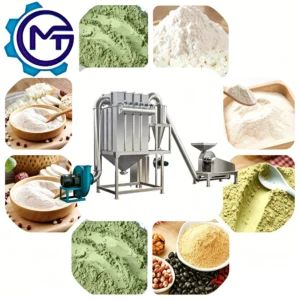
Automatic Iron Fortified Baby Rice Cereal Nutrition Powder Making Machine 500kg/h PLC Controlled
¥8,238.27 Add to cart -
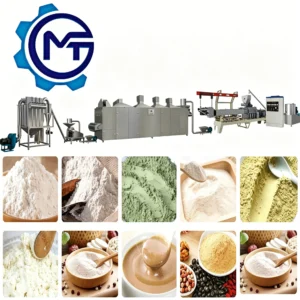
Organic Gluten Free Baby Rice Nutrition Powder Automatic 500kg/h Production Processing Line
¥8,238.27 Add to cart -

New Automatic Nutritional Powder Making Machine for Baby Food Production Line
¥20.00 Select options This product has multiple variants. The options may be chosen on the product page -
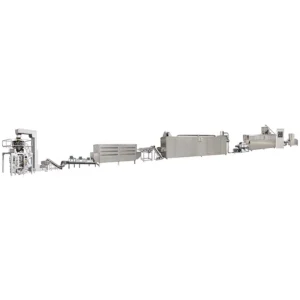
High Productivity New Condition Nutritious Baby Food Meal Replacement Powder Production Line
¥30.00 Select options This product has multiple variants. The options may be chosen on the product page