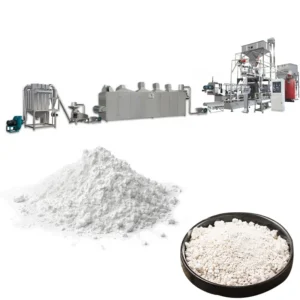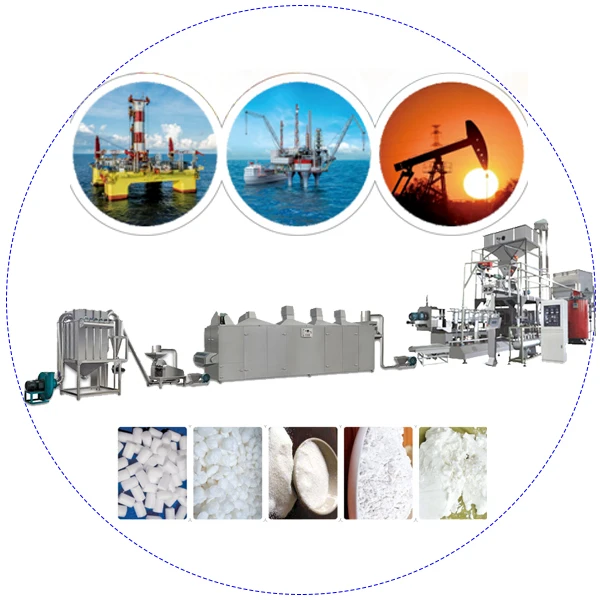
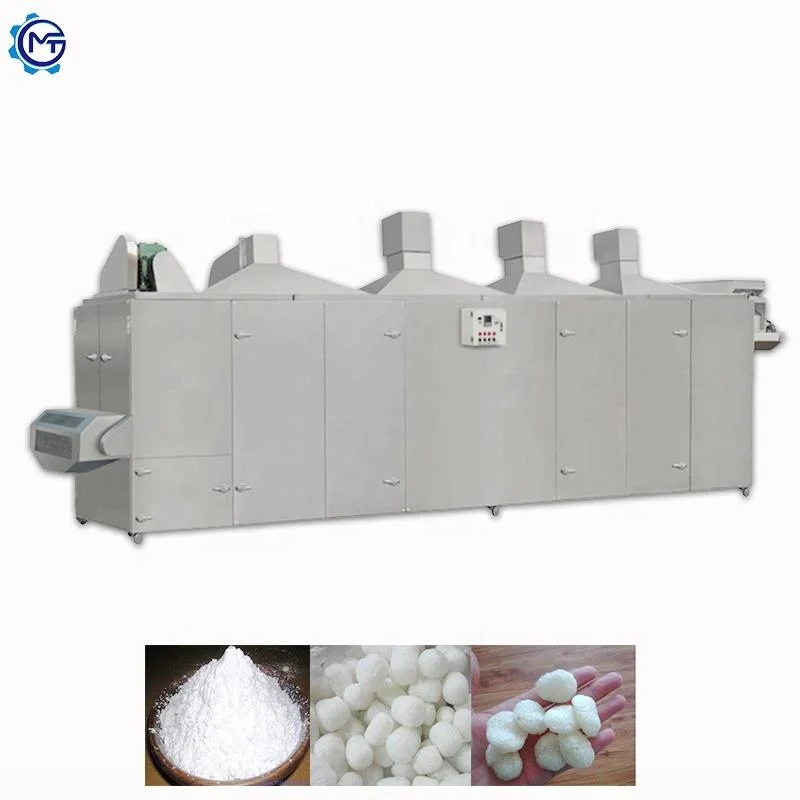
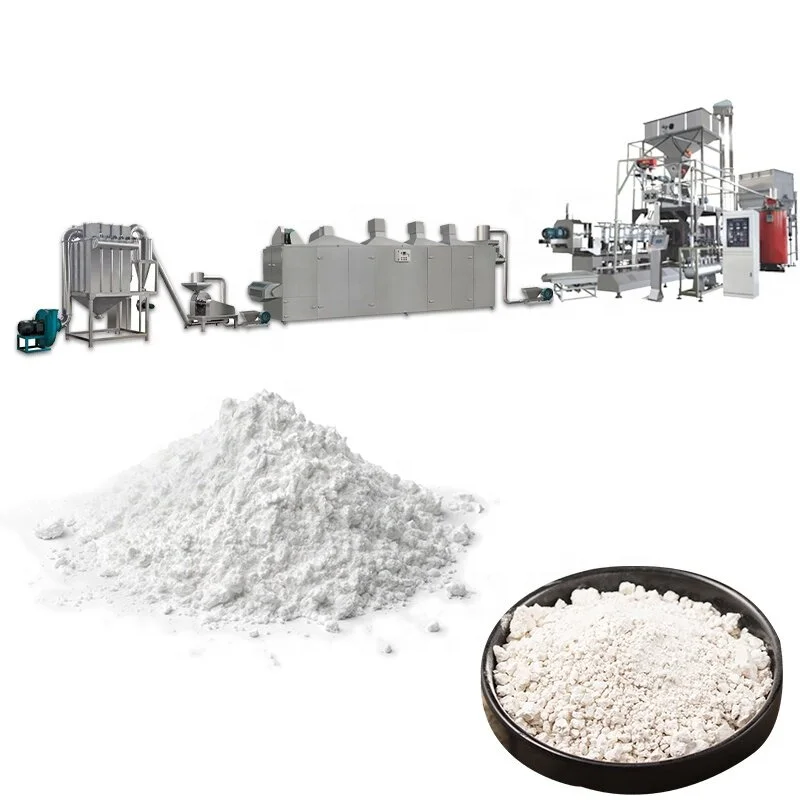


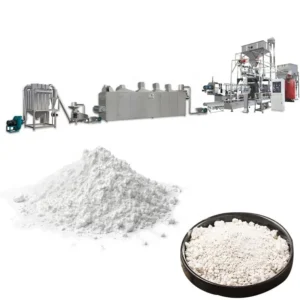
Modified Starch Processing Line, Twin-Screw Extruder, 304 Stainless Steel Contact Parts, CE Certified — engineered for gelatinisation and denaturation of corn, cassava, potato and wheat starch feedstock.
- Screw configuration and die geometry specified to your raw material and target degree of modification, with barrel temperature profile matched to starch behaviour under shear and moisture.
- Energy source selectable across electricity, gas, diesel or steam to align with site utilities.
Layout, throughput calculation and trial run on your starch sample completed in our testing workshop before shipment.
Description
Integrated Throughput Matching — Every station from mixing through grinding is specified as a single project, so the extruder, dryer, and conditioner run at the same actual throughput on your starch feedstock.
Technical Specifications
| Parameter | Value |
|---|---|
| Product Type | Modified Starch Processing Line |
| Raw Materials | Wheat flour, corn starch, potato starch, cassava starch |
| Output Capacity | 80-500 kg/h (basis not stated in source — confirm raw material type, moisture content, and target degree of gelatinisation) |
| Extruder Type | Twin-screw extruder |
| Frame Material | Stainless steel 201 |
| Contact Material | Food grade stainless steel 304 |
| Voltage & Frequency | Three phase 380V/50Hz, Single phase 220V/50Hz (customisable to local voltage) |
| Total Installed Power (electrical heating) | Approx. 100 kW |
| Total Installed Power (gas/diesel heating) | Approx. 50-60 kW |
| Energy Options | Electricity, gas, diesel, steam |
| Motor & Inverter | Siemens (China) or equivalent; Delixi or Delta inverter |
| Mixer Motor | 4.0 kW |
| Mixer Batch Size | 3.0-4.0 kg/time (source value — verify against manufacturer catalog) |
| Screw Conveyor Motor | 1.1 kW |
| Screw Conveyor Output | 0-150 kg/h (basis not stated in source — confirm material bulk density) |
| Process Flow | Mixer → Screw Conveyor → Twin-screw Extruder → Air Conveyor → Dryer → Air Conveyor → Conditioning → Conveyor → Grinder |
| Assembly State | Complete line, modular stations |
| Standards | CE |
Application Suitability
| Application | Material or Output |
|---|---|
| Modified and pregelatinised starch production | Corn, cassava, potato, and wheat feedstock |
| Starch gelatinisation and denaturation | Food processing raw materials requiring specific viscosity profiles |
| Industrial-grade modified starch | Paper manufacturing and textile sizing applications |
| Starch paste expansion | Viscosity modification under controlled temperature and pressure |
What a Nominal Capacity Rating Leaves Out on Starch Lines
A rated output figure means nothing until you test the extruder on the exact starch variety and moisture level you will run in production.
Buyers comparing proposals often see a modified starch processing line turnkey rated at the upper end of a range, then discover after installation that the actual throughput on their raw material falls short. The twin-screw extrusion process behaves differently on cassava starch versus corn starch — the gelatinisation temperature, melt viscosity, and shear response all change. A line configured on one feedstock and shipped without a trial run on the buyer’s actual material frequently requires days of screw and die adjustment on site [NEED_CITE: variability of starch gelatinisation behaviour across botanical sources]. The dryer and grinder may be sized for a throughput the extruder cannot sustain on that particular material, turning one station into a bottleneck that holds back the entire line.
Screw and Die Configuration Matched to Gelatinisation Target
Starch modification depends on precise control of shear, temperature, and residence time inside the barrel. The screw element sequence — conveying, kneading, and reverse elements — determines how thoroughly the starch granules break down and gelatinise. A modified starch processing line turnkey configured with a generic screw build may produce incomplete gelatinisation on potato starch while over-shearing corn starch, leading to inconsistent viscosity batch after batch. The die geometry controls expansion ratio and moisture flash-off at the exit, directly shaping the density and grindability of the extrudate entering the dryer.
Energy Source Selection and Its Impact on Drying Uniformity
The dryer station can run on electricity, gas, diesel, or steam depending on site utility availability. Each energy source affects temperature ramp-up speed and zone uniformity differently. For pregelatinised starch destined for food-grade applications, consistent drying temperature across the belt width prevents patches of under-dried material that later cause lumping during storage. Steam heating offers stable zone temperatures where a boiler is already available, while gas-fired systems suit sites with existing gas infrastructure [NEED_CITE: industrial drying energy source selection criteria for food ingredient lines]. Selecting the right option at the proposal stage avoids costly utility retrofits after the line arrives.
How Motor Sizing and Inverter Selection Shape Process Control
The 4.0 kW mixer motor handles batch blending of starch with water and minor additives before the screw conveyor feeds the extruder. On the extruder main drive, a Siemens-class motor paired with a Delixi or Delta inverter allows screw speed adjustment across the full operating range. Inverter-controlled screw speed is critical because different starch types demand different shear rates — cassava starch typically requires lower shear to avoid excessive viscosity build-up inside the barrel, while wheat flour may need higher shear to achieve the target degree of modification. The screw conveyor motor at 1.1 kW feeds material at a rate matched to extruder intake capacity, preventing surge or starvation conditions that destabilise extrusion pressure.
The Cost of Skipping a Pre-Shipment Trial Run
A line assembled from separate vendors, each quoting their station in isolation, often arrives with mismatched capacities. The extruder runs at one rate, the dryer at another, and the grinder chokes on feed surges. I once saw a cassava starch line where the extruder performed well during a corn starch trial at the factory, but the buyer’s actual cassava feedstock pushed melt viscosity high enough to stall the screws within the first hour of commissioning. The crew spent two full days disassembling, cleaning, and reconfiguring before the line ran at all [NEED_CITE: starch extrusion processing challenges with high-amylopectin feedstocks]. That kind of delay at the buyer’s facility costs production time and erodes confidence in the equipment supplier before the first saleable batch is produced.
Why Sourcing the Full Line from One Supplier Matters Here
When every station from the mixer through the grinder is specified under one modified starch processing line turnkey project, throughput is balanced across the entire chain. The screw configuration and die design are selected against your specific raw material and target modification degree rather than copied from a standard template. The in-house testing workshop runs your actual starch feedstock before dispatch, so screw speed, barrel temperature profile, and die geometry are documented and locked in before crating. Electrical schematics are confirmed against your site voltage and frequency before production begins, eliminating commissioning delays caused by mismatched power supply. Food-grade stainless steel 304 contact materials throughout the product zone meet hygiene requirements for food-ingredient-grade starch output.
Documentation & Verification
- Line layout showing throughput balance across mixer, extruder, dryer, and grinder stations
- Screw and die configuration record matched to your starch type and gelatinisation target
- Trial run report on your raw material from the in-house testing workshop before shipment
- Electrical schematic with confirmed voltage and frequency for your local grid standard
- CE declaration of conformity and ISO certificate for the complete line
Installation, Commissioning & Support
- Foundation plan and utility routing matched to the full process flow from mixer to grinder
- Three phase 380V/50Hz or confirmed local voltage with dedicated circuit for the approx. 100 kW electrical heating load
- Modular station delivery with reassembly sequence documented for the extruder, dryer, and conditioning units
- First-run parameter setting including barrel temperature zones, screw speed, and dryer belt speed
- Operator training on screw element changeover and die swap procedures for different starch varieties
- Wear parts list covering screw elements, dies, and conveyor flighting with recommended stock quantities
What to Prepare Before Requesting a Proposal
To size a modified starch processing line turnkey correctly, share your starch source and whether you are running corn, cassava, potato, or wheat feedstock along with typical moisture content. Confirm your target output in kg per hour and whether the end product is food-grade or industrial-grade. Specify your site voltage, frequency, and available energy sources such as steam boiler or gas supply. If you can send a raw material sample for a trial run in the testing workshop, that sample will determine the screw build, die selection, and dryer sizing before the quotation is finalised.
Frequently Asked Questions
Q: How is the 80-500 kg/h output range confirmed for my starch type?
A: The stated range depends on the specific starch variety, incoming moisture content, and target degree of gelatinisation. A trial run using your actual raw material in the testing workshop establishes the achievable throughput on your feedstock. The quotation then reflects a capacity figure with documented test conditions rather than a generic rating.
Q: How is screw configuration chosen for different starch sources?
A: Each starch type — corn, cassava, potato, wheat — has distinct gelatinisation temperature, amylose content, and shear sensitivity. The screw element sequence and die geometry are specified to your raw material and target modification degree. This configuration is tested during the pre-shipment trial and recorded for future reference and reordering.
Q: What happens if my site voltage differs from 380V/50Hz?
A: The electrical system is configurable to your local voltage and frequency. The exact specification is confirmed and documented on the electrical schematic before production starts. This prevents motor rewinding or transformer installation delays during on-site commissioning.
Q: How are the dryer and grinder sized relative to the extruder?
A: Both stations are specified within the same project based on extruder discharge rate and moisture content of the extrudate. This ensures the dryer belt speed and grinder feed rate match the actual output rather than operating as independently sourced units that bottleneck each other.
Related products
-
Cassava & Pregelatinized Corn Starch Extrusion Equipment – CE Certified Industrial Twin-Screw Modified Starch Line
¥65.00 Select options This product has multiple variants. The options may be chosen on the product page -
Modified and Pregelatinized Starch Processing Equipment – Pregelatinized Corn Cassava Modified Starch Puffing Machine
¥65.00 Select options This product has multiple variants. The options may be chosen on the product page -
Automatic Industrial Adhesive Starch Modification Production Line – Pre-Gelatinization Extrusion Equipment
¥65.00 Select options This product has multiple variants. The options may be chosen on the product page -
Modified Starch for Construction Adhesives Production – Custom Built Double Screw Extruder Line
¥65.00 Select options This product has multiple variants. The options may be chosen on the product page