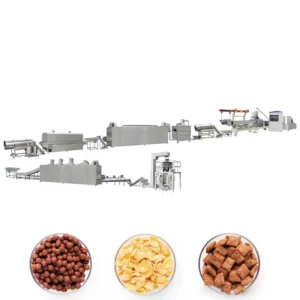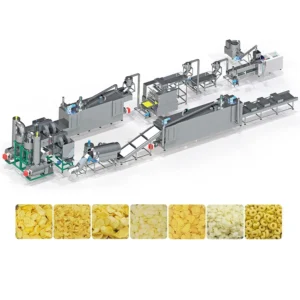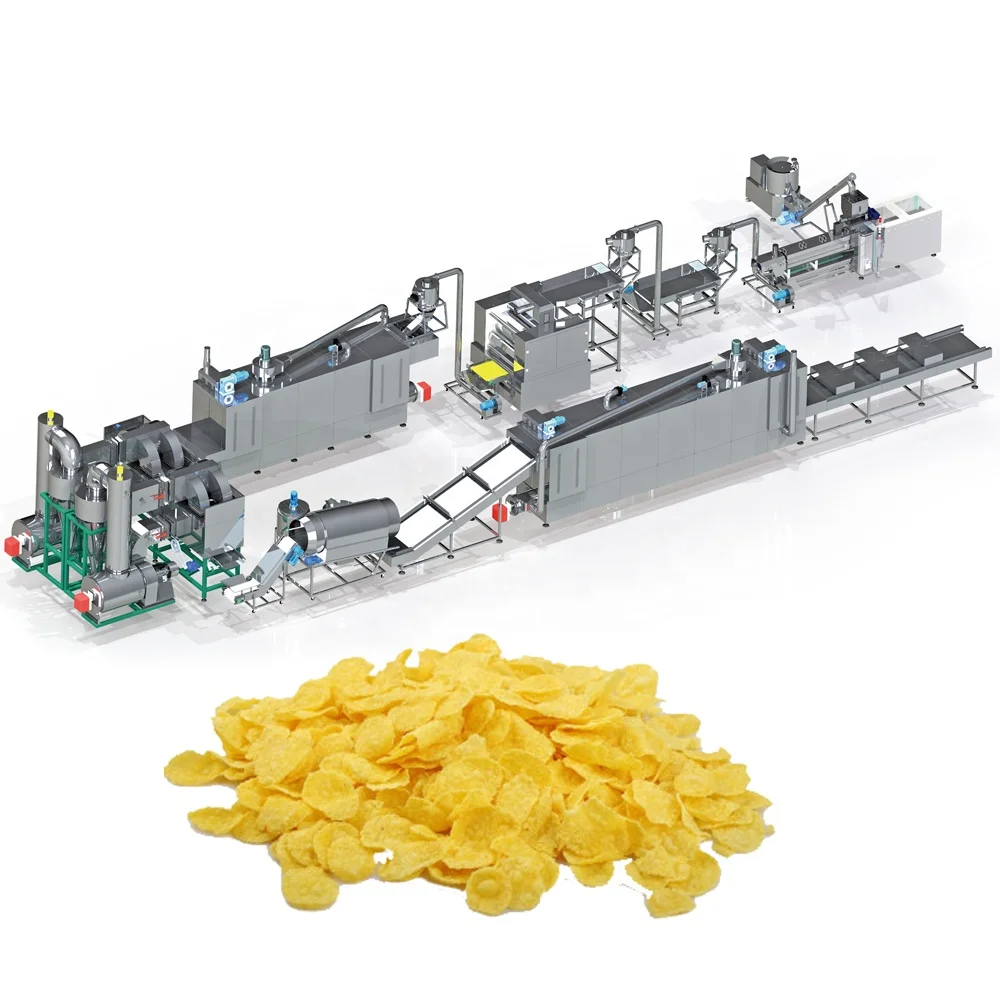


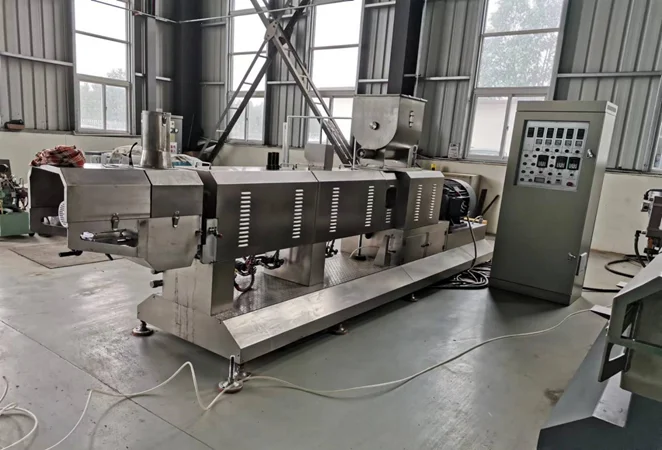


MT70 / MT85 / MT75 Corn Flakes Processing Line, Twin Screw Extruder, PLC Control, 380V/220V — engineered as a complete turnkey project from mixing through flaking, drying, roasting, coating to packing.
- Screw configuration and die design matched to your corn, rice, or oat formulation for target flake density and expansion
- Hydraulic double-roller flaking with infrared temperature control ensures consistent flake thickness
- Hot air roasting oven with dual circulating fans and cyclone dust removal delivers precise, sanitary heat treatment
- Capacity ranges from 150–500 kg/hr (basis not stated — verify raw material, moisture content, and flake thickness)
Backed by in-house trial runs on your raw material before shipment, throughput-matched station design to eliminate bottlenecks, and full documentation including layout, electrical schematics, and wear parts lists.
Description
Throughput Matched Across Stations — Every unit from the batching system to the packing conveyor is calculated against your specific corn or oat formulation so no single machine becomes the bottleneck holding back the rest of the line.
Technical Specifications
| Parameter | Value |
|---|---|
| Product Type | Corn Flakes Processing Line |
| Installed Power | 160 kW (MT70) / 190 kW (MT85) / 210 kW (MT75) |
| Power Consumption | 120 kW (MT70) / 140 kW (MT85) / 150 kW (MT75) |
| Capacity Range | 150-200 kg/h (MT70) / 300-400 kg/h (MT85) / 300-500 kg/h (MT75) (basis not stated in source — confirm raw material, moisture content, and flake thickness) |
| Voltage | 380V / 220V |
| Extruder Type | Twin Screw |
| Control System | PLC |
| Overall Dimensions (L×W×H) | 41×1.5×2.2 m (MT70) / 43×1.5×3.2 m (MT85) / 45×1.5×3.5 m (MT75) |
| Net Weight | 5000 kg |
| Material | Stainless Steel |
| Assembly State | Complete Line |
| Standards | CE, ISO |
Application Suitability
| Application | Material or Output |
|---|---|
| Natural Corn Flakes | Corn powder, rice powder, oat powder, barley powder |
| Sugar-Coated Corn Flakes | Extruded flakes with sugar or syrup coating |
| Breakfast Cereal Shapes | Ball, tube, stick, ring, fruit loop, star, wheel, flower, heart via mould change |
| Fortified Cereal Production | Blends including added vitamins and mineral premixes |
What a Quoted Capacity Figure Actually Means for Corn Flakes
A capacity number printed on a spec sheet does not account for the particle size, starch content, or moisture level of the grain you actually feed into the hopper.
A line rated at a specific hourly tonnage can fall short when the raw corn grits are coarser than the screw profile was designed to handle, or when the moisture content shifts the gelatinisation window inside the barrel. We have seen buyers commit to a corn flakes production line turnkey project based on a nominal figure, only to find the flakes breaking during the flaking stage because the extruder output density was wrong for their specific flour blend. Verifying throughput on your actual raw material before the line leaves the factory is the only way to know what the machines will do once they are bolted to your floor [NEED_CITE: raw material variability in grain extrusion processes].
Matching the Extruder to the Flaking Mill
The extruder must produce a pellet with the right internal moisture and starch gelatinisation level so that the flaking rollers can press it into a thin, intact sheet without cracking or sticking. Our corn flakes production line turnkey configuration pairs the twin-screw extruder output directly with the hydraulic double-roller flaking machine, which uses separate motors for each roller and an infrared temperature sensor on the temperature pipe to hold a consistent gap and surface condition throughout the run.
Balancing the Drying and Roasting Stages
After flaking, the cereal must pass through drying and hot air roasting without over-drying the edges or leaving moisture in the centre. The hot air roasting oven on this line uses two separate circulating fans and a cyclone dust removal device, with a combustion chamber and conciliation burner that gives precise zone control. This matters because an uneven roast produces flakes that either burn at the edges or remain chewy in the middle, and the throughput of the roaster must match what the flaker feeds into it so product does not pile up between stations.
Reading the Key Parameters on the Spec Sheet
The installed power figures across the three configurations — 160 kW, 190 kW, and 210 kW — reflect the combined load of the extruder motor, flaker hydraulics, and drying or roasting heat source, and they tell you what your facility electrical panel must supply. The overall line dimensions, ranging from 41 to 45 metres in length, define the minimum workshop bay length needed for a straight-line installation. The PLC control system governs barrel temperature zones, screw speed, and flaking roller pressure from a single interface, which is where batch-to-batch consistency actually lives. Twin-screw extrusion allows the screw configuration to be rearranged for different grain blends and target flake densities, giving producers room to move between natural and coated variants without replacing the barrel.
The Cost of Skipping the Pre-Shipment Trial
When a corn flakes line arrives at a buyer’s factory and the first test run reveals that the flakes are too dense or too fragile, the cost is not limited to a delayed launch. The extruder screw profile may need to be reconfigured, the flaking gap recalibrated, and the roasting temperature curve re-established — all while raw material is being consumed and the production schedule slips [NEED_CITE: extrusion line commissioning delays from untested configurations]. Running the buyer’s actual corn, rice, or oat formulation through the line in the testing workshop before shipment catches these mismatches early, so the screw and die configuration record shipped with the machine already reflects the product you intend to make.
Why Sourcing the Whole Line from One Supplier Matters
When each station is designed and built under one roof, the throughput calculation for the mixer is checked against the extruder, the extruder against the flaker, and the flaker against the dryer and roaster, so no single machine slows the rest down. The corn flakes production line turnkey project includes a line layout and capacity calculation drawn against your factory footprint and utility availability. Screw and die configurations are recorded and documented at the factory, and a trial run report on your raw material is produced before dispatch. The electrical schematic and voltage confirmation are matched to your local grid standard, whether that is 380V or 220V, so commissioning does not stall over a transformer mismatch [NEED_CITE: industrial voltage standards by export market]. Stainless steel contact materials are used throughout the wet and heated zones to meet food-grade requirements. After installation, operator training covers the PLC interface and the wear parts list so your team knows which screws, dies, and flaker roller surfaces to monitor.
Documentation & Verification
- Line layout and capacity calculation based on your specific corn or oat formulation
- Screw and die configuration record matched to target flake thickness
- Trial run report on customer raw material conducted before dispatch
- Electrical schematic with voltage and frequency confirmed for your market
- Operation and maintenance manual with wear parts list included
Installation, Commissioning & Support
- Line dimensions up to 45 m require a level concrete floor with adequate bay clearance
- Installed power up to 210 kW requires a dedicated three-phase supply at confirmed voltage
- Equipment ships as a complete line and is assembled station by station on site
- PLC parameters for barrel zones and roller pressure are set during first-run commissioning
- Operator training covers the hydraulic flaking system and hot air roasting oven controls
- Wear parts list identifies screws, dies, and flaker roller surfaces for reorder planning
Preparing Your Project Brief
To move from an initial enquiry to a line layout proposal, share your target raw material and its typical moisture content, the flake thickness and density your market expects, and the daily output you need to justify the investment. Include your workshop dimensions, available voltage and frequency, and whether you plan to run both natural and sugar-coated variants on the same corn flakes production line turnkey installation.
Frequently Asked Questions
Q: How is the capacity of a corn flakes line verified on actual raw material before shipment?
A: The buyer sends a sample of their corn, rice, or oat formulation to the testing workshop where the line runs a trial at the target throughput. The output is measured for flake integrity, density, and roast consistency, and a trial run report is issued before the machines are packed for dispatch.
Q: How is throughput balanced between the extruder, flaker, dryer, and roaster?
A: Each station is sized so its maximum sustainable output matches the extruder output on the buyer’s confirmed raw material. The hydraulic flaker, drying belt speed, and hot air roasting oven circulation are all calculated against the same throughput figure to prevent product backlog between stages.
Q: What electrical details are confirmed before production begins?
A: The buyer provides the local voltage, frequency, and phase specification along with the preferred PLC interface language. An electrical schematic is then prepared and confirmed so the line arrives ready to connect to the facility supply without on-site transformer changes.
Q: How is the line layout adapted to an existing factory building?
A: The buyer shares workshop length, width, ceiling height, and utility entry points. A layout is drawn placing each station — from mixing through packing — in a sequence that fits the available space while maintaining the material flow direction and access clearances required for maintenance.
Related products
-
Corn Flake Making Machine Corn Puffs Making Machine Snack Food Production Line
Price range: ¥500.00 through ¥1,200.00 Select options This product has multiple variants. The options may be chosen on the product page -
Whole Grain Choco Hoop Crunchy Wheat Cereal Ring Fruit Loops Snacks Extruder Machine /breakfast Cereals Corn Flakes Production
¥48,000.00 Select options This product has multiple variants. The options may be chosen on the product page -

Hot Selling Automatic Corn Flakes Breakfast Cereal Production Line Making Machine
¥20,000.00 Select options This product has multiple variants. The options may be chosen on the product page -
New Automatic Cornflakes Making Machine Oats Snack Food Chips Extruder Processing Line
¥30.00 Select options This product has multiple variants. The options may be chosen on the product page