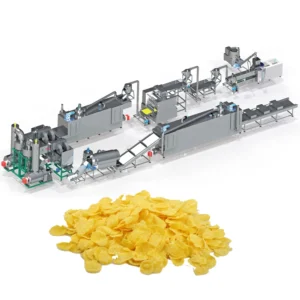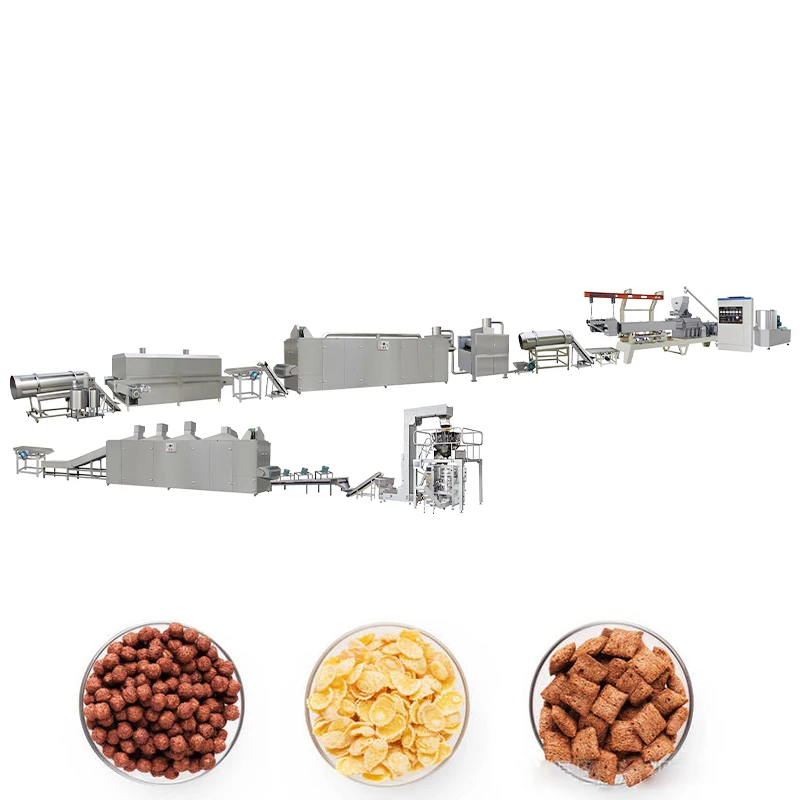


MT70, MT85, MT75 Breakfast Cereal Corn Flakes Production Line — twin-screw extrusion, PLC flaking control, hot air roasting, sugar-coating subsystem, CE/ISO certified.
Engineered as a complete turnkey project from layout and utility planning through phased installation and commissioning, with extruder screw configuration and die design specified to your raw material blend and target flake density rather than a generic build.
Line capacity is verified in our testing workshop on your actual raw material before shipment, and every downstream station — flaking mill, dryer, roasting oven, coating drum — is throughput-matched to eliminate bottlenecks at rated output.
- Complete line from mixing to packing under one supplier
- Trial run on your raw material with written report before delivery
- Electrical schematic, voltage confirmation, and screw configuration record included
Description
Turnkey Line Delivery — we map every station throughput on your corn flake recipe before the first machine ships, so the extruder, flaking mill, and roasting oven run at matched capacity from day one.
Technical Specifications
| Parameter | Value |
|---|---|
| Product Type | Breakfast Cereal Corn Flakes Production Line |
| Models Available | MT70, MT85, MT75 |
| Installed Power | 160 kW (MT70), 190 kW (MT85), 210 kW (MT75) |
| Power Consumption | 120 kW (MT70), 140 kW (MT85), 150 kW (MT75) |
| Output Capacity | 150–200 kg/hr (MT70), 300–400 kg/hr (MT85), 300–500 kg/hr (MT75) (basis not stated in source) |
| Overall Dimensions | 41 × 1.5 × 2.2 m (MT70), 43 × 1.5 × 3.2 m (MT85), 45 × 1.5 × 3.5 m (MT75) |
| Extruder Screw Type | Twin Screw |
| Flaking Machine Control | PLC control system |
| Flaking Machine Roller Drive | Double motors with hydraulic system for double rollers |
| Flaking Machine Temperature | Infrared sensor for even temperature pipe control |
| Dryer Heating Source | Gas / Electric |
| Roasting Oven Type | Hot air roasting oven |
| Coating System | Double tumble sugar melting, elevator, coating drum, spraying nozzle |
| Basic Raw Materials | Powder of corn, rice, wheat, oat, barley |
| Final Products | Natural corn flakes, sugar-coated corn flakes, multi-shape cereals |
| Production Procedure | Mixing, Extruding, Flaking, Roasting, Coating, Cooling, Packing |
| Assembly State | Complete production line |
Application Suitability
| Application | Material or Output |
|---|---|
| Natural Corn Flake Manufacturing | Corn powder blended with malt and salt, extruded, flaked, dried, and hot-air roasted |
| Sugar-Coated Cereal Production | Corn, wheat, or oat base passing through sugar spraying and drum coating after roasting |
| Multi-Shape Breakfast Cereal Lines | Rice, barley, and mixed grain powders shaped via adjustable die into balls, tubes, rings, stars, and wheels |
| Turnkey Facility Projects | New plants requiring matched throughput from batching system through to cooling and packing |
Why "Rated Capacity" Often Fails on the Factory Floor
A breakfast cereal corn flakes production line turnkey project quoted on paper capacity that cannot hold that output on the buyer’s actual raw material blend is the most frequent cause of post-installation disputes in cereal extrusion.
Capacity is only real when verified against your specific flour blend, moisture content, and target flake density.
I have watched lines stall because the flaking mill was rated on pure corn grits while the customer ran a wheat-and-oat mix that behaves entirely differently under pressure. The rollers slip, the flakes tear, and the downstream roasting oven runs half-empty. No one caught it because no trial run happened before shipment [NEED_CITE: common post-installation disputes in cereal extrusion lines]. Sizing each station to the actual recipe, not a catalog number, is what keeps a line running at its stated output.
Throughput Matching Across Every Station
The core challenge in a cereal extrusion project is keeping material flow balanced from the mixer all the way to the packing station. If the twin-screw extruder pushes more cooked dough than the flaking mill can press, material piles up on the conveyor and cools below the temperature needed for clean sheeting. Our line layout calculates the hold-up volume at each transfer point so that the breakfast cereal corn flakes production line turnkey configuration runs continuously without manual intervention or buffer bins overflowing.
Utility Planning Before the Floor Plan Is Drawn
Power, gas, compressed air, and water consumption all need to be confirmed against the site’s available utilities before any foundation is poured. The roasting oven alone draws significant thermal energy, and a gas-fired dryer requires a dedicated supply line with adequate pressure [NEED_CITE: industrial gas supply requirements for food roasting equipment]. We provide a utility load sheet that maps every motor, heater, and pneumatic point, so the contractor can size transformers, gas mains, and air compressors before the machines arrive.
Reading the Specification Sheet Against Your Recipe
The twin-screw extruder’s barrel temperature profile and screw configuration determine how completely starch gelatinises in your particular grain blend. A corn-dominant recipe needs a different moisture window and shear history than an oat-heavy mix, and the die geometry controls how much the pellet expands before it reaches the flaking rollers. Installed power ranges from 160 kW on the MT70 to 210 kW on the MT75, but the meaningful number is the power actually consumed during steady-state running on your material, which only a trial run reveals. The PLC-controlled flaking mill uses hydraulic pressure on its double rollers and an infrared sensor to hold even temperature, keeping flake thickness consistent across the full belt width — a parameter that directly affects how uniformly the flakes toast in the hot air roasting oven.
The Hidden Cost of a Mismatched Station
When a buyer sources the extruder from one vendor and the roasting oven from another, no single supplier owns the throughput guarantee. I once saw a line where a standalone flaking machine was added to an existing setup without recalculating the oven’s belt speed. The pressed flakes stacked up waiting for the roaster, the line lost significant capacity, and the customer faced days of downtime while the layout was redesigned [NEED_CITE: throughput mismatch consequences in multi-vendor food lines]. That single un-matched station cost more in lost production than the entire downstream equipment purchase.
Why Source the Entire Line From One Supplier
Every station — mixer, extruder, flaking mill, dryer, roasting oven, coating drum, cooler, and packer — is engineered under one roof, so throughput is matched by design rather than negotiated after installation. Screw configuration and die geometry are specified to your raw material blend and target flake density, not copied from a generic template. Our in-house testing workshop runs your actual recipe before shipment, producing a written trial run report that confirms capacity and product quality. Pre-sales line layout, on-site installation, commissioning, and operator training are handled by the same engineering team that built the machines, eliminating finger-pointing between vendors. Documentation arrives as a single package: electrical schematics, CE declaration, screw configuration records, and wear parts lists all cross-referenced to your line serial numbers.
Documentation & Verification
- Line layout drawing showing throughput calculation at every station from mixer to packer
- Trial run report on your grain blend confirming flake thickness and roasting uniformity
- Screw and die configuration record matched to your raw material and target product shape
- Electrical schematic with voltage and frequency confirmed before production begins
- CE declaration of conformity and ISO certificate included in the shipping document set
Installation, Commissioning & Support
- Foundation plan provided per overall dimensions, up to 45 × 1.5 × 3.5 m for the MT75 layout
- Dedicated power circuit sized for peak installed load of 210 kW on the largest configuration
- Twin-screw extruder barrel alignment and roller gap calibrated on-site during commissioning
- PLC interface language confirmed with your operators before the control panel is powered up
- First production run supervised by our engineer with roasting oven temperature profile fine-tuned to your flake target
- Wear parts list covering screws, dies, and flaking roller shells stocked for immediate dispatch
What We Need to Size Your Line Accurately
Send us your primary grain blend with typical moisture content, the target flake dimensions, and the hourly output you need to meet your packing schedule. Include your factory ceiling height and available voltage and frequency so we can confirm motor and heater specifications before quoting. If you are retrofitting into an existing building, a simple floor plan with column positions lets us draft a layout that respects your utility drop points and material flow corridors.
Frequently Asked Questions
Q: How is line capacity verified on my specific raw material blend before shipment?
A: We run your exact grain recipe through the twin-screw extruder and flaking mill in our in-house testing workshop. The trial confirms starch gelatinisation, flake thickness, and roasting behaviour. A written trial run report with measured output rates and product samples is delivered before the line is crated for dispatch.
Q: What voltage, frequency, and control language options are confirmed before production?
A: Before any steel is cut, we issue an electrical schematic showing motor ratings, heater loads, and control voltage for your site. The PLC interface language is agreed with your operators so that alarms, recipes, and maintenance prompts read correctly on day one. Gas or electric heating is selected to match your local utility availability.
Q: How is throughput matched between the extruder, flaking mill, dryer, and coating drum?
A: Each station’s nominal capacity is recalculated against your recipe’s bulk density and moisture loss curve. Conveyor speeds, dryer belt length, and drum volume are then adjusted so material flows continuously without buffering. The final line layout document shows the matched throughput at every transfer point.
Q: Can the same extruder produce both natural corn flakes and sugar-coated varieties?
A: Yes. The twin-screw extruder and flaking mill produce the base flake for both product types. For sugar-coated output, the line routes flakes through the sugar spraying and coating drum subsystem after roasting. Changeover involves activating the coating station and loading the sugar recipe in the PLC.
Q: What documentation is provided with the complete line?
A: You receive a line layout with capacity calculations, machine specification sheets, screw and die configuration records, electrical schematics, a trial run report on your raw material, CE declaration of conformity, ISO certificate, operation and maintenance manuals, and a wear parts list — all cross-referenced to your project number.
Related products
-
New Automatic Cornflakes Making Machine Oats Snack Food Chips Extruder Processing Line
¥30.00 Select options This product has multiple variants. The options may be chosen on the product page -
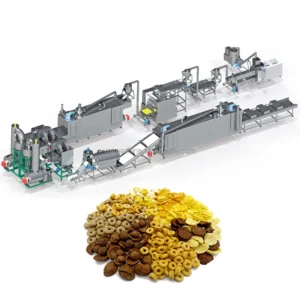
Stainless Steel Honey Small Corn Flake Breakfast Cereal Flakes Maker Making Machine Production Plant
¥30,000.00 Add to cart -
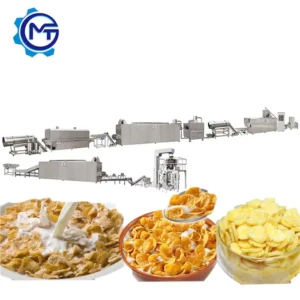
Automatic 500kg/h Corn Flakes Making Machine New Condition High Productivity Sweet Breakfast Cereal Processing Line From Factory
¥8,500.00 Select options This product has multiple variants. The options may be chosen on the product page -
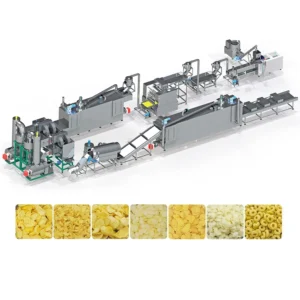
Automatic Commercial Breakfast Wheat Circle Corn Flake Production Line
¥65,000.00 Add to cart