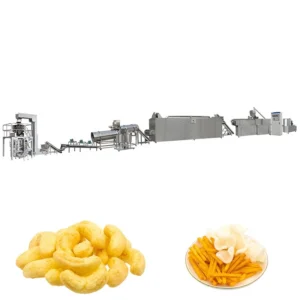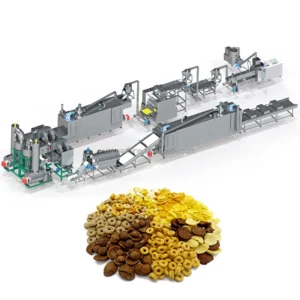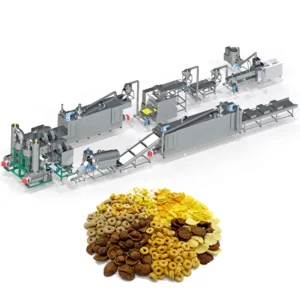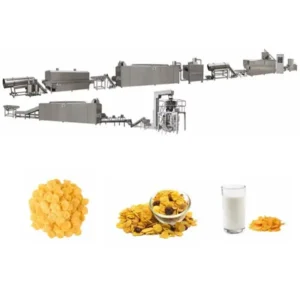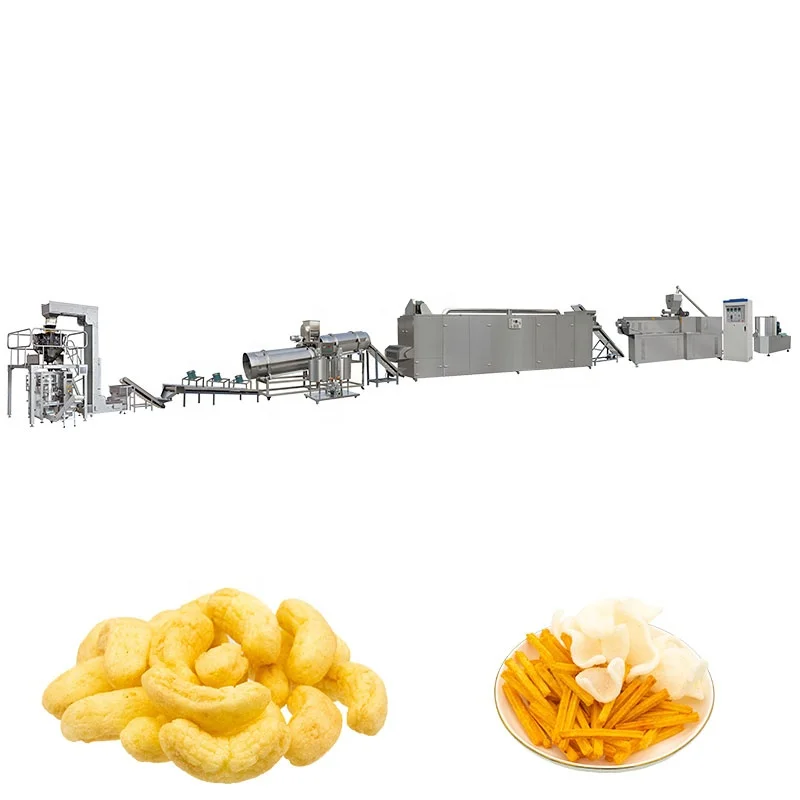
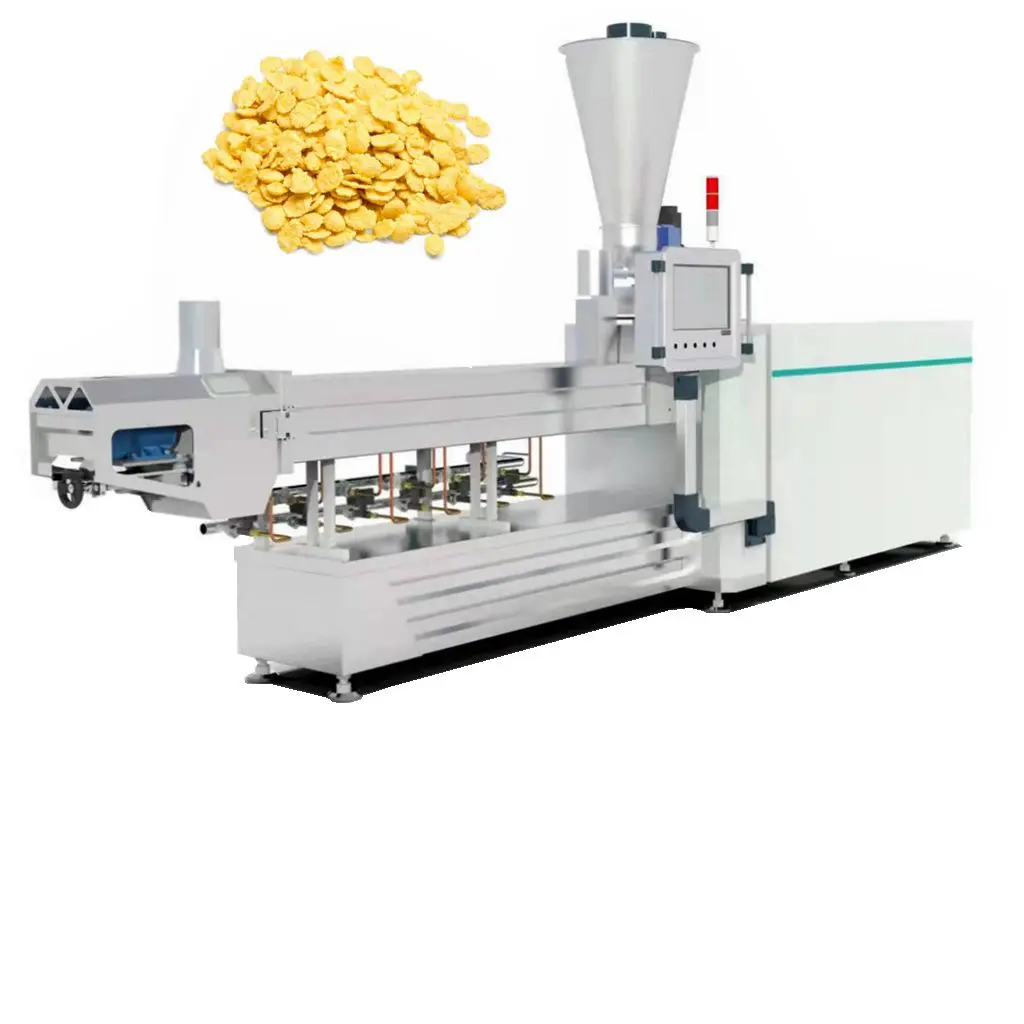
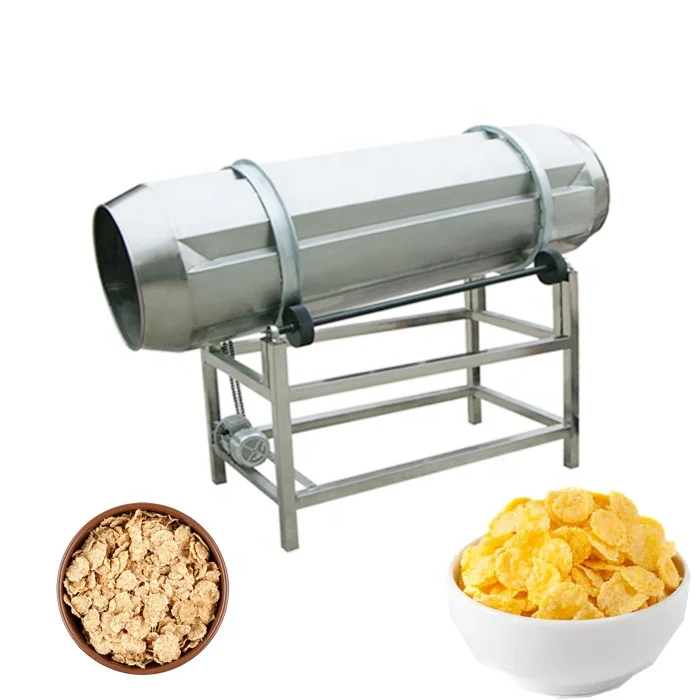
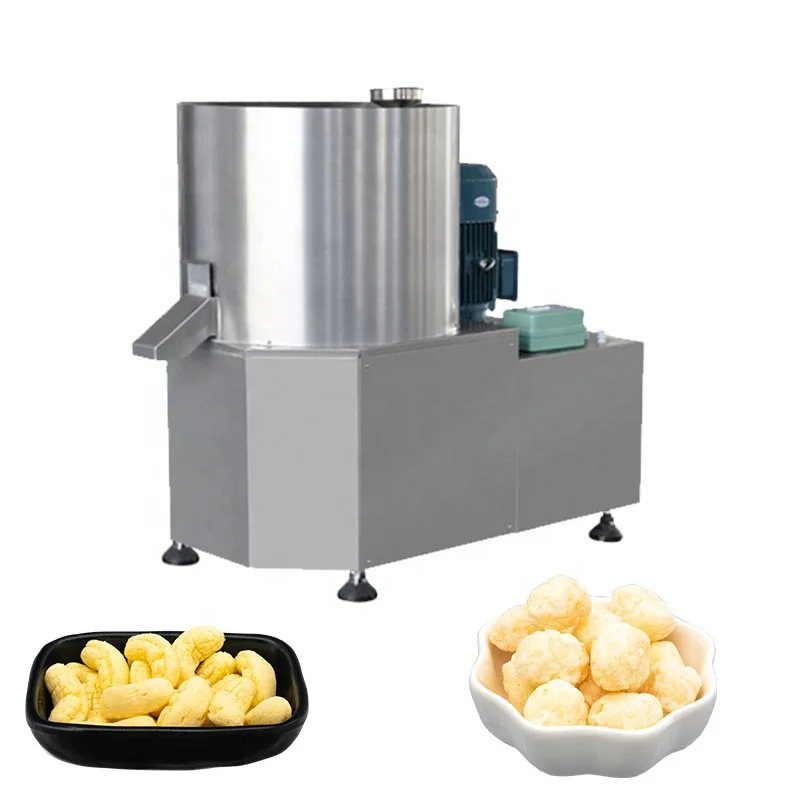

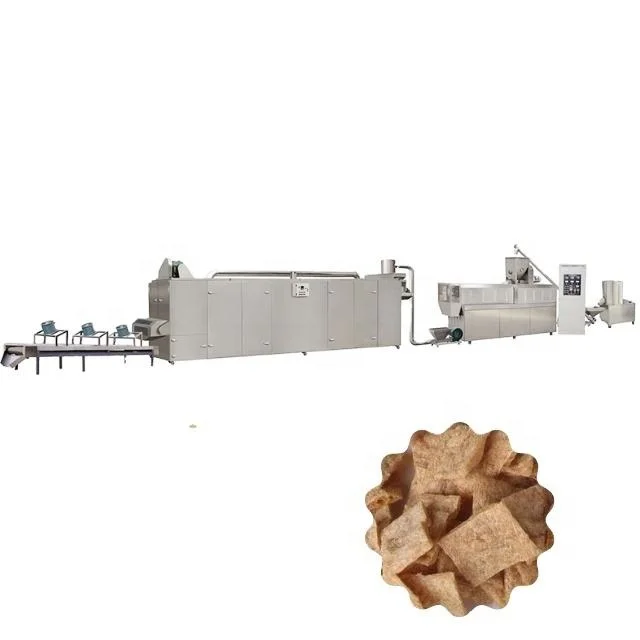
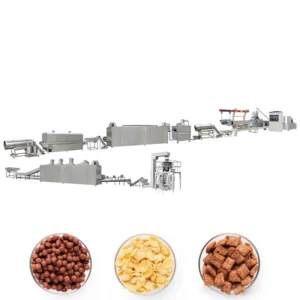
MT70 Corn Flakes Production Line, Twin-Screw Extruder, PLC Control — engineered as a complete turnkey project from batching through extrusion, flaking, roasting, coating and packing. Screw configuration and die design are specified to your raw material blend and target flake density, with throughput matched across every station to prevent bottlenecks.
- Twin-screw extrusion with configurable moulds for multiple cereal shapes
- Hydraulic flaking station with infrared temperature monitoring
- Trial run on your raw material in our testing workshop before shipment
- On-site installation, commissioning and operator training included
Description
Turnkey line integration under one supplier — every station from batching through extrusion, flaking, roasting and packing is throughput-matched and engineered as a single coordinated project rather than assembled from separate equipment vendors.
Technical Specifications
| Parameter | Value |
|---|---|
| Product Type | Corn Flakes Production Line |
| Available Models | MT70 / MT85 / MT75 |
| Installed Power | 160 kW (MT70) / 190 kW (MT85) / 210 kW (MT75) |
| Power Consumption | 120 kW (MT70) / 140 kW (MT85) / 150 kW (MT75) |
| Output Capacity | 150–200 kg/hr (MT70, basis not stated in source) / 300–400 kg/hr (MT85, basis not stated in source) / 300–500 kg/hr (MT75, basis not stated in source) |
| Overall Dimensions | 41 × 1.5 × 2.2 m (MT70) / 43 × 1.5 × 3.2 m (MT85) / 45 × 1.5 × 3.5 m (MT75) |
| Extruder Screw Type | Twin Screw (MT75) |
| Flaking Control | PLC system; hydraulic double rollers; dual independent motors; infrared temperature monitoring |
| Dryer Heating Source | Gas or Electric (configurable) |
| Roasting Oven | Hot air with vibrating pan, high-temperature spraying tubes, conciliation burner, dual circulating fans, cyclone dust removal |
| Coating System | Double tumble sugar melter, elevator, coating drum, spraying nozzle |
| Basic Material Compatibility | Corn, rice, wheat, oat, barley powder |
| Final Product Shapes | Natural corn flakes, sugar-coated corn flakes; ball, tube, stick, ring, fruit loop, star, wheel, flower, heart (by adjusting mould) |
| Standards | CE, ISO |
Application Suitability
| Application | Material or Output |
|---|---|
| Natural corn flakes for breakfast cereal packaging | Corn grits or corn flour via extrusion, flaking, drying and hot air roasting |
| Sugar-coated corn flakes for retail and foodservice | Corn base with sugar glaze applied through double tumble melter and coating drum |
| Multi-shape extruded cereal snacks | Rice, wheat, oat and barley powder blends producing rings, balls, stars, loops and wheels by mould change |
| Fortified breakfast cereal production | Cereal grain blends with added nutritional premix processed through twin-screw extrusion |
| Turnkey cereal factory projects | Phased installation covering mixing, extruding, flaking, roasting, coating and packing stations |
Why Capacity Claims Fail Once Your Actual Recipe Hits the Extruder
A corn flakes production line turnkey rated on paper often cannot sustain that output when the buyer switches to a local raw material blend with different fat, moisture or starch behaviour.
The problem surfaces weeks after installation. The extruder was configured for a standard corn grit profile, but the buyer’s regional supplier delivers corn with higher oil content or inconsistent particle size. Flake density drifts outside market specification. The roaster cannot keep pace because the upstream extrusion rate was never validated against that specific recipe. [NEED_CITE: common causes of extruder throughput deviation when raw material composition changes]
I once watched a line stall for two full weeks because the corn formulation changed after shipment — the flaking pressure and oven curve both needed recalibration against the new material. That kind of delay is preventable if the trial run happens before the equipment leaves the factory, not after.
Line Layout as an Integrated Engineering Exercise
The fundamental challenge in a corn flakes production line turnkey project is ensuring every station is sized to the same verified throughput. An extruder capable of 300–400 kg/hr output is wasted if the downstream dryer can only handle half that volume. Each station — mixing, extrusion, flaking, drying, hot air roasting, sugar coating, cooling and packing — must be calculated against the same target output and the same material residence time.
This is where the layout drawing becomes more than a floor plan. The spacing between the flaking rollers and the dryer infeed, the conveyor elevation changes, the buffer capacity between roasting and coating — all of these determine whether the line runs continuously or cycles through stop-start interruptions that degrade flake texture.
Phased Installation and Utility Planning for Cereal Facilities
Building a complete cereal production facility requires coordinating mechanical installation with utility provisioning in a defined sequence. The 41 to 45 metre line footprint demands a clear floor area with specific ceiling clearance — the MT85 and MT75 configurations reach 3.2 and 3.5 metres in height respectively. [NEED_CITE: industrial food production facility utility planning requirements]
Electrical supply must match the installed power envelope, which ranges from 160 kW to 210 kW depending on the model selected. Gas and electric heating options for the dryer and roasting oven each have different infrastructure implications. Gas-fired systems require certified piping and combustion ventilation; electric systems require dedicated high-amperage circuits. Confirming these utility specifications before production begins prevents costly rework during commissioning.
How Extrusion Parameters Translate to Flake Quality
The twin-screw extruder configuration on the MT75 is central to how raw cereal material behaves under heat and shear. Screw geometry determines residence time inside the barrel, which directly controls the degree of starch gelatinisation. Insufficient gelatinisation produces a dense, hard flake that cracks during roasting; excessive gelatinisation creates a gummy extrudate that collapses on the flaking rollers.
The die and mould selection governs the cross-section of the extrudate before it reaches the flaker. Switching from a flat die for traditional flakes to a ring or star mould changes the pressure profile at the die face and requires corresponding adjustments to screw speed and barrel temperature. The PLC-controlled flaking station uses hydraulic pressure on the double rollers with infrared temperature monitoring to maintain consistent flake thickness — a critical variable because uneven flakes roast at different rates, producing mixed colour and texture in the finished product.
The roasting oven’s conciliation burner and dual circulating fans provide the uniform air distribution necessary for consistent surface bubbling. The cyclone dust removal device captures fine particulate generated during high-temperature roasting, which protects product quality and meets workshop air standards.
The Hidden Cost of Mismatched Station Capacity
When equipment is sourced from separate vendors, each machine arrives with its own nominal capacity rating — but those ratings are rarely measured under the same material conditions. The extruder supplier quotes output on standard corn grits. The dryer supplier rates capacity on ambient moisture evaporation. The coater specifies throughput on a sugar syrup viscosity that may not match your formulation. [NEED_CITE: risks of assembling food processing lines from multiple independent vendors]
The result is a bottleneck that reveals itself only during full-line production runs. One station consistently limits output while the others idle. Operators compensate by adjusting upstream feed rates, which introduces variability in extrusion pressure and flake density. Over time, this variability accumulates into product inconsistency that the market notices.
What Distinguishes This Turnkey Approach
Every station in this corn flakes production line turnkey configuration is specified under a single engineering responsibility, so throughput matching is verified at the design stage rather than discovered during commissioning.
The screw configuration and die design are specified to the buyer’s actual raw material blend and target flake density, not copied from a generic build. An in-house testing workshop conducts trial runs on customer-supplied raw material before shipment, meaning product development begins at the factory rather than after installation. Complete documentation — from line layout and capacity calculation through electrical schematics and trial run reports — is delivered as one integrated package. The hot air roasting oven, flaking station and coating system are all engineered to operate at the same verified output, eliminating the station-level bottleneck risk inherent in multi-vendor assemblies.
Documentation & Verification
- Line layout and capacity calculation matched to your factory footprint and target cereal output
- Screw and die configuration record specified to your raw material blend and target flake density
- Trial run report on customer-supplied corn, rice or oat material before shipment
- Electrical schematic with voltage, frequency and control language confirmation for your market
- CE declaration of conformity and ISO certificate included with shipping documentation
Installation, Commissioning & Support
- Floor space requirement spans up to 45 × 1.5 m with ceiling clearance reaching 3.5 m for the MT75 configuration
- Power supply must support installed loads from 160 kW to 210 kW with dedicated circuit protection
- Equipment ships in sectional modules for staged assembly and alignment on your workshop floor
- PLC and MCC control systems are commissioned on-site with parameter sets tuned to your local material
- Operator training covers die changes, flaking roller adjustment and roasting oven temperature profiling
- Wear parts list for screws, dies and roller surfaces provided with recommended replacement intervals
What to Prepare Before Requesting a Quote
To move from inquiry to line configuration, share your target raw material specification — including grain type, particle size distribution and moisture content — along with your desired daily output and the available workshop dimensions. Specify the local voltage and frequency standard, the preferred control language for the PLC interface, and whether you need the natural flake line, the sugar-coated variant, or both running from a shared extrusion base.
Frequently Asked Questions
Q: How is line capacity verified against my actual raw material and recipe?
A: Before shipment, your raw material is run through the extruder and flaking station in the in-house testing workshop. The trial run records screw speed, barrel temperature, flaking pressure and roasting curve under your specific formulation. A trial run report documents the achieved throughput and flake quality, so capacity is confirmed on your material rather than on a generic reference recipe.
Q: How do you ensure throughput is matched across every station?
A: Each station — mixer, extruder, flaker, dryer, roasting oven, coater and cooler — is calculated against the same target output and material residence time during the layout design phase. No single machine is selected independently. The result is a corn flakes production line turnkey configuration where every section sustains the same verified rate without one station bottlenecking the others.
Q: What is the phased installation and commissioning schedule?
A: Installation follows a defined sequence: base frame and conveyor positioning, extruder and flaker alignment, dryer and roasting oven utility connections, coating system assembly, then electrical and control integration. Commissioning proceeds station by station before full-line runs begin. The schedule is planned during the layout stage and adjusted to your facility readiness.
Q: How are voltage, frequency and PLC control language confirmed?
A: These specifications are confirmed during the proposal stage before production starts. The electrical schematic is prepared to your local voltage and frequency standard, and the PLC interface language is set to match your operator requirements. This prevents delays during on-site commissioning caused by mismatched electrical or control configurations.
Q: What operator training and maintenance support is included?
A: On-site training covers extruder die changes, flaking roller pressure adjustment, roasting oven temperature profiling and PLC parameter navigation. A wear parts list identifies screws, dies and roller surfaces with recommended replacement intervals. Ongoing maintenance support is available after commissioning for process optimisation and part replacement.
Related products
-
Automatic 500kg/h Corn Flakes Making Machine New Condition High Productivity Sweet Breakfast Cereal Processing Line From Factory
¥8,500.00 Select options This product has multiple variants. The options may be chosen on the product page -
Automatic Commercial Breakfast Wheat Circle Corn Flake Production Line
¥65,000.00 Add to cart -
Automatic Instant Breakfast Cereals Snack Food Making Machine
¥10,000.00 Select options This product has multiple variants. The options may be chosen on the product page -
Kelloggs Corn Flakes Breakfast Cereal Normal Making Machine Breakfast Cereal Extruder Production Line
¥30,000.00 Select options This product has multiple variants. The options may be chosen on the product page