

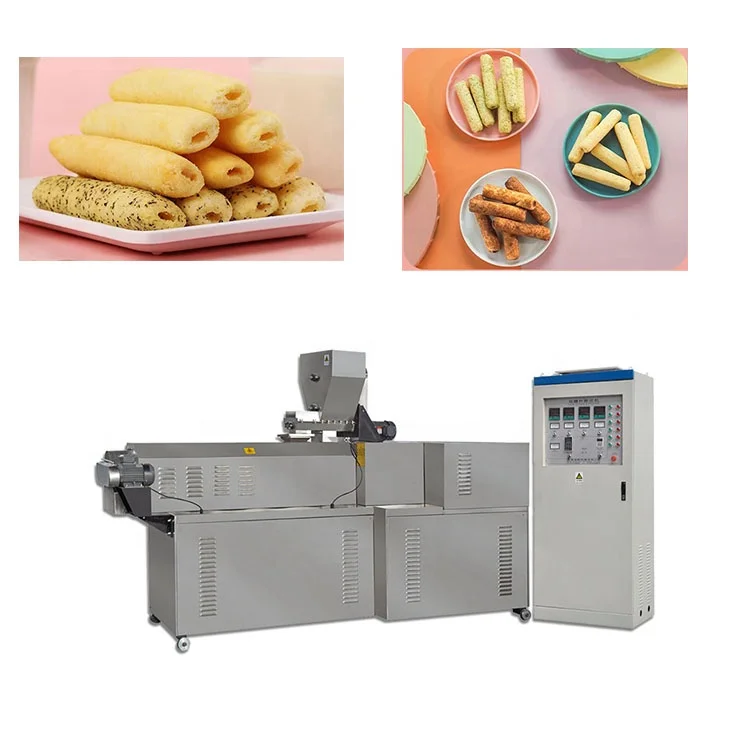
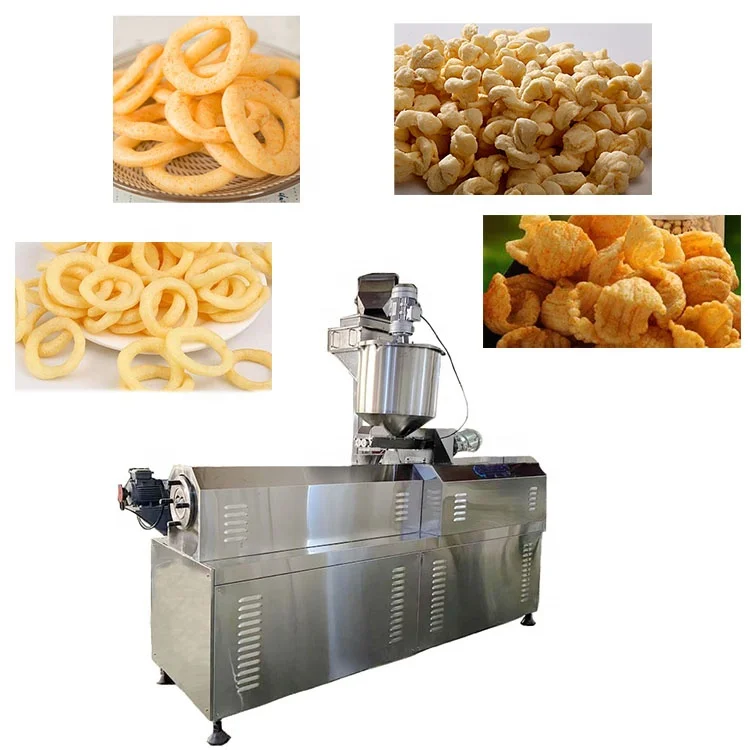
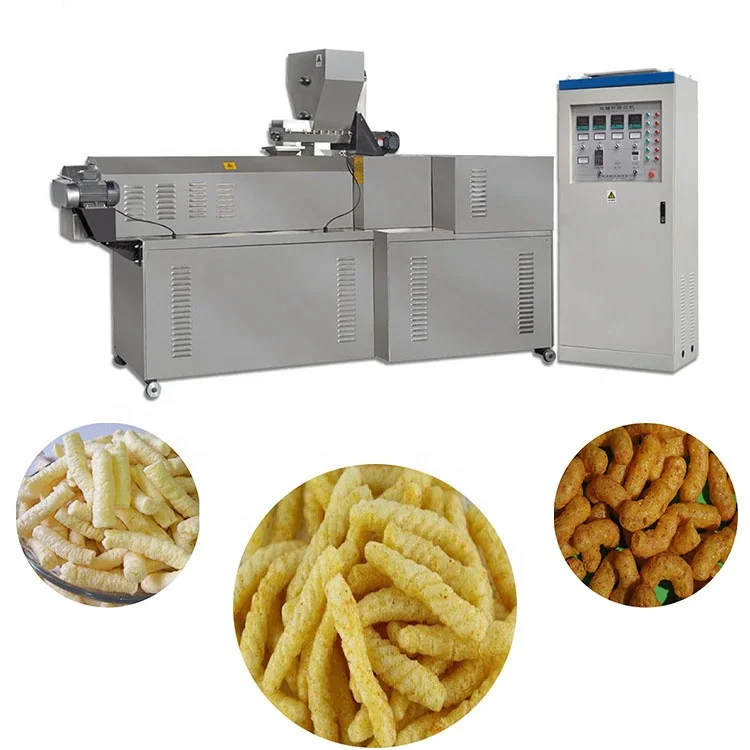
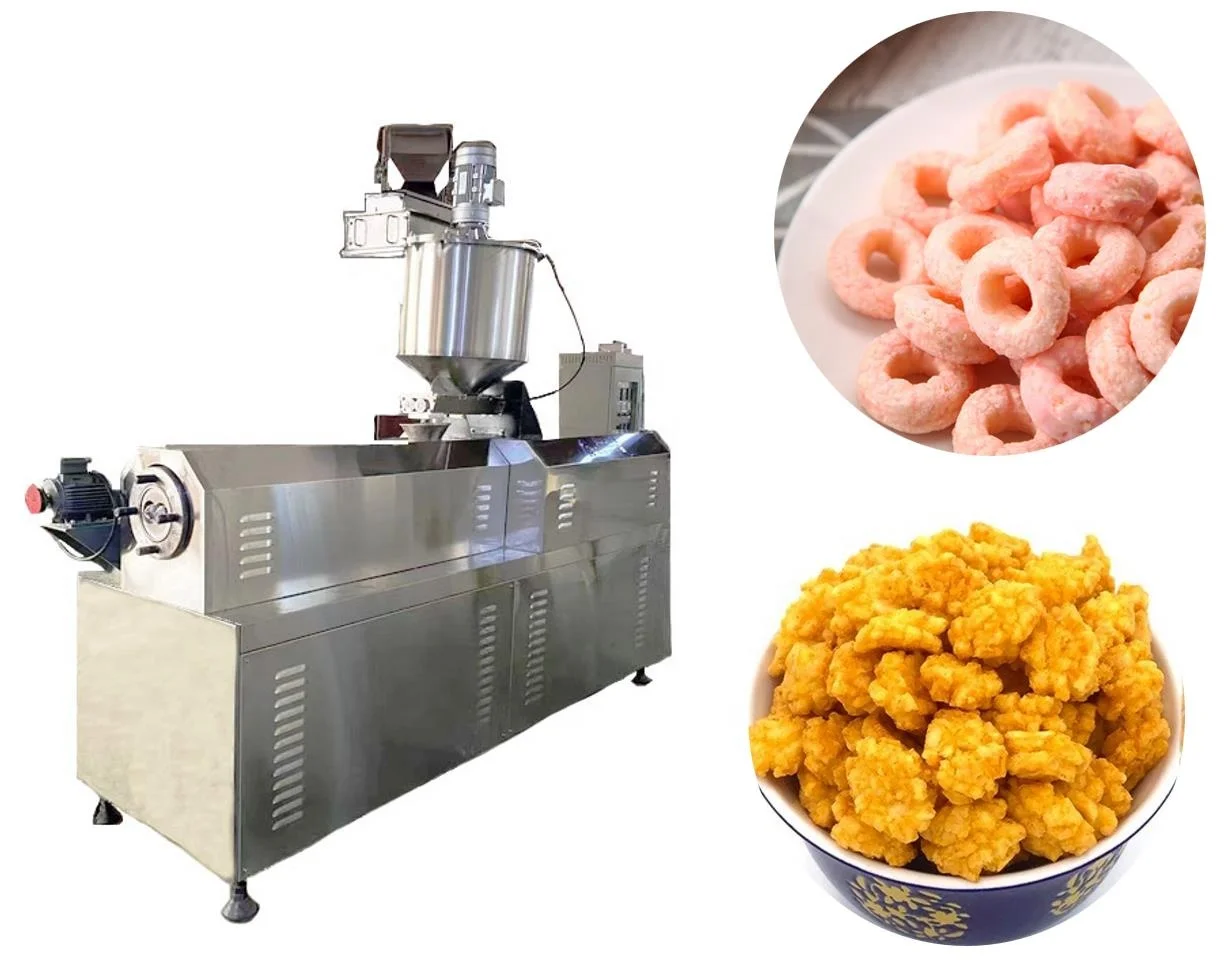
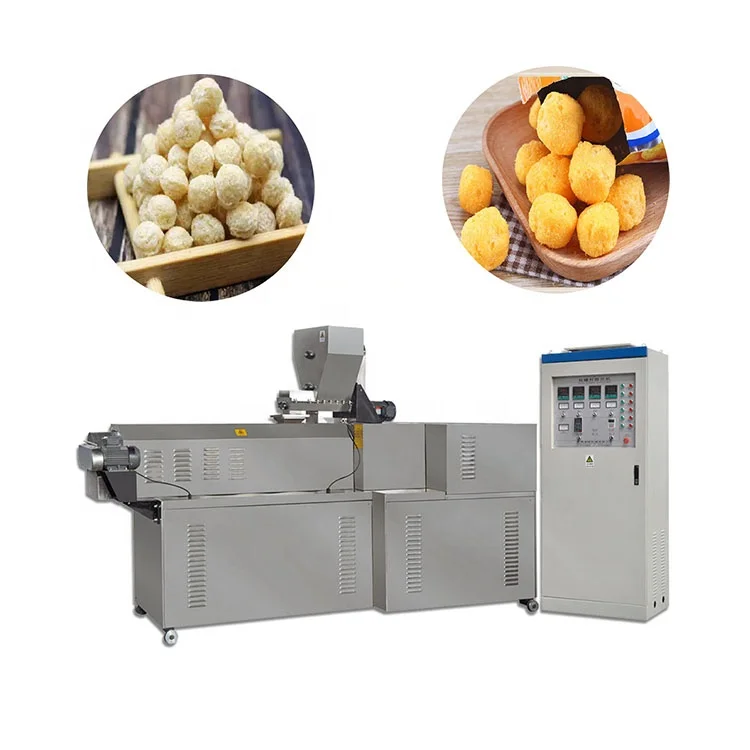
Twin-screw Puffed Snacks Production Line, 380V/50Hz, Food-grade SS 201/304 — engineered for extruded corn snacks, cheese balls, and core-filled formats. Screw configuration and die design are matched to your raw material moisture and target expansion, balancing throughput across mixing, extrusion, cooling, roasting, and packing stations. Energy options include electric, gas, diesel, or steam heating to fit site utilities. Trial runs on customer-supplied raw material are conducted in-house before shipment to confirm real-world output and product texture.
Description
Turnkey Line Accountability — Throughput balanced from mixer through packing on a single supplier’s responsibility, so no station chokes the line when your snack formula changes mid-run.
Technical Specifications
| Parameter | Value |
|---|---|
| Product Type | Puffed Snacks Production Line |
| Extruder Type | Twin-screw (double screw extruder) |
| Heating Energy Options | Electricity (~100 kW) / Gas or Diesel (50–60 kW) / Steam (basis not stated in source — confirm production capacity & product format) |
| Voltage & Frequency | 3-phase 380V/50Hz; Single-phase 220V/50Hz (customizable to local voltage) |
| Contact Material | Food-grade stainless steel 201/304 |
| Control System | Delta or Delixi inverter (source value — verify against manufacturer catalog) |
| Motor | Siemens (China-made) or equivalent Chinese top brand (source value — verify against manufacturer catalog) |
| Line Stations | Mixer → Extruder → Vibrating Cooler → Roasting Machine → Packing Machine |
| Standards | CE, ISO |
Application Suitability
| Application | Material or Output |
|---|---|
| Puffed corn snacks and corn puffs | Corn grits, corn flour, maize meal |
| Cheese balls and coated puffed snacks | Corn and rice blends with post-extrusion oil and flavour coating |
| Core-filled snacks (cream pillows, chocolate bars) | Cereal flour blends with injected cream or chocolate filling |
| Rice cakes and sheet snacks | Rice, brown rice, millet flour |
| Multigrain extruded puffs | Buckwheat, oat, and mixed cereal blends |
What "Nominal Capacity" Hides From Snack Line Buyers
A rated output figure means nothing until it holds on your exact raw material mix and moisture level.
Snack extrusion lines are often quoted on a single benchmark grain, typically clean corn grits at a fixed moisture content. The moment a buyer introduces rice flour, cassava starch, or a higher-fat blend, the barrel pressure, residence time, and die expansion behaviour shift. I have watched a puffed snacks production line turnkey installation stall at the roasting stage because the extruder was sized for corn while the buyer planned to run a rice-dominant formula. The extruder kept pace, but the cooler and roaster could not handle the altered moisture curve, creating a bottleneck that surfaced only during commissioning. [NEED_CITE: impact of starch composition on extrusion expansion and downstream throughput]
Matching the Screw Profile to Your Snack Texture Target
Every puffed snack format demands a distinct shear and expansion profile inside the barrel. A twin-screw extruder configured for a light, open-cell corn puff will compress a core-filled pillow dough incorrectly, producing shells that split during cooling. The screw element sequence, die aperture, and barrel temperature zones must all be selected together against the specific cereal blend and the target crunch or melt-in-mouth density. When we build a puffed snacks production line turnkey project, the screw and die record is locked to the buyer’s formula before metal is cut.
Why the Dryer and Roaster Cannot Be Afterthoughts
Extruded snack moisture drops sharply in the first minutes after the die, then tapers. A vibrating cooler and roasting machine sized only for peak extruder output on a dry corn recipe will underperform on a high-moisture, multi-grain formula. The entire downstream section — cooler airflow, roaster drum retention time, and packing station feed rate — must be calculated against the actual exit moisture and product density the extruder delivers on the buyer’s material. Skipping this station-by-station balance is the most common cause of line-wide throughput loss [NEED_CITE: typical moisture reduction stages in extruded snack processing].
Reading the Specs That Actually Shape Your Line
Twin-screw extrusion offers far wider material tolerance than single-screw designs, handling high-fat and high-moisture blends without surging. The choice between electric heating at roughly 100 kW and gas or diesel options around 50–60 kW determines not just energy cost but the temperature ramp control available across barrel zones — electric gives finer zone-by-zone tuning, while gas may suit sites with limited electrical infrastructure. Food-grade stainless steel 201/304 contact surfaces prevent corrosion from acidic cheese coatings and salty seasoning blends applied downstream. The Delta or Delixi inverter drives allow motor speed adjustment to match screw RPM with different cereal viscosities, giving operators a practical way to fine-tune expansion without swapping screw elements during a product changeover.
The Hidden Cost of Skipping a Pre-Shipment Trial Run
Installing a line without a factory trial on the buyer’s actual cereal blend means the first production run doubles as the product development test. I have seen buyers in humid tropical climates discover that their local corn grits absorbed ambient moisture during storage, changing the barrel behaviour entirely from the dry test material the supplier used. Die blockages, uneven puff expansion, and cooler overload all appeared at once. The downtime and material waste during those first weeks can exceed the cost of a structured pre-shipment trial. [NEED_CITE: cost of unplanned commissioning rework on food processing lines]
Why Source the Full Line From One Responsible Supplier
Each station in this puffed snacks production line turnkey configuration is matched for throughput under a single engineering responsibility, so the mixer batch size, extruder screw speed, cooler airflow, and roaster drum speed are calculated together rather than negotiated between separate vendors. The in-house testing workshop runs trial production on the buyer’s submitted raw material before shipment, generating a documented output record rather than a theoretical capacity claim. Screw and die configurations are selected against the specific snack format — puffed corn, cheese ball, or core-filled pillow — and recorded for future reorder. Electrical schematics and control language are confirmed to the buyer’s local grid and operator requirements before assembly begins, avoiding the on-site rewiring delays that push commissioning past schedule.
Documentation & Verification
- Line layout drawing with station-by-station throughput balance for your snack format
- Screw element sequence and die aperture record matched to your cereal blend
- Trial run report produced on your submitted raw material in the testing workshop
- Electrical schematic confirming voltage, frequency, and control panel language for your site
- CE declaration of conformity covering the complete extrusion and downstream line
- Wear parts list identifying screw elements, dies, and barrel sleeves by station
Installation, Commissioning & Support
- Foundation and floor loading plan provided for the full station footprint, including the vibrating cooler mass
- Dedicated electrical circuit sizing confirmed against the selected heating option, electric or gas
- Line arrives in modular station sections for sequential assembly and utility connection
- First-run parameter setting covers barrel zone temperatures, screw RPM, and die pressure for your formula
- Operator training includes product changeover between puffed and core-filled formats on the twin-screw extruder
- Scheduled wear part replacement intervals documented for screw elements and die plates
Before You Send the Inquiry
To configure this puffed snacks production line turnkey project accurately, we need your target snack format and the exact cereal blend or recipe you plan to run, including any cassava, rice, or multigrain components. Share your site voltage and frequency, plus the available energy source for heating. If you have an existing packing system upstream or downstream, let us know the interface dimensions and feed rate so the line can be balanced to it.
Frequently Asked Questions
Q: How is line capacity verified on my actual raw material before shipment?
A: You send a representative sample of your cereal blend to our in-house testing workshop. We run it through the configured twin-screw extruder and downstream stations, documenting actual throughput, expansion rate, and moisture reduction at each stage. The trial run report is shared before the line ships, so you see real output figures on your material, not a generic benchmark.
Q: How do I confirm voltage, frequency, and control language for my target market?
A: During the specification confirmation stage, you provide your local grid standard — for example 3-phase 380V/50Hz or another regional configuration. The electrical schematic is then drawn to match, and the control panel labels and inverter interface language are set to your operator’s preference before assembly begins.
Q: How are screw and die configurations selected for different snack textures?
A: The screw element sequence, barrel zone temperatures, and die aperture are all chosen together based on your target product — open-cell puffed corn requires a different shear profile than a dense core-filled pillow shell. We document the exact configuration for your formula so future production runs remain consistent and reorder of wear parts is straightforward.
Q: What does the installation and operator training process look like?
A: The line arrives in station modules. Our engineers assemble, connect utilities, and run initial parameter settings on your cereal blend. Training covers daily operation, screw speed and temperature adjustment for product changeovers, and the scheduled replacement intervals for dies and screw elements specific to your production volume.
Q: How are spare wear parts supplied and when should first replacement be planned?
A: A complete wear parts list is provided at delivery, identifying screw elements, die plates, and barrel sleeves by position. First replacement timing depends on your cereal blend abrasiveness and weekly operating hours. We supply matched replacement sets so that a worn die or screw element does not force you to re-validate the entire product texture from scratch.
Related products
-

Hot Sale Corn Snack Extruder Puffed Snacks Production Machine Corn Puffs Making Machine
¥20,000.00 Select options This product has multiple variants. The options may be chosen on the product page -

New Stainless Steel Automatic Snack Food Machinery Extruder Puffed Corn Maize Puff Processing Line for Food Industry High
¥12,350.00 Select options This product has multiple variants. The options may be chosen on the product page -

Twin Screw Corn Puffs Extruder Machine Small Corn Snack Food Extruder Machine
¥100.00 Select options This product has multiple variants. The options may be chosen on the product page -

Full Automatic Puffed Corn Snack Food Extruder Puffed Snack Corn bar Making Machine
¥8,500.00 Select options This product has multiple variants. The options may be chosen on the product page


