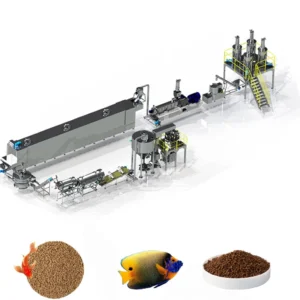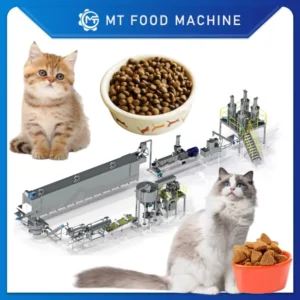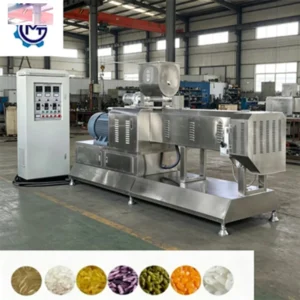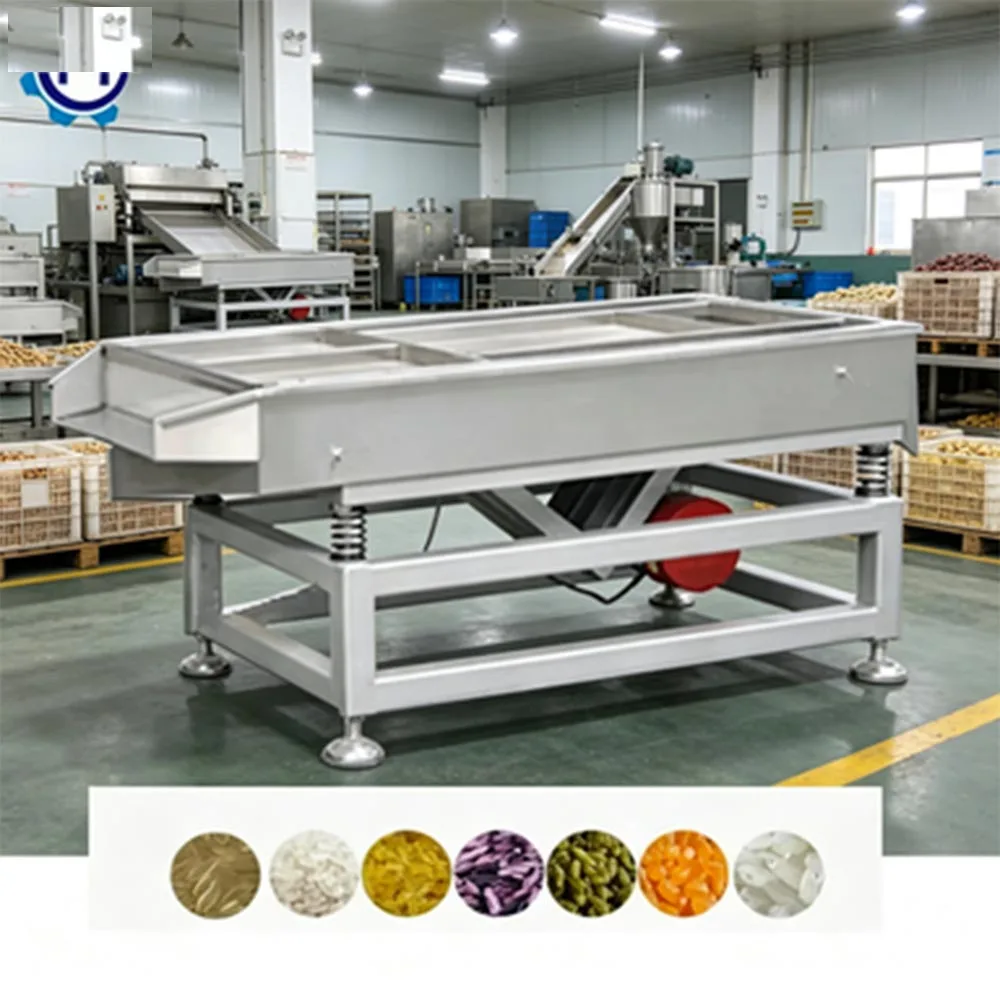


Twin Screw Aquatic Fish Feed Extrusion Production Line, PLC Control, 304 Stainless Steel Contact Parts — delivers matched throughput from mixing through extrusion, drying, seasoning, and screening within one integrated turnkey project.
- Screw configuration and die design specified to your raw material formulation to control pellet buoyancy, density, and expansion across floating and sinking formats
- Full continuous automatic production with humanized interface, food-grade contact materials, and adjustable pellet size and hardness for diverse species requirements
- Trial runs on customer raw material conducted in-house before shipment, with line layout, capacity calculation, and electrical schematics confirmed to site conditions
Description
Integrated Project Delivery — Every station from raw material batching to finished pellet packing is sized and balanced as one continuous system, eliminating the throughput mismatch that plagues lines assembled from separate vendors.
Technical Specifications
| Parameter | Value |
|---|---|
| Product Type | Twin Screw Aquatic Fish Feed Extrusion Production Line |
| Screw Type | Twin screw |
| Control System | PLC automatic control system |
| Material Contact Parts | Food-grade 304 stainless steel |
| Line Stations | Raw material mixer, extruder, dryer, seasoning/coating machine, vibrating sieve, conveyor equipment |
| Product Output Types | Floating and sinking fish feed pellets |
| Pellet Customization | Adjustable size, hardness, buoyancy |
| Applicable Raw Materials | Fish meal, soybean meal, corn powder, compound additives |
| Automation Level | Full continuous automatic production (mixing → extrusion → drying → seasoning → screening → discharging) |
| Energy Design | Optimized energy-saving transmission structure and heating system |
| Maintenance Design | Humanized operation interface, convenient daily cleaning, quick replacement of vulnerable parts |
| Output Capacity | (basis to be confirmed) |
| Rated Power (kW) | (basis to be confirmed) |
| Voltage & Frequency | (basis to be confirmed) |
Application Suitability
| Application | Material or Output |
|---|---|
| Commercial koi and goldfish feed production | Floating pellets from fish meal, corn starch, and compound vitamin premix |
| Tropical ornamental fish feed processing | Small-diameter slow-sinking pellets with high protein dispersion |
| Freshwater aquaculture feed manufacturing | Sinking and floating pellets from soybean meal, corn powder, and fish meal blends |
| Medium-to-large scale feed mill expansion | Continuous mass production runs across multiple pellet size and buoyancy grades |
What "Nominal Line Capacity" Leaves Out on an Aquatic Fish Feed Extruder Production Line Turnkey
The number on the quote only matters when it is measured on your actual raw material formulation at your target moisture content.
Floating feed that sinks on arrival, or pellet density drifting outside the specification your distributors expect, rarely traces back to a broken machine. It traces back to a screw configuration and die design copied from a generic build rather than matched to the protein ratio, starch content, and fat level in your specific formulation. An aquatic fish feed extruder production line turnkey project quoted on a standard corn-based test recipe will behave differently the moment your actual fish meal percentage enters the barrel. [NEED_CITE: relationship between raw material protein content and extrusion expansion rate]
Barrel Temperature Zones and Starch Gelatinisation Control
The twin screw extrusion process relies on precise thermal and mechanical energy input to achieve the starch gelatinisation required for stable pellet buoyancy. A PLC automatic control system manages barrel temperature profiles across multiple heating zones, allowing operators to adjust the thermal gradient in response to changes in raw material moisture or ambient workshop conditions. Consistent gelatinisation is what separates a floating pellet that holds its structure in water from one that disintegrates on contact.
Die Geometry and Pellet Density Specification
Die design directly determines the expansion ratio of the extrudate as it exits the barrel, which in turn governs whether the pellet floats, sinks, or achieves the slow-sinking behaviour required for certain aquaculture species. An aquatic fish feed extruder production line turnkey project must specify die orifice diameter, land length, and face pattern to the buyer’s target pellet size and buoyancy grade. Swapping die plates between production runs allows a single line to serve multiple market segments without reconfiguring the entire extrusion platform. [NEED_CITE: die land length influence on extrudate expansion and density]
Reading the Screw Configuration Against Your Formulation
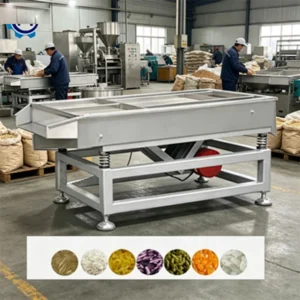
The L:D ratio and screw element arrangement — conveying segments, kneading blocks, and reverse-flight sections — define the residence time and shear profile inside the barrel. High fish meal formulations demand different screw geometry than corn-dominant recipes because protein-rich materials resist expansion and require higher shear to achieve the necessary melt homogeneity. Food-grade 304 stainless steel contact parts resist the corrosive salts and amino acids present in marine-origin raw materials, extending component service life in continuous aquatic feed production. The vibrating sieve downstream removes fines and undersized pellets before the coating stage, ensuring only specification-compliant product reaches the seasoning drum.
The Bottleneck That Appears Three Months After Startup
A line assembled from individually sourced stations often reveals its imbalance only after the dryer falls behind the extruder during sustained production, or the coating drum cannot keep pace with the screening output. Throughput mismatch between stations forces operators to idle the extruder, wasting energy and degrading pellet quality through inconsistent residence time. [NEED_CITE: throughput balancing methodology for multi-station extrusion lines]
Why a Single-Source Turnkey Project Reduces Commissioning Risk
Delivering the complete line — mixer, extruder, dryer, seasoning and coating equipment, vibrating sieve, and conveyors — under one supplier means throughput is calculated and matched across every station before fabrication begins. Screw configuration and die design are specified to the buyer’s raw material formulation and target pellet buoyancy rather than copied from a generic template. An in-house testing workshop conducts trial runs on the buyer’s actual raw material before shipment, generating a configuration record that becomes the baseline for production. Electrical schematics are confirmed against the installation site’s voltage, frequency, and control language requirements, preventing the commissioning delays that arise from mismatched power supply or unreadable HMI text.
Documentation & Verification
- Line layout and capacity calculation confirming matched throughput at every station from mixer through screening
- Screw and die configuration record specified to buyer’s fish meal ratio and target buoyancy
- Trial run report on customer raw material conducted in testing workshop before dispatch
- Electrical schematic with voltage, frequency, and PLC control language matched to installation site
- CE declaration of conformity and ISO certificate for international market compliance
Installation, Commissioning & Support
- Foundation plan and utility connection schedule matched to line footprint and PLC cabinet load
- Power circuit specification confirming voltage and frequency match before extruder motor energisation
- Assembly sequence for dryer and conveyor sections to minimise on-site installation duration
- First-run parameter logging and screw speed calibration against trial run baseline data
- Operator training covering die plate changeover and daily cleaning of food-grade 304 stainless steel surfaces
- Wear parts list specifying screw elements, die plates, and seals with recommended replacement intervals
Preparing Your Project Brief
To size an aquatic feed line accurately, share your target pellet diameter range, required buoyancy type, and the raw material formulation you intend to run — particularly the fish meal and starch percentage. Confirm the local voltage, frequency, and preferred PLC interface language at the inquiry stage. If you have existing upstream batching or downstream packing equipment, provide interface dimensions so the conveyor layout bridges correctly.
Frequently Asked Questions
Q: How is the line’s output capacity verified, and on what raw material basis?
A: Capacity is confirmed through a trial run using your actual raw material formulation in our in-house testing workshop before shipment. The resulting report documents throughput, pellet density, and buoyancy under specific screw speed and barrel temperature settings, providing a production baseline rather than a generic nominal figure.
Q: How are screw configuration and die design matched to my specific aquatic feed formulation?
A: We analyse your raw material composition — protein content, starch ratio, fat level — and select screw element arrangement and die geometry accordingly. High fish meal blends require different kneading block placement and die land length than corn-dominant recipes to achieve target expansion and pellet stability.
Q: What voltage, frequency, and PLC control language will be confirmed before production?
A: Your installation site electrical specifications are confirmed during the quotation stage and documented in the electrical schematic. The PLC interface language is set to your operator preference before factory testing, ensuring the HMI is readable from the first day of commissioning.
Q: Is a trial run on my raw material performed before shipment, and what does the report cover?
A: Yes. The trial run uses your supplied raw material in our testing workshop. The report covers achieved throughput, pellet size distribution, buoyancy verification, screw and die configuration used, and barrel temperature profile — forming the baseline your operators replicate on site.
Q: How is throughput balanced across mixer, extruder, dryer, and seasoning stations to prevent bottlenecks?
A: Each station is sized during the line layout phase based on the extruder’s verified output on your raw material, not a nominal catalogue figure. Dryer belt length, coating drum volume, and sieve area are all calculated to handle continuous extruder discharge without material backlog or idle gaps.
Related products
-
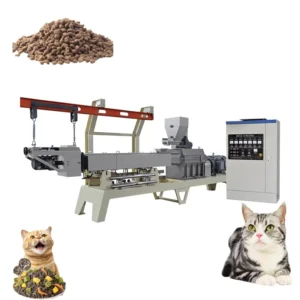
Premium Pet Food Processing Equipment Dog Cat Feed Making Machine
¥9,500.00 Select options This product has multiple variants. The options may be chosen on the product page -
In Stock Pet Feed Production Line / Dog Cat Food Extrusion Machine
¥9,500.00 Select options This product has multiple variants. The options may be chosen on the product page -
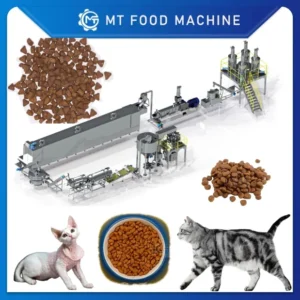
MT100 Brand 1.5-2.0t/h PLC Controlled Multi-Species Cat Food Processing Line
¥45,000.00 Select options This product has multiple variants. The options may be chosen on the product page -
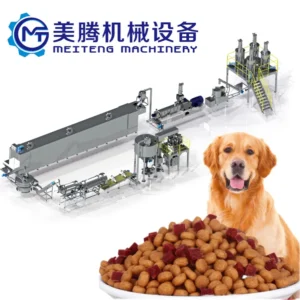
High Capacity Pet Food Extrusion Production Line Suitable for Dog. Cat. Bird. Fish and Cattle Feed
¥9,500.00 Select options This product has multiple variants. The options may be chosen on the product page