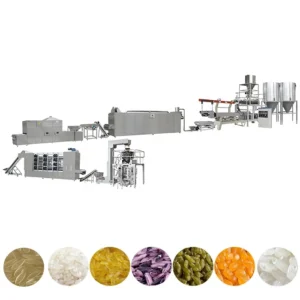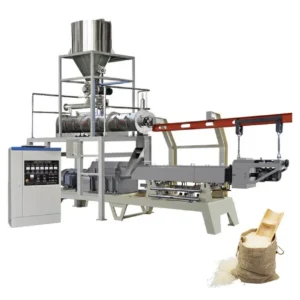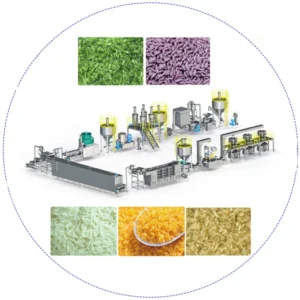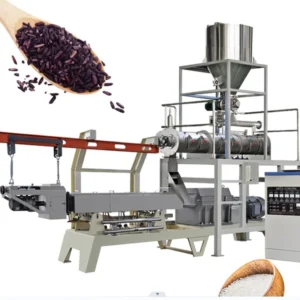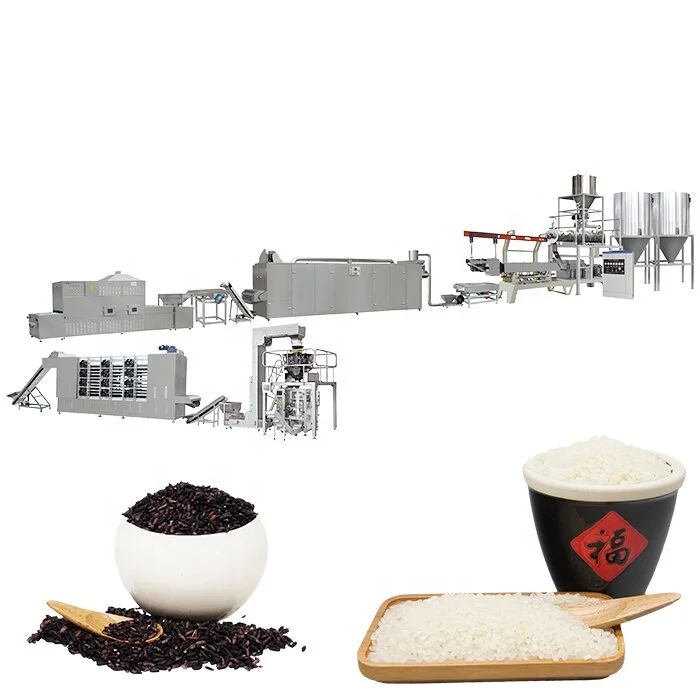


Fortified Rice Production Line, Twin-Screw Extruder, 110 kW Main Drive, 2500 mm Screw Length — engineered as a complete turnkey project from powder mixing through extrusion, drying and packing. Screw configuration and die design are matched to the buyer’s raw material formulation and target grain density, with throughput balanced across every station to prevent bottlenecks. Trial runs on customer raw material are completed in-house before shipment, supported by full line layout documentation and on-site commissioning.
Description
Single-Supplier Accountability — every station on this fortified rice production line from powder mixing through packing is throughput-matched under one engineering scope, removing the finger-pointing that happens when line segments come from separate vendors.
Technical Specifications
| Parameter | Value |
|---|---|
| Product Type | Fortified Rice Production Line |
| Output Capacity | 200 kg/h (basis not stated in source — confirm raw material formulation and moisture content) |
| Extruder Type | Twin-screw |
| Screw Length | 2500 mm |
| Extruder Main Motor Power | 110 kW |
| Feeder Motor Power | 1.5 kW with frequency control |
| Cutter Motor Power | 2.2 kW with frequency control |
| Oil Pump Power | 0.75 kW |
| Control System | Frequency control on main drives (PLC / MCC available on request) |
| Voltage and Frequency | 380V 50Hz default; 380V 60Hz, 415V 60Hz, 220V 60Hz configurable |
| Mixing Machine Motor Power | 15 kW |
| Mixing Batch Capacity | 130–150 kg per batch |
| Mixing Tank Wall Thickness | 1.5 mm stainless steel |
| Mixing Machine Dimensions | 1450 × 1550 × 980 mm |
| Vibrating Screen Motor Power | 0.2 kW |
| Vibrating Screen Dimensions | 1700 × 1210 × 740 mm |
| Cooling Dryer Motor Power | 2.2 kW |
| Cooling Dryer Belt Width | 1 m |
| Cooling Dryer Dimensions | 5000 × 1500 × 1900 mm |
| Drying Box Heating Type | Electric heating default; gas, diesel or steam available |
| Line Stations | Powder mixer, screw feeder, twin-screw extruder, vibrating screen with fan, air conveyor, drying box, lifting machine, polishing drum, air conveyor to storage, packaging machine |
| Certification | CE |
Application Suitability
| Application | Material or Output |
|---|---|
| Government and NGO nutrition fortification programmes | Rice flour blended with vitamin and mineral premix into uniform rice-shaped kernels |
| Retail and institutional fortified rice production | Corn flour, broken rice flour and starch-based blends with micronutrient dosing |
| Artificial rice for food aid and school meal projects | Multi-grain flour formulations shaped and dried to resemble natural rice grains |
| Commercial parboiled and instant rice alternatives | Starch-based raw materials requiring controlled gelatinisation and grain density |
What "200 kg per Hour" Actually Means on Your Formulation
Line capacity only matters when measured against your specific flour blend, moisture target and grain density.
A nominal output figure on a quotation rarely survives contact with the buyer’s actual premix. I watched a South Asian customer arrive with a rice flour base cut with coarse millet and sorghum at ratios their nutritionist specified, only to find the standard screw configuration could not gelatinise the blend evenly. The grains came out friable and broke apart in cooking water, forcing a complete screw rebuild before the line could ship. On a fortified rice production line turnkey project, capacity must be validated on your exact formulation — not a generic rice flour benchmark — before the equipment leaves the factory [NEED_CITE: starch gelatinisation behaviour across different grain flour blends].
Screw Configuration and Gelatinisation Control
The twin-screw extruder carries a 2500 mm screw length that provides the residence time needed for complete starch gelatinisation across varied flour blends. Frequency-controlled dosing on both the feeder and cutter keeps the feed rate steady, which matters when a micronutrient premix must stay evenly distributed through every kernel. The screw and die combination is selected after trial runs on the buyer’s raw material rather than copied from a standard build.
Thermal Handling Across Multiple Stages
After extrusion, the kernels pass through a vibrating screen with fan pre-cooling before entering the main drying box. This staged approach prevents surface moisture from trapping internal steam, which would cause cracking or hollow centres. The drying box supports electric, gas, diesel or steam heating depending on site utilities, and a final cooling dryer with a 1-metre belt brings kernel temperature down gradually to prevent condensation inside the packaging. For a fortified rice production line turnkey installation, matching the dryer throughput to the extruder output is where most bottleneck problems originate.
Reading the Power and Drive Specifications
The 110 kW main extruder drive is sized to maintain torque through high-moisture starch masses where resistance fluctuates during gelatinisation. The 15 kW mixing motor handles 130–150 kg batches in a 1.5 mm stainless steel tank, which sets the batch cycle time against the extruder’s continuous feed rate — if these are mismatched, the feeder starves or overflows. The 0.75 kW oil pump provides barrel temperature conditioning independent of the main drive load [NEED_CITE: twin-screw extruder barrel temperature zoning and starch processing requirements]. Frequency control on the feeder and cutter motors allows fine adjustment of grain length without stopping the line, which is essential when a buyer switches between rice grain sizes for different market segments.
The Cost of Skipping the Trial Run
When an extruder ships with a generic screw set and the buyer’s first production run uses a coarse whole-grain premix, the result is uneven expansion and a high percentage of cracked or misshapen kernels. I have seen entire first batches scrapped because the die bore diameter was specified for white rice flour while the actual formulation contained fibrous bran particles that altered flow behaviour. The rework involves not just new screws and dies but also dryer temperature adjustments, since the altered grain density changes the moisture migration rate during drying [NEED_CITE: die geometry and product density correlation in food extrusion].
Why This Scope Stays Under One Supplier
The full line from the powder mixer through the polishing drum to the storage tank air conveyor arrives as a single engineering package, so throughput calculations are validated across every station before fabrication. Screw and die configurations are locked to your raw material after in-house trial runs, not guessed from a catalogue. Electrical schematics are drawn to your destination voltage and frequency before panel assembly begins. The testing workshop runs your actual formulation through the complete extruder and dryer sequence, producing a trial report before the crate is sealed. On-site installation follows a phased schedule that accounts for utility hookups, mechanical alignment and operator training in sequence.
Documentation & Verification
- Line layout drawing with station-by-station throughput matched to your target output
- Trial run report generated on your specific rice flour and micronutrient premix
- Screw and die configuration record linked to your grain size and density target
- Electrical schematic reflecting confirmed voltage, frequency and control language
- CE declaration of conformity covering the extruder and downstream stations
- Wear parts list with reorder codes for screws, dies and cutter blades
Installation, Commissioning & Support
- Floor area planning based on the 5000 mm cooling dryer and full station footprint
- Dedicated power circuit sized for the 110 kW extruder drive plus heating load
- Phased mechanical assembly with extruder barrel alignment before feeder connection
- First-run parameter logging covering screw speed, barrel zones and dryer temperature
- Operator training on frequency drive adjustment for grain length and feed rate
- Spare screw elements and die inserts identified and stocked before commissioning
What to Prepare Before Sending an Inquiry
To move from a general concept to a workable line configuration, share your raw material formulation including flour types, premix ratios and target moisture content at the extruder outlet. Confirm the destination voltage, frequency and the language your operators will need on the control interface. Provide the available workshop floor area and ceiling height so the layout can be drafted around your building constraints rather than the other way around.
Frequently Asked Questions
Q: How is line capacity verified against a specific fortified rice formulation and target grain density?
A: We run your actual flour blend and micronutrient premix through the extruder in our testing workshop, logging screw speed, barrel temperature and cutter settings. The trial report documents the achieved output rate and grain density, which becomes the baseline for the quotation rather than a generic catalogue figure.
Q: What utility planning is needed for the full fortified rice production line turnkey installation?
A: The 110 kW extruder drive, drying box heating and cooling dryer require a dedicated electrical circuit sized to the confirmed voltage. Gas or steam supply options for the drying box depend on site availability. Floor area must accommodate the 5000 mm cooling dryer and air conveyor runs between stations.
Q: How are upstream mixing batch size and downstream drying capacity matched to the extruder throughput?
A: The 130–150 kg mixing batch cycle is calculated against the extruder’s continuous feed rate to prevent feeder starvation. The drying box belt speed and temperature profile are then set so that kernel moisture reaches the target before the cooling dryer stage, avoiding bottlenecks at either end.
Q: Can voltage, frequency and control language be confirmed before commissioning?
A: Yes. The electrical schematic is drawn and panels are wired to your specified voltage and frequency — whether 380V 50Hz, 415V 60Hz or another configuration — before assembly. Control interface language is set during factory testing so operators see familiar terms from day one on site.
Q: What does the phased installation and commissioning schedule look like?
A: Installation follows a sequence from base frame levelling through extruder barrel assembly, feeder alignment and dryer connection. Each stage is tested before the next begins. Operator training runs in parallel with the final commissioning passes using your production formulation.
Related products
-
Fully Automatic 500kg/h Baby Cereal Nutrition Powder Extrusion Drying Line with PLC Control
¥9,500.00 Add to cart -
500kg/h Automatic PLC Controlled Nutrition Baby Food Extruder Machine for Rice Cereal Processing
¥9,500.00 Add to cart -
CE Approved MT Brand Organic Baby Rice Nutrition Powder Extrusion Production Line with 500kg/h Capacity and Automatic Grade
¥9,500.00 Add to cart -

Full Automatic Complete Baby Food Nutrition Powder Porridge Processing Production Line for Infant Nutrition Factory
¥9,500.00 Add to cart