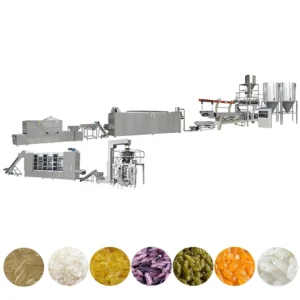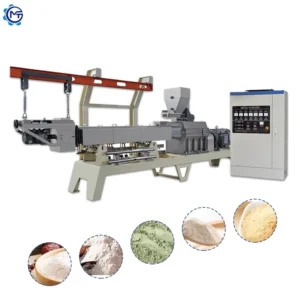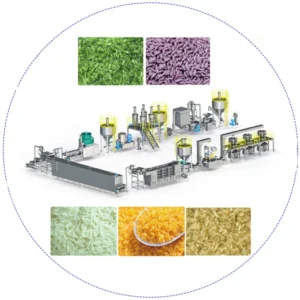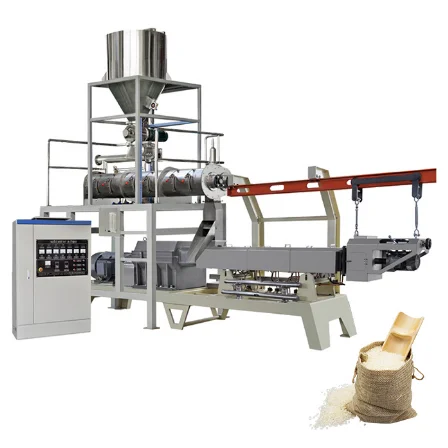


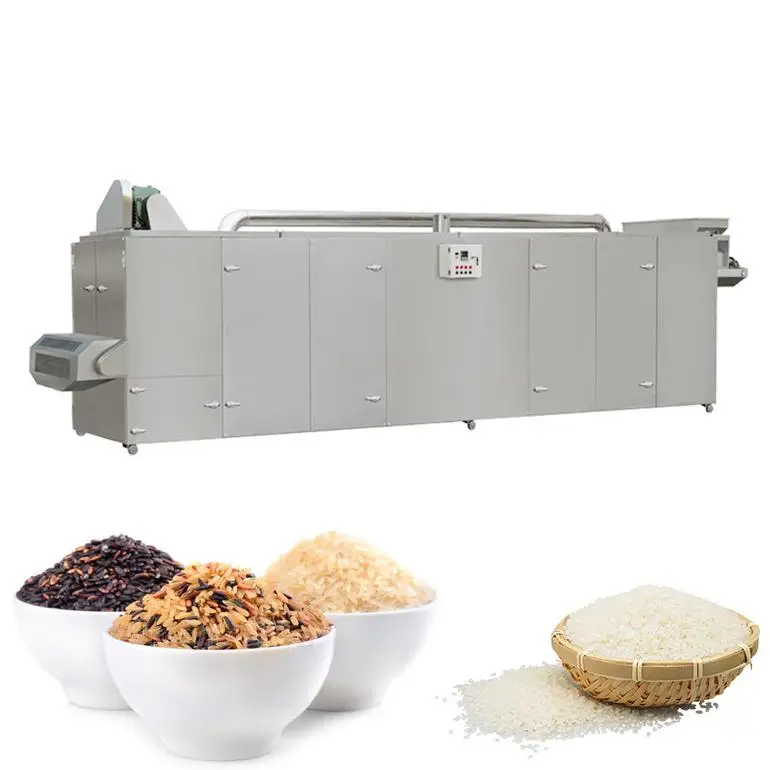
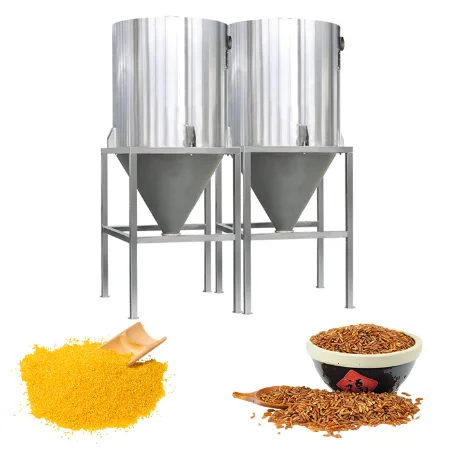

MT65 / MT70 / MT85 / MT75 / MT95 Nutritional Fortified Rice Extrusion Line, Twin-Screw, PLC & MCC Control — configured as a complete turnkey project from batching through extrusion, drying, roasting, cooling and packing.
- Screw configuration and die design matched to your raw material blend and target kernel density
- Throughput balanced across every station to prevent bottlenecks on your specific formulation
- Trial runs performed on your actual raw material in our in-house testing workshop before shipment
Line layout, capacity calculation and electrical schematic confirmed to your facility’s voltage, frequency and control language before production begins.
Description
Throughput-Matched Station Design — every dryer, cooler, and packing head is sized against the extruder’s actual output on your grain formulation, not catalog numbers.
Technical Specifications
| Parameter | Value |
|---|---|
| Model | MT65 / MT70 / MT85 / MT75 / MT95 |
| Product Type | Nutritional Fortified Rice Extrusion Line |
| Screw Type | Twin-screw |
| Installed Power | MT65: 85 kW; MT70: 120 kW; MT85: 235 kW; MT75: 180 kW; MT95: 260 kW |
| Power Consumption | MT65: 60 kW; MT70: 85 kW; MT85: 165 kW; MT75: 135 kW; MT95: 195 kW |
| Output Capacity | MT65: 80–100 kg/h; MT70: 100–120 kg/h; MT85: 200–300 kg/h; MT75: 300–500 kg/h; MT95: 800–1000 kg/h (basis not stated in source — confirm raw material, moisture content, and formulation) |
| Overall Dimensions (L×W×H) | MT65: 28 × 1.2 × 2.2 m; MT70: 30 × 1.5 × 2.2 m; MT85: 34 × 3.5 × 4.3 m; MT75: 32 × 3.5 × 4.3 m; MT95: 36 × 3.5 × 4.3 m |
| Control System | PLC and MCC with frequency speed controlling |
| Feeding System | Single or double screw feeding, selected by material |
| Screw Material | Special wear-resistant technology |
| Lubrication | Automatic lubricating and cooling system |
| Dryer Heating Source | Electric or gas |
| Dryer Feature | Circulation drying with frequency motor mesh belt speed control |
| Line Stations | Mixing → Extruding → Vibrating → Low-temperature drying → Cooling → High-temperature roasting → Cooling → Packing |
| Assembly State | Complete turnkey line |
| Standards | CE declared; ISO certified |
Application Suitability
| Application | Material or Output |
|---|---|
| Government and NGO fortified staple food programmes | Broken rice, corn, millet blended with vitamin and mineral premix — artificial rice kernels with standardised micro-nutrient content |
| Rice millers upgrading by-products | Broken rice and rice bran reprocessed into high-value artificial rice kernels for commercial retail |
| Food manufacturers entering fortified grain markets | Wheat, oats, buckwheat, bean, and starch blends extruded into nutritionally enriched rice-shaped kernels |
| Institutional and school feeding supply chains | Fortified rice kernels produced from locally sourced grains with added iron, zinc, folic acid, and vitamin A |
Why Nominal Line Capacity Fails on Real Grain Blends
A nutritional fortified rice production line turnkey quoted at a catalog output rarely holds that rate once the buyer’s actual grain blend enters the barrel — and the gap widens with every station downstream.
Capacity verification must happen on your specific raw material before the line ships, not after installation.
I spent years on the assembly floor in Jinan before moving into line planning, and the pattern is consistent: a twin-screw extruder rated for a certain throughput on pure rice flour will behave differently when the buyer introduces millet, buckwheat, or bean powder at varying ratios. The starch gelatinisation window shifts, moisture absorption changes, and the die pressure curve moves. If the dryer and cooler downstream were sized for the original catalog number, product piles up or exits under-dried. [NEED_CITE: starch gelatinisation behaviour across mixed grain formulations] This is not a theoretical concern — it is the single most common reason fortified rice projects stall during commissioning.
Matching Extruder Output to Dryer and Cooler Throughput
A nutritional fortified rice production line turnkey operates as a continuous chain where every station must handle the exact mass flow leaving the one before it. The twin-screw extruder sets the pace, but the low-temperature dryer, the cooling conveyor, and the high-temperature roasting stage each have their own residence-time requirements. When we configure a line, we calculate the moisture load exiting the extruder barrel and size the dryer mesh belt length and airflow accordingly. The frequency motor on the dryer belt lets operators fine-tune dwell time, but only within the envelope the physical dryer was built for.
Screw Configuration Against Your Grain Blend
The screw elements inside the barrel — convey pitch, kneading block angle, and reverse-element placement — determine how thoroughly the grain blend is sheared, mixed, and cooked before it reaches the die. A formulation heavy in broken rice with a small vitamin premix addition needs a different screw profile than one built around oat and buckwheat flour with higher fibre content. [NEED_CITE: twin-screw element geometry and residence time distribution in food extrusion] We document the screw configuration matched to each buyer’s raw material and target kernel density, so replacements can be ordered with certainty when wear parts are due.
Reading the Power and Dimension Data
The installed power across the range spans from 85 kW on the MT65 to 260 kW on the MT95, but power consumption — the figure that affects your electricity cost — sits lower at 60 kW to 195 kW respectively. This gap reflects motor starting surge and peak-load headroom versus steady-state draw. Overall line length grows from 28 metres to 36 metres as capacity increases, which directly affects workshop floor planning. The PLC and MCC control system with frequency speed regulation across extruder and dryer means operators can adjust throughput without stopping the line, maintaining batch-to-batch consistency in kernel shape and density. The automatic lubricating and cooling system on the screw shaft reduces manual maintenance intervals, keeping the barrel temperature stable during long production runs.
The Hidden Cost of Skipping Pre-Shipment Trials
When an extruder arrives at a buyer’s facility without a prior trial run on the actual raw material, the commissioning phase becomes the product development phase. Operators spend days adjusting moisture content, screw speed, and die selection to find a workable kernel shape — and every hour of trial production consumes raw material, energy, and labour without generating saleable output. [NEED_CITE: commissioning delays in food extrusion projects without factory trial runs] The downstream stations compound the problem: if the dryer was specified for a faster extrusion rate that the untested formulation cannot sustain, the mesh belt runs partially empty, wasting thermal energy and extending shift times.
Why Buyers Plan Turnkey Rice Projects Here
Complete line stations from batching through packing are configured under one supplier, so throughput is matched across every station rather than assembled from separate vendors with mismatched capacities. Screw configuration and die design are specified to the buyer’s raw material blend and target kernel shape before production begins, not copied from a generic build. The in-house testing workshop runs trial production on the buyer’s actual grain formulation before shipment, confirming output rate, kernel integrity, and drying behaviour. Twin-screw expertise across rice, grain, starch, and protein applications means the same engineering team handles pet food, aquatic feed, and fortified cereal lines, cross-referencing process knowledge. Pre-sales consultation through engineer design, on-site installation, commissioning, and ongoing maintenance keeps the same technical thread from first inquiry to long-term operation.
Documentation & Verification
- Line layout and capacity calculation showing throughput match across every station against your grain blend
- Screw and die configuration record documenting the element profile selected for your formulation
- Trial run report on your actual raw material conducted in the testing workshop before shipment
- Electrical schematic with voltage, frequency, and control language confirmed for your facility
- CE declaration of conformity and ISO certificate for customs and regulatory filing
Installation, Commissioning & Support
- Floor space from 28 to 36 metres in length requires level concrete foundation with drainage for the drying and cooling sections
- Dedicated electrical circuit matching the 60–195 kW steady-state draw, with voltage and frequency confirmed before production
- Line ships in sectional modules; extruder barrel, dryer segments, and cooling conveyors are assembled on-site and aligned
- First-run commissioning includes screw speed, die pressure, and dryer mesh belt frequency calibration against your grain blend
- Operator training covers PLC interface navigation, feeding system adjustment, and automatic lubrication monitoring
- Wear parts list with screw elements, die plates, and feeding screws documented for reorder planning
What We Need to Configure Your Line
To prepare a line layout and capacity proposal, share your primary grain materials and their ratios, the vitamin or mineral premix composition, and your target daily output in finished kernels. Provide your workshop length, width, and ceiling height so we can map the station sequence. Confirm your local voltage, phase, and frequency, and whether you prefer electric or gas heating for the dryer — these decisions lock in the electrical schematic and utility connections before production starts.
Frequently Asked Questions
Q: How is line capacity verified against my specific raw material blend?
A: We run a trial on your actual grain formulation in our testing workshop before shipment. The extruder output rate, kernel density, and drying behaviour are measured under controlled conditions, and the results are documented in a trial run report. This confirms whether the selected model holds the projected throughput on your blend rather than on a generic reference material.
Q: What does the phased installation and commissioning schedule look like?
A: The line arrives in sectional modules sized to fit standard shipping containers. Foundation and utility stubs must be ready before arrival. Assembly, mechanical alignment, and electrical connection typically take several weeks depending on line length. Commissioning then proceeds station by station, starting with the extruder and moving through drying, roasting, cooling, and packing once each stage is validated.
Q: How are extruder throughput and dryer capacity matched to prevent bottlenecks?
A: We calculate the mass flow and moisture load exiting the extruder at the confirmed output rate, then size the dryer mesh belt length, airflow volume, and heating capacity to handle that exact load. The cooling conveyor and packing station are scaled to the same figure. This prevents product backlog at any point in the nutritional fortified rice production line turnkey.
Q: Can a trial run be performed on my raw material before the line ships?
A: Yes. Send a representative sample of your grain blend and premix to our testing workshop. We run the material through the configured extruder and document kernel shape, expansion ratio, moisture content after drying, and overall output rate. You receive the trial run report before approving shipment.
Q: What utility details must be confirmed before production begins?
A: Voltage, phase, and frequency at your facility determine the motor and control panel specification. You also need to confirm whether the dryer will use electric or gas heating, the available compressed air pressure for pneumatic components, and the water supply for the automatic lubrication and cooling system. These are locked into the electrical schematic before manufacturing.
Related products
-
Healthy Baby Food Production Line Nutritional Powder Equipment for Baby Food Supplements for Flour Processing Machinery
¥8,500.00 Select options This product has multiple variants. The options may be chosen on the product page -

Compact Automatic Baby Cereal Nutrition Powder Production Line with 500kg/h Capacity and PLC Control
¥9,500.00 Add to cart -

High Precision Automatic 500kg/h Baby Food Nutrition Powder Rice Extrusion Processing Line
¥8,238.27 Add to cart -

Automatic Instant Powder Production Line Nutritional Powder Extruder Machine
¥10,000.00 Select options This product has multiple variants. The options may be chosen on the product page