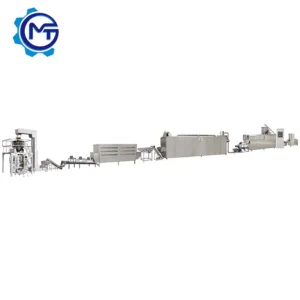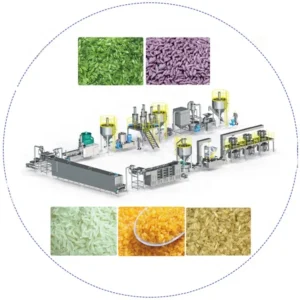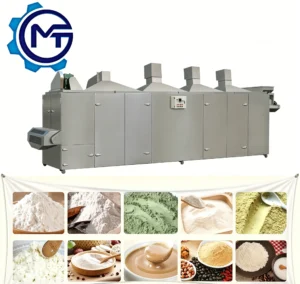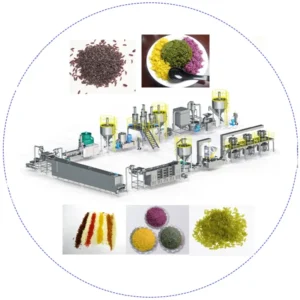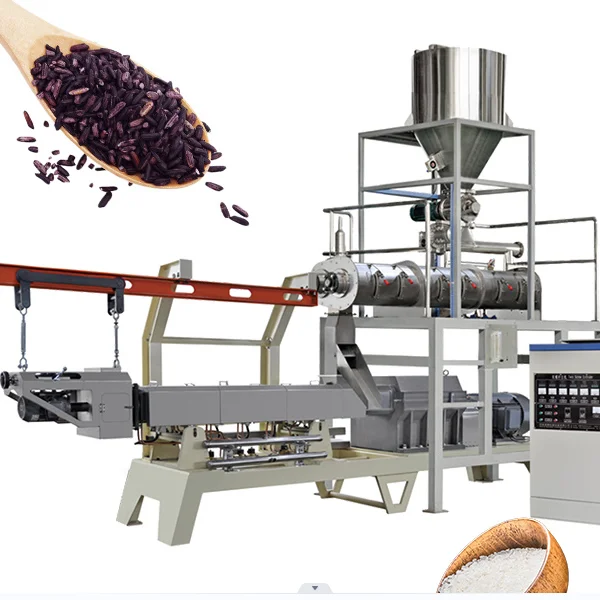
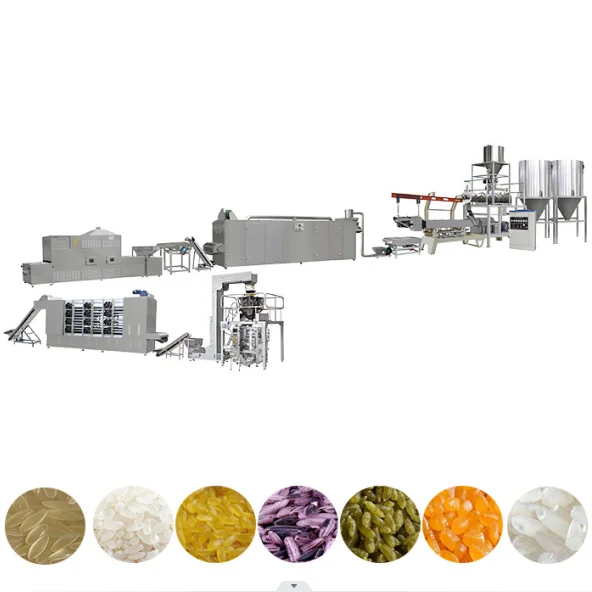
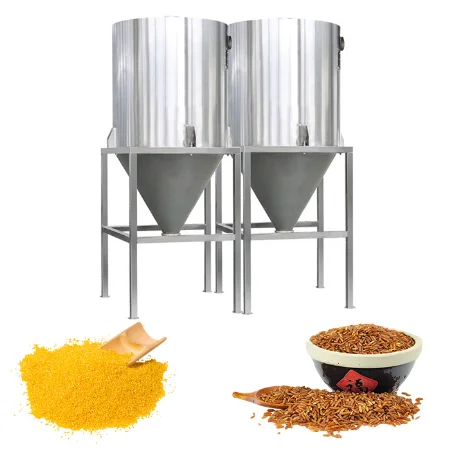

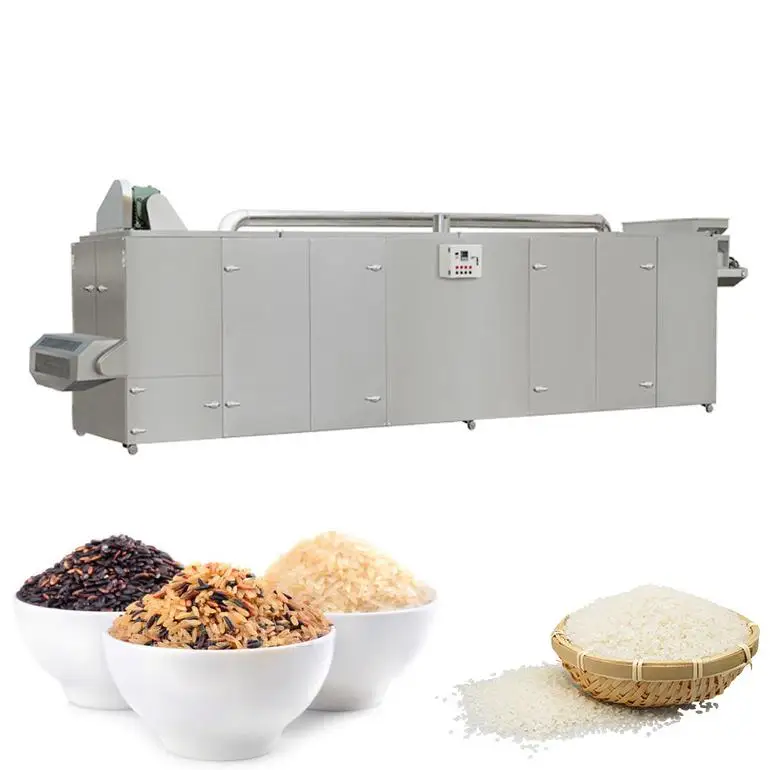
MT65 / MT70 / MT85 / MT75 / MT95 Fortified Rice Extrusion Line, Twin-Screw, CE Certified — configured as a complete turnkey project from batching through extrusion, drying, roasting and packing, with throughput matched across every station to prevent bottlenecks. Screw and die design specified to your grain formulation and vitamin premix for consistent kernel density and nutritional retention.
- In-house trial runs on your raw material validate product quality before shipment
- Electrical schematics and voltage confirmed for your local grid prior to production
- On-site installation, commissioning and operator training included with phased rollout planning
Description
Turnkey Line Integration — We engineer the entire fortified rice production sequence from batching to packing as a single coordinated system, matching throughput at every station so no downstream bottleneck limits your extruder output.
Technical Specifications
| Parameter | Value |
|---|---|
| Product Type | Fortified Rice Extrusion Line |
| Installed Power | MT65 — 85 kW; MT70 — 120 kW; MT85 — 235 kW; MT75 — 180 kW; MT95 — 260 kW |
| Power Consumption | MT65 — 60 kW; MT70 — 85 kW; MT85 — 165 kW; MT75 — 135 kW; MT95 — 195 kW |
| Output Capacity | 80–1000 kg/h across model range (basis not stated in source — confirm raw material formulation and moisture content) |
| Overall Dimensions (L×W×H) | MT65 — 28×1.2×2.2 m; MT70 — 30×1.5×2.2 m; MT85 — 34×3.5×4.3 m; MT75 — 32×3.5×4.3 m; MT95 — 36×3.5×4.3 m |
| Screw Type | Twin-screw |
| Feeding System | Single or double screw feeding, selected by material type |
| Control System | Frequency speed controlling with high automation |
| Lubrication | Automatic lubricating and cooling system |
| Screw Material | Special alloy steel, wear-resistant |
| Dryer Heating Source | Electric or gas |
| Dryer Feature | Circulation drying with variable-speed mesh belt, frequency motor controlled |
| Production Procedure | Mixing → Extruding → Vibrating → Low temperature drying → Cooling → High temperature roasting → Cooling → Packing |
| Certification | CE |
Application Suitability
| Application | Material or Output |
|---|---|
| Fortified nutritional rice production | Broken rice, corn, millet blended with vitamin and mineral premix |
| Artificial rice from grain by-products | Wheat, oats, buckwheat and starch as base ingredients |
| Government and NGO food programme supply | Fortified rice kernels meeting regional nutritional standards |
| Value-added grain processing | Bean flour and milled grain fractions reformed into uniform rice-shaped kernels |
Why Line-Level Throughput Matching Matters for Fortified Rice Production
A Fortified Rice Production Line Turnkey only performs as well as its slowest station.
I worked on a nutritional rice project where the extruder was sized correctly, but the dryer was undersized for the actual moisture load coming off the die. The result was a line that technically ran but could never hold its rated output because wet kernels piled up waiting for drying space. The buyer ended up replacing the dryer six months later and reconfiguring the floor layout to fit a larger unit [NEED_CITE: common line imbalance issues in grain extrusion projects]. That kind of retrofit is expensive and disruptive, especially when your commissioning schedule is already tight.
A Fortified Rice Production Line Turnkey avoids this by calculating throughput at every station — mixer batch cycle, extruder output, dryer belt speed, roaster dwell time and packing rate — against your specific grain formulation before the equipment is built.
Station-by-Station Throughput Calculation
Each station in the fortified rice manufacturing plant is sized against the actual output of the preceding stage. The mixer batch volume is matched to the extruder’s continuous feed rate, and the dryer belt width and length are calculated based on the moisture removal required for your specific formulation. This eliminates the common problem where one station forces the entire Fortified Rice Production Line Turnkey to run below capacity.
Utility Planning Across the Full Line Footprint
Electrical load, gas supply for the roaster, ventilation for the drying section and water supply for the cooling stages are mapped out before installation begins. The automatic lubricating and cooling system on the twin-screw extruder requires its own dedicated circuit separate from the dryer heating elements. Utility planning at the design stage prevents the situation where a facility’s existing electrical panel cannot support simultaneous operation of the extruder and dryer [NEED_CITE: electrical infrastructure requirements for food extrusion facilities].
Specifying the Extruder Within a Complete Line Context
The twin-screw extruder is available in five models spanning different capacity ranges, each with distinct installed power and dimensional footprint. Selection is not based on extruder output alone — the downstream drying and roasting capacity must absorb the full extruder throughput at the moisture level your grain blend requires. The special alloy steel screw elements and frequency-controlled feeding system maintain consistent material flow, which is essential because any surge or starvation at the extruder propagates through every subsequent station.
Reading the Specs Against Your Raw Material
The installed power figures — ranging from 85 kW on the smallest model to 260 kW on the largest — indicate the thermal and mechanical energy available for starch gelatinisation inside the barrel. Higher installed power allows the extruder to handle grain blends with higher starch content that demand more shear energy. The overall dimensions include the full production procedure sequence from mixing through packing, so the footprint figures represent the complete line length rather than the extruder alone. Power consumption values are lower than installed power because heating elements cycle and motors do not run at full load continuously [NEED_CITE: typical load factor calculations for twin-screw food extruders]. The circulation dryer’s frequency-controlled mesh belt allows belt speed adjustment to control dwell time, which directly determines final kernel moisture content.
The Cost of Undersized Supporting Equipment
When a dryer or cooler is specified from a generic catalogue rather than calculated against the extruder’s actual output, the line develops a hidden constraint that only appears during continuous production runs. The extruder must be slowed down to match the dryer, reducing your effective output below what you planned for. In nutritional rice production, inconsistent drying also affects kernel integrity — under-dried kernels crack during the high-temperature roasting stage, increasing waste [NEED_CITE: effect of moisture uniformity on extruded rice kernel quality]. These problems are difficult to diagnose because each individual machine appears to be functioning correctly.
Why This Line Configuration Works for Turnkey Projects
Every station from the batching system through extrusion, vibrating, low-temperature drying, cooling, high-temperature roasting and packing is designed and supplied together, so throughput is matched by calculation rather than assumption. The in-house testing workshop runs your actual grain blend and vitamin premix before shipment, validating that the screw configuration and temperature profile produce the correct gelatinisation and kernel density. Electrical schematics and voltage are confirmed against your facility’s grid before production begins, avoiding commissioning delays. The automatic lubricating system on the extruder reduces unplanned stops during long production campaigns. On-site installation follows a phased schedule with operator training built into the commissioning period.
Documentation & Verification
- Line layout and capacity calculation showing throughput at each station for your grain formulation
- Trial run report on your specific raw material blend from the in-house testing workshop
- Electrical schematic and voltage confirmation matched to your local grid standard
- Screw and die configuration record for your target kernel shape and density
- Operation and maintenance manual covering every station in the production sequence
- CE declaration of conformity for the complete line
Installation, Commissioning & Support
- Floor plan and foundation requirements based on the selected model’s overall dimensions and weight
- Dedicated electrical circuits sized to the extruder’s installed power plus dryer heating load
- Phased assembly sequence from extruder placement through downstream station alignment
- First-run parameter setting for barrel temperature profile and dryer belt speed
- Operator training on the frequency-controlled feeding and automatic lubrication system
- Wear parts list covering screw elements, die inserts and dryer belt sections
What We Need to Configure Your Line
To prepare a line layout and capacity proposal, share your primary grain ingredients and vitamin premix formulation, your target daily output, and the available floor space with ceiling height in your facility. We also need your local voltage and frequency standard so that the control panels and motor drives are specified correctly before manufacturing begins. If you have existing upstream milling or downstream packing equipment, provide the interface specifications so the line can be integrated.
Frequently Asked Questions
Q: How is throughput matched across every station so the dryer or cooler never bottlenecks the extruder?
A: We calculate the material flow at each station based on your specific grain formulation and moisture content. The dryer belt length, roaster capacity and cooler airflow are all sized to handle the extruder’s full output, so no single station forces the line to run below its designed capacity.
Q: What utility planning is required for the complete line footprint?
A: The full line requires electrical supply for the extruder motor, dryer heating elements and frequency-controlled drives, plus gas supply if the roaster uses gas heating. Ventilation is needed for the drying and roasting sections. We provide a utility requirements document matched to your selected model before installation.
Q: Can a trial run on our specific grain formulation and vitamin premix be conducted before shipment?
A: Yes. The in-house testing workshop runs your actual raw materials through the extruder with the specified screw and die configuration. A trial run report is provided showing kernel density, gelatinisation degree and moisture content, so product development is validated before the line ships.
Q: How is voltage, frequency and control panel language confirmed before production?
A: We collect your local grid specifications and operator language preference during the design phase. The electrical schematic and motor drive configuration are built to match, and control panel labels and PLC interface language are set accordingly, preventing delays when the line is powered up on site.
Q: What does the phased installation and commissioning schedule look like?
A: Installation follows a sequence from extruder and mixer placement through downstream station alignment, utility connection and individual station testing. Commissioning includes first-run parameter setting, throughput verification at each station and operator training. The schedule is planned around your facility readiness and any existing equipment integration requirements.
Related products
-
Organic Gluten Free Baby Rice Nutrition Powder Automatic 500kg/h Production Processing Line
¥8,238.27 Add to cart -
Hygienic Stainless Steel Infant Rice Powder Processing Line Automatic 500kg/h Capacity PLC Controlled
¥9,500.00 Add to cart -
Fully Automatic Fortified Nutrition Powder Baby Food Production Line
¥8,238.27 Select options This product has multiple variants. The options may be chosen on the product page -
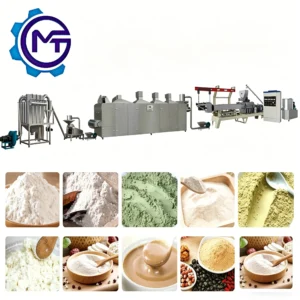
Fully Automatic 500kg/h Baby Cereal Nutrition Powder Extrusion Drying Line with PLC Control
¥9,500.00 Add to cart