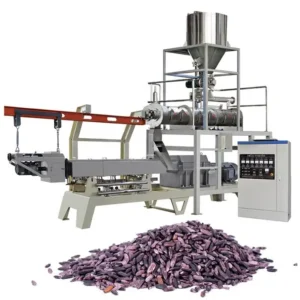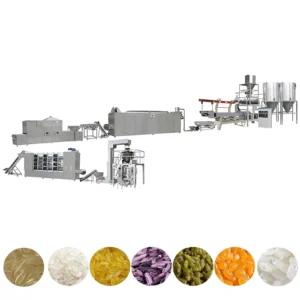
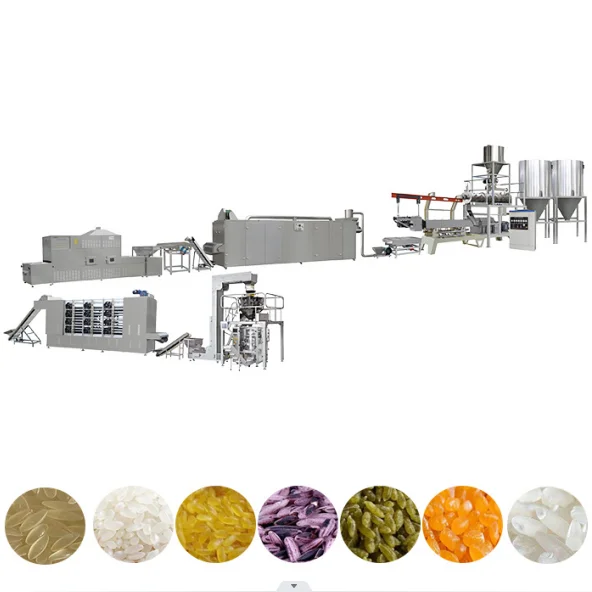

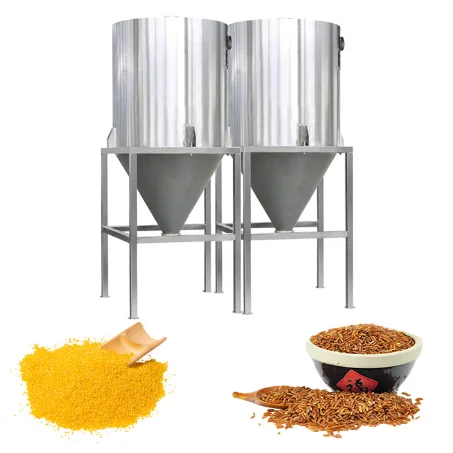
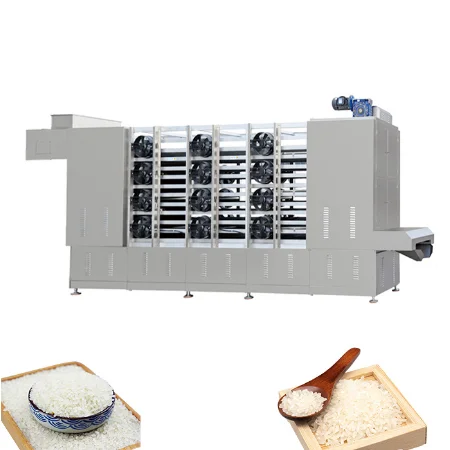

MT65, MT70, MT85, MT75, MT95 Fortified Rice Processing Line, Twin-Screw Extrusion, Automatic Lubricating System — engineered as a complete turnkey project from batching through extrusion, drying, roasting, and packing under one supplier.
- Screw configuration and die design matched to your raw material blend and target kernel density
- Circulation drying with frequency motor-controlled mesh belt for flexible moisture adjustment
- Capacity tiers from laboratory scale to continuous production in one line layout
Every station is throughput-matched to eliminate bottlenecks, backed by a pre-shipment trial run on your raw material in our testing workshop.
Description
Throughput-Matched Engineering — Every station in this fortified rice processing line is sized against the others under one supplier, so extruder output never waits on a smaller dryer or roaster.
Technical Specifications
| Parameter | Value |
|---|---|
| Product Type | Fortified Rice Processing Line |
| Available Models | MT65, MT70, MT75, MT85, MT95 |
| Screw Type | Twin-screw |
| Installed Power | 85 kW (MT65) / 120 kW (MT70) / 180 kW (MT75) / 235 kW (MT85) / 260 kW (MT95) |
| Power Consumption | 60 kW (MT65) / 85 kW (MT70) / 135 kW (MT75) / 165 kW (MT85) / 195 kW (MT95) |
| Output Capacity | 80–100 kg/h (MT65) to 800–1000 kg/h (MT95) (basis not stated in source — confirm raw material composition, moisture content, and pellet size) |
| Overall Dimensions | 28 × 1.2 × 2.2 m (MT65) to 36 × 3.5 × 4.3 m (MT95) |
| Control System | Frequency speed control with high automation |
| Feeding System | Single or double screw feeding, selected per material characteristics |
| Lubrication | Automatic lubricating and cooling system |
| Dryer Heating Source | Electric or gas |
| Dryer Feature | Circulation drying with frequency motor-controlled mesh belt speed |
| Production Procedure | Mixing → Extruding → Vibrating → Low temperature drying → Cooling → High temperature roasting → Cooling → Packing |
| Certification | CE (line-level declaration to be confirmed per model) |
Application Suitability
| Application | Material or Output |
|---|---|
| Fortified rice kernel production | Broken rice, rice bran, corn, millet, wheat, oats, buckwheat, beans, starch with vitamin and mineral premix |
| Artificial nutritional rice | Rice flour blends with added micronutrients shaped into natural rice kernel form |
| Instant rice porridge base | Pre-gelatinised extruded rice pellets for quick-cook porridge formats |
| Nutrition programme supply | Vitamin- and mineral-enriched rice kernels for institutional feeding programmes |
What "Nominal Capacity" Means When Stations Are Mismatched
A line is only as fast as its slowest station, and mismatched throughput between extruder, dryer, and roaster is the most common reason buyers never reach quoted output.
I watched a nutrition programme supplier install a line where the extruder could push well beyond the dryer’s moisture removal rate. The mesh belt simply could not carry enough product through the heating zones, so half the extruded kernels sat in bins waiting for dryer space. That bottleneck cost them months of lost production before a larger dryer was retrofitted [NEED_CITE: dryer capacity matching in extrusion line design]. When sourcing a fortified rice processing line turnkey, the question is never just what the extruder can produce — it is whether every downstream station can keep pace on your specific raw material blend.
Screw Configuration Against Your Ingredient Blend
The twin-screw extruder in this fortified rice processing line is configured with screw elements and die geometry matched to your raw material formulation. Broken rice behaves differently from corn or buckwheat under shear and heat — starch gelatinisation temperature, fibre content, and fat level all change how the material flows through the barrel. A die designed for high-amylose rice flour will produce the wrong kernel density if the buyer later switches to an oat-heavy blend without reconfiguring.
Circulation Drying With Controlled Belt Speed
Moisture removal is where kernel integrity is won or lost. The circulation dryer uses a frequency motor-controlled mesh belt, meaning belt speed adjusts independently of the extruder feed rate. Low temperature drying preserves the shape of delicate fortified kernels before they move to high temperature roasting for final texture. This two-stage approach prevents case hardening — a surface shell that traps internal moisture and causes kernels to crack during storage [NEED_CITE: drying profile effects on extruded rice kernel stability].
Reading the Power and Footprint Data
Installed power ranges from 85 kW on the MT65 to 260 kW on the MT95, but power consumption — the figure that actually affects your utility cost — sits lower at 60 kW to 195 kW across the same range. The gap between installed and consumed power reflects motor headroom for startup surges and denser material loads. Footprint scales accordingly: the MT65 fits within roughly 28 metres of linear floor space, while the MT95 extends to 36 metres with a wider and taller profile at 3.5 × 4.3 m to accommodate the larger dryer and roaster assemblies. The automatic lubricating and cooling system on the extruder reduces manual greasing intervals, which matters when running continuous shifts. Feeding system selection — single or double screw — depends on whether your premix includes fine mineral powders that tend to bridge in a single-screw hopper.
The Cost of Skipping Pre-Shipment Verification
Buyers who accept a line without a pre-shipment trial run on their own raw material often discover texture and density problems only after installation. Kernels that look correct at the factory may fracture during drying if the screw configuration was set for a different formulation. Reworking screw elements and die plates on-site means weeks of trial and error with production material — material that should have been making saleable product [NEED_CITE: extrusion trial run protocols before equipment shipment]. Electrical mismatches compound the problem: if voltage and frequency were not confirmed against your local utility standard before the control panel was wired, commissioning stalls until transformers or drives are replaced.
Why Source This Line Here
Every station from mixing through packing is engineered under one supplier, so throughput calculations account for actual material flow between extruder, dryer, roaster, and cooler rather than assuming generic transfer rates. Screw configuration and die design are specified to your raw material blend and target kernel density before production begins. An in-house testing workshop allows trial runs on customer-supplied ingredients before the line ships, catching formulation issues early. Five model tiers from MT65 to MT95 let buyers plan phased capacity scaling within the same equipment family. Pre-sales consultation extends through on-site installation, commissioning, and ongoing maintenance support.
Documentation & Verification
- Line layout and capacity calculation showing throughput matched across mixing, extrusion, drying, roasting, and packing stations
- Screw and die configuration record specified to your raw material formulation and target kernel shape
- Trial run report on your ingredient blend conducted in the testing workshop before dispatch
- Electrical schematic with voltage, frequency, and control language confirmed to your local standard
- CE declaration of conformity and factory test record for your specific line configuration
Installation, Commissioning & Support
- Foundation and floor space planning based on your selected model footprint, up to 36 × 3.5 × 4.3 m for the MT95
- Dedicated electrical circuits sized to your model’s installed power, from 85 kW to 260 kW, with voltage and frequency matched to local supply
- Modular station delivery with on-site assembly, belt alignment, and mesh belt tensioning for the circulation dryer
- First-run parameter setting including barrel temperature profile, screw speed, and dryer belt frequency adjusted to your material
- Operator training covering feeding system changeover between single and double screw configurations for different premix types
- Wear parts list including screw elements, die plates, and mesh belt sections with recommended replacement intervals
What to Include in Your Inquiry
To configure the right fortified rice processing line turnkey for your facility, share your primary grain base and any supplemental ingredients including vitamin and mineral premixes. Specify your target daily output and whether you plan phased scaling. Include your local voltage, frequency, and preferred control panel language so the electrical design aligns before production starts.
Frequently Asked Questions
Q: How is the line capacity verified against my specific raw material blend and moisture content?
A: We run a trial in our testing workshop using your actual ingredient formulation. The extruder screw configuration and die design are set to your blend, and output is measured under realistic moisture and feed conditions. Results are documented in a trial run report shared before shipment, so you know what throughput to expect on your material rather than relying on generic capacity figures.
Q: How do you match extruder, dryer, and roaster throughput so no station becomes a bottleneck?
A: Each station is sized against the others during the line layout phase. The extruder output rate determines the dryer belt width and heating zone length, and the roaster capacity is calculated from the dried kernel flow rate. This throughput matching is documented in the capacity calculation, so every station can sustain the line’s rated output without product queuing between stages.
Q: What is the phased installation and commissioning schedule for a complete turnkey line?
A: Installation follows a station-by-station sequence — extruder and feeding system first, then dryer and cooler, followed by roaster and packing. Commissioning proceeds through dry runs, then wet runs with your material, adjusting barrel temperature, screw speed, and dryer belt frequency. The schedule depends on your model selection and site readiness, and is confirmed during the project planning stage.
Q: Can voltage, frequency, and control language be confirmed to my local market standard before production?
A: Yes. Electrical specifications are confirmed during the proposal stage and locked into the electrical schematic before the control panel is built. This covers supply voltage, frequency, plug and breaker standards, and the language used on the frequency control interface. Confirming these details early avoids commissioning delays caused by incompatible drives or transformers.
Q: What does the pre-shipment trial run in the testing workshop cover, and how are results documented?
A: The trial covers extrusion behaviour, kernel shape and density, drying profile, and final roasted texture using your raw material. Screw speed, barrel temperature zones, and die selection are adjusted until the output matches your product specification. A written report records all parameters and sample results, giving you a reference baseline for production startup at your facility.
Related products
-
Fully Automatic Fortified Nutrition Powder Baby Food Production Line
¥8,238.27 Select options This product has multiple variants. The options may be chosen on the product page -
Fully Automatic 500kg/h Baby Cereal Nutrition Powder Extrusion Drying Line with PLC Control
¥9,500.00 Add to cart -

Full Automatic Complete Baby Food Nutrition Powder Porridge Processing Production Line for Infant Nutrition Factory
¥9,500.00 Add to cart -

New Automatic Nutritional Powder Making Machine for Baby Food Production Line
¥20.00 Select options This product has multiple variants. The options may be chosen on the product page