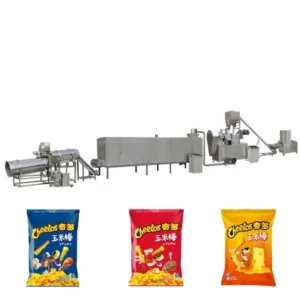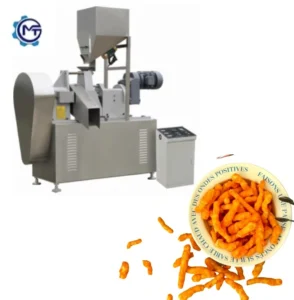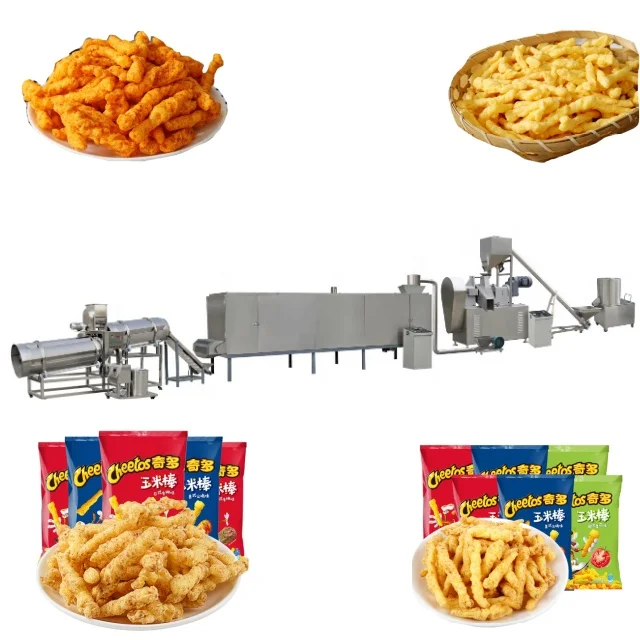
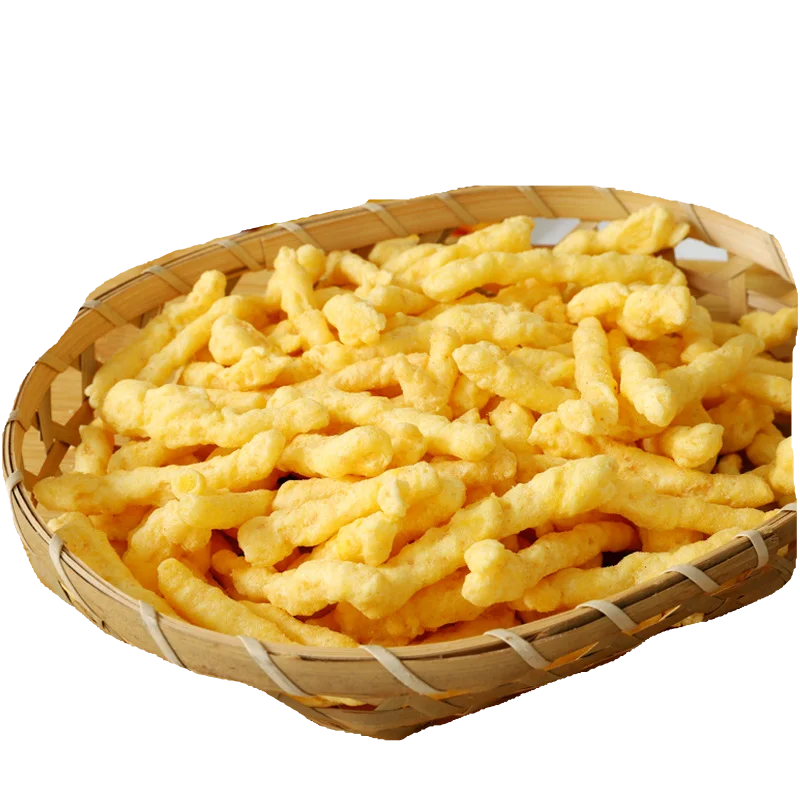
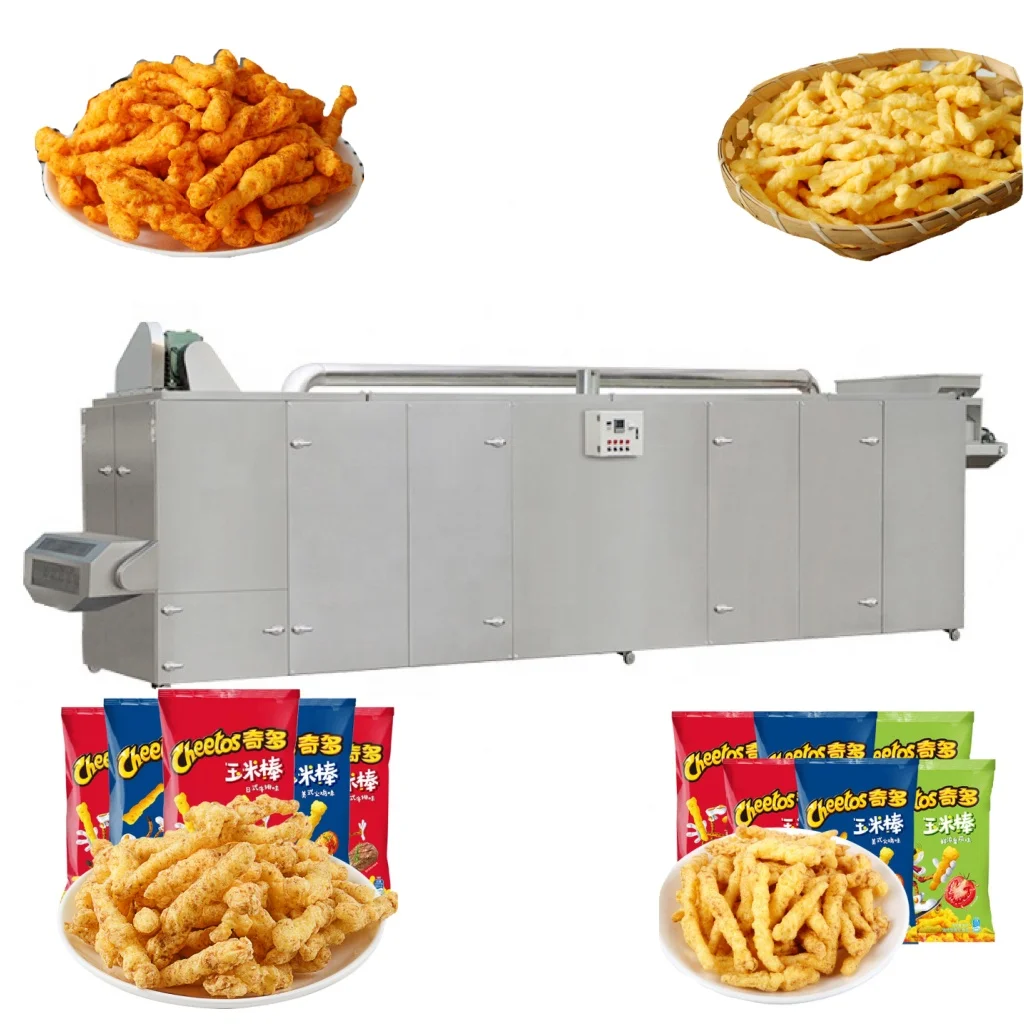


Fried Extruded Snack Production Line, 250 kg/h Output, 304 Stainless Steel — designed for consistent Cheetos, Kurkure and NikNak formats with matched throughput from extrusion through frying to flavouring.
- Single-screw extruder configured with screw geometry and die design matched to corn-based formulations, controlling moisture shear and expansion density
- Dual-voltage 220V / 380V compatibility with PLC and MCC control for international deployment
- Line capacity calculation and layout document provided to confirm station-to-station throughput balance before shipment
Description
Throughput-Matched Line Integration — Every station on this fried extruded snack line, from mixer to flavouring drum, is sized against the extruder output so no single unit chokes the flow during sustained production runs.
Technical Specifications
| Parameter | Value |
|---|---|
| Product Type | Fried Extruded Snack Production Line (Cheetos / Kurkure / NikNak) |
| Output Capacity | 250 kg/h (basis not stated in source — confirm raw material, moisture content and product format) |
| Voltage & Frequency | 220V / 380V (frequency to be confirmed with destination market) |
| Construction Material | 304 Stainless Steel (food-contact zones) and Carbon Steel (structural frame) |
| Control System | PLC / MCC available based on buyer specification |
| Line Stations | Mixing, extrusion, frying, flavouring / coating |
| Extruder Type | Single-screw extruder typical for Kurkure / Cheetos format (verify against final configuration) |
| Certification | CE (company-level, confirm applicability to specific line build), ISO |
Application Suitability
| Application | Material or Output |
|---|---|
| Kurkure-style fried snack production | Corn grits, corn flour, and blended cereal bases |
| Cheetos-format puffed snack lines | Maize and rice flour blends with seasoning adhesion targets |
| NikNak-style extruded snack manufacturing | Cereal-based formulations requiring controlled expansion and oil absorption |
| Pilot runs for new snack concepts | Small-batch recipe trials before full-scale commitment |
What the Capacity Figure Actually Means on a Kurkure Cheetos Making Machine Production Line
A quoted capacity number means nothing until it is tied to your exact raw material, moisture content, and target product density.
I have watched lines sit idle because the extruder was rated on paper for one output, but the buyer’s corn blend had soy protein added, shifting gelatinisation behaviour and dropping real throughput. On a kurkure cheetos making machine production line, the barrel temperature profile and screw pitch must match the starch composition you actually run — not the standard test flour the factory keeps on hand [NEED_CITE: raw material variability and extrusion throughput correlation]. Without that match, the number on the nameplate stays on the nameplate.
Station-by-Station Throughput Balancing
The extruder sets the pace, but a kurkure cheetos making machine production line only holds its rated rhythm when the fryer, de-oiling conveyor, and flavouring drum each handle the same mass flow per minute. If the fryer basket cycle is slower than the extruder output, product backs up and moisture content drifts. We size every downstream unit against the extruder’s real-world discharge rate, not a theoretical maximum.
Screw Geometry and Product Texture
For Cheetos and Kurkure formats, the single-screw profile governs how much shear the corn dough experiences before it exits the die. A deeper flight angle pushes more volume but reduces residence time, which can leave the centre undercooked. We adjust screw pitch and barrel zone temperatures based on the buyer’s flour blend during the in-house trial, so the expansion and surface blistering match market expectations before the line ever ships [NEED_CITE: single-screw extrusion shear and expansion control in snack applications].
Decoding the Core Parameters
The 304 Stainless Steel contact surfaces matter most at the die face and fryer basket, where product temperature and oil exposure are highest; carbon steel in the structural frame keeps weight and cost manageable without touching the food. The 220V / 380V dual-voltage option means the motor and heating elements can be wound for either supply, but frequency must be confirmed separately — running a 50 Hz motor on 60 Hz power shifts extruder screw speed and fryer heating curves. The PLC versus MCC choice affects how operators interact with barrel temperature zones and fryer oil temperature; PLC allows recipe storage and repeatable batch calls, while MCC relies on manual dial settings that vary between shifts.
The Cost of Skipping the Configuration Step
Buyers who order a kurkure cheetos making machine production line on capacity alone, without locking in screw configuration and die geometry to their recipe, often face weeks of post-installation tuning. The extruder runs, but product density wanders outside what the local market accepts, and the fryer oil degrades faster because moisture content at the die exit is inconsistent [NEED_CITE: post-installation commissioning delays in snack extrusion lines]. Reworking screw elements and die orifice diameter on-site costs more in downtime than a pre-shipment trial run ever would.
Why Source the Full Line from One Build
Sizing the fryer, de-oiling belt, and flavouring drum to the extruder output under one supplier eliminates the blame-shifting that happens when stations come from different vendors. The in-house testing workshop runs your actual raw material before dispatch, producing a trial report with barrel temperatures and screw speeds already documented. Electrical schematics arrive with your confirmed voltage, frequency, and control language, so the electrician on your floor does not spend the first week rewiring cabinets. Wear parts like screw segments and die plates ship with the line, and replacements are catalogued against your specific configuration rather than a generic build.
Documentation & Verification
- Line layout drawing showing throughput match across mixing, extrusion, frying, and flavouring stations
- Trial run report generated on your raw material blend with recorded barrel temperatures and screw speeds
- Screw and die configuration sheet specifying pitch, flight depth, and die orifice diameter for your product
- Electrical schematic with confirmed voltage, frequency, and PLC or MCC control language for your market
- CE declaration of conformity and ISO certificate covering the manufacturing facility
- Factory test record documenting continuous run performance before crate packing
Installation, Commissioning & Support
- Foundation plan showing load points for extruder, fryer, and flavouring drum with anchor bolt positions
- Dedicated power circuit sizing for 220V / 380V supply matching confirmed motor and heater loads
- Assembled extruder barrel and screw set installed on-site with alignment check against die face
- First-run parameter log capturing barrel zone temperatures, fryer oil temperature, and screw RPM
- Operator training on PLC recipe recall or MCC manual dial adjustment for each production batch
- Wear parts list identifying screw segments, die plates, and fryer basket seals with reorder codes
Before You Send the Inquiry
Share the exact corn flour or cereal blend you plan to run, including any protein or fibre additives, so we can configure the screw and die before the trial. Let us know your local voltage and frequency, the control language your operators need, and whether your workshop floor space has height restrictions that affect the fryer hood and exhaust duct routing. If you have an existing packing system downstream, tell us the infeed conveyor height so the flavouring drum discharge aligns.
Frequently Asked Questions
Q: How is output capacity verified, and what raw material basis is it tied to?
A: The 250 kg/h figure must be confirmed against your specific corn blend, moisture content, and target product format. We run your actual raw material in our testing workshop and document the real throughput, barrel temperatures, and screw speeds in a trial report before the line ships.
Q: How do you balance throughput between the extruder, fryer, and flavouring drum?
A: Each station is sized so its cycle time matches the extruder discharge rate. The fryer basket volume, oil turnover, and de-oiling belt speed are calculated from the extruder output, preventing product backup or moisture drift at any point on the line.
Q: What voltage, frequency, and control language options are confirmed before shipment?
A: We confirm your local supply voltage and frequency and wind motors and heaters accordingly. The PLC interface or MCC labels are set to your operators’ language, and the electrical schematic reflects these choices before the control cabinet leaves the factory.
Q: Is a trial run on my raw material done before the line ships?
A: Yes. Your raw material is run in our in-house testing workshop, and the trial report records the screw configuration, die selection, barrel temperature profile, and real output. This report ships with the line so commissioning starts from a known baseline.
Related products
-
Turnkey Solution Corn Flakes Breakfast Cereal Production Line
Read more -

Turnkey Solution Corn Flakes Production Line for Breakfast Cereal
Read more -
Kurkure Cheetos Making Machine for Corn Snacks – Turnkey Solution
Read more -
New MT 120-350kg/h Fully Automatic Multifunctional Cheetos Kurkure Processing Line Electric Heat Source 304 Stainless Steel
¥8,500.00 Select options This product has multiple variants. The options may be chosen on the product page