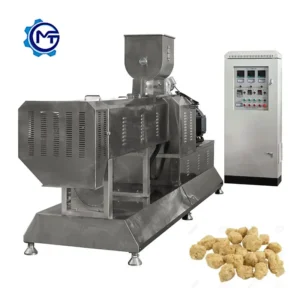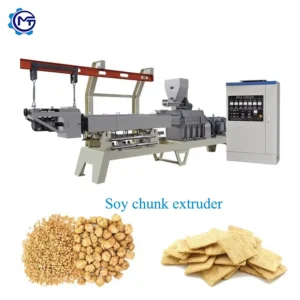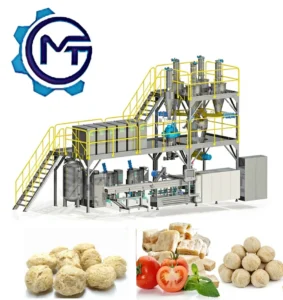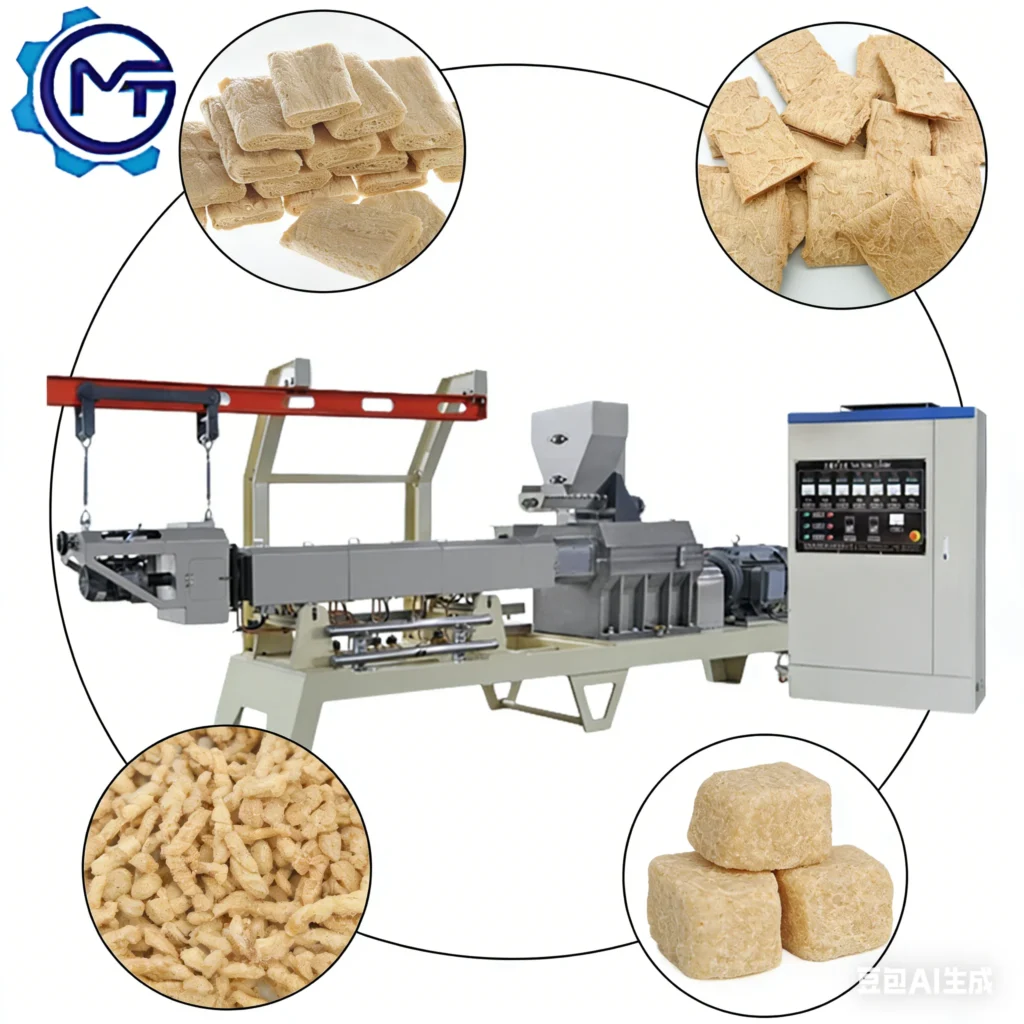
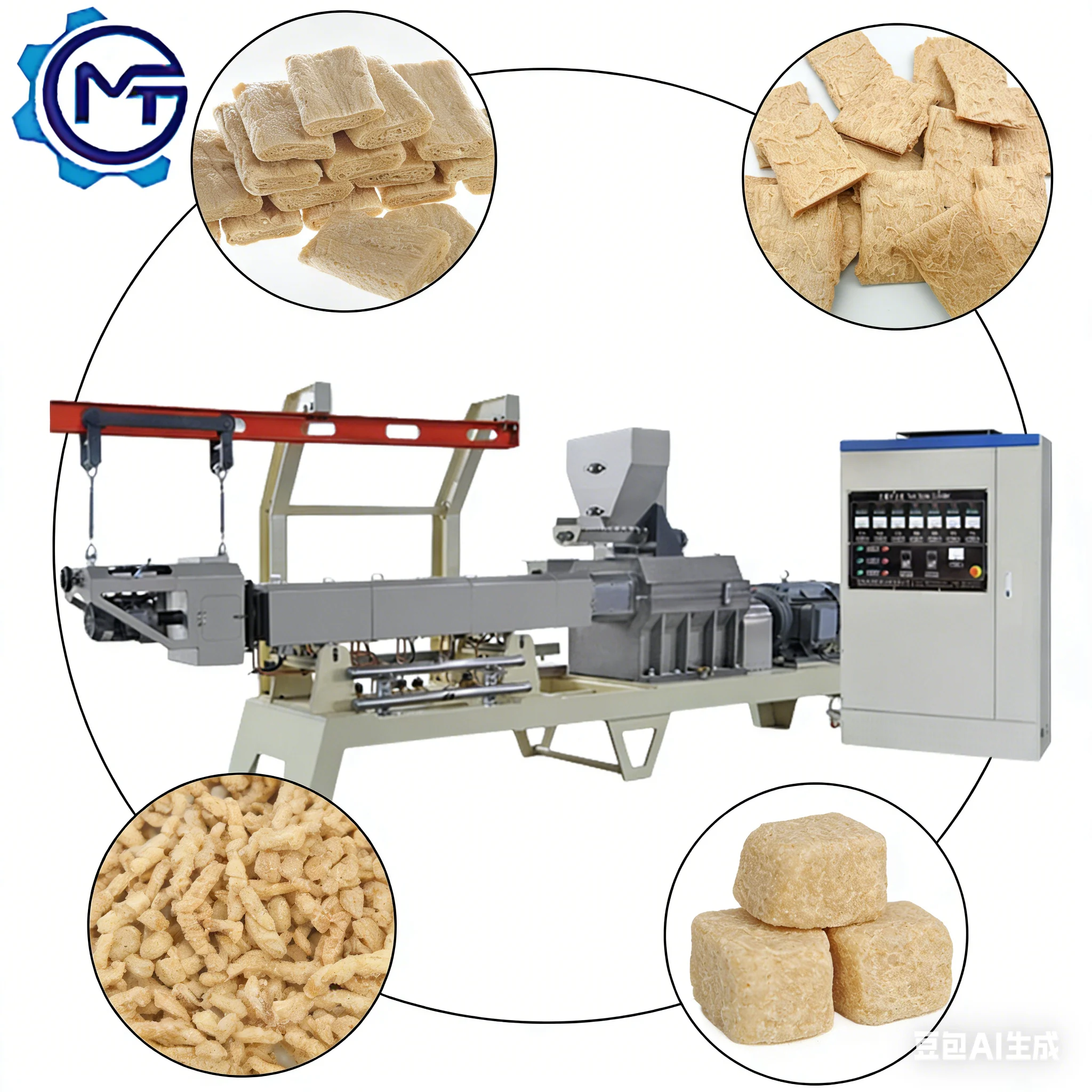

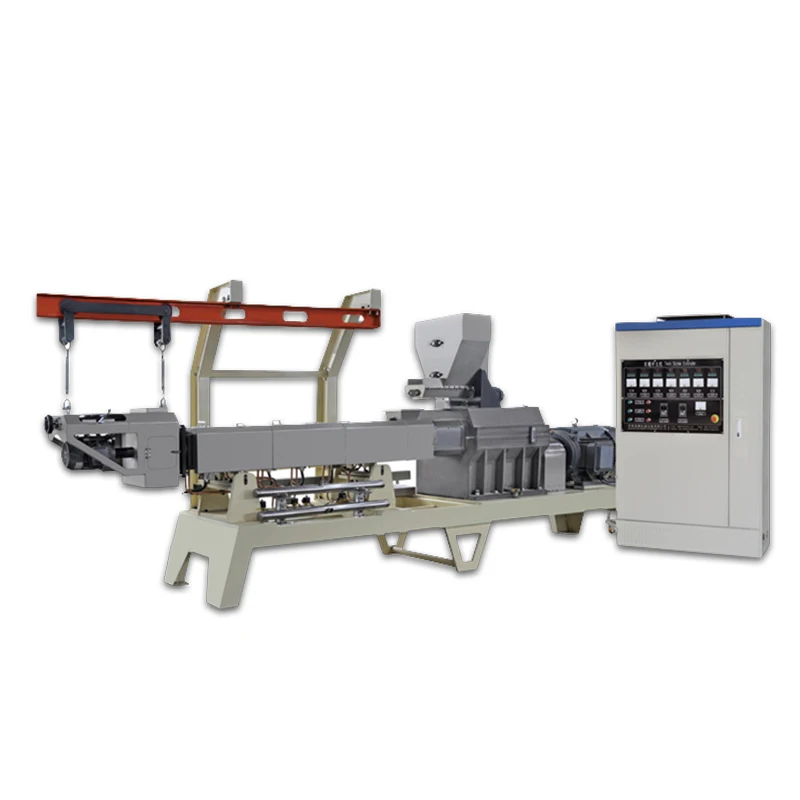

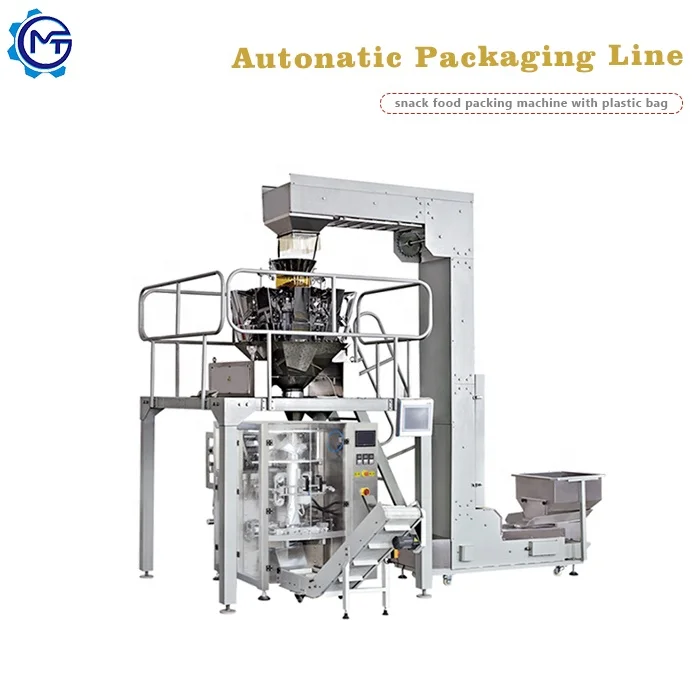
MT65 / MT70 / MT75 / MT85 High Moisture Vegetarian Meat Extrusion Line, Twin-Screw, CE Certified — configured for TVP, soya chunks, and plant-based meat analogues from defatted soya flour or protein isolate.
- Complete turnkey line from mixer through multi-layer dryer to cooling machine, with throughput matched across every station
- Screw configuration and adjustable die moulds specified to your raw material and target texture, validated by in-house trial runs before shipment
Supported by full documentation, on-site installation with operator training, and ongoing wear parts supply.
Description
Turnkey Line Matching — Every station from the mixer to the cooling conveyor is sized against the extruder’s actual throughput on high-moisture protein dough, preventing the bottlenecks that occur when lines are assembled from separate vendors.
Technical Specifications
| Parameter | Value |
|---|---|
| Product Type | High Moisture Vegetarian Meat Extrusion Line (Twin-Screw Plant-Based Meat Processing Line) |
| Models Available | MT65 / MT70 / MT75 / MT85 |
| Screw Type | Twin-screw |
| Installed Power | 84 kW (MT65) / 160 kW (MT70) / 190 kW (MT75) / 210 kW (MT85) |
| Power Consumption | 59 kW (MT65) / 120 kW (MT70) / 140 kW (MT75) / 140 kW (MT85) |
| Output Capacity | 100–150 kg/h (MT65) / 150–200 kg/h (MT70, MT75) / 250–300 kg/h (MT85) (basis not stated in source — confirm raw material type and moisture content) |
| Main Motor Power | 22 kW / 30 kW / 45 kW (model-dependent) |
| Overall Dimensions | 40,000 × 1,200 × 2,200 mm (MT65) up to 45,000 × 1,500 × 3,500 mm (MT85) |
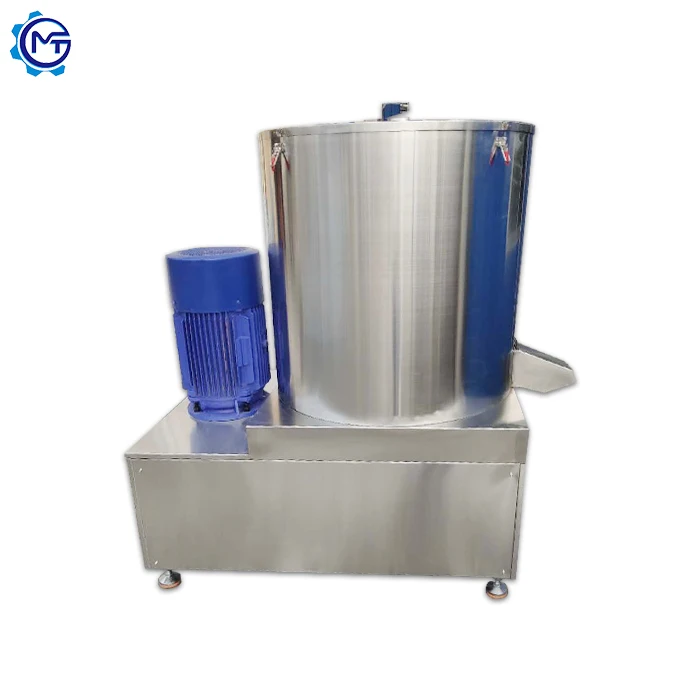
| Mixer Batch Capacity | 20–30 kg / 70–80 kg / 170–180 kg |
| Mixer Power | 4 kW / 7.5 kW / 15 kW |
| Contact Material (Mixer) | Stainless steel 304 |
| Dryer Heating Options | Fuel / Gas / Electricity |
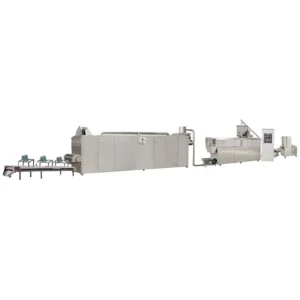
| Line Stations | Mixer → Screw Conveyor → Twin Screw Extruder → Air Conveyor → Multi-layer Dryer → Cooling Machine |
| Die Configuration | Adjustable moulds for soya nuggets, TVP, TSP, soya chunks |
| Control System | PLC / MCC availability to be confirmed |
| Certifications | CE (since 2014), ISO certified |
| Testing Before Shipment | In-house testing workshop trial run on customer raw material |
| Installation | On-site, 1 engineer for 7–14 days including operator training |
| Lead Time | 15–35 working days after deposit; 5–10 days if in stock |
Application Suitability
| Application | Material or Output |
|---|---|
| Textured vegetable protein (TVP/TSP) | Defatted soya flour, low-temperature soya flakes |
| Soya nuggets and soya chunks | Defatted soya flour, soybean dregs |
| High-moisture vegetarian meat analogues | Soya protein, peanut dregs, protein blends |
| Plant-based meat for frozen and fast food | Formulated plant-protein mixes requiring fibrous texture |
| Lean snack food variants | Adjusted screw configuration for expanded snack formats |
Why "Rated Capacity" Means Nothing Without Raw Material Context
A plant based meat processing line turnkey is only as fast as the slowest station matched to your actual protein blend.
I spent two weeks on a factory floor in Guangdong because a buyer switched from soy to pea protein without telling anyone before commissioning. The screw configuration and barrel temperature profile were set for one material, and the extruder simply refused to produce the fibrous拉丝 structure the market expected. The extruder was not the problem — the mismatch between the stated capacity and the real formulation was. [NEED_CITE: how protein source affects extrusion shear and residence time requirements] When a supplier quotes an output figure without specifying the raw material basis and moisture content, that number is a ceiling nobody will reach on a different formulation. Every plant based meat processing line turnkey should ship with a trial run report based on the buyer’s own ingredients, not a generic benchmark.
Station-by-Station Throughput Alignment
A high-moisture extrusion line fails when the dryer cannot keep pace with the extruder, or when the mixer batches are too small to feed continuous operation. On this platform, each station — mixer, screw conveyor, twin-screw extruder, air conveyor, multi-layer dryer, and cooling machine — is specified as one system. The mixer batch sizes of 20–30 kg, 70–80 kg, and 170–180 kg correspond to different extruder models so that upstream feeding never starves the barrel.
Die and Screw Configuration Matched to Fibrous Texture
High-moisture vegetarian meat requires a specific shear profile and cooling die arrangement to form the layered, muscle-like structure that distinguishes it from dry TVP. The twin-screw configuration on the MT65 through MT85 allows screw element rearrangement to adjust shear intensity and residence time. Die moulds are adjustable so that the same platform produces soya nuggets, soya chunks, or high-moisture meat analogues simply by reconfiguring the die plate and downstream cooling. This flexibility matters when a producer needs to serve both frozen food and retail meat-substitute markets from one line. [NEED_CITE: twin-screw configuration impact on high-moisture protein texturization]
Reading the Power and Dimension Specs
The installed power range of 84 kW to 210 kW across the four models reflects not just motor size but the combined heating, feeding, and cutting loads during continuous extrusion of viscous protein dough. Main motor options of 22 kW, 30 kW, and 45 kW determine how much mechanical energy reaches the screws — critical for maintaining the shear required to align protein molecules into fibrous strands. The line footprint stretches from 40 meters to 45 meters in length, which means buyers must confirm workshop clearance before the line ships. The multi-layer dryer uses a double-pitch roller chain drive with round-trip drying, and heating source selection between fuel, gas, and electricity depends entirely on local utility cost and availability. Mixer contact parts are stainless steel 304 throughout, meeting food-grade hygiene requirements without needing post-installation upgrades.
What Happens When the Line Is Not Specified as a System
I have watched a plant-based meat installation stall because the dryer was undersized relative to the extruder output — product piled up wet and stuck to the conveyor belts within hours of startup. When stations are sourced from separate vendors, nobody takes responsibility for the gap between them. [NEED_CITE: throughput mismatch consequences in multi-station food extrusion lines] The buyer ends up paying for a second dryer or accepting output far below the contracted rate. On a turnkey plant based meat processing line, these interfaces are the supplier’s problem before the machines leave the factory, not the buyer’s problem on the shop floor.
Why Procure the Full Line Here
Throughput matching across every station is calculated and documented before contract signing, so the mixer cycle time, extruder output, and dryer residence time all align to one target. Screw and die configurations are specified to the buyer’s raw material formulation and target product texture, not copied from a generic build. An in-house testing workshop runs the buyer’s actual ingredients before shipment, generating a trial run report with proven parameters. CE and ISO documentation supports customs clearance and commissioning in regulated markets. Pre-sales consultation through on-site installation, commissioning, and operator training is handled by the same engineering team that configured the line.
Documentation & Verification
- Line layout and capacity calculation for your specific protein blend and target throughput
- Screw and die configuration record matched to your raw material, not a generic template
- Trial run report from in-house testing on your actual ingredients before shipment approval
- CE declaration of conformity and ISO certificate for customs and regulatory compliance
- Electrical schematic with voltage and frequency confirmation for your facility
- Operation and maintenance manual plus wear parts list for ongoing production
Installation, Commissioning & Support
- Full line footprint of up to 45 meters requires confirmed workshop length and ceiling height before delivery
- Power supply matching the installed load of up to 210 kW with dedicated circuit planning
- Factory-assembled stations shipped together, reducing on-site assembly time and misalignment risk
- On-site parameter tuning by one engineer over 7 to 14 days using your raw material
- Operator training covering screw configuration changes and die adjustment for product changeovers
- Wear parts list including screws and dies with recommended replacement intervals provided at handover
What to Include in Your Inquiry
Send your raw material specification — protein source, fat content, and target moisture percentage — along with the product format you intend to produce, whether soya chunks, high-moisture meat analogues, or both. Confirm your facility voltage, frequency, and available floor length, since the line extends up to 45 meters. If you have existing upstream batching or downstream packing equipment, note the interface requirements so the plant based meat processing line turnkey can be configured to connect without redundant stations.
Frequently Asked Questions
Q: How is the output capacity figure verified before the line ships?
A: Output figures are based on specific raw material types and moisture levels, which must be confirmed during the inquiry stage. We run your actual formulation through our in-house testing workshop before shipment and provide a trial run report documenting the achieved throughput, product texture, and process parameters so you commission with real data.
Q: Can the screw and die setup handle both soya flour and pea protein blends?
A: The twin-screw platform allows screw element rearrangement and die mould changes to accommodate different protein sources. The configuration is specified to your formulation before production begins, and the trial run validates whether the selected setup produces the target fibrous structure on your specific blend.
Q: What electrical and control details are confirmed before manufacturing starts?
A: Voltage, frequency, and control language are confirmed during the specification stage to match your facility’s power supply and operator requirements. The electrical schematic is provided for review, and any PLC or MCC control options are finalized before the line enters production to avoid commissioning delays.
Q: What does the on-site installation and training period cover?
A: One engineer stays at your facility for 7 to 14 days to assemble stations, tune extrusion parameters on your raw material, and train operators on screw configuration changes, die adjustment, and routine maintenance. The wear parts list and maintenance manual are handed over at the end of commissioning.
Related products
-

Vegetarian Meat Floss Production Line with Twin Screw
¥9,500.00 Select options This product has multiple variants. The options may be chosen on the product page -
Twin Screw Extruder for Textured Vegetable Protein (TVP)
¥9,500.00 Select options This product has multiple variants. The options may be chosen on the product page -
Dry Protein Drawing Equipment – Intelligent Puffing Machine for Cake Protein & Vegetarian Meat
¥65.00 Select options This product has multiple variants. The options may be chosen on the product page -
New High Efficiency Protein Production Line Plant Protein Equipment for Artificial Vegetarian Meat Processing Food Grade
¥65.00 Select options This product has multiple variants. The options may be chosen on the product page