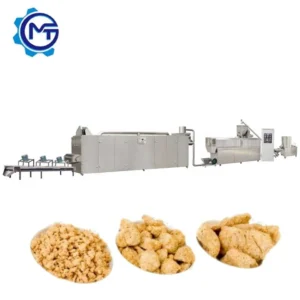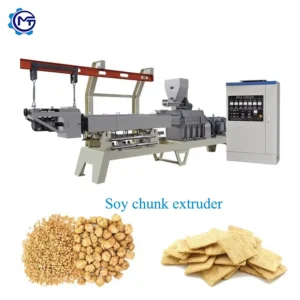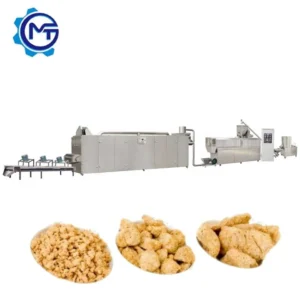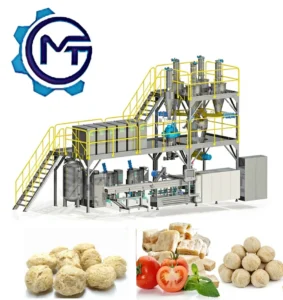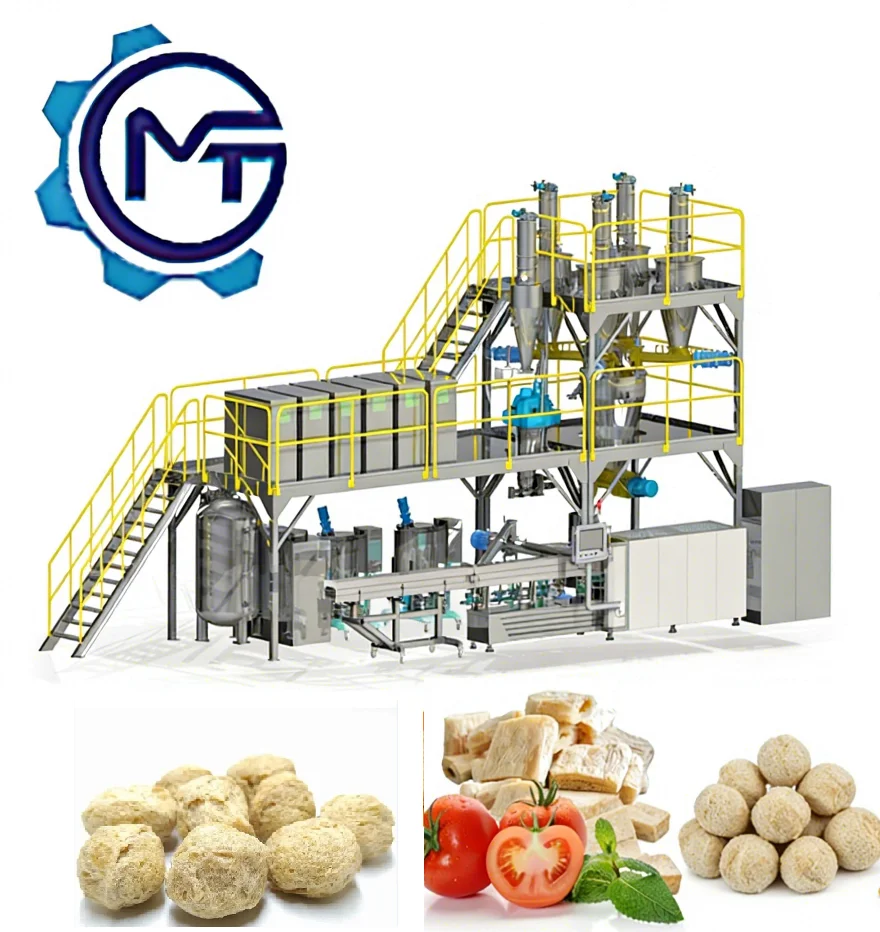


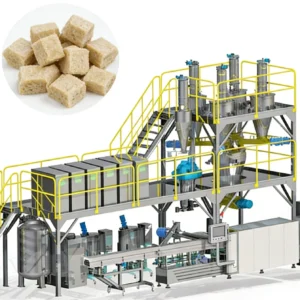
MT65, MT70, MT75, MT85 Twin Screw Textured Vegetable Protein Extrusion Line, 84–210 kW Installed Power — engineered as a complete turnkey project from mixing through cooling. Screw configuration and die design are specified to your raw material formulation, with station throughput matched across the entire line to prevent bottlenecks. Multi-layer dryer with selectable fuel type ensures target moisture is met consistently.
- In-house trial runs on your exact raw material before shipment, with documented test reports
- Line layout, utility planning, and capacity calculation delivered as one integrated project scope
- On-site installation, commissioning, and operator training included for single-supplier accountability
Description
Integrated Project Accountability — From the first mixer sizing calculation to the final cooling belt speed, every station on this textured vegetable protein line is engineered as one throughput equation rather than sourced and assembled as independent units.
Technical Specifications
| Parameter | Value |
|---|---|
| Product Type | Twin Screw Textured Vegetable Protein Extrusion Line |
| Model | MT65 / MT70 / MT75 / MT85 |
| Screw Type | Twin-screw |
| Installed Power | 84 kW (MT65) / 160 kW (MT70) / 190 kW (MT75) / 210 kW (MT85) |
| Power Consumption | 59 kW (MT65) / 120 kW (MT70) / 140 kW (MT75) / 140 kW (MT85) |
| Output Capacity | 100–150 kg/h (MT65) / 150–200 kg/h (MT70, MT75) / 250–300 kg/h (MT85) (basis not stated in source — confirm raw material formulation / moisture content / product format) |
| Main Motor Power | 22 kW / 30 kW / 45 kW (verify per model) |
| Screw Length | 1,050 mm / 1,520 mm (verify per model) |
| Overall Dimensions (L×W×H) | 40,000×1,200×2,200 mm (MT65) to 45,000×1,500×3,500 mm (MT85) |
| Mixer Type | Vertical mixer, stainless steel 304 mixing ruler, carbon steel shelf |
| Mixer Capacity Options | 20–30 kg / 70–80 kg / 170–180 kg |
| Mixer Power Options | 4 kW / 7.5 kW / 15 kW |
| Dryer Type | Multi-layer dryer, double pitch roller chain drive |
| Dryer Fuel Options | Electricity / Gas / Fuel (buyer selectable) |
| Control System | MCC + PLC |
| Line Stations | Mixer → Screw Conveyor → Twin Screw Extruder → Air Conveyor → Multi-layer Dryer → Cooling Machine |
| Certification | CE, ISO |
Application Suitability
| Application | Material or Output |
|---|---|
| Textured vegetable protein production | Defatted soya flour, low temperature soya flakes |
| Soya nuggets and chunks for food service | Soybean dregs, peanut dregs, soya protein concentrate |
| Plant-based meat analogues for frozen food | Defatted soya flour layered into fibrous protein structures |
| Vegetarian meat substitutes for retail and fast food | Soya and pulse protein blends processed into TVP/TSP formats |
Why "Nominal Capacity" Misleads Plant-Based Meat Buyers on Turnkey Lines
A plant based meat production line turnkey rated at a fixed output tells you nothing until you know which raw material formulation and moisture level that number was measured against.
I have watched lines quoted at a certain hourly throughput shut down within days because the buyer’s actual pea protein or soya flour blend absorbed water at a different rate than the supplier’s test material. The extruder pushed product, but the density was wrong — too light and the downstream dryer could not keep pace, too dense and the cooling conveyor piled up. The plant based meat production line turnkey had been specified station by station rather than calculated as a single throughput chain, and the gap showed up only after installation [NEED_CITE: throughput matching between extruder and downstream drying capacity in protein extrusion lines].
Screw Configuration Matched to Protein Fibre Structure
The twin-screw extrusion process builds the layered fibre texture that defines a convincing meat analogue. Screw element sequencing, barrel temperature zones, and die geometry all respond to the specific protein content and hydration behaviour of the incoming material. This plant based meat production line turnkey specifies screw configuration and die design against the buyer’s raw material formulation, not a generic build copied across unrelated applications.
Throughput Calculation Across Every Station
A line is only as fast as its slowest station. Mixer batch cycle time must align with extruder feed rate, dryer residence time must match the extruder’s output moisture profile, and cooling belt speed must handle the dried product volume without accumulation. Each station on this line is sized through a single capacity calculation so that the plant based meat production line turnkey runs as a continuous chain without intermediate buffering or starvation [NEED_CITE: line balancing principles in continuous extrusion-based food processing].
Reading the Specifications That Actually Matter
Screw length and barrel segment count determine residence time inside the extrusion zone — longer screws give more shear and heat transfer, which matters when you need full starch gelatinisation and protein restructuring from dense soya flour. The main motor power across the MT65 through MT85 range reflects the torque needed to push higher-viscosity protein doughs that demand more mechanical energy than simple starch-based snacks. Installed power versus power consumption figures reveal the thermal headroom available for barrel heating, which directly affects your ability to hold consistent product density batch after batch. The multi-layer dryer with selectable fuel source lets buyers in regions with cheap gas or unreliable electricity choose the heating method that fits their utility profile.
The Hidden Cost of Mismatched Line Stations
When an extruder is specified without matching dryer or cooling capacity, the bottleneck migrates downstream and shows up as product stacking, uneven moisture, or forced line stops. I have seen cooling conveyors on protein lines jam because the dryer discharged product faster than the belt could carry it away, forcing operators to run the extruder at reduced output and miss their production target entirely. These failures trace back to sourcing stations from separate vendors who each quoted their own equipment in isolation [NEED_CITE: downstream bottleneck causes in multi-vendor food processing lines].
Why This Line Is Engineered as One Project
Every station from the vertical mixer through the cooling machine is sized within a single throughput calculation, so mixer batch output, extruder feed rate, dryer residence time, and cooling belt speed are confirmed before production begins. Screw configuration and die design are set against the buyer’s specific raw material and target protein fibre structure rather than defaulted from a generic template. The in-house testing workshop runs trial production on the customer’s actual formulation before shipment, generating a documented trial run report that fixes process parameters before the line leaves the factory. Electrical schematics confirm voltage, frequency, and control language against the installation site, preventing commissioning delays. The complete line arrives under one supplier’s accountability for layout, utility planning, and phased installation scheduling.
Documentation & Verification
- Line layout and capacity calculation showing throughput matched across every station from mixer to cooling
- Screw and die configuration record specified to the buyer’s raw material formulation and target protein density
- Trial run report on customer raw material conducted in the testing workshop before shipment
- Electrical schematic with voltage, frequency, and control language confirmed against the installation site
- CE declaration of conformity and ISO certificate for the complete line
- Wear parts list covering screws, dies, and mixer components with replacement intervals
Installation, Commissioning & Support
- Overall line length up to 45,000 mm requires floor space planning with utility trench routing confirmed before delivery
- Power supply must match installed power up to 210 kW with dedicated circuits for main motor and dryer heating elements
- Line arrives factory-assembled in modular stations for phased positioning and mechanical connection on site
- First-run commissioning includes screw speed, barrel temperature, and dryer parameter setting against the trial run report baseline
- Operator training covers screw configuration changes for switching between TVP chunks and finer protein textures
- Wear parts inventory for screws, dies, and mixer rulers stocked against the documented replacement schedule
What to Include in Your Project Inquiry
When specifying a plant based meat production line turnkey, share your raw material formulation including protein source, fat content, and target moisture level so that screw configuration and dryer parameters can be set accurately. Confirm your local voltage and frequency standards along with preferred control language, as these affect the electrical schematic and PLC programming before production starts. If you have existing upstream batching or downstream packing equipment, provide interface dimensions and throughput rates so the line layout accounts for connection points.
Frequently Asked Questions
Q: How is line capacity verified against my specific raw material formulation and target product format?
A: Before shipment, your actual raw material is run through the extruder in the in-house testing workshop. Screw speed, barrel temperature profile, die selection, and moisture addition are adjusted until the output matches your target protein fibre structure and density. A trial run report documents these parameters, and they become the commissioning baseline at your site.
Q: How do you match throughput between extruder, dryer, and cooling to prevent line bottlenecks?
A: Each station is sized within one capacity calculation. Mixer batch cycle time feeds the extruder at a steady rate, the multi-layer dryer is specified with sufficient belt area and residence time for the extruder’s output moisture, and the cooling machine belt speed is set to clear dried product without accumulation or gap starvation.
Q: What utility planning is included in the turnkey layout?
A: The line layout drawing specifies power draw per station against your available supply, compressed air points for pneumatic conveying, water feed for the extruder pump and mixer, and exhaust routing for the dryer. Fuel type for the dryer — electricity, gas, or liquid fuel — is selected to match your local utility cost structure.
Q: Can the line configuration support both TVP chunks and finer protein textures by changing screw and die setup?
A: Yes. Screw element sequencing and die geometry are adjusted to shift between chunky nugget formats and finer minced textures. The configuration record documents each setup, and operator training covers the changeover procedure so your team can switch formats without external engineering support.
Q: What does on-site installation, commissioning, and operator training cover in the project scope?
A: Installation covers station positioning, mechanical and electrical connection, and utility hook-up against the layout drawing. Commissioning verifies that the parameters from the trial run report produce consistent output on your site. Training covers daily operation, screw and die changeover, dryer adjustment, and routine maintenance for screws, dies, and mixer components.
Related products
-
High Moisture Vegetarian Meat Extrusion Machine
¥9,500.00 Select options This product has multiple variants. The options may be chosen on the product page -
Soybean Protein Making Machine Automatic Soy Chunk Production Line
¥30.00 Select options This product has multiple variants. The options may be chosen on the product page -
New High Efficiency Protein Production Line Plant Protein Equipment for Artificial Vegetarian Meat Processing Food Grade
¥65.00 Select options This product has multiple variants. The options may be chosen on the product page -
CE Certified Vegetarian Meat Processing Machine
¥9,500.00 Select options This product has multiple variants. The options may be chosen on the product page