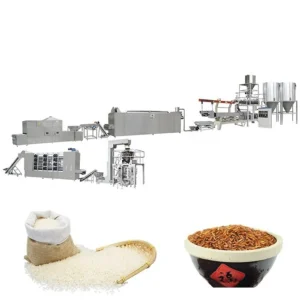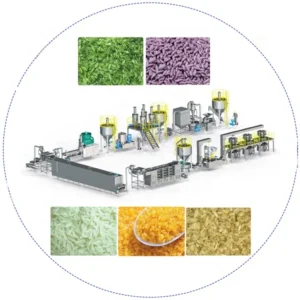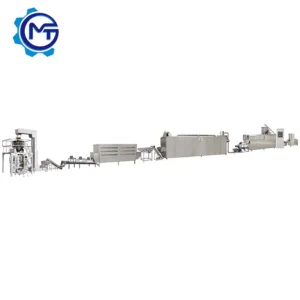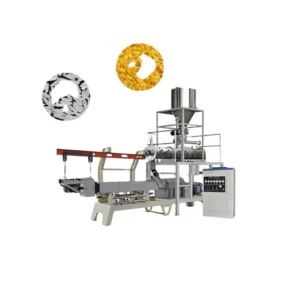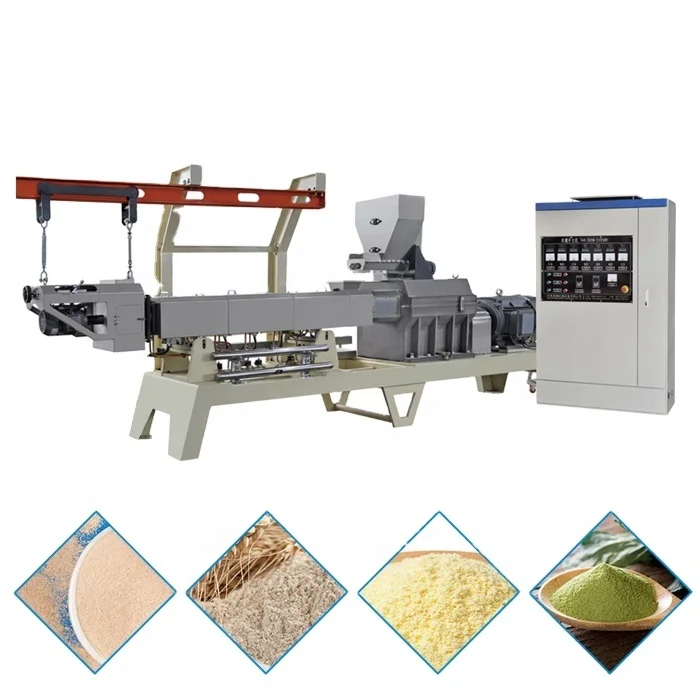


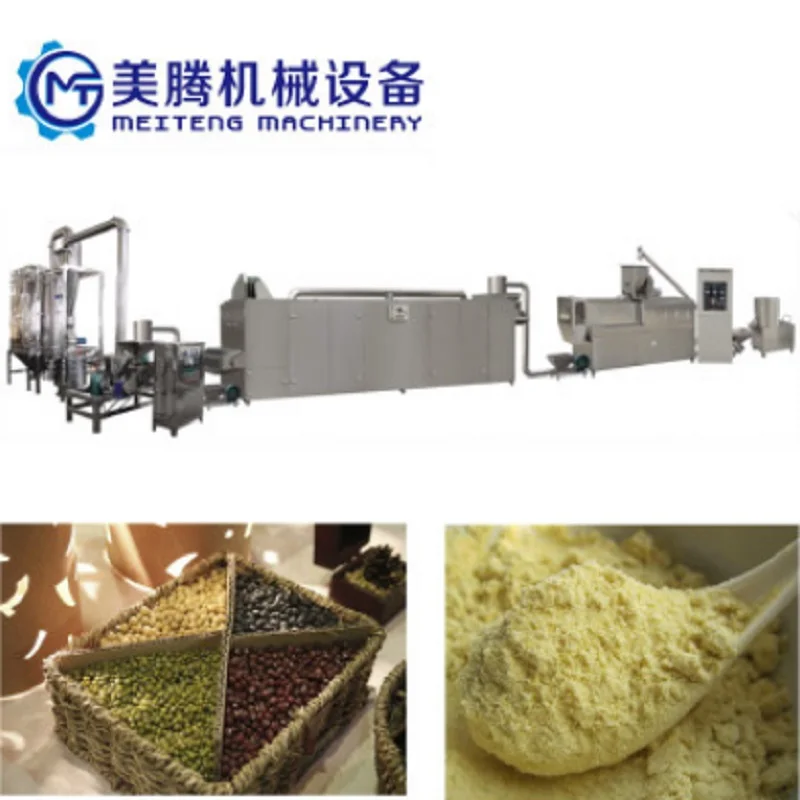
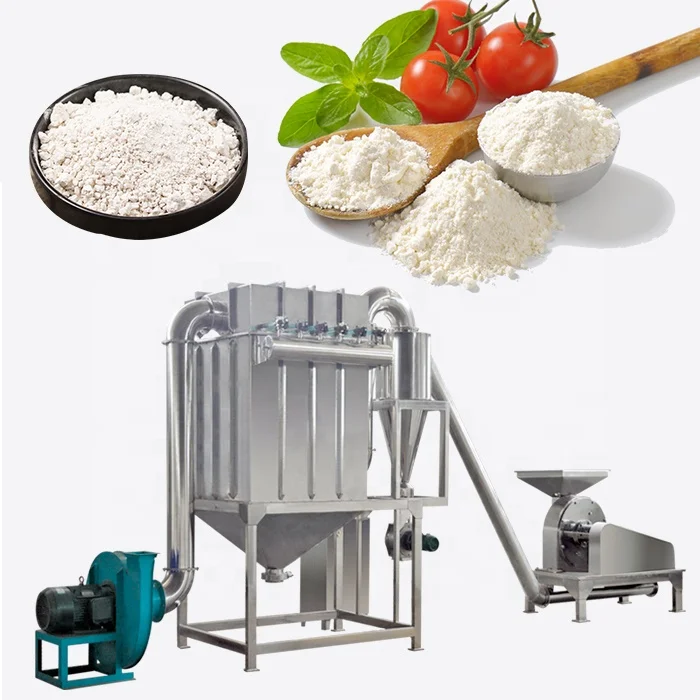
MT65 Nutritional Powder Processing Line, Twin-Screw Extruder, PLC Control — complete turnkey project from mixing through extrusion, roasting and blending. Twin-screw configuration and die design are matched to your raw material and target powder texture, with barrel temperature profile adjusted for starch gelatinisation and expansion control. Every station is throughput-balanced so no single unit bottlenecks output. Line layout, capacity calculation and factory trial run on your actual formulation are provided before shipment, with on-site commissioning and operator training included.
- Food-grade 304 stainless steel contact surfaces
- Automated PLC flow with no dust leakage
- Applications: infant cereal, meal replacement powder, modified starch
Description
Throughput-Matched Station Design — Every mixing, extrusion and roasting module in this nutritional powder processing line is capacity-balanced before shipment so material flow stays continuous across the entire layout.
Technical Specifications
| Parameter | Value |
|---|---|
| Model | MT65 |
| Product Type | Nutritional Powder Processing Line |
| Screw Configuration | Twin-screw |
| Line Installed Power | 85 kW |
| Line Real Power | 65 kW |
| Line Output Capacity | 150–200 kg/h (basis not stated in source — confirm raw material, moisture content and formulation) |
| Overall Dimensions (L × W × H) | 18000 × 1300 × 2300 mm |
| Extruder Main Motor Power | 30 kW (source lists 45.87 kW installed / 30–35 kW actual) |
| Extruder Dimensions (L × W × H) | 2800 × 830 × 1875 mm |
| Extruder Output | 200–250 kg/h (basis not stated in source — confirm raw material and product format) |
| Powder Mixer Tank Volume | 150 kg |
| Powder Mixer Rotary Speed | 385 rpm |
| Powder Mixer Motor Power | 4 kW |
| Powder Mixer Dimensions (L × W × H) | 1000 × 630 × 1100 mm |
| Powder Mixer Output | 300–600 kg/h (basis not stated in source — confirm material bulk density) |
| High-Temperature Roaster Output | 300–400 kg/h (basis not stated in source — confirm material and moisture reduction target) |
| Roaster Belt Effective Length | 3.5 m |
| Roaster Belt Motor Power | 0.55 kW |
| Roaster Far Infrared Heater Power | 3.9 kW × 24 elements |
| Roaster Gas Consumption | 6.8 m³ (per hour basis not stated in source — verify operating cycle) |
| Roaster Dimensions (L × W × H) | 4500 × 1500 × 1600 mm |
| Air Conveyor Motor Power | 1.1 kW |
| Air Conveyor Dimensions (L × W × H) | 4200 × 500 × 2200 mm |
| Construction Material | Food-grade stainless steel 304 (contact surfaces) |
| Control System | PLC with MCC (configurable to buyer specification) |
| Certification | CE |
| Warranty | 1 year |
Application Suitability
| Application | Material or Output |
|---|---|
| Baby rice cereal and infant formula powder | Rice flour, corn starch, vitamin and mineral premix blends |
| Instant corn paste and meal replacement powder | Corn grits, soybean, sesame and grain blends |
| Fortified nutritional powder for feeding programmes | Soybean, mung bean, oat and micronutrient formulations |
| Modified starch for textile and papermaking | Cassava, corn and potato starch feedstocks |
| Modified starch for oil drilling and building materials | Pregelatinised starch from corn and wheat sources |
What "200 kg per Hour" Leaves Out About Line Capacity
A rated figure means nothing until it is tested on your actual formulation.
Many nutritional powder processing line turnkey quotes carry a single capacity number pulled from a standard grain recipe. When the buyer switches to a high-fat soybean blend or a sticky rice-and-sesame mix, the extruder barrel fills unevenly, the roaster belt runs dry, and material piles up between stations. I once watched a line in the Middle East sit idle for four days because the mixer outpaced the extruder by a wide margin — the operator had nowhere to put the intermediate stock. [NEED_CITE: throughput mismatch between line stations in extrusion projects]
This MT65 nutritional powder processing line addresses the problem with a factory trial run on your raw material before dispatch. The powder mixer, twin-screw extruder and high-temperature roaster are each rated at different nominal outputs, which is why the line configuration must be calculated as a system rather than a collection of individual machines. Only a test on your specific blend reveals whether the 385 rpm mixer cycle, the twin-screw residence time, and the 3.5 m roaster belt together hold the target throughput without bottlenecks.
Balancing the Mixer, Extruder and Roaster Across One Continuous Flow
The nutritional powder processing line turnkey layout sequences a powder mixer, air conveyor, twin-screw extruder, high-temperature roaster, crusher and final blender. Each station must accept material at the rate the previous one delivers it. The mixer tank holds 150 kg per batch and discharges through an air conveyor rated at 1.1 kW into the extruder hopper. If the batch cycle is set too short, the extruder starves; too long, and cooked material cools in the conveyor pipe.
Matching these intervals is the core engineering task on any nutritional powder processing line, and it can only be finalised after a trial run on the buyer’s formulation in the testing workshop.
How Screw Configuration Shapes Powder Texture and Solubility
Twin-screw extrusion gives the operator independent control over shear, residence time and barrel temperature at each zone. For a baby rice cereal that must dissolve instantly in warm water, the screw elements are arranged to maximise starch gelatinisation at moderate shear. For a modified starch destined for textile sizing, the configuration shifts toward higher shear and shorter residence to limit dextrinisation. [NEED_CITE: twin-screw element configuration effects on starch gelatinisation degree]
The die plate at the extruder outlet further influences the expanded pellet density that feeds into the roaster, so screw profile and die geometry are specified together based on the buyer’s target product.
Reading the Power and Dimension Data Against Your Workshop Reality
The MT65 line draws 85 kW installed and occupies 18 m in length. The extruder alone accounts for 30 kW at the main motor, while the roaster’s 24 far-infrared heating elements pull 93.6 kW peak if all zones fire simultaneously — though in practice the PLC stages them to stay within the line’s real power envelope of 65 kW. The 18000 × 1300 × 2300 mm footprint requires clear access on both sides for maintenance and die changes.
Buyers planning a nutritional powder processing line turnkey installation should confirm ceiling height against the 2300 mm line profile and verify that the local supply can sustain the real power draw with margin for start-up surges. Voltage and frequency must be locked in before production begins, because rewinding a 30 kW extruder motor on-site is neither fast nor inexpensive. [NEED_CITE: industrial voltage and frequency standards across export markets]
The Hidden Cost of Skipping the Pre-Shipment Trial
When an extruder arrives without a documented trial on the buyer’s raw material, the first week of production becomes an expensive experiment. Operators adjust feed rates, barrel temperatures and screw speeds by trial and error while off-spec powder accumulates. If the roaster belt speed was set for a different moisture reduction target, the finished powder may retain too much residual moisture, shortening shelf life and inviting microbial growth.
Downstream, a crusher calibrated for one pellet density may produce particle sizes outside the buyer’s specification, forcing a re-grind that wastes time and energy. These compounding delays are why a nutritional powder processing line turnkey project should always include a factory test report before the crate is sealed.
Why This Line Is Configured as One Integrated Project
Every station is sourced and assembled under one supplier, which means the air conveyor ducting matches the extruder hopper throat, and the roaster belt width matches the extruder die output pattern. The PLC programme sequences each motor start and stop across the full 18 m layout, so a fault at the roaster automatically pauses the extruder feed rather than flooding the belt.
Food-grade 304 stainless steel covers all product contact surfaces from the mixer tank to the final blender, simplifying sanitation audits. The line layout document, screw and die configuration record, and trial run report ship with the machines, giving the buyer a complete baseline for future production runs. Spare screws, die plates and roaster belt segments are packed with the first shipment so the first scheduled changeover does not require an emergency air-freight order. [NEED_CITE: food-grade material and documentation requirements for nutritional powder export lines]
Documentation & Verification
- Line layout drawing with throughput calculation for each station on your formulation
- Trial run report produced on your raw material in the testing workshop before dispatch
- Screw and die configuration record matched to your target powder texture and solubility
- Electrical schematic with voltage, frequency and control language confirmed for your market
- CE declaration of conformity covering the complete assembled line
- Operation and maintenance manual with wear parts list and replacement intervals
Installation, Commissioning & Support
- Foundation must support 18 m line length and accommodate 2300 mm maximum height clearance
- Dedicated electrical circuit sized for 85 kW installed load with PLC and MCC cabinet connection
- Modular stations arrive separated for container loading and are reassembled on-site with alignment checks
- First-run commissioning includes barrel temperature profiling and roaster belt speed calibration on your material
- Operator training covers PLC interface navigation, screw element changes, and daily sanitation protocol
- Spare screw segments, die plates and roaster belt sections included in the initial shipment
Before You Send an Inquiry
To size the nutritional powder processing line turnkey configuration correctly, share your raw material list with approximate proportions, target moisture content in the finished powder, and the particle size range your market expects. Confirm the voltage and frequency at your facility along with available gas supply for the roaster, and let us know whether your workshop ceiling height or floor space imposes constraints on the 18 m layout. If you need the line tested on your exact blend before committing to production settings, we can arrange a trial run in the testing workshop.
Frequently Asked Questions
Q: How is line capacity verified against my specific raw material and formulation?
A: We run your actual blend through the mixer, twin-screw extruder and roaster in our testing workshop before shipment. The trial records throughput at each station, barrel temperature profile, and final powder moisture, giving you a baseline that reflects your formulation rather than a generic grain recipe.
Q: What utility requirements must be confirmed before installation?
A: The line draws up to 85 kW installed and requires a gas supply for the roaster’s far-infrared heaters. Voltage, frequency, compressed air pressure and gas pipe diameter must match the electrical schematic and layout document we prepare once your local supply specifications are confirmed.
Q: How is throughput balanced between the mixer, extruder, roaster and packing station?
A: Each station’s batch cycle time and continuous feed rate are calculated so the mixer discharge interval matches the extruder intake, and the roaster belt speed matches the extruder output. The PLC programme enforces these intervals and pauses upstream stations if a downstream fault occurs.
Q: What does the installation and commissioning schedule look like?
A: Modular stations are positioned and aligned over several days, followed by electrical and gas connections, PLC parameter loading, and a supervised first production run on your raw material. Operator training and wear parts handover are completed before the commissioning engineer departs.
Q: Can the same line switch between nutritional powder and modified starch production?
A: Yes. The twin-screw configuration, barrel temperature zones and die plate are adjusted between runs. The PLC stores separate recipes for each product, so changeover involves swapping screw elements and loading the correct programme rather than replacing hardware.
Related products
-
Fully Automatic 500kg/h Baby Cereal Nutrition Powder Extrusion Drying Line with PLC Control
¥9,500.00 Add to cart -
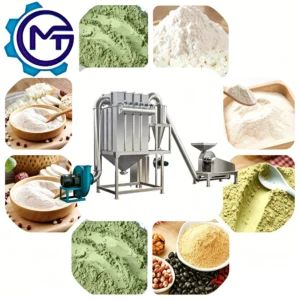
Automatic Iron Fortified Baby Rice Cereal Nutrition Powder Making Machine 500kg/h PLC Controlled
¥8,238.27 Add to cart -

High Productivity New Condition Safe Healthy and Nutritious Baby Food Meal Replacement Powder Production Line
¥30.00 Select options This product has multiple variants. The options may be chosen on the product page -

High Precision Automatic 500kg/h Baby Food Nutrition Powder Rice Extrusion Processing Line
¥8,238.27 Add to cart