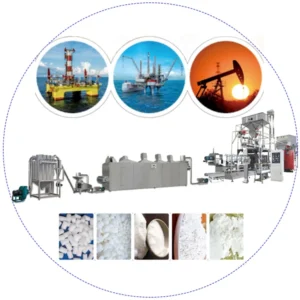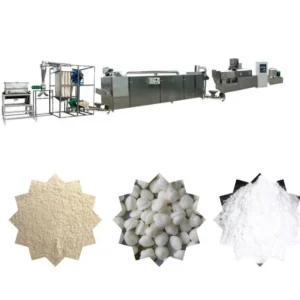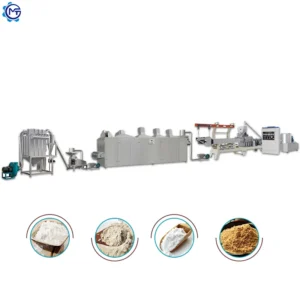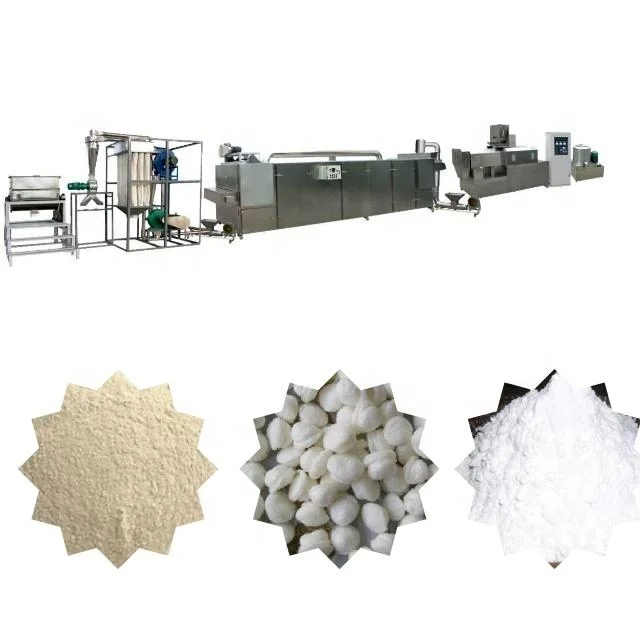


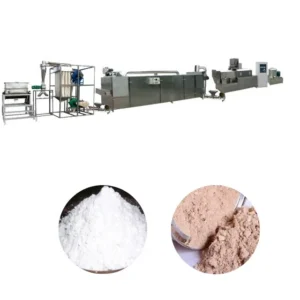
MT70 / MT85 / MT75 Modified Starch Extrusion Processing Line, Twin-Screw, PLC & MCC Control — configured for corn, cassava, potato starch and wheat flour with multi-zone barrel heating and 5-layer dryer integration.
- Screw configuration and die design specified to your raw material and target gelatinisation degree
- Throughput matched across mixer, extruder, dryer and pulse grinder to eliminate bottlenecks
- Trial run on customer raw material performed in-house before shipment with full report
Description
Matched Throughput Across Stations — every mixer, extruder, dryer and grinder in this modified starch processing line is sized against your raw material flow rate before layout finalisation, preventing idle stations and bottleneck-induced downtime.
Technical Specifications
| Parameter | Value |
|---|---|
| Product Type | Modified Starch Extrusion Processing Line |
| Model Options | MT70 / MT85 / MT75 |
| Extruder Type | Twin-screw |
| Screw Diameter (MT70) | 70 mm |
| Screw Length (MT70) | 1510 mm |
| Screw Material | 38CrMoAl |
| Installed Power (MT70 / MT85 / MT75) | 160 kW / 190 kW / 210 kW |
| Power Consumption (MT70 / MT85 / MT75) | 120 kW / 140 kW / 150 kW |
| Output Capacity (MT70) | 150–200 kg/h (basis not stated in source — confirm raw material type and moisture content) |
| Output Capacity (MT85) | 300–400 kg/h (basis not stated in source — confirm raw material type and moisture content) |
| Output Capacity (MT75) | 300–500 kg/h (basis not stated in source — confirm raw material type and moisture content) |
| Overall Dimensions (MT70 / MT85 / MT75) | 41000 × 1500 × 2200 mm / 43000 × 1500 × 3200 mm / 45000 × 1500 × 3500 mm |
| Barrel Temperature Control | Multi-zone heating rings with integrated cooling |
| Main Motor Power (MT70 reference) | 30 kW |
| Voltage & Frequency | 380V 50Hz 3-phase (configurable: 3ph 380V 60Hz, 3ph 415V 60Hz, 3ph 220V 60Hz) |
| Control System | PLC and MCC |
| Machine Contact Material | Food-grade stainless steel (201SS / 304SS options) |
| Mixer Power Options | 4 kW / 7.5 kW / 15 kW |
| Mixer Batch Capacity | 20–30 kg / 70–80 kg / 170–180 kg per batch |
| Dryer Type | 5-layer baking oven |
| Dryer Heating Source | Gas or diesel (electricity and steam available) |
| Dryer Dimensions | 5000 × 1200 × 2300 mm |
| Dryer Speed Control | Inverter |
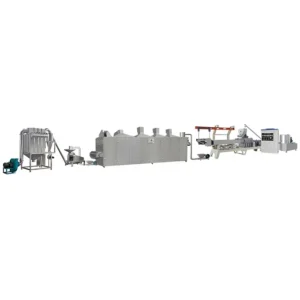
| Line Stations | Mixer → Twin-screw extruder → 5-layer dryer → Pulse grinder → Packing |
Application Suitability
| Application | Material or Output |
|---|---|
| Oil drilling fluid starch | Pre-gelatinized corn or cassava starch with controlled viscosity and solubility |
| Textile sizing starch | Denatured wheat or corn starch for warp yarn coating |
| Papermaking binder | Modified potato or cassava starch for surface sizing and coating |
| Building material additive | Pre-gelatinized starch for gypsum board and dry-mix mortar |
| Casting binder | Denatured starch for sand core binding in foundry operations |
| Food-grade modified starch | Functional starch for thickening, stabilising and gelling in processed foods |
Why Nominal Line Capacity Fails When the Mixer Cannot Keep Up
A modified starch processing line turnkey is only as fast as its slowest station — and the bottleneck is usually upstream.
I once configured a pre-gelatinized starch line where the extruder was rated correctly but the mixer batch cycle ran longer than the extruder feed rate demanded. The result was a twin-screw running half-starved, starch gelatinisation dropping out of spec, and two extra weeks of commissioning while we re-matched the batch timing. Starch behaves differently from snack dough — it needs consistent moisture conditioning and steady feed density, or the barrel temperature profile simply cannot hold the target denaturation degree [NEED_CITE: starch gelatinisation temperature thresholds by raw material source]. Buyers who skip throughput calculation across every station end up paying for capacity they never actually see on the floor.
Throughput Synchronisation from Batching to Grinding
Every modified starch processing line turnkey we configure starts with a mass-balance calculation: mixer batch size and cycle time are matched against extruder hopper demand, which in turn dictates dryer belt loading and grinder throughput. If the mixer delivers 180 kg batches every 25 minutes, the extruder must consume that mass without surge or starvation, and the 5-layer dryer must carry the output without overloading any single tier. This synchronisation is documented in the line layout and capacity calculation before production begins.
Screw and Die Configuration Staged to Your Starch Source
Corn starch, cassava starch and potato starch each gelatinise at different temperatures and shear sensitivities. The twin-screw configuration — including screw element sequence, compression ratio and die orifice geometry — is specified to the buyer’s raw material and target product function, whether that is oil drilling viscosity or textile sizing film strength. The barrel heating rings and integrated cooling maintain the temperature profile zone by zone, so the starch reaches the die at the correct degree of modification [NEED_CITE: twin-screw extrusion screw element selection for starch modification].
Reading the Specifications That Actually Matter
The screw diameter and length define the residence time inside the barrel — a 70 mm screw at 1510 mm length provides the shear history needed for partial gelatinisation without over-degrading the polymer chain. Multi-zone barrel heating allows independent temperature staging: earlier zones can hold lower temperatures for moisture equilibration while later zones peak for denaturation. The PLC and MCC control system logs these zone temperatures continuously, giving operators traceable batch records rather than relying on manual dial readings. Dryer inverter speed control adjusts belt travel to match extruder output fluctuations, preventing both over-drying and moisture carryover into the pulse grinder.
The Hidden Cost of Skipping Pre-Shipment Trial Runs
When a modified starch line ships without a trial run on the buyer’s actual raw material, the first production attempt becomes the trial — except now it is happening on the factory floor with installation costs already sunk. Screw configurations copied from a generic build produce the wrong gelatinisation degree, forcing weeks of die and element swaps while the dryer sits idle [NEED_CITE: impact of screw configuration on starch gelatinisation consistency]. For industrial starch producers, that downtime means missed contract delivery windows with downstream customers in oil drilling or textile manufacturing who operate on just-in-time procurement.
Why Procurement Converges Here
Our line layout and capacity calculation is shared with the buyer before any metal is cut, showing throughput at every station rather than a single headline number. The screw and die configuration record is written against your specific starch source and target modification, not copied from a previous project. An in-house testing workshop runs your raw material before shipment, generating a trial run report that documents actual output and product quality. Electrical schematics and voltage confirmation are locked in during the specification phase, so the control panel language and power supply match your facility on arrival. All contact materials are food-grade stainless steel, meeting hygiene expectations for both industrial and food-grade starch production.
Documentation & Verification
- Line layout with station-by-station throughput calculation for your target starch output
- Screw and die configuration record matched to your raw material and modification target
- Trial run report on your starch sample documenting gelatinisation degree and output rate
- Electrical schematic with voltage, frequency and control language confirmed pre-production
- CE declaration of conformity and ISO certificate included in shipping documentation
- Operation and maintenance manual with wear parts list for screws, dies and heating rings
Installation, Commissioning & Support
- Overall line length up to 45 m requires level concrete floor with utility trenches for 380V 3-phase supply
- Twin-screw extruder shipped with barrel assembled; heating rings and cooling lines connected on site
- PLC and MCC panel commissioned with operator language set before first powered run
- 5-layer dryer gas or diesel burner calibrated to local fuel pressure during commissioning week
- Pulse grinder cyclone and dust collector balanced for starch powder discharge rate
- Screw elements and die plates inventoried as spare wear parts with reorder thresholds defined
Preparing Your Line Enquiry
To move from a general enquiry to a concrete layout proposal, we need your starch raw material type and source, the target modification function such as pre-gelatinized for drilling or denatured for sizing, and the daily output volume your downstream contracts require. Share your facility voltage and frequency standard, available floor length and ceiling height, and whether an existing grinder or packing station will be retained. If you can send a raw material sample, we will schedule a trial run in the testing workshop before finalising the quotation.
Frequently Asked Questions
Q: How is line throughput matched between extruder, dryer and grinder to prevent bottlenecks?
A: We calculate mass flow at each station starting from mixer batch cycle time through extruder consumption rate, dryer belt loading capacity and grinder discharge volume. The modified starch processing line turnkey layout document shows these values side by side so no station is over-specified or starved, and the calculation is shared before production begins.
Q: What screw configuration and die design is specified for my starch raw material and target product?
A: Screw element sequence, compression ratio and die orifice geometry are selected based on your starch source — corn, cassava, potato or wheat — and the target modification such as pre-gelatinisation degree or denaturation for industrial binding. This configuration is documented in the screw and die record provided with the line.
Q: Can voltage, frequency and control language be confirmed before production to avoid commissioning delays?
A: Yes. Electrical schematics including voltage, frequency and PLC interface language are confirmed during the specification phase. Available configurations include 380V 50Hz, 380V 60Hz, 415V 60Hz and 220V 60Hz three-phase, ensuring the control panel matches your facility power supply on arrival.
Q: Is a trial run on my raw material performed before shipment, and what does the report cover?
A: An in-house testing workshop runs your starch sample through the configured extruder before dispatch. The trial run report documents barrel temperature profile, screw speed, output rate and product quality parameters including gelatinisation degree, so commissioning on site starts from a proven baseline rather than trial and error.
Q: What is the phased installation and commissioning schedule for a complete turnkey starch line?
A: Installation follows a sequence of floor preparation, station positioning, utility connection, individual station testing and full-line integrated runs. The commissioning schedule covers burner calibration on the 5-layer dryer, PLC parameter loading, grinder cyclone balancing and operator training across all stations over a typical multi-week period.
Related products
-
Modified and Pregelatinized Starch Processing Equipment – Pregelatinized Corn Cassava Modified Starch Puffing Machine
¥65.00 Select options This product has multiple variants. The options may be chosen on the product page -
High-Efficiency Customizable Modified Starch Production Line – Automatic Corn Pellet Adhesive Making Equipment
¥65.00 Select options This product has multiple variants. The options may be chosen on the product page -
Modified Starch Production Line for Industrial Drilling Twin Screw Extruder Large Output Modified Starch Manufacturing Machine
¥50.00 Select options This product has multiple variants. The options may be chosen on the product page -
Big Capacity Modified Starch Industrial Use and Food Additives
¥50.00 Select options This product has multiple variants. The options may be chosen on the product page