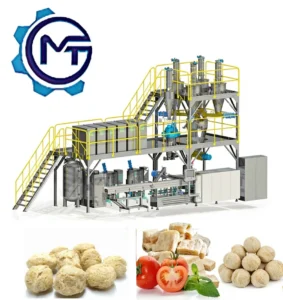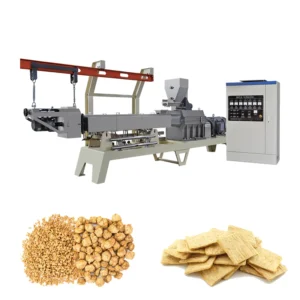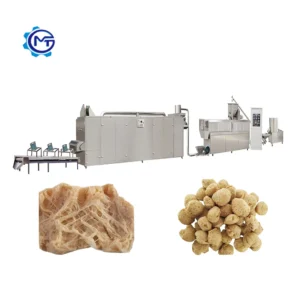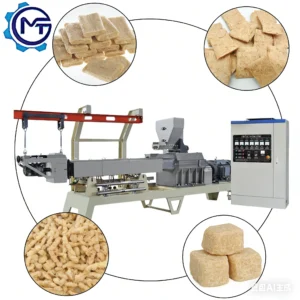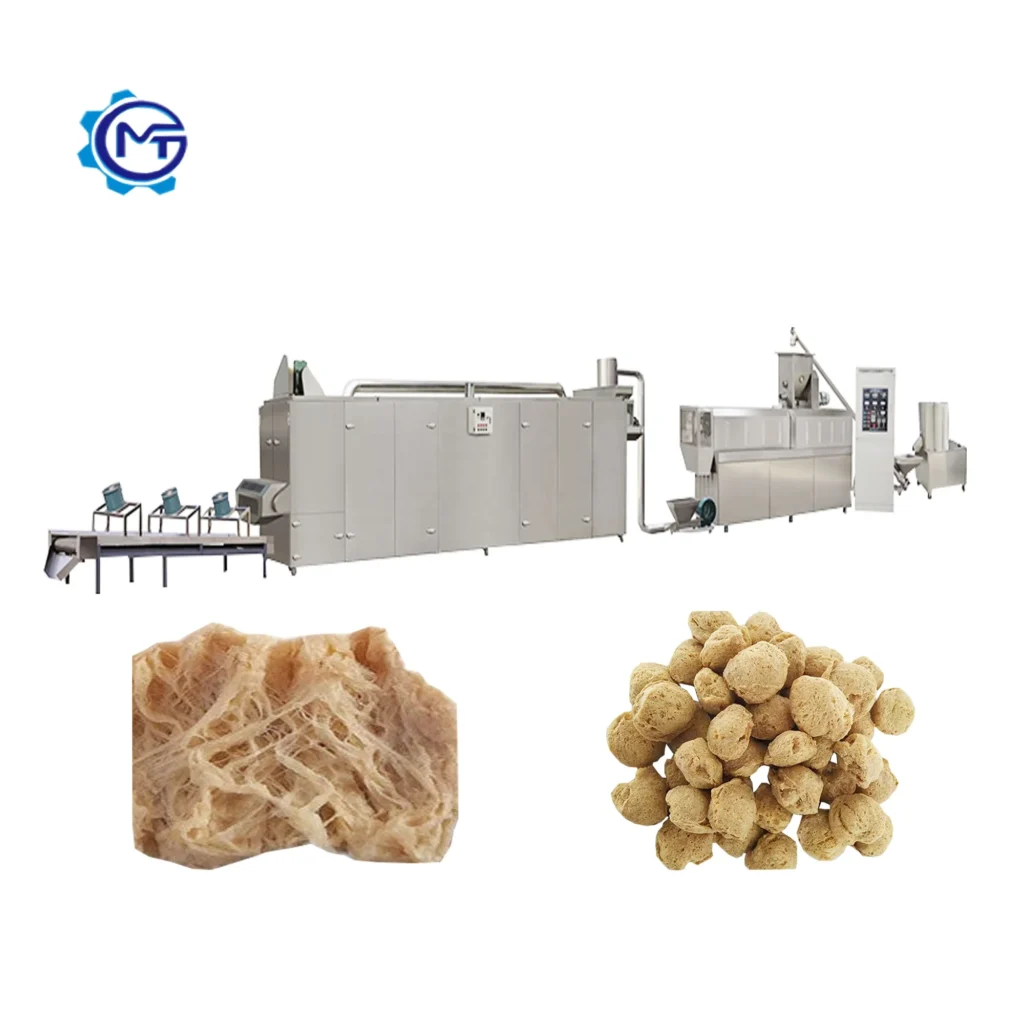
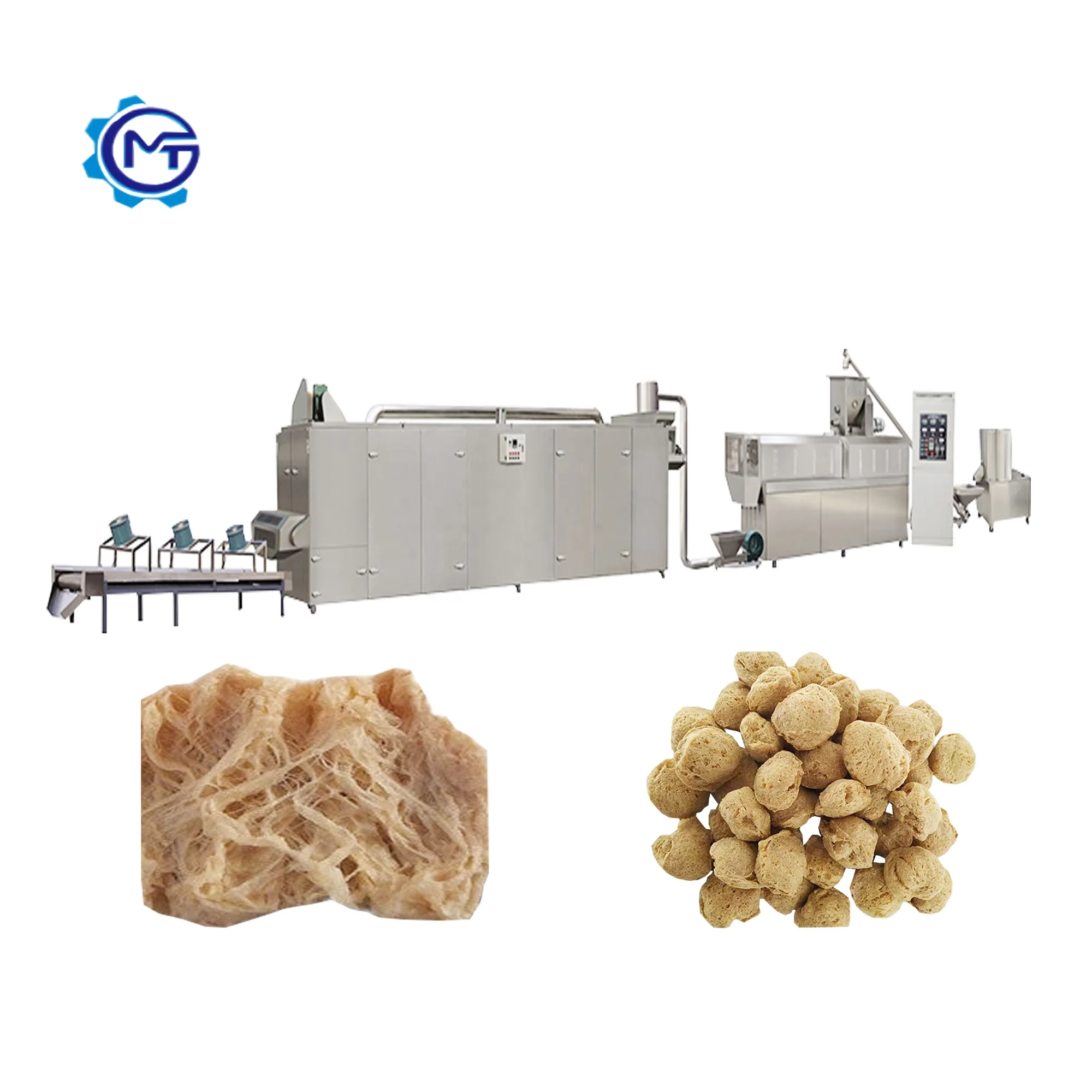

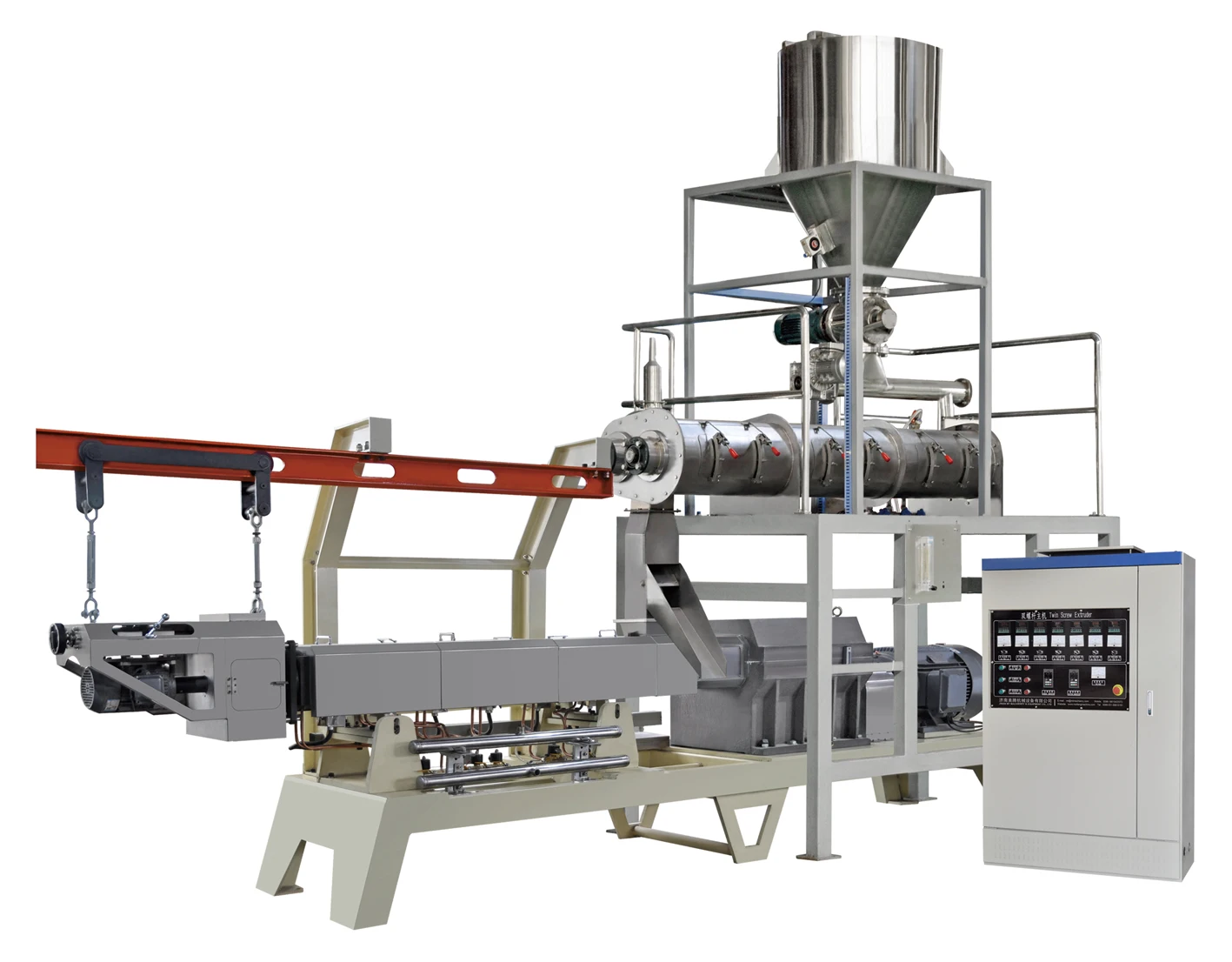


MT65 / MT70 / MT85 Textured Vegetable Protein Production Line, Twin-Screw Extrusion, Batching to Packing — engineered as a complete turnkey project where every station is throughput-matched under single-source responsibility.
- Screw configuration and die design specified to your soybean meal formulation and target fiber texture
- In-house testing workshop runs trial extrusion on your actual raw material before shipment, confirming real output and product structure
- Three extruder frame sizes cover small-scale to industrial output ranges for flexible project scaling
- Line layout and capacity calculation document provided, showing matched throughput across mixer, extruder, dryer, cooler and packing
Trial runs on customer raw material verify capacity and fiber structure before the line leaves the factory.
Description
Integrated Line Throughput Matching — Every station from the powder mixer through the twin-screw extruder to the high-temperature roaster is sized to the same output range, so no single machine bottlenecks the textured vegetable protein production line you are commissioning.
Technical Specifications
| Parameter | Value |
|---|---|
| Product Type | Textured Vegetable Protein (Soy Meat) Extrusion Production Line |
| Available Models | MT65 / MT70 / MT85 |
| Screw Type | Twin-screw (Double Screw Extruder) |
| MT65 Installed Power / Real Power | 85 kW / 65 kW |
| MT65 Output Capacity | 150–200 kg/h (basis not stated in source — confirm raw material formulation / moisture content) |
| MT65 Overall Dimensions | 18000 × 1300 × 2300 mm |
| MT70 Installed Power / Real Power | 120 kW / 90 kW |
| MT70 Output Capacity | 200–300 kg/h (basis not stated in source — confirm raw material formulation / moisture content) |
| MT70 Overall Dimensions | 20000 × 1500 × 2400 mm |
| MT85 Installed Power / Real Power | 195 kW / 165 kW |
| MT85 Output Capacity | 600–800 kg/h (basis not stated in source — confirm raw material formulation / moisture content) |
| MT85 Overall Dimensions | 24000 × 3500 × 4300 mm |
| Powder Mixer Capacity | 300–600 kg/h (basis not stated in source — confirm batch material / density) |
| Powder Mixer Tank Volume / Mixing Time | 150 kg / 10 min per batch |
| Powder Mixer Rotary Speed / Power | 385 rpm / 4 kW |
| High-temperature Roaster Output | 300–400 kg/h (basis not stated in source — confirm material thickness / moisture target) |
| High-temperature Roaster Effective Belt Length | 3.5 m |
| High-temperature Roaster Heating | Far Infrared Heater 3.9 kW × 24 / Gas Consumption 6.8 m³ |
| High-temperature Roaster Dimensions | 4500 × 1500 × 1600 mm |
| Cooling Machine Capacity | 200–300 kg/h (source value — verify against manufacturer catalog) |
| Cooling Machine Temperature Range | 0–260 °C (source value — verify against manufacturer catalog; likely drying/cooling air temp) |
| Line Stations | Raw material preparation → Mixing → Conveying → Extrusion → Conveying → Drying → Cooling → Packing |
| Construction Material | Stainless steel (food-grade contact parts) |
| Warranty | 1 year complete warranty, life-time maintenance service |
| Certification | CE, ISO (company level) |
Application Suitability
| Application | Material or Output |
|---|---|
| Textured vegetable protein (TVP) for retail and food-service markets | Low-temperature soybean meal, peanut meal as primary raw materials |
| Soy meat and meat substitute ingredients | Defatted soy flour blended with water and minor functional additives |
| Vegetarian meat for ham, sausage and canned food production | Extruded soy protein chunks, slices or granules dried to stable moisture |
| Quick-frozen meal and fast-food ingredient supply | High-fiber structured protein pieces rehydrated before secondary cooking |
Why "Nominal Line Capacity" Means Nothing Without Your Raw Material
A turnkey soy meat extrusion line must be validated on your actual soybean meal formulation before it leaves the factory floor.
I spent weeks on-site in a South Asian plant where the line ran fine on standard defatted soy flour during the factory test, but the buyer’s local supplier delivered meal with higher fiber and different protein solubility. The screw shear profile could not develop the fiber network, and the extrudate came out crumbly instead of stringy. Three days of trial production yielded no sellable batch. When you source a textured vegetable protein production line, the capacity figure on the quotation sheet assumes a specific raw material and moisture content that may not match what you will actually feed into the hopper [NEED_CITE: raw material variability in soy meal supply chains].
Screw Configuration Dictates Fiber Structure
The twin-screw extruder sits at the heart of this textured vegetable protein production line. Screw elements are arranged in sections — conveying, kneading, and reverse-flight — each generating a different balance of shear and residence time. Soy protein requires sufficient mechanical energy to unfold and realign into fibrous strands, but excessive shear denatures the structure into a paste. The configuration must be matched to your specific meal grade and target texture, whether you need chunky granules for mince analogues or long fibers for whole-cut substitutes.
Die Geometry and Moisture Control Shape the Final Product
Downstream of the screws, the die plate determines the cross-section and density of the extrudate. A multi-hole die produces granules, while a slit die creates sheets that are later cut into strips or chunks. Moisture content at the die face, barrel temperature profile, and screw speed together govern the expansion ratio. Small adjustments to any of these variables shift the product from a dense, chewy bite to a light, open-cell sponge that rehydrates quickly. Getting this balance right during the pre-shipment trial run eliminates weeks of on-site guesswork [NEED_CITE: extrusion parameter interaction on soy protein structuring].
Reading the Power and Throughput Figures
The MT65 frame draws 85 kW installed with a real running load around 65 kW, while the MT85 frame reaches 195 kW installed and 165 kW real. These differences reflect not just motor size but the mechanical energy available for shear inside the barrel — a larger frame can process higher-protein, harder-to-structure meals that demand more torque. The powder mixer handles 150 kg per batch at 385 rpm, which is adequate to hydrate soy meal uniformly before extrusion. The high-temperature roaster uses 24 far-infrared heating elements plus gas burners across a 3.5-meter belt, providing staged drying that sets the fiber structure without case-hardening the surface. Understanding these relationships helps you select the right frame size for your formulation rather than simply chasing the highest capacity number.
The Cost of Mismatched Station Throughput
One pain point I see repeatedly is an extruder sized correctly but paired with a dryer that cannot keep up. The extruder pushes out material faster than the roaster can dry it, so wet extrudate piles up on the conveyor, cools unevenly, and develops off-colors. The buyer then throttles the extruder down, losing the capacity they paid for. In a properly engineered turnkey soy meat extrusion line, the mixer batch cycle, extruder output, roaster belt speed, and cooler airflow are all calculated against the same throughput target [NEED_CITE: throughput balancing in food extrusion lines]. When any station is undersized, the entire line runs at the pace of its weakest link.
Why Sourcing the Complete Line from One Supplier Matters
This textured vegetable protein production line is supplied as a single integrated project. Every station — from the powder mixer through the twin-screw extruder, high-temperature roaster, and cooling machine — is throughput-matched at the design stage. Screw configuration and die design are specified to your raw material before the build begins. An in-house testing workshop runs trial extrusion on your actual soybean meal formulation, so you can evaluate fiber structure and real output before the line ships. Electrical schematics and voltage are confirmed against your facility’s supply. And the same engineering team that designs the layout handles on-site installation, commissioning, and operator training, which eliminates finger-pointing between multiple vendors when something does not run right on day one.
Documentation & Verification
- Line layout and capacity calculation showing throughput matching across every station
- Trial run report on your soybean meal formulation confirming actual output and fiber texture
- Screw and die configuration record tied to your specific raw material batch
- Electrical schematic with voltage, frequency, and control language confirmed for your site
- CE declaration of conformity and ISO certificate for the complete line
- Operation and maintenance manual with wear parts list and replacement intervals
Installation, Commissioning & Support
- Foundation plan and floor loading details matched to the MT65, MT70, or MT85 frame dimensions
- Dedicated electrical circuit sized to the extruder’s real power draw, up to 165 kW for the MT85
- Pre-assembled barrel and screw modules shipped in labeled sections for rapid on-site assembly
- First-run parameter setting covering barrel temperature zones, screw speed, and die pressure
- Operator training on screw configuration changes when switching between granule and chunk formats
- Wear parts inventory including spare screw elements, die plates, and roaster belt sections
What to Include in Your Inquiry
Share your raw material specification sheet — protein content, moisture, and particle size of the soybean meal or peanut meal you plan to use. Confirm your target output range per shift and the physical format you need, whether granules, chunks, or strips. Provide your facility voltage, frequency, and preferred control language so the electrical package is built correctly from the start. If you can send a sample of your raw material, we will run it through the testing workshop and send you a trial report before the quotation is finalized.
Frequently Asked Questions
Q: How is line capacity verified against my specific soybean meal formulation?
A: We run your raw material through the in-house testing workshop on a twin-screw extruder configured with the screw and die set proposed for your line. The trial report documents actual throughput, extrudate fiber structure, and moisture at the die face, so you see real performance data before committing to production.
Q: What does the installation and commissioning schedule look like?
A: The phased schedule covers foundation preparation, mechanical assembly of the extruder and roaster, electrical hookup, and staged commissioning. Each station is tested individually before the full line runs continuously. Operator training runs in parallel with the final commissioning phase so your team gains hands-on experience under supervision.
Q: How is throughput matched between the extruder, dryer, and cooler?
A: The line layout document calculates the output of each station against the same target capacity. The roaster belt length and heating capacity are sized to handle the extruder’s maximum output, and the cooler airflow is specified to bring the dried product to packing temperature without creating a bottleneck.
Q: What voltage and control options are confirmed before production?
A: We confirm your facility voltage, frequency, and preferred control language before the electrical schematic is finalized. The motor drives, heating elements, and control panel are then built to match, preventing commissioning delays caused by incorrect supply specifications.
Q: Can I send my raw material for a trial run before the line ships?
A: Yes. Sending a representative sample of your soybean meal or peanut meal allows us to run a full trial in the testing workshop. You receive a report covering throughput, product texture, and recommended screw configuration, giving you confidence that the line will perform on your actual formulation.
Related products
-
Twin Screw Extruder for High Moisture Vegetarian Meat
¥9,500.00 Select options This product has multiple variants. The options may be chosen on the product page -
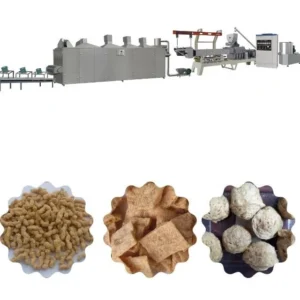
Dry Protein Drawing Equipment – Intelligent Puffing Machine for Cake Protein & Vegetarian Meat
¥65.00 Select options This product has multiple variants. The options may be chosen on the product page -
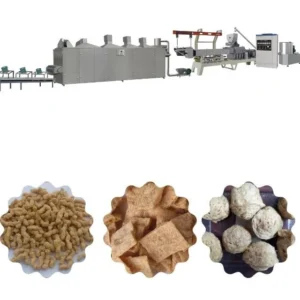
High Productivity Single Screw Extruder Machine New Condition Textured Soya Meat & Soy Protein Like Meat Making Machine
Price range: ¥20.00 through ¥30.00 Select options This product has multiple variants. The options may be chosen on the product page -

Vegetarian Meat Floss Production Line with Twin Screw
¥9,500.00 Select options This product has multiple variants. The options may be chosen on the product page