

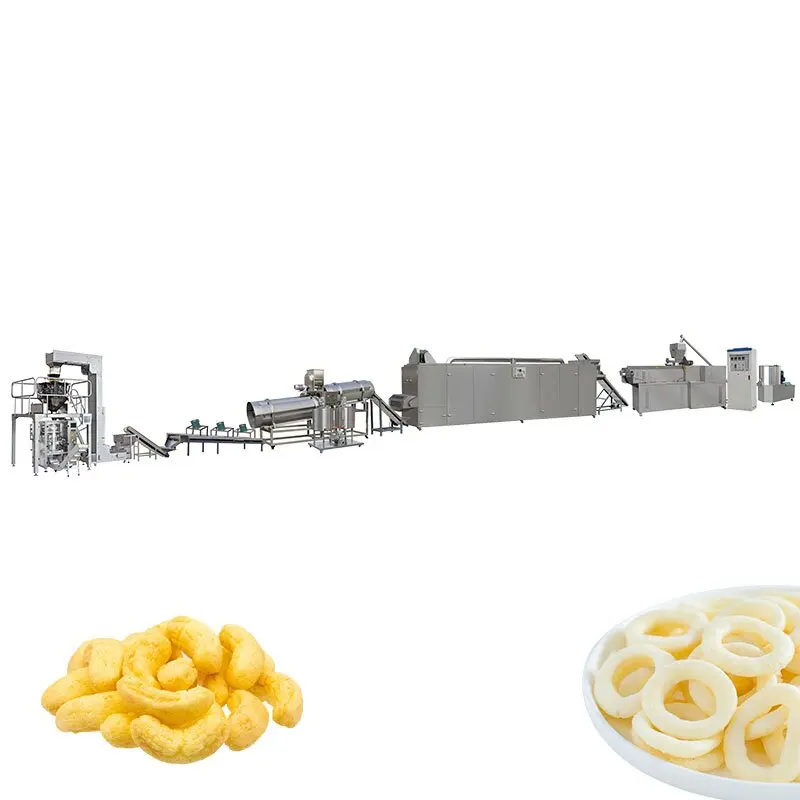
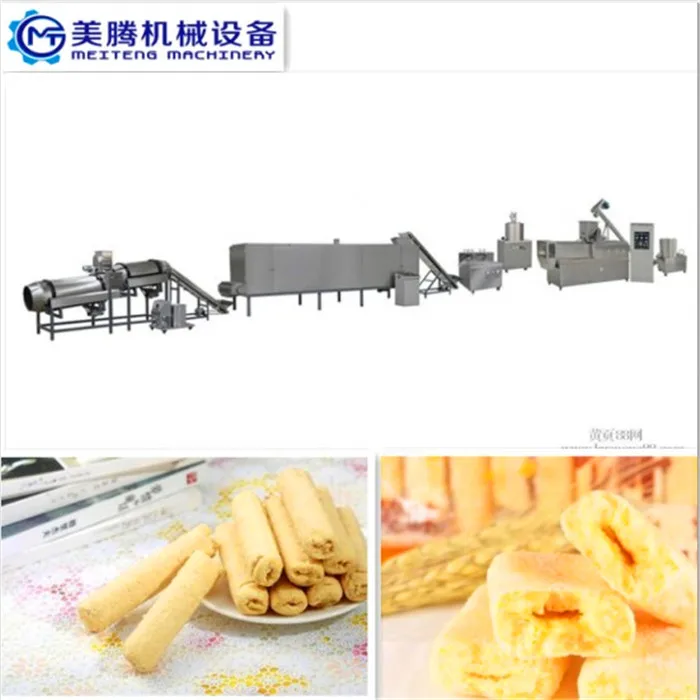
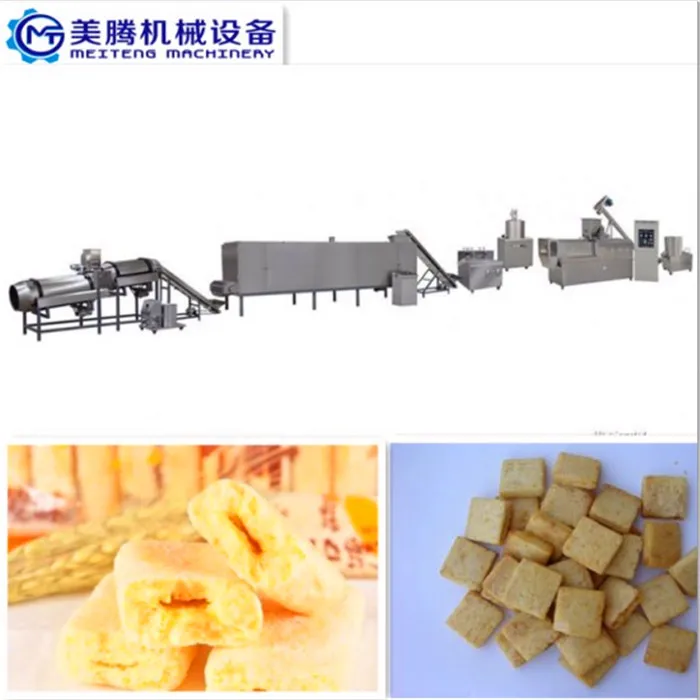
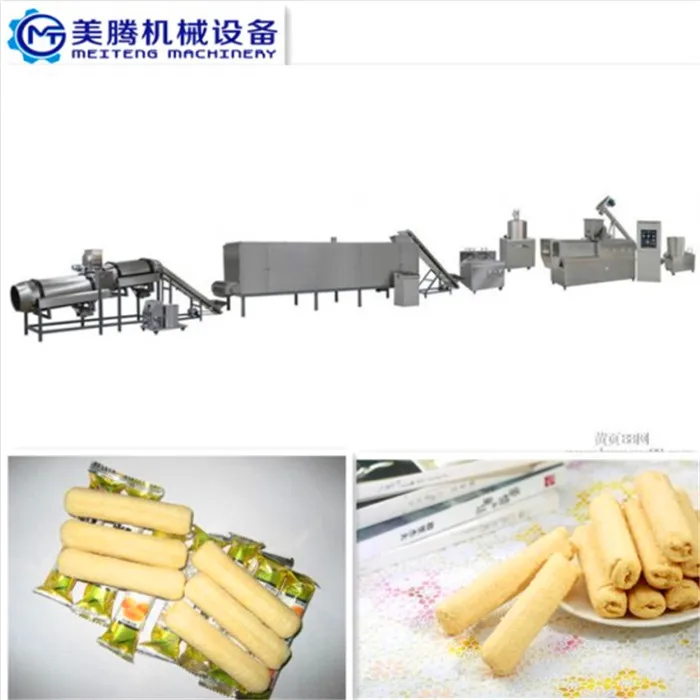
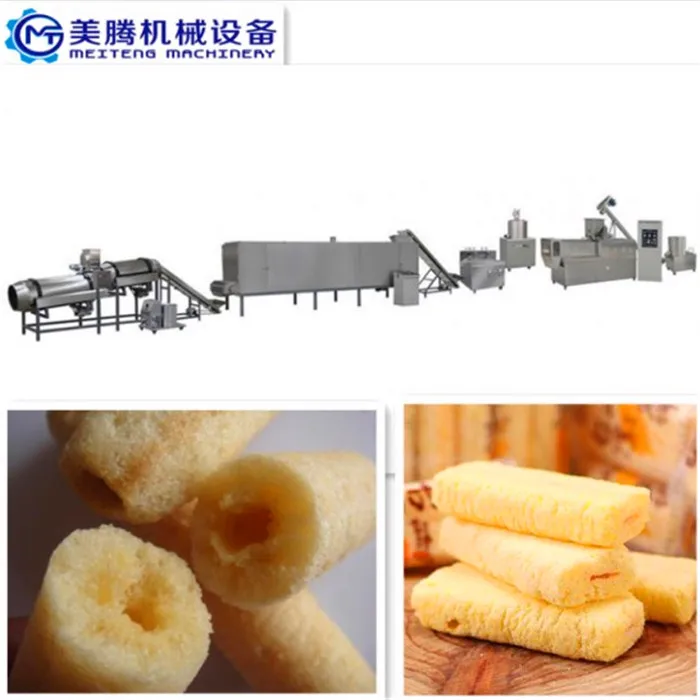
MT-65 / MT-70 / MT-85 Core Filling Snack Extrusion Line, Twin-Screw, PLC & MCC Control — configured as a complete turnkey project from flour mixing through extrusion, core filling, drying, flavoring to packing.
- Screw configuration and die design specified to your cereal formulation and target product density
- Throughput matched across every station under one supplier to eliminate bottlenecks
- In-house trial runs on your actual raw material before shipment verify real output
Delivered with line layout, capacity calculation, and electrical schematic confirmed to your site voltage and control language.
Description
Throughput-Matched Integration — Every station from flour mixing to packing is sized against the extruder’s actual output on your cereal formulation, so the line runs at verified capacity rather than a theoretical maximum.
Technical Specifications
| Parameter | Value |
|---|---|
| Model | MT-65 / MT-70 / MT-85 |
| Product Type | Core Filling Snack Food Extrusion Line |
| Extruder Type | Twin-screw (Double Screw Extruder) |
| Installed Power | 81.5 kW (MT-65) / 115 kW (MT-70) / 181 kW (MT-85) |
| Real Power Consumption | 53 kW (MT-65) / 76 kW (MT-70) / 117 kW (MT-85) |
| Output Capacity | 100-150 kg/h (MT-65) / 200-240 kg/h (MT-70) / 400-500 kg/h (MT-85) (basis to be confirmed with raw material formulation and target density) |
| Overall Dimensions (L×W×H) | 21000×1200×2200 mm (MT-65) / 23000×1500×2200 mm (MT-70) / 28000×3500×4300 mm (MT-85) |
| Control System | Automated PLC and MCC control |
| Line Stations | Flour Mixer → Double Screw Extruder → Core Filling → Shaping → Dryer → Flavoring System → Cooling → Packing |
| Raw Materials (Outer Shell) | Wheat, rice, corn, barley, rye, oats, sorghum |
| Raw Materials (Core Filling) | Chocolate, cream, jelly, fruit paste, date paste |
| Screw Configuration | Specified to buyer’s raw material and target product |
| Standards | CE, ISO |
| Warranty | 1 year complete guarantee with life-time maintenance service |
Application Suitability
| Application | Material or Output |
|---|---|
| Core-filled pillow snacks | Corn and rice flour shells with chocolate or cream centers |
| Co-extruded cereal rings | Wheat and oat formulations with fruit paste or jelly filling |
| Nutrient-fortified snack tubes | Barley and sorghum blends with date paste or soft confectionery core |
| Puffed rice bread snacks | Multi-grain cereal mixes with sweet or savory cream injection |
Why Nominal Capacity Figures Fail on the Factory Floor
Actual throughput depends on your cereal formulation’s moisture content, starch gelatinisation behaviour, and the density of the target filled snack.
When a core filling snack extrusion production line turnkey quotation lists a single output number, it rarely specifies the raw material or moisture level behind that figure. I have walked into facilities where the extruder could physically push dough through the die at the quoted rate, but the downstream dryer could not remove enough moisture fast enough to keep up, and the core filling injector could not maintain consistent center weight at that line speed. The result is a line that runs well below its nameplate capacity because one station bottlenecks the rest [NEED_CITE: throughput matching across extrusion line stations]. The only way to verify real output is to run your exact formulation through every station before the equipment leaves the factory.
Screw Geometry Dictates What Your Cereal Dough Becomes
The twin-screw extruder at the heart of this line is not a fixed machine; its screw configuration and die design are rebuilt around your specific cereal grain blend and the texture you need in the outer shell. Corn-heavy formulations require different shear profiles and barrel temperature zones than oat-dominant mixes, because starch gelatinisation onset temperatures vary across grain types. A core filling snack extrusion production line turnkey project only delivers consistent shell expansion when the screw elements are arranged to match the hydration and gelatinisation curve of your actual flour blend.
Matching Core Injection Rhythm to Extruder Output
The most frequent failure point on a co-extruded snack line is the junction where filling meets shell. If the core filling station injects chocolate or cream at a rhythm that does not sync with the extruder’s dough output rate, you get misaligned centers, broken shells, or blocked injection nozzles. I once saw a line where the chocolate viscosity at production scale was much higher than what the trial used, and the injection nozzles clogged repeatedly, shutting the line down for over a week. That is why pulling the rheology data of your actual filling material and matching pump pressure and nozzle diameter to the extruder’s output speed is the first engineering task, not an afterthought [NEED_CITE: rheological matching of core filling viscosity to extrusion throughput].
What the Power and Dimension Figures Mean for Your Facility
The installed power range across the MT-65, MT-70, and MT-85 models spans from 81.5 kW to 181 kW, with real consumption sitting around 65% of those values during steady-state operation. That gap between installed and real power matters for your transformer sizing and utility contract: you need to provision for peak draw during start-up and barrel heating phases, not just the running average. The overall line length stretches from 21 metres to 28 metres depending on the model, and the MT-85 footprint expands to 3.5 metres wide and over 4 metres high to accommodate the larger dryer and multi-layer cooling conveyor. Twin-screw extrusion relies on sustained barrel temperature across multiple heating zones; if your facility voltage fluctuates, the PID controllers in the PLC cabinet will struggle to hold temperature bands tight enough for consistent shell expansion and surface finish.
The Cost of Skipping Pre-Shipment Verification
When an extrusion line ships without a trial run on the buyer’s actual raw material, the first weeks of production become an expensive experiment. Shell density drifts outside specification, the core-to-shell ratio wanders, and the dryer either over-dries the product or lets it through too moist for safe packing. Operators spend days adjusting screw speed, barrel temperature, and filling pump pressure with no baseline to work from [NEED_CITE: post-installation commissioning delays without factory trial runs]. These are not minor tuning issues; they consume raw material, delay first shipments to customers, and erode confidence in the line before it has produced a single saleable batch.
Why Sourcing the Complete Line From One Supplier Changes the Equation
Every station on this core filling snack extrusion production line turnkey project is sized and specified by the same engineering team, so the flour mixer batch cycle, the extruder output rate, the dryer residence time, and the flavoring drum throughput are calculated against one another rather than assembled from independent vendor quotes. Screw configuration and die design are documented against your formulation, not copied from a generic build. The in-house testing workshop runs your actual cereal grains and filling materials through the assembled line before crating, generating a trial report that becomes your baseline for commissioning. Electrical schematics confirm voltage, frequency, and control language for your target market before production begins, so the PLC cabinet arrives ready to power on rather than needing rewiring after delivery. Food-grade contact materials are used throughout every product-contact surface from the mixer bowl to the packing conveyor.
Documentation & Verification
- Line layout drawing with throughput calculation showing matched capacity at every station
- Screw and die configuration record specific to your cereal formulation and filling material
- Trial run report from testing workshop using your raw material before dispatch
- Electrical schematic with confirmed voltage, frequency, and PLC interface language
- CE declaration of conformity and ISO certificate for the complete line
- Operation and maintenance manual with wear parts list and replacement intervals
Installation, Commissioning & Support
- MT-85 line requires a minimum 30-metre clear floor length with 4.5-metre ceiling clearance for dryer exhaust routing
- Dedicated power circuit sized for 181 kW installed load with soft-start provision for the main extruder drive motor
- Line ships in modular sections; on-site assembly includes barrel alignment and screw element sequencing verification
- First production run supervised by commissioning engineer with parameter logging against the factory trial baseline
- Operator training covers PLC interface navigation, screw speed and barrel temperature adjustment, and core filling pump calibration
- Wear parts kit includes replacement screw elements, die inserts, and filling nozzles matched to your product specification
Preparing Your Inquiry
To configure the right line, share your cereal grain formulation with moisture percentages, the specific filling material and its viscosity range at processing temperature, your target daily output in kilograms, and the finished snack dimensions and core-to-shell ratio you need. Include your facility voltage and frequency, preferred PLC language, and whether you plan to send raw material samples for a pre-shipment trial run in the testing workshop.
Frequently Asked Questions
Q: How is line capacity verified on my specific raw material formulation before shipment?
A: We run your actual cereal grains and filling materials through the assembled line in our in-house testing workshop. The trial documents real throughput, shell expansion, core-to-shell ratio, and moisture levels leaving the dryer. You receive a full trial report that becomes the baseline for on-site commissioning, so capacity is confirmed on your formulation rather than estimated from generic test data.
Q: What utility planning and site preparation is required for the complete turnkey line installation?
A: You will need a power supply matching the confirmed voltage and frequency for your model tier, with circuit capacity covering the installed power rating plus start-up surge. The MT-85 model needs roughly 28 metres of clear floor length and over 4 metres of headroom. Compressed air, water supply for the mixer, and exhaust ventilation for the dryer are also specified in the line layout document provided before shipment.
Q: How are screw configuration and die design matched to my target product texture and core filling ratio?
A: The screw element arrangement and barrel zone temperatures are selected based on the starch gelatinisation profile of your cereal blend. The die opening geometry controls shell wall thickness and expansion rate, which directly affects how much filling the shell can hold without splitting. Both are recorded in a configuration document tied to your formulation and shared before production begins.
Q: How is throughput balanced between the extruder, dryer, and flavoring stations to prevent line bottlenecks?
A: Each station’s capacity is calculated from the extruder’s verified output on your formulation. The dryer length and belt speed are set to achieve target moisture at that output rate, and the flavoring drum rotation speed and seasoning feed rate are matched accordingly. This calculation is documented in the line layout and confirmed during the pre-shipment trial run.
Related products
-

Puff Corn Extruder Machine Puffed Core Filled Snack Food Production Line Machine
¥8,500.00 Select options This product has multiple variants. The options may be chosen on the product page -

Automatic Corn Crisps Extruder Production Machine for Maize Chips and Corn Sticks New Condition
¥8,000.00 Select options This product has multiple variants. The options may be chosen on the product page -

Fully automatic puff snack processing line
¥8,500.00 Select options This product has multiple variants. The options may be chosen on the product page -

Twin Screw Extruder for Cheese Puffs Food Stainless Steel Simple Puffed Rice Snack Machine
¥8,500.00 Select options This product has multiple variants. The options may be chosen on the product page


