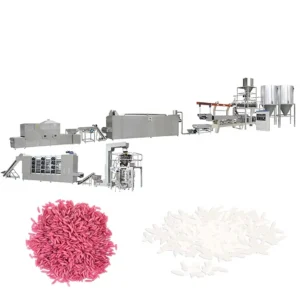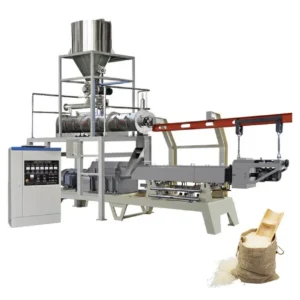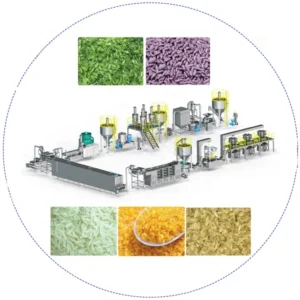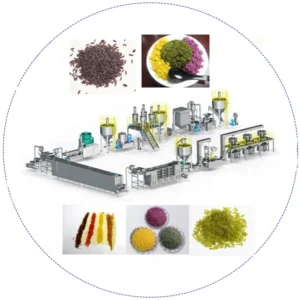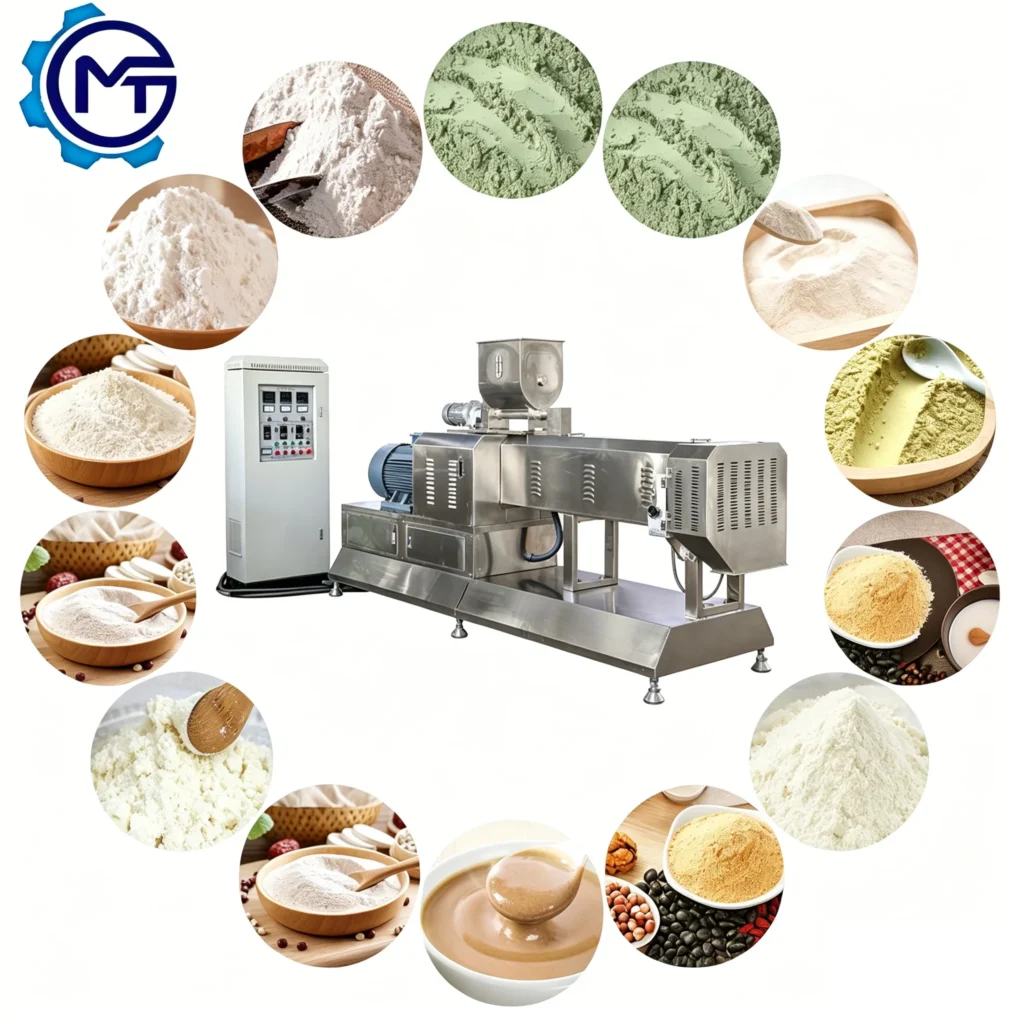


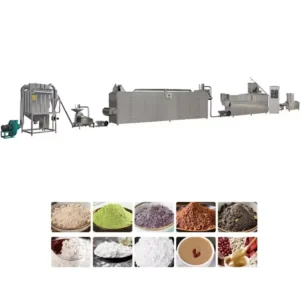
MT65 / MT70 / MT75 / MT85 Fortified Nutrition Powder Production Line, Twin-Screw, 380V 50Hz, PLC Control — engineered as one integrated turnkey project from batching through extrusion, drying, and pulse grinding. Screw configuration and die design are specified to the buyer’s raw material and target powder texture, with every station sized to the same output target so no bottleneck constrains the line. Multi-layer drying oven provides adjustable temperature and chain speed to match extruder throughput and achieve precise moisture content.
Delivered with matched throughput documentation, in-house trial runs on your actual raw material before shipment, and on-site commissioning with operator training.
Description
Integrated Turnkey Engineering — Every station on this fortified nutrition powder production line is sized and sequenced as a single project, eliminating the throughput mismatches that stall standalone equipment purchases.
Technical Specifications
| Parameter | Value |
|---|---|
| Product Type | Fortified Nutrition Powder Production Line |
| Model Options | MT65 / MT70 / MT75 / MT85 |
| Extruder Screw Type | Twin Screw |
| Installed Power | 84 kW (MT65) / 160 kW (MT70) / 190 kW (MT75) / 210 kW (MT85) |
| Power Consumption | 59 kW (MT65) / 120 kW (MT70) / 140 kW (MT75) / 150 kW (MT85) |
| Output Capacity | 120–150 kg/h (MT65, basis not stated in source) / 150–200 kg/h (MT70, basis not stated in source) / 200–250 kg/h (MT75, basis not stated in source) / 300–400 kg/h (MT85, basis not stated in source) |
| Overall Dimensions (L×W×H) | 20,000×1,500×2,200 mm (MT65) up to 25,000×1,500×3,500 mm (MT85) |
| Voltage & Frequency | 380 V, 50 Hz, Three Phase (configurable) |
| Control System | PLC automation |
| Line Sequence | Mixer → Screw Conveyor → Extruder → Air Conveyor → Drying Oven → Air Conveyor → Pulse Grinder |
| Mixer Material | 304 Stainless Steel |
| Mixer Batch Capacity | 20–30 kg / 70–80 kg / 170–180 kg per batch (option dependent) |
| Drying Oven Type | Multi-layer, adjustable temperature and time, double pitch roller chain drive |
| Pulse Grinder Power | 11 kW |
| Pulse Grinder Dimensions | 3,000×900×2,200 mm |
| Assembly State | Complete turnkey line |
| Standards | CE, ISO |
| Warranty | One year |
Application Suitability
| Application | Material or Output |
|---|---|
| Infant Formula & Baby Food Powder | Rice, oat, and wheat base blended with milk powder and micronutrients |
| Fortified Nutrition Programme Supply | Corn, soy, and grain matrices enriched with vitamin and mineral premixes |
| Modified & Functional Starch Powder | Pregelatinised starch from cassava, potato, or cereal sources |
| Therapeutic & Functional Food Powder | High-protein blends including whey, pea protein, and dietary fibre |
| Breakfast Cereal Porridge Powder | Multi-grain formulations requiring controlled gelatinisation and fine grind |
The Hidden Bottleneck That Derails Powder Line Projects
A fortified nutrition powder production line turnkey purchase only works when every station is matched; an extruder running faster than the dryer can process, or a grinder that chokes on the oven’s output, silently caps the entire project at the weakest link.
Throughput matching is a calculation, not a guess — every station on this line is engineered to the same target output from the initial layout.
I used to field service calls where a buyer had sourced an extruder from one vendor and a dryer from another, only to find the dryer could not handle the moisture load coming off the barrel. The line ran, but at a fraction of the planned volume, and the buyer spent weeks adjusting temperatures and belt speeds to compensate. That kind of mismatch is invisible in a quotation that lists each machine’s nominal capacity in isolation [NEED_CITE: throughput balancing principles in continuous food processing lines]. When a project contractor or factory manager reviews a layout, the critical question is not what each station can do alone, but whether the material flow between stations holds steady under the specific formulation being processed.
Project Layout and Phased Installation Planning
A turnkey nutrition powder line occupies a continuous footprint that can exceed 25 metres in length, depending on the model selected. The layout must account for material flow direction, air conveyor routing, and maintenance access on both sides of the extruder barrel and drying oven. For contractors managing phased factory build-outs, the line can be planned so that the extrusion and drying stages install first, with the pulse grinder and packing integration following in a second phase. This approach requires that utility stubs — electrical trunking, compressed air drops, and ventilation ducts — are roughed in during the initial civil work to avoid disruptive retrofits later.
Utility Planning Across the Full Line Sequence
Power distribution on a project of this scope goes well beyond plugging in the extruder. The mixer, screw conveyors, air conveyors, multi-layer drying oven, and pulse grinder each draw from separate circuits, and the total connected load must be calculated against the site’s transformer capacity. Compressed air is required for pneumatic gates and air conveyor operation, while the drying oven may demand steam or hot water if the heat exchanger specification calls for it. Confirming voltage, frequency, and phase at the inquiry stage prevents costly rewiring or transformer upgrades after the equipment arrives on site [NEED_CITE: industrial voltage and frequency standards by export market].
Reading the Specifications for Actual Production Impact
The twin-screw extruder at the heart of this line is specified across four model tiers, each with a distinct installed power and barrel length. The screw configuration and die design are matched to the buyer’s raw material — a high-fat infant formula blend behaves very differently inside the barrel than a lean, starch-dominant grain mix, and the screw element arrangement must account for that difference in shear and residence time. The multi-layer drying oven uses a double pitch roller chain drive to move product through adjustable temperature zones; the number of layers and the belt speed together determine how much moisture is removed before the product reaches the pulse grinder. The grinder itself, rated at 11 kW, is sized to reduce the dried extrudate to the fine particle size that infant formula and nutrition powders demand. PLC control ties the entire sequence together, maintaining consistent feed rates and temperature profiles so that batch-to-batch variation stays within the tight tolerances that nutritional labelling requires.
The Cost of Overlooking Configuration Details
A line that ships with a generic screw profile and a standard die will run, but it may produce a powder that fails the target density or particle size specification once the buyer’s actual formulation is introduced. I have seen projects where the extruder was commissioned on a plain rice flour trial, and the first production run with a whey-protein-heavy blend caused the material to clump inside the barrel, forcing a full parameter overhaul that delayed launch by over a week [NEED_CITE: impact of raw material composition on twin-screw extrusion behaviour]. When the grinder receives extrudate that was not dried to the correct residual moisture, the screens clog and the throughput drops — another mismatch that only surfaces under real production conditions.
Why Project Buyers Source This Line Here
The entire sequence from batching mixer through pulse grinder is supplied under one project responsibility, so the throughput at every station is calculated against the same target rather than assembled from independent vendor quotations. Screw configuration and die geometry are documented against the buyer’s specific raw material and target powder texture before production begins. An in-house testing workshop conducts trial runs using the customer’s actual formulation, generating a report that confirms output and product quality before the line ships. Electrical schematics are issued with voltage, frequency, and control language verified for the installation site, reducing commissioning surprises. On-site installation, operator training, and a documented wear parts list ensure the line transitions from project delivery to steady production without an extended learning curve.
Documentation & Verification
- Line layout and capacity calculation showing matched throughput from mixer to grinder
- Screw and die configuration record specific to your formulation and target powder density
- Trial run report on your actual raw material conducted before shipment
- Electrical schematic with confirmed voltage, frequency, and PLC language for your site
- CE declaration of conformity and ISO certificate for the complete line
- Operation and maintenance manual with wear parts list and replacement intervals
Installation, Commissioning & Support
- Foundation and floor loading plan based on the selected model’s overall dimensions and weight distribution
- Dedicated circuit planning for total connected load up to 210 kW depending on model
- Air conveyor and ductwork routing coordinated with your facility’s ceiling height and column spacing
- First-run parameter setting on your raw material, covering screw speed, barrel temperatures, and dryer chain speed
- Operator training on PLC interface, safety interlocks, and batch changeover procedures
- Wear parts list covering screws, dies, grinder screens, and dryer chain links with recommended stock levels
Preparing Your Project Inquiry
To move from an initial concept to a detailed line proposal, the most useful information you can share at the inquiry stage includes your target raw material formulation with approximate ratios, the daily or hourly output you need the line to sustain, and the available floor space and ceiling height in your production hall. Confirming your local voltage and frequency, along with the preferred PLC operating language, allows the electrical design to be finalised before fabrication begins.
Frequently Asked Questions
Q: How is line throughput calculated and matched between the extruder, dryer, and grinder?
A: Each station is sized against a single target output that accounts for moisture loss in the dryer and the grinder’s reduction ratio. The extruder’s barrel capacity and screw speed set the upstream flow, the drying oven’s belt speed and layer count are matched to remove the required moisture within that flow rate, and the pulse grinder is selected so its screen area and motor power can handle the dried throughput without bottlenecking the sequence.
Q: What utility planning is needed for the complete nutrition powder line?
A: The line requires three-phase electrical supply sized to the total connected load of the selected model, compressed air for pneumatic gates and air conveyors, and potentially steam or hot water for the drying oven heat exchanger. Ventilation and dust extraction must be planned around the mixer, grinder, and air conveyor discharge points. Confirming these utilities at the layout stage prevents costly site modifications after delivery.
Q: Can the line layout be phased for staged installation as production ramps up?
A: Yes, the layout can be designed so that the extrusion and drying sections install in a first phase, with the pulse grinder and downstream packing integration added later. Utility stubs for the second phase are roughed in during initial civil work so that the expansion does not require shutdown or structural modification of the running line.
Q: What does on-site commissioning and operator training cover?
A: Commissioning includes mechanical alignment verification, electrical continuity and safety interlock testing, and first-run parameter tuning on your raw material. Operator training covers the PLC interface, normal and emergency shutdown sequences, screw and die changeover, dryer temperature adjustment, and grinder screen replacement, along with daily and weekly maintenance checklists specific to your line configuration.
Q: How are screw and dryer settings adjusted for different raw materials?
A: Screw element arrangement and die geometry are specified to the formulation’s fat, protein, and starch content, which determines the shear and residence time needed for proper gelatinisation. Dryer temperature zones and chain speed are then set to achieve the target residual moisture for that specific extrudate, ensuring the pulse grinder receives material at the correct consistency for the required final particle size.
Related products
-
CE Approved MT Brand Organic Baby Rice Nutrition Powder Extrusion Production Line with 500kg/h Capacity and Automatic Grade
¥9,500.00 Add to cart -
Fully Automatic Fortified Nutrition Powder Baby Food Production Line
¥8,238.27 Select options This product has multiple variants. The options may be chosen on the product page -
Industrial Instant Corn Paste Production Line Nutritional Powder Processing Equipment Meal Replacement Nutrition Powder Machine
¥65.00 Select options This product has multiple variants. The options may be chosen on the product page -
Healthy Baby Food Production Line Nutritional Powder Equipment for Baby Food Supplements for Flour Processing Machinery
¥8,500.00 Select options This product has multiple variants. The options may be chosen on the product page