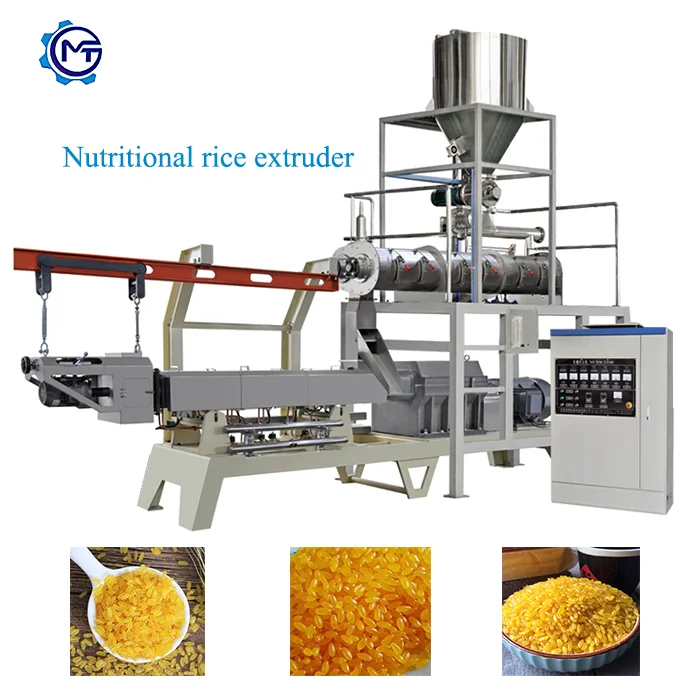
MT65 / MT70 / MT85 / MT75 / MT95 Artificial Nutritious Rice Production Line, Twin-Screw Extrusion, CE/ISO Certified — designed for grain processors producing fortified rice kernels from broken rice, corn, millet, wheat, oats and starch blends.
- Twin-screw configuration and die design are matched to your specific grain formulation and micro-nutrient additive ratio, ensuring proper kernel density and nutritional retention through extrusion
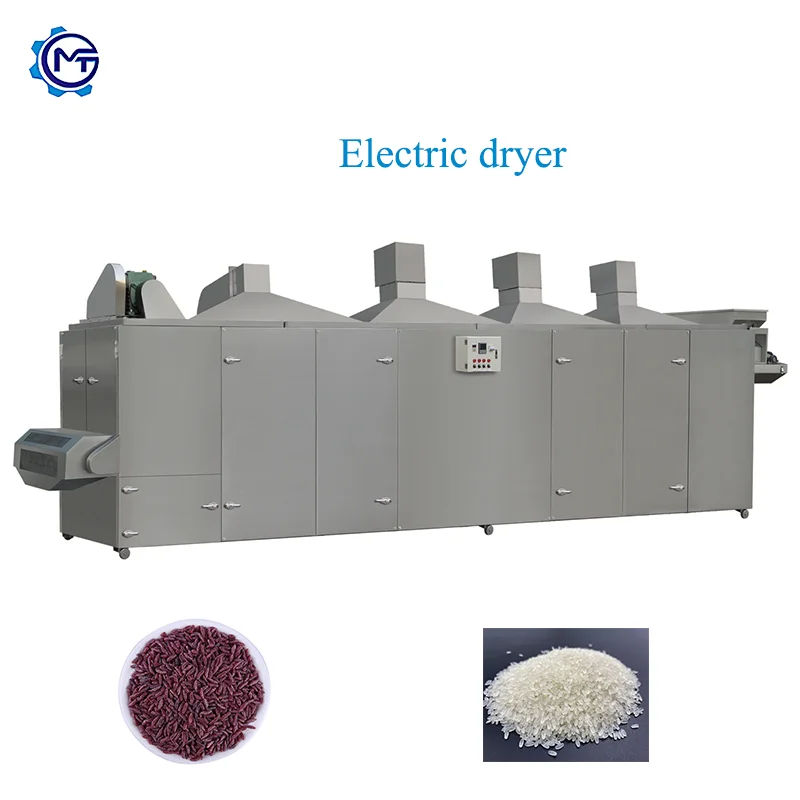
- Circulation drying oven with frequency-controlled mesh belt adapts to the moisture profile of each batch
One-supplier turnkey layout with every station throughput-matched, validated by in-house trial runs on your raw material before shipment.
Description
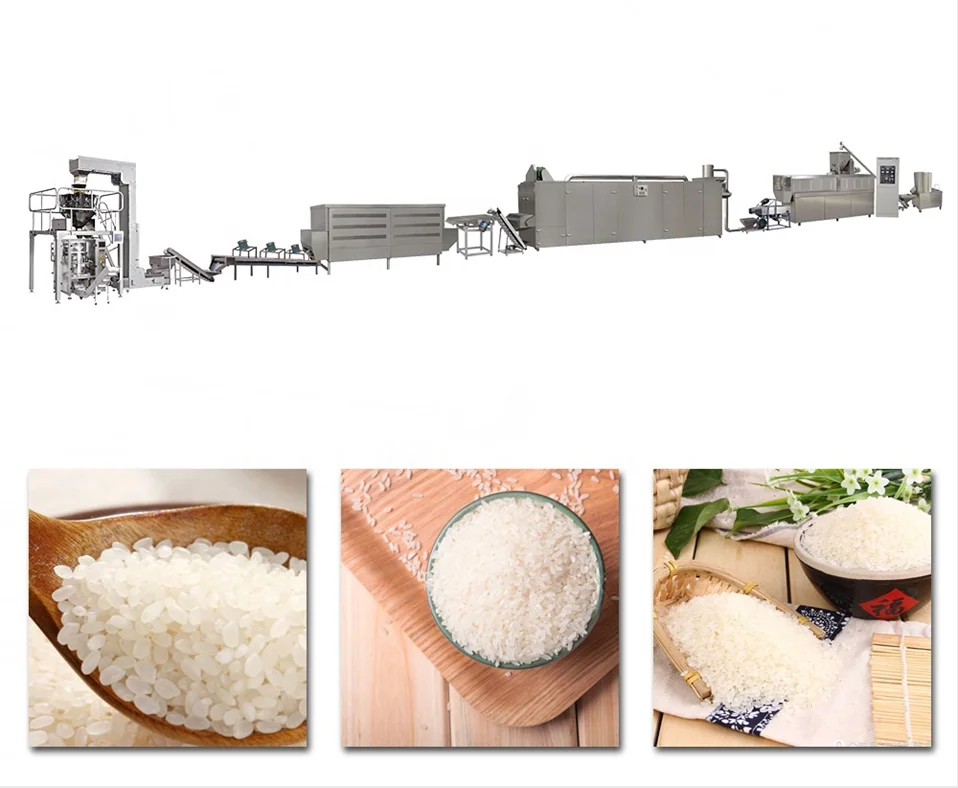
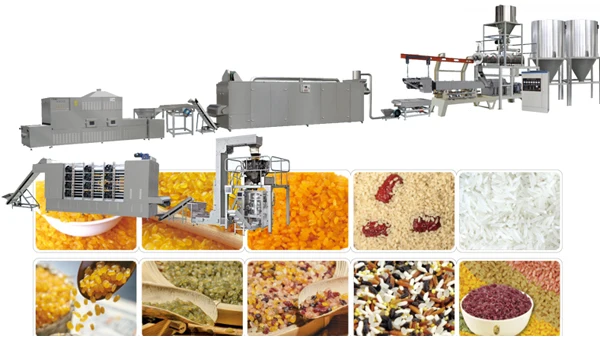
Turnkey Throughput Matching — MT65 to MT95 artificial nutritious rice production lines are engineered from batching through extrusion, drying, roasting, and packing under one supplier, eliminating the bottleneck risk when stations are assembled from separate vendors.
Technical Specifications
| Parameter | Value |
|---|---|
| Product Type | Artificial Nutritious Rice Production Line |
| Models Available | MT65 / MT70 / MT85 / MT75 / MT95 |
| Screw Type | Twin-screw (single or double screw feeding system available) |
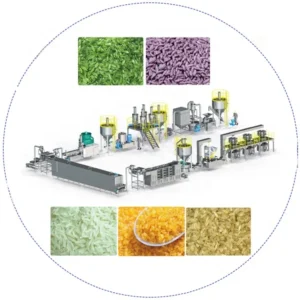
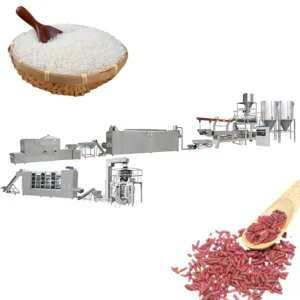
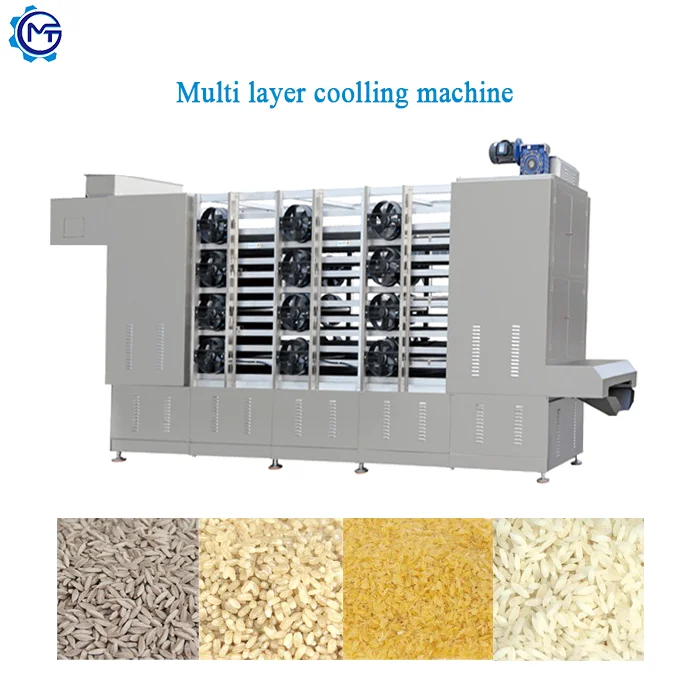
| Line Stations | Mixing → Extruding → Vibrating → Low Temperature Drying → Cooling → High Temperature Roasting → Cooling → Packing |
| MT65 Installed Power / Consumption | 85 kW / 60 kW |
| MT65 Capacity | 80–100 kg/h (basis not stated in source — confirm raw material formulation and moisture content) |
| MT65 Dimensions | 28 × 1.2 × 2.2 m |
| MT70 Installed Power / Consumption | 120 kW / 85 kW |
| MT70 Capacity | 100–120 kg/h (basis not stated in source — confirm raw material formulation and moisture content) |
| MT70 Dimensions | 30 × 1.5 × 2.2 m |
| MT85 Installed Power / Consumption | 235 kW / 165 kW |
| MT85 Capacity | 200–300 kg/h (basis not stated in source — confirm raw material formulation and moisture content) |
| MT85 Dimensions | 34 × 3.5 × 4.3 m |
| MT75 Installed Power / Consumption | 180 kW / 135 kW |
| MT75 Capacity | 300–500 kg/h (basis not stated in source — confirm raw material formulation and moisture content) |
| MT75 Dimensions | 32 × 3.5 × 4.3 m |
| MT95 Installed Power / Consumption | 260 kW / 195 kW |
| MT95 Capacity | 800–1000 kg/h (basis not stated in source — confirm raw material formulation and moisture content) |
| MT95 Dimensions | 36 × 3.5 × 4.3 m |
| Drying Oven Heating Source | Electric or gas |
| Drying Oven Feature | Circulation drying with frequency-controlled mesh belt |
| Control System | Frequency speed controlling, high automation |
| Lubrication & Cooling | Automatic, integrated |
| Certifications | CE, ISO |
Application Suitability
| Application | Material or Output |
|---|---|
| Fortified rice for nutrition programmes | Broken rice and rice bran blended with vitamin and mineral micro-nutrients |
| Artificial rice kernel production | Broken rice, rice, corn, millet, wheat, oats, buckwheat, bean, starch |
| Commercial reconstituted grain products | Multi-grain blends targeting natural viscosity, elasticity and taste |
| Infant and nutritional formula rice | Starch-based formulations with heat-sensitive additive integration |
What "Rated Capacity" Hides When Your Grain Blend Changes
An artificial nutritious rice production line quoted on a standard corn-starch basis can lose a large share of its output the moment your raw material carries higher protein, fibre, or moisture.
I learned this the hard way. A nutrition programme buyer once sent us a formulation built on broken rice and mung bean flour with a vitamin premix — protein content well above the reference material we used for the original line configuration. The twin-screw extruder choked on the denser feed, output dropped sharply, and the drying oven sat half-empty because there was not enough upstream throughput to keep it loaded. The fix was not a bigger motor; it was a revised screw element arrangement and a wider die aperture matched to that specific blend [NEED_CITE: twin-screw extrusion screw configuration for high-protein grain blends]. Until we ran the buyer’s actual material in the testing workshop and recorded the real throughput, no capacity number on paper meant anything.
Screw Geometry and the Grain-Blend Variable
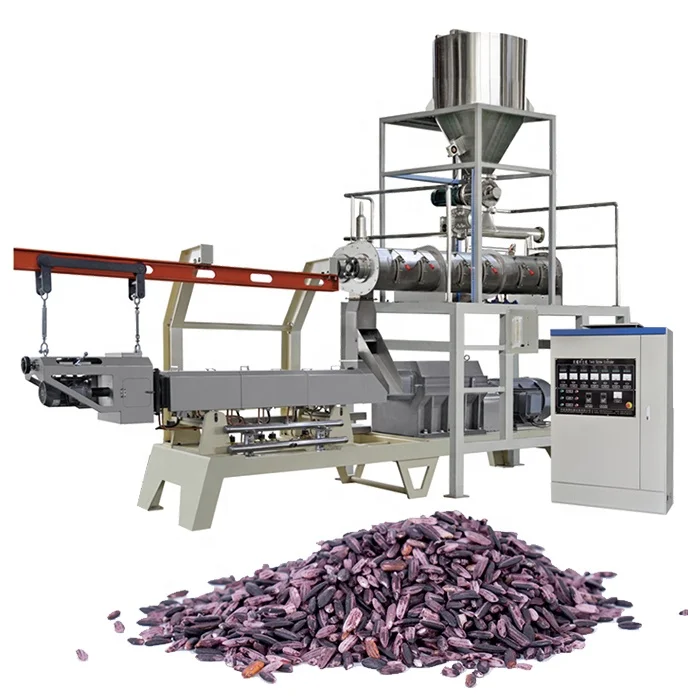
The twin-screw extruder at the heart of this artificial nutritious rice production line does more than push material forward — it controls residence time, shear intensity, and the degree of starch gelatinisation inside the barrel. When the raw material shifts from pure rice flour to a blend containing buckwheat, oat bran, or bean protein, the viscosity curve changes and the original screw profile may no longer deliver consistent expansion. MT specifies screw element sequences — conveying, kneading, and reverse elements — against the buyer’s exact formulation rather than copying a generic build.
Die Aperture and Kernel Shape Control
The die plate determines the cross-section of each extruded kernel, and its aperture must balance pressure inside the barrel with the target shape of the fortified rice grain. Too small an opening raises back-pressure and slows output; too large an opening lets the dough expand beyond the natural rice kernel silhouette. For multi-grain formulations that include fibrous materials like oat or buckwheat, the die land length is adjusted to maintain surface smoothness and prevent ragged edges that break during the downstream roasting stage [NEED_CITE: die design parameters for extruded rice kernel shape retention].
Reading the Power and Capacity Table Correctly
The MT65 draws roughly 60 kW in operation and is dimensioned at 28 × 1.2 × 2.2 m, fitting compact workshops, while the MT95 needs 195 kW and a 36 × 3.5 × 4.3 m floor area with adequate overhead clearance for the drying and roasting ovens. The capacity range for each model is based on a reference formulation; actual throughput on your grain blend can differ materially, which is why MT runs a trial on the buyer’s raw material before confirming the final model selection. Installed power figures include the extruder main drive, feeder, cutting mechanism, and drying oven heating elements — always verify whether your local electrical tariff charges on peak demand or cumulative consumption when sizing the transformer.
The Hidden Cost of Skipping the Trial Run
When a line ships without a factory trial on the buyer’s actual grain formulation, the first production run becomes the test. Screw combinations that worked on the manufacturer’s reference starch may cause uneven gelatinisation on your blend, producing kernels that crack during the high-temperature roasting stage or fail to rehydrate properly in the consumer’s pot. The downstream dryer and cooler, sized for a different throughput, either run half-empty — wasting energy — or become a bottleneck that forces the extruder to idle [NEED_CITE: extrusion line throughput mismatch between extruder and dryer]. Reconfiguring screw elements and adjusting mesh belt speed on-site adds days of downtime that a pre-shipment trial would have eliminated.
Why Source the Full Line from One Supplier
MT designs every station — mixing, extruding, vibrating, low-temperature drying, cooling, high-temperature roasting, second cooling, and packing — so throughput is matched across the chain rather than assembled from separate vendors who each rate their equipment on different assumptions. Screw and die configurations are specified against the buyer’s raw material report, not copied from a generic catalogue. The in-house testing workshop runs the buyer’s exact grain blend before shipment, generating a trial run report that locks in screw profile, die aperture, and dryer temperature settings. Frequency-controlled motors across the line keep station speeds synchronised, and automatic lubrication and cooling protect the gearbox during extended runs. CE and ISO certification documentation accompanies every shipment, smoothing customs and regulatory approval in the destination market.
Documentation & Verification
- Line layout and capacity calculation confirming throughput match across all eight stations
- Screw and die configuration record tied to your grain and micro-nutrient blend
- Trial run report on your raw material from the in-house testing workshop
- Electrical schematic with voltage and frequency confirmed for your market
- CE declaration of conformity and ISO certificate for regulatory clearance
- Operation manual with wear parts list covering screws, dies, and mesh belts
Installation, Commissioning & Support
- Floor plan and foundation load calculated per model dimensions, up to 36 × 3.5 × 4.3 m for the MT95
- Dedicated electrical circuit sized for installed power ranging from 85 kW to 260 kW depending on model
- Machines shipped in modular sections; on-site assembly aligns extruder, dryer, and roaster
- First-run parameter setting covers barrel temperature profile, screw speed, and mesh belt frequency
- Operator training on screw element changes and die swap procedures for different kernel shapes
- Spare screw elements, die plates, and dryer mesh belts listed in the wear parts schedule
Before You Request a Quote
Send your raw material formulation — including grain types, protein and fibre percentages, and any vitamin or mineral premix ratios — along with your target daily output and the voltage and frequency standard at your facility. If you already operate upstream milling or downstream packing equipment, share the interface dimensions so the line layout accounts for existing conveyors and silos. Specify whether you need the drying oven heated by electric elements or gas burners, and confirm the control language for the frequency drive panels.
Frequently Asked Questions
Q: How is the capacity of each model verified against my specific grain formulation?
A: Each model’s published kg/h range is based on a reference material. Before we confirm a model, we run your actual grain and micro-nutrient blend through the twin-screw extruder in our testing workshop and record real throughput, screw configuration, and die settings in a trial report.
Q: Can the voltage and control language be set for my country before the line ships?
A: Yes. During the specification confirmation stage we record your local voltage, frequency, and preferred control panel language. The electrical schematic and motor nameplates are then produced to match, avoiding rewiring or reprogramming delays during on-site commissioning.
Q: How is the screw and die configuration chosen for a fortified rice blend with vitamins?
A: We review your formulation report — grain ratios, protein content, fibre level, and additive particle size — then select conveying, kneading, and reverse screw elements and a die aperture that maintain kernel shape and prevent nutrient degradation from excessive shear heat.
Q: What does the pre-shipment trial run actually test?
A: The trial feeds your raw material through the extruder at production speed, measures output rate, checks kernel shape and surface quality after drying and roasting, and records barrel temperature, screw speed, and dryer belt speed so those parameters transfer directly to your factory start-up.
Q: Are spare screws and dies available when I need the first replacement?
A: A wear parts list is included with every line, covering screw elements, die plates, and dryer mesh belts. Replacement parts are manufactured to the same configuration record used in your trial run, so fit and performance remain consistent after installation.
Related products
-

New Automatic Nutritional Powder Making Machine for Baby Food Production Line
¥20.00 Select options This product has multiple variants. The options may be chosen on the product page -
Organic Gluten Free Baby Rice Nutrition Powder Automatic 500kg/h Production Processing Line
¥8,238.27 Add to cart -
Automatic Iron Fortified Baby Rice Cereal Nutrition Powder Making Machine 500kg/h PLC Controlled
¥8,238.27 Add to cart -
Hygienic Stainless Steel Infant Rice Powder Processing Line Automatic 500kg/h Capacity PLC Controlled
¥9,500.00 Add to cart