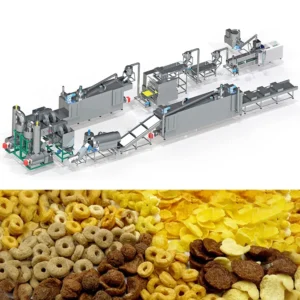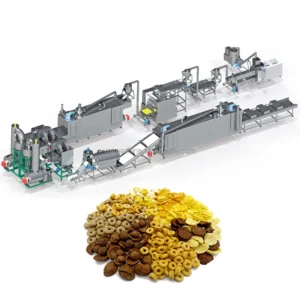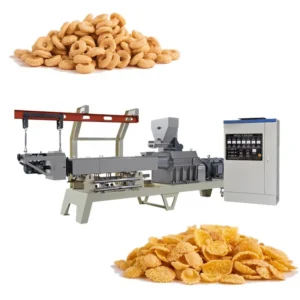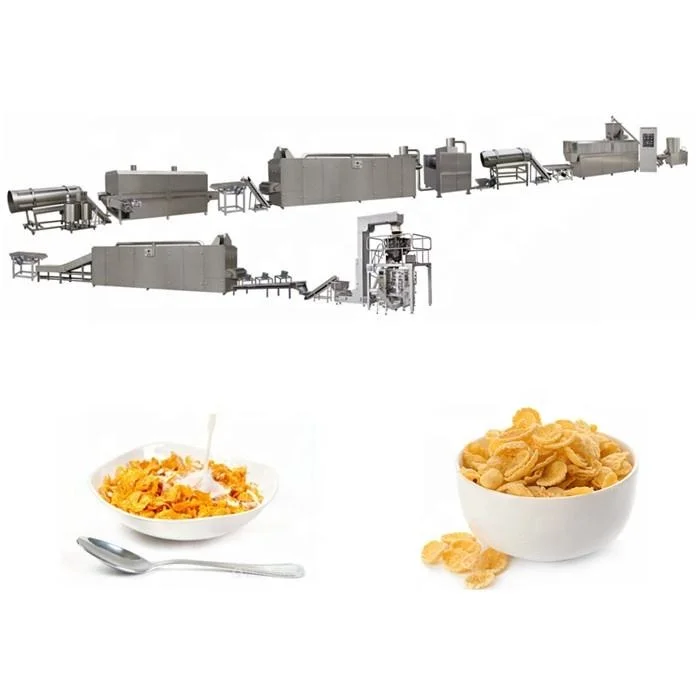
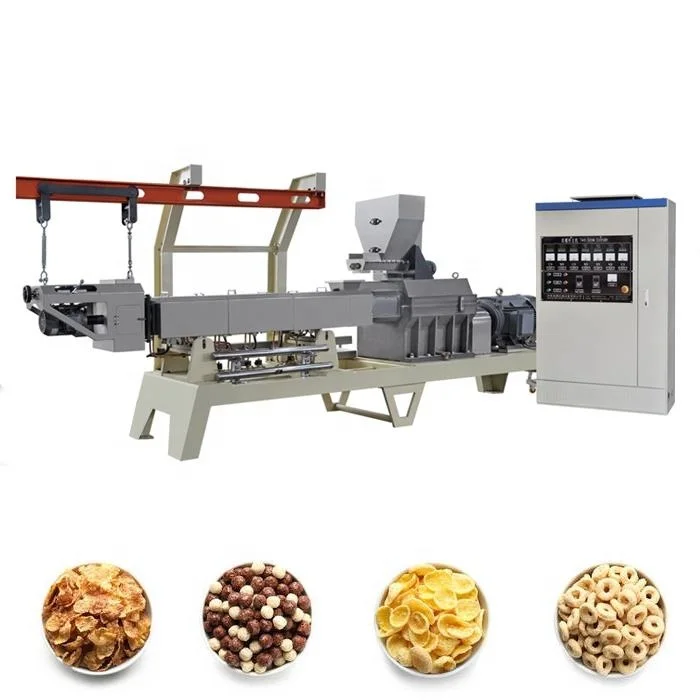
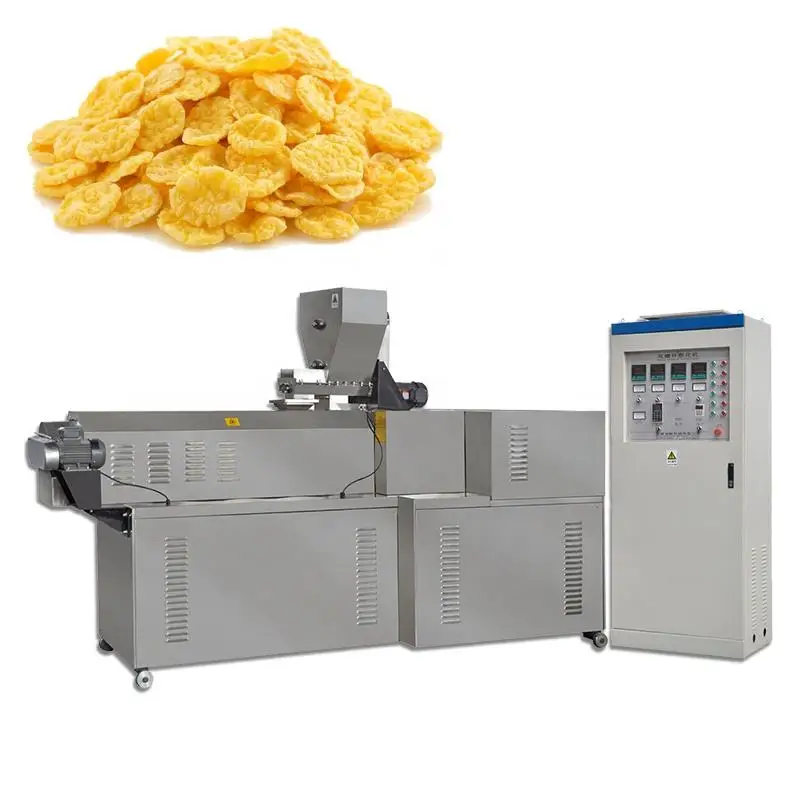
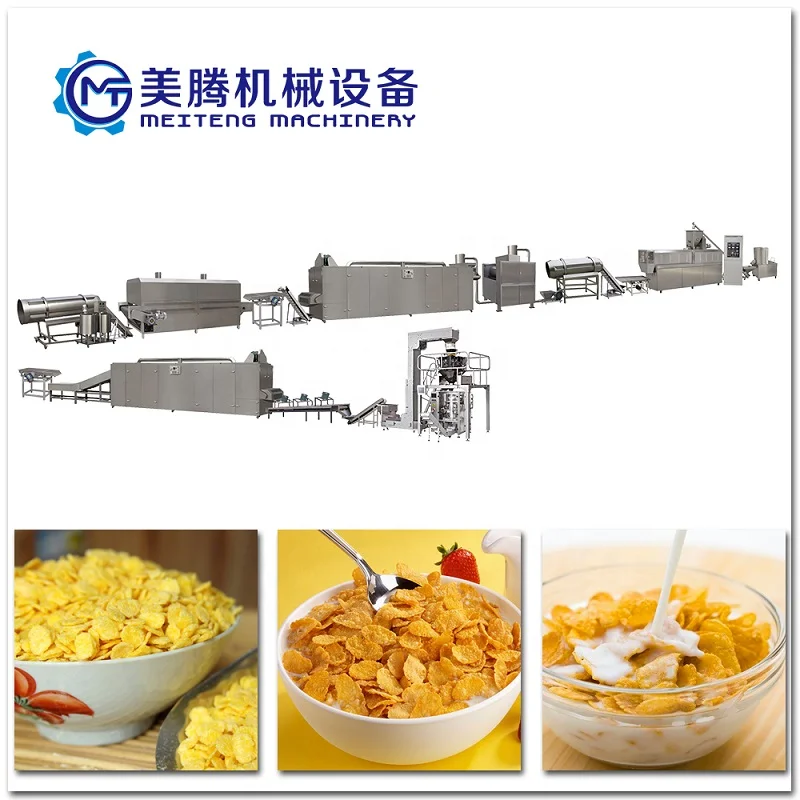
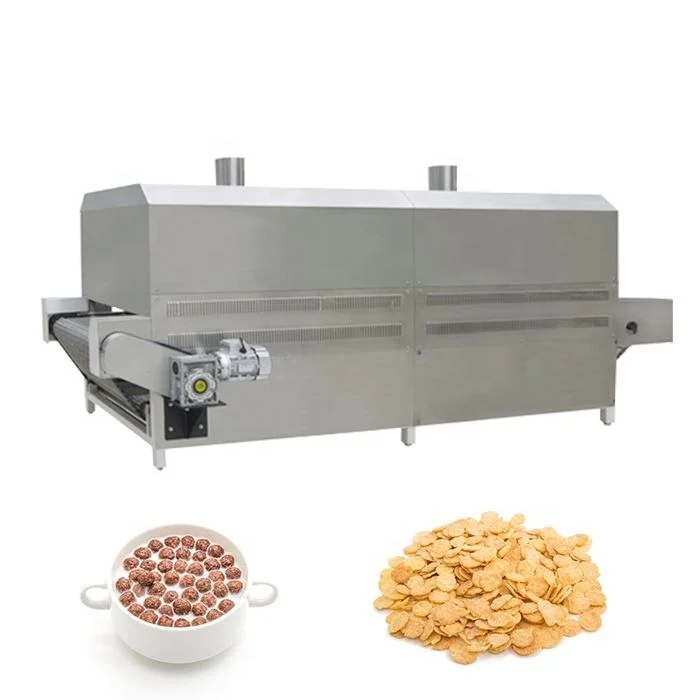
MT75 Breakfast Cereal Corn Flakes Production Line, 210KW Installed Power, Twin-Screw Extruder, PLC Control — turnkey layout from mixing through packing with throughput matched across every station.
- Screw configuration and die design specified to your raw material for target flake density
- Hydraulic double-roller flaking with infrared temperature control ensures consistent thickness
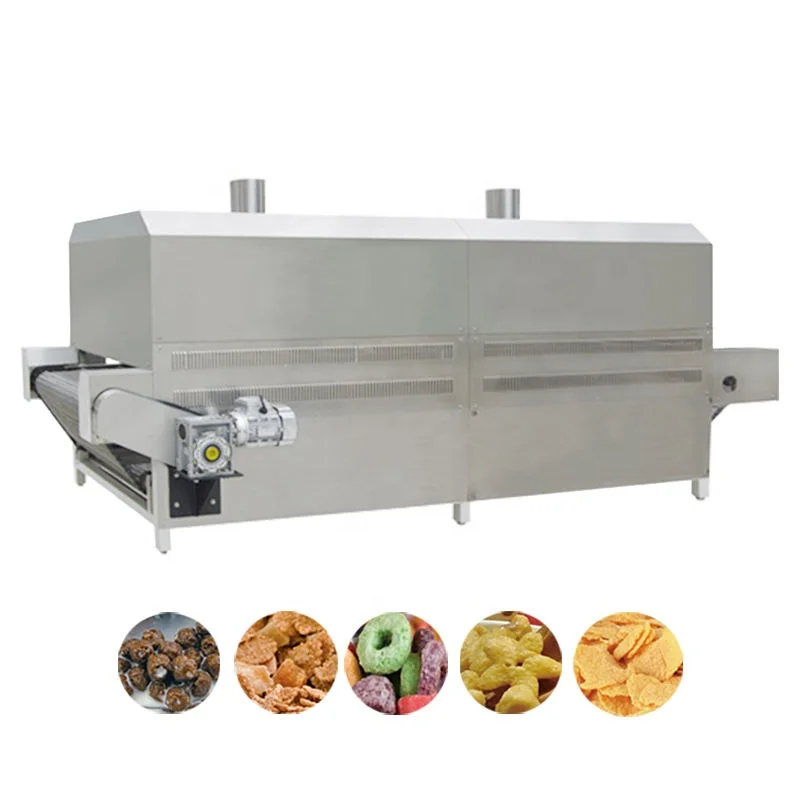
- Hot air roasting oven with cyclone dust removal delivers uniform blistering and crispness
Designed as a whole-line project: layout, phased installation, commissioning schedule and operator training are planned together so the line fits your factory footprint and production target from day one.
Description
Single-Source Line Integration — Every station from the batching mixer to the sugar-coating drum is sized and matched in-house, eliminating the throughput gaps that appear when extruders, flakers, and dryers come from separate vendors.
Technical Specifications
| Parameter | Value |
|---|---|
| Product Type | Breakfast Cereal Corn Flakes Production Line |
| Assembly State | Complete line (Mixing, Extruding, Flaking, Drying, Hot Air Roasting, Sugar Coating, Cooling, Packing) |
| Screw Type | Twin Screw |
| Installed Power | 210 kW |
| Power Consumption | 150 kW |
| Output Capacity | 300–500 kg/hr (basis to be confirmed against raw material and moisture) |
| Overall Dimensions | 45 × 1.5 × 3.5 m |
| Control System | PLC control system |
| Flaking Machinery | Hydraulic double-roller system; double motors for separate roller driving; infrared sensor temperature control |
| Dryer Heating Source | Gas, Electric (configurable) |
| Roasting Oven | Conciliation burner; two separate circulating fans; cyclone dust removal device |
| Coating System | Double tumble for sugar melting, elevator, coating drum, spraying nozzle |
| Final Product Shapes | Ball, tube, stick, ring, fruit loop, star, wheel, flower, heart (by adjusting mould) |
| Raw Materials | Corn, rice, wheat, oat, barley powder |
| Standards | CE, ISO |
Application Suitability
| Application | Material or Output |
|---|---|
| Natural corn flakes at commercial scale | Corn grits, corn flour blends |
| Sugar-coated breakfast flakes | Corn, rice, or wheat-based pellet with sugar syrup coating |
| Multi-shape cereal formats (rings, balls, fruit loops) | Cereal-based powder blends with oat, barley, or wheat |
| Fortified breakfast cereals for nutrition programmes | Grain powder blends with added vitamin and mineral premix |
What "300 to 500 kg/hr" Leaves Out About Corn Flake Lines
A quoted capacity means nothing unless it is verified on the buyer’s actual raw material at the target moisture.
I have walked into plants where the extruder was rated for 500 kg/hr but the downstream flaker and dryer were only sized for 350 kg/hr, and wet corn flakes were piling up on conveyors, sticking together, and going to waste. The breakfast cereal corn flakes production line turnkey only works when every station is calculated against the same throughput figure. [NEED_CITE: throughput matching across sequential food processing stations] When the flaker cannot keep pace with the extruder, you get a bottleneck that forces the whole line to run at the slowest station’s speed — and the operator ends up running the extruder at partial feed just to avoid a jam.
Screw Configuration and Die Design for Flake Density
The twin-screw extruder on this line is configured with screw elements and die geometry selected for the specific cereal formulation the buyer intends to run. Corn behaves differently from rice or oat blends under shear and heat; gelatinisation windows shift with starch composition and feed moisture. The barrel temperature profile and screw arrangement are set so the extrudate exits at the correct moisture and expansion level for the downstream flaker. If the pellet density is wrong coming out of the die, no amount of adjustment at the flaking rollers will produce a cornflake that toasts and blisters correctly in the roasting oven. This is where the breakfast cereal corn flakes production line turnkey earns its name — the extruder specification is written around the product target, not pulled from a generic build sheet.
Matching the Flaker, Dryer, and Roaster to Extruder Output
The hydraulic double-roller flaking system uses separate motors for each roller and infrared sensor temperature control to maintain consistent flake thickness across the full belt width. When the extruder pushes material at full rate, the flaker must accept every kilogram without slippage or build-up. Downstream, the dryer and hot air roasting oven — equipped with two separate circulating fans and a cyclone dust removal device — must remove moisture and achieve surface blistering at the same mass flow rate. If any one of these stations is undersized, the line cannot sustain its target output. [NEED_CITE: thermal processing and moisture removal rates in cereal flake manufacturing] The sugar coating system, with its double tumble melting unit and spraying nozzle, is the last checkpoint — it must handle the roasted flake volume without causing clumping or uneven syrup coverage.
Reading the Specifications for Production Impact
The installed power of 210 kW and power consumption of 150 kW reflect a line that runs heating, drive motors, and circulating fans simultaneously across multiple stations. For buyers planning utility connections, this means a dedicated transformer circuit with adequate headroom for start-up surges across the extruder gearbox and the hydraulic flaker motors. The PLC control system coordinates the feeding rate, barrel temperature zones, flaker roller gap, and dryer belt speed so that adjustments at one station propagate correctly to the others — critical when switching between a natural cornflake recipe and a sugar-coated variant that requires different drying times. The overall line footprint of 45 × 1.5 × 3.5 m means buyers need a clear linear bay with adequate ceiling height for the elevator and coating drum, plus service access on both sides. The interchangeable die and mould options — covering ball, tube, ring, fruit loop, star, and other shapes — allow a single extruder platform to produce multiple breakfast cereal formats without replacing the core machine. The choice between gas and electric dryer heating has a direct bearing on running cost and on whether the plant’s existing gas supply can support the roasting oven’s conciliation burner at full load.
The Hidden Cost of Mismatched Stations
When a corn flake line is assembled from separate vendors, the extruder supplier quotes one capacity, the flaker supplier quotes another, and the dryer arrives rated somewhere in between. I have seen the result: wet flakes stacking on the conveyor between the extruder and flaker, sticking together in clumps, and the roasting oven producing a mix of under-dried and over-burnt product because the feed rate fluctuates. [NEED_CITE: consequences of unmatched throughput in sequential food processing lines] The operator then slows the entire line to match the weakest station, and the quoted capacity becomes a number that only existed on paper. The sugar coating drum receives an inconsistent flow, syrup application varies, and the packing station sees surges and gaps. These problems do not show up in a factory acceptance test on the extruder alone — they appear only when the full line runs under continuous production conditions.
Why Source the Full Line Here
The line layout and capacity calculation are produced before the quotation, mapping every station’s throughput to the buyer’s target output and factory footprint. Screw configuration and die design are recorded against the specific cereal formulation, not copied from a previous project. An in-house testing workshop allows trial runs on the buyer’s actual raw material before the equipment ships, so the breakfast cereal corn flakes production line turnkey arrives with a verified process window rather than requiring weeks of on-site commissioning to find one. The twin-screw platform covers not only corn flakes but also multi-shape cereals, which means future product expansion does not require a new extruder. Electrical schematics are confirmed with the buyer’s local voltage, frequency, and preferred control language before production begins, preventing the delays that occur when a panel arrives wired for the wrong supply standard. Documentation includes a full wear parts list covering screws, dies, and flaker roller surfaces, so the first replacement cycle does not catch the maintenance team off guard.
Documentation & Verification
- Line layout drawing matched to your factory bay dimensions and utility connection points
- Capacity calculation sheet showing throughput matched across extruder, flaker, dryer, and roaster
- Screw and die configuration record tied to your specific cereal formulation
- Trial run report on your raw material conducted in the testing workshop before shipment
- Electrical schematic with voltage, frequency, and PLC language confirmed for your market
- Wear parts list specifying screw elements, die inserts, and flaker roller surfaces
Installation, Commissioning & Support
- Foundation and floor plan referencing the 45 × 1.5 × 3.5 m line footprint and station-by-station utility drops
- Dedicated power circuit sized for 210 kW installed load with allowance for hydraulic flaker motor start-up surge
- PLC control system configured to buyer’s language and local voltage standard before dispatch
- First-run commissioning with screw speed, barrel temperature, and flaker gap set to trial-run baseline
- Operator training covering die changeover across ball, ring, fruit loop, and other cereal shapes
- Scheduled replacement programme for twin-screw elements, dies, and hydraulic roller surfaces
Starting Your Line Specification
To begin the layout and capacity calculation, we need your target cereal format, the raw material blend you intend to run, and the daily output you are designing for. Share your factory bay dimensions, ceiling height, and available voltage and frequency so the line footprint and electrical package are sized correctly. If you have existing upstream mixing or downstream packing equipment, let us know so the breakfast cereal corn flakes production line turnkey interfaces properly at both ends.
Frequently Asked Questions
Q: How is line capacity verified against my specific raw material and moisture content?
A: Before shipment, your raw material is run through the extruder and flaker in the testing workshop. Output rate, flake thickness, and moisture at each station are recorded. The trial run report confirms the throughput the line can sustain on your formulation, so the capacity figure is based on your material, not a generic benchmark.
Q: How do you match throughput between extruder, flaker, dryer, and roaster?
A: Each station is sized during the layout phase using the same target mass flow rate. The flaker roller width and speed, dryer belt length and air volume, and roasting oven fan capacity are all calculated to handle the extruder’s full output without accumulation or starvation between stations.
Q: What voltage, frequency, and control language options are confirmed before production?
A: The electrical schematic and PLC programme are configured to your local supply standard and preferred operator language before the control panels are wired. This is confirmed during the specification stage so that no rewiring or reprogramming is needed when the line arrives at your facility.
Q: Can I run a trial on my raw material before the line ships?
A: Yes. The in-house testing workshop runs your cereal formulation through the extruder, flaker, and a sample dryer cycle. You receive a trial run report with process parameters, flake density, and moisture readings, giving you a verified starting point for commissioning.
Q: What spare wear parts are included and how are replacements supplied?
A: The initial spare parts package covers twin-screw elements, die inserts, and flaker roller surfaces — the components subject to the most wear. A full wear parts list is included in the documentation, and replacement items are manufactured to the same configuration records so they fit without modification.
Related products
-
Sweet Corn Flakes Maize Breakfast Cereal Full-automatic Food Grade Stainless Steel Heat Exchanger Mixer Fryer Processing Line
¥8,000.00 Add to cart -
Corn Flake Making Machine Corn Puffs Making Machine Snack Food Production Line
Price range: ¥500.00 through ¥1,200.00 Select options This product has multiple variants. The options may be chosen on the product page -

MT Cocoa Flour Puffed Breakfast Cereal Production Line-High Large Capacity Multi-Fuel (Steam/Gas/Electric) New Shandong Origin
¥8,000.00 Select options This product has multiple variants. The options may be chosen on the product page -
Corn Flakes Machine Breakfast Cereal Corn Flakes Production Line Cornflakes Making Machine
¥85,800.00 Select options This product has multiple variants. The options may be chosen on the product page