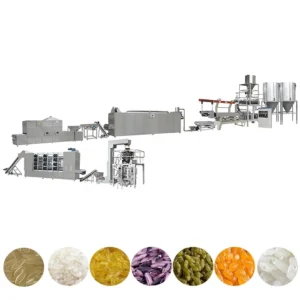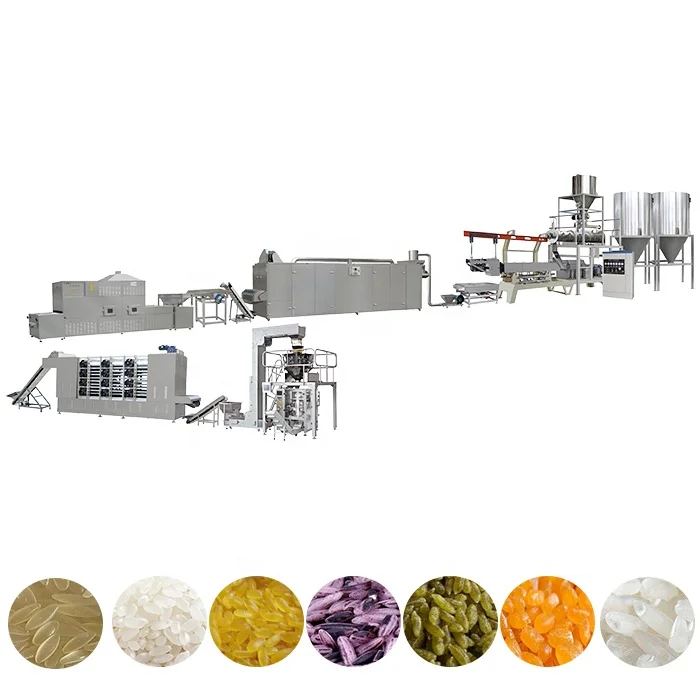
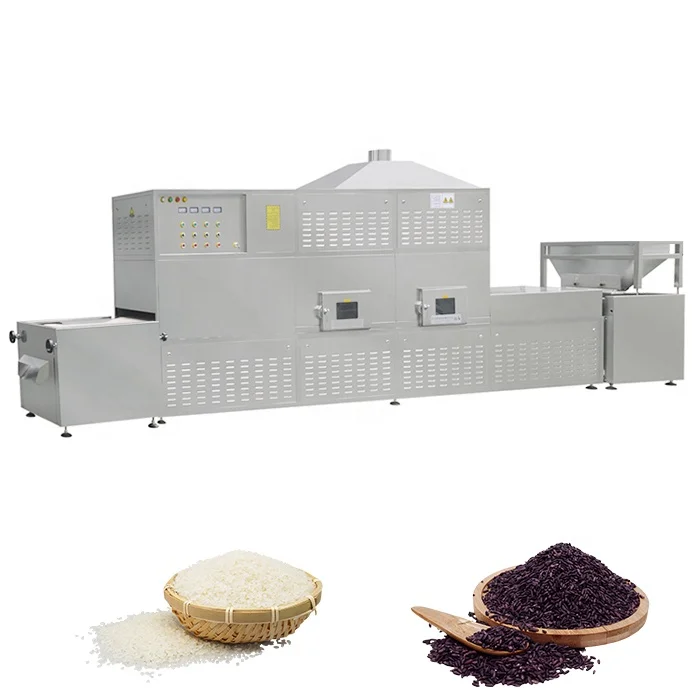


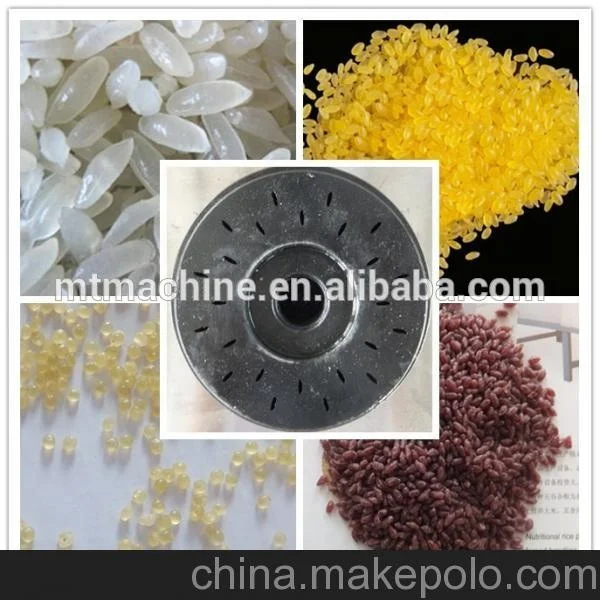
MT65 / MT70 / MT85 / MT75 / MT95 Fortified Artificial Rice Extrusion Production Line, Twin-Screw, CE Certified — throughput-matched from mixing through extrusion, drying, roasting, and packing under one supplier.
- Screw configuration and die design specified to your grain formulation and target kernel density
- Circulation drying oven with frequency-controlled mesh belt speed for uniform moisture reduction
- In-house testing workshop runs your specific grain blend before shipment to verify capacity on actual material
Full line layout, trial run report, and electrical schematics confirmed to your site utility supply included with delivery.
Description
Integrated Line Engineering — throughput matching from mixing through packing verified on your grain blend in our testing workshop before the first bolt is tightened on site.
Technical Specifications
| Parameter | Value |
|---|---|
| Model | MT65 / MT70 / MT85 / MT75 / MT95 |
| Product Type | Fortified Artificial Rice Extrusion Production Line |
| Extruder Type | Twin-screw |
| Installed Power | 85 kW (MT65) / 120 kW (MT70) / 235 kW (MT85) / 180 kW (MT75) / 260 kW (MT95) |
| Power Consumption | 60 kW (MT65) / 85 kW (MT70) / 165 kW (MT85) / 135 kW (MT75) / 195 kW (MT95) |
| Output Capacity | 80–100 kg/h (MT65) / 100–120 kg/h (MT70) / 200–300 kg/h (MT85) / 300–500 kg/h (MT75) / 800–1000 kg/h (MT95) (basis not stated in source — confirm raw material formulation and moisture content) |
| Overall Dimensions | 28×1.2×2.2 m (MT65) / 30×1.5×2.2 m (MT70) / 34×3.5×4.3 m (MT85) / 32×3.5×4.3 m (MT75) / 36×3.5×4.3 m (MT95) |
| Screw Material | Wear-resistant alloy (specific grade to be confirmed) |
| Feeding System | Single or double screw feeding, selectable based on raw material |
| Control System | Frequency speed control, high automation (PLC / MCC architecture to be confirmed) |
| Lubrication | Automatic lubricating system |
| Cooling | Integrated cooling system |
| Drying Oven Heating | Electric or gas |
| Drying Oven Feature | Circulation drying with frequency-controlled mesh belt speed |
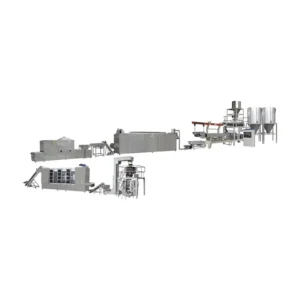
| Line Stations | Mixing → Extruding → Vibrating → Low temperature drying → Cooling → High temperature roasting → Cooling → Packing |
| Raw Materials | Broken rice, rice, corn, millet, wheat, oats, buckwheat, bean, starch; vitamin and mineral premix as supplementary ingredient |
| Certification | CE |
Application Suitability
| Application | Material or Output |
|---|---|
| Fortified rice kernel production for nutrition programmes | Rice flour blended with vitamin and mineral premixes |
| Reconstituted artificial rice from broken rice | Broken rice and rice bran with added micro-nutrients |
| Multi-grain nutritional rice products | Corn, millet, oats, buckwheat, and bean-based formulations |
| Starch-fortified rice analogues | Starch-dominant blends with supplementary nutrients |
Why "Nominal Capacity" Is the Wrong Number to Buy On
A line rated on a generic benchmark grain blend will underperform the moment your actual formulation enters the barrel.
I spent years doing after-sales work across the Yangtze River Delta region before moving into turnkey line planning. One project stands out: a customer invested in a nutritional powder processing line, and the screw and die configuration had been copied from a standard build rather than matched to his specific grain and premix formulation. During commissioning, the gelatinisation degree could not reach spec, and the first week of production was consumed entirely by re-tuning parameters. That is the kind of loss a fortified rice production line turnkey project cannot afford when you are running against delivery commitments [NEED_CITE: extrusion gelatinisation sensitivity to raw material moisture and starch composition].
The root cause is almost always the same — capacity figures quoted on a reference material that behaves nothing like the buyer’s actual grain blend, starch ratio, or moisture profile. A twin-screw extruder that processes corn grits at a steady rate may stall or surge when fed a high-fibre buckwheat mix. The only way to remove that variable is to run the buyer’s material through the configured machine before it leaves the factory.
Screw Configuration and Die Design Matched to Your Grain Formulation
Every grain formulation behaves differently inside the barrel. The ratio of amylose to amylopectin, the fibre content from bran, and the particle size of milled ingredients all determine how the material shears, gelatinises, and expands at the die face. On a fortified rice production line turnkey project, the screw element sequence — conveying sections, kneading blocks, and reverse elements — must be arranged to produce the residence time and shear profile your specific blend requires. A die orifice diameter that works for pure rice flour may yield kernels that fracture during drying when the blend includes oat or buckwheat fractions.
Throughput Matching Across Every Station in the Line
An extruder that delivers output faster than the downstream dryer can handle creates a wet-product bottleneck; a roasting oven that runs ahead of the cooling conveyor leaves kernels unevenly conditioned before packing. Each station in this line — mixing, extruding, vibrating, low temperature drying, cooling, high temperature roasting, final cooling, and packing — is specified so that its processing window overlaps with the station before and after it [NEED_CITE: throughput balancing principles in continuous food extrusion lines]. The circulation drying oven uses frequency-controlled mesh belt speed to adjust dwell time, and the roasting stage provides the thermal input needed for final kernel texture. When these are sourced from separate vendors, matching responsibility falls on the buyer.
Reading the Spec Sheet for What It Actually Means
The installed power figures across the MT65 through MT95 range reflect the torque demand of twin-screw extrusion on dense grain formulations. Higher installed power correlates with the ability to process viscous, high-starch doughs at throughput without motor stall. The automatic lubricating system protects bearing surfaces during continuous runs, while the integrated cooling system manages barrel temperature zones — a critical variable because starch gelatinisation in rice-based formulations requires a narrow thermal window. The choice between electric and gas heating on the drying oven affects both operating cost and the moisture gradient across the kernel bed. Single or double screw feeding is selected based on whether the raw material is free-flowing granulate or a cohesive premix blend.
The Hidden Cost of Skipping the Trial Run
When a line ships without a pre-delivery trial on the buyer’s material, the commissioning period becomes the de facto product development phase. Parameters that should have been locked in at the factory — barrel temperature profile, screw speed, feed rate, die pressure — are adjusted repeatedly on the production floor, burning raw material and consuming utility costs with every failed batch [NEED_CITE: cost of unplanned commissioning delays in food processing installations]. The downstream consequences compound: kernels that exit the extruder at inconsistent density dry unevenly, roast unevenly, and produce a final product that fails the texture and cooking-quality tests that buyers in the fortified rice market expect.
Why Sourcing the Complete Line from One Supplier Matters
Every station from batching to packing is specified under a single engineering scope, so throughput calculations are not the buyer’s problem to reconcile. Screw configuration and die design are documented against the buyer’s grain formulation and target kernel density, not copied from a generic reference build. The in-house testing workshop runs your specific grain blend before shipment, producing a trial report that confirms capacity and product quality on your material. Twin-screw extrusion expertise covers the full range of rice, corn, millet, oat, and bean-based formulations, which means configuration decisions draw on application data rather than catalogue defaults. The line layout, utility plan, and commissioning schedule are delivered as one integrated project document.
Documentation & Verification
- Line layout drawing showing station sequence and throughput match for your grain blend
- Screw and die configuration record tied to your specific formulation and kernel spec
- Trial run report from testing workshop on your raw material before shipment
- Electrical schematic with voltage and frequency confirmed to your site supply
- Operation and maintenance manual covering all line stations
- CE declaration of conformity and ISO certificate
Installation, Commissioning & Support
- Foundation plan aligned to overall line dimensions up to 36×3.5×4.3 m for the MT95 configuration
- Electrical supply verification against installed power up to 260 kW before connection
- Station-by-station assembly sequence with throughput calibration at each transfer point
- First-run parameter setting on your grain blend using trial report baseline values
- Operator training covering frequency speed control adjustment and drying oven belt speed tuning
- Wear parts list with screw element and die replacement intervals documented
What to Include in Your Inquiry
To configure a fortified rice production line turnkey project accurately, share your grain formulation breakdown including the percentage of each base ingredient and the vitamin-mineral premix ratio. Specify your target daily output and whether your facility runs on 50 Hz or 60 Hz power. Let us know your available floor space and ceiling height so the layout can be drafted around your existing infrastructure, and indicate whether you need the trial run conducted on material you ship to our testing workshop.
Frequently Asked Questions
Q: How is the line capacity verified against my specific grain blend before shipment?
A: We run your actual grain formulation — including your exact premix ratio and moisture content — through the configured extruder and downstream stations in our in-house testing workshop. The trial run produces a documented report covering throughput, kernel density, gelatinisation degree, and drying profile, all measured on your material rather than a generic reference blend.
Q: How do you ensure throughput is matched across the extruder, dryer, and roasting oven?
A: Each station is specified within a single engineering scope so that the output rate of the extruder falls within the processing window of the circulation drying oven and the high temperature roasting stage. Mesh belt speed on the dryer is frequency-controlled to adjust dwell time, and the layout document shows the calculated throughput match at every transfer point.
Q: What screw and die configuration process do you follow for different grain formulations?
A: The screw element sequence and die orifice specification are selected based on your grain blend’s starch composition, fibre content, and target kernel texture. This configuration is documented in the delivery package so that replacement parts match the original build, and any future formulation change can be evaluated against the baseline record.
Q: What documentation comes with the turnkey line delivery?
A: The package includes a line layout with capacity calculation, screw and die configuration record, electrical schematic with confirmed voltage and frequency, trial run report on your raw material, CE declaration of conformity, operation and maintenance manual, wear parts list, and packing photographs for customs support.
Q: How is on-site installation and operator training structured?
A: Installation follows a station-by-station sequence aligned with the layout document. Commissioning uses the trial run report as the parameter baseline, and operator training covers control system adjustment, drying oven tuning, and routine maintenance. Wear parts supply and ongoing technical support continue after the line reaches steady production.
Related products
-

Compact Automatic Baby Cereal Nutrition Powder Production Line with 500kg/h Capacity and PLC Control
¥9,500.00 Add to cart -
500kg/h Automatic PLC Controlled Nutrition Baby Food Extruder Machine for Rice Cereal Processing
¥9,500.00 Add to cart -

High Productivity New Condition Safe Healthy and Nutritious Baby Food Meal Replacement Powder Production Line
¥30.00 Select options This product has multiple variants. The options may be chosen on the product page -

High Precision Automatic 500kg/h Baby Food Nutrition Powder Rice Extrusion Processing Line
¥9,500.00 Add to cart