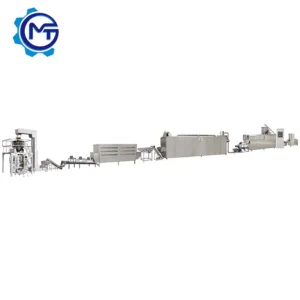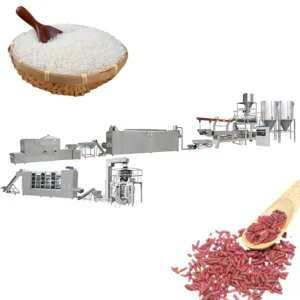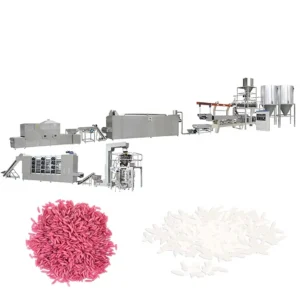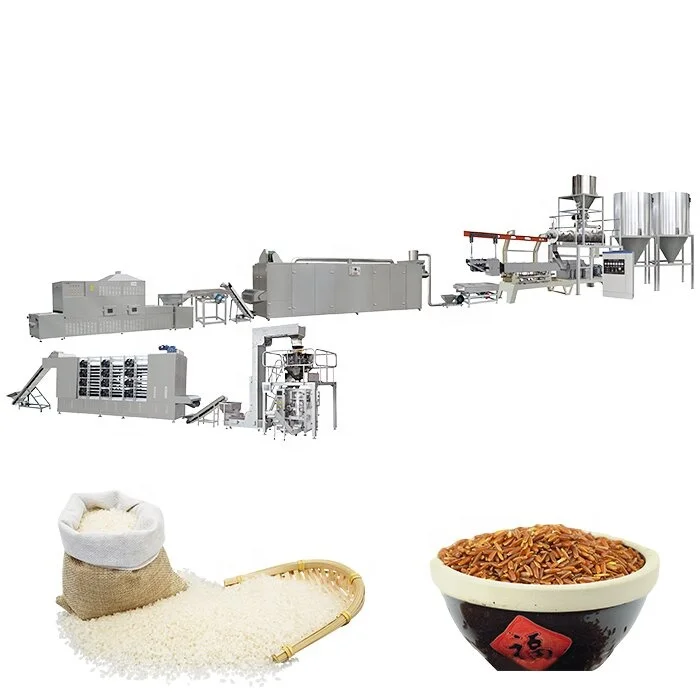


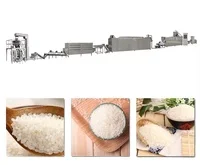
MT65, MT70, MT85, MT75, MT95 Fortified Artificial Rice Extrusion Line, Twin-Screw, CE Certified — engineered as a complete turnkey project from batching through extrusion, drying, and packing with throughput matched at every station.
- Screw configuration and die design specified to your raw material blend, including broken rice, corn, starch, and micronutrient premix
- Circulation drying oven with adjustable mesh belt speed via frequency motor ensures uniform moisture content across fortified rice kernels
- Five capacity tiers available to align with project output targets and facility utility planning
Delivered with line layout documentation, in-house trial run reports on customer raw materials, and on-site commissioning support for contractors and production facilities.
Description
Integrated project execution — every station from batching to packing is sized against the same throughput target, eliminating the bottleneck risk that plagues multi-vendor line builds.
Technical Specifications
| Parameter | Value |
|---|---|
| Product Type | Fortified Artificial Rice Extrusion Line |
| Models Available | MT65, MT70, MT85, MT75, MT95 |
| Screw Type | Twin-screw (single or double screw feeding system available based on material) |
| MT65 Installed Power | 85 kW |
| MT65 Power Consumption | 60 kW |
| MT65 Capacity | 80–100 kg/h (basis not stated in source — confirm raw material blend and moisture content) |
| MT65 Overall Dimensions | 28 × 1.2 × 2.2 m |
| MT70 Installed Power | 120 kW |
| MT70 Power Consumption | 85 kW |
| MT70 Capacity | 100–120 kg/h (basis not stated in source — confirm raw material blend and moisture content) |
| MT70 Overall Dimensions | 30 × 1.5 × 2.2 m |
| MT85 Installed Power | 235 kW |
| MT85 Power Consumption | 165 kW |
| MT85 Capacity | 200–300 kg/h (basis not stated in source — confirm raw material blend and moisture content) |
| MT85 Overall Dimensions | 34 × 3.5 × 4.3 m |
| MT75 Installed Power | 180 kW |
| MT75 Power Consumption | 135 kW |
| MT75 Capacity | 300–500 kg/h (basis not stated in source — confirm raw material blend and moisture content) |
| MT75 Overall Dimensions | 32 × 3.5 × 4.3 m |
| MT95 Installed Power | 260 kW |
| MT95 Power Consumption | 195 kW |
| MT95 Capacity | 800–1000 kg/h (basis not stated in source — confirm raw material blend and moisture content) |
| MT95 Overall Dimensions | 36 × 3.5 × 4.3 m |
| Control System | Frequency speed control with high automation |
| Lubrication | Automatic lubricating and cooling system |
| Heating System | Integrated heating system for barrel zones |
| Drying Oven Heating Source | Electric or gas |
| Drying Oven Feature | Circulation drying process, frequency motor controls mesh belt speed |
| Raw Materials | Broken rice, corn, millet, wheat, oats, buckwheat, bean, starch, with vitamin and mineral additives |
| Production Procedure | Mixing → Extruding → Vibrating → Low temperature drying → Cooling → High temperature roasting → Cooling → Packing |
| Certification | CE |
Application Suitability
| Application | Material or Output |
|---|---|
| Fortified rice kernel production | Broken rice and rice bran blended with vitamin and mineral premix |
| Artificial rice manufacturing | Corn, millet, wheat, oats, and buckwheat starch bases |
| Nutritional rice reconstitution | Grain-based blends with soya dal, lentils, and micronutrient additives |
| High-nutrition grain processing | Starch-dominant formulations for institutional feeding programmes |
| Public health nutrition supply | Fortified kernels meeting micronutrient density targets for government contracts |
Why Nominal Line Capacity Fails on Your Actual Blend
A capacity number without a raw material basis is a guess, not a guarantee.
When a fortified artificial rice production line turnkey is quoted at a single throughput figure, that number almost always assumes a standard rice flour feedstock. I have watched lines stall during commissioning because the buyer’s real formulation — heavy on soya dal and lentil flour — behaved completely differently inside the barrel. Starch gelatinisation shifted, die pressure spiked, and the extruder could not hold the quoted output. The fix required re-profiling barrel temperature zones on-site, costing days of lost production [NEED_CITE: starch gelatinisation behaviour in legume-dominant blends]. A turnkey Fortified artificial rice production line turnkey only earns its capacity claim when the trial run uses your exact material, not a generic proxy.
Phased Layout and Throughput Matching
A complete Fortified artificial rice production line turnkey begins with a line layout and capacity calculation that sizes every station — mixing, extrusion, drying, cooling, and packing — against a single target output. When an extruder pushes more volume than the dryer can handle, kernels accumulate on the mesh belt and moisture removal drops unevenly. When packing runs slower than the cooling conveyor, product backs up and degrades. Each model in the MT series occupies a different footprint, and the layout must account for utility runs, access corridors, and operator stations across the full procedure from batching through to final packing.
Barrel Temperature Profiling for Blended Formulations
The integrated heating system across barrel zones allows independent temperature control at each stage of the extrusion path. Starch-dominant materials like broken rice gelatinise at lower shear thresholds, while protein-rich additions such as bean flour demand higher thermal input to achieve the same degree of cook. On one project, a standard rice flour trial ran without issue, but switching to the buyer’s actual soya-lentil blend caused expansion to drop and die pressure to climb. Re-mapping the barrel zone temperatures resolved the issue, but only because the control system allowed zone-by-zone adjustment [NEED_CITE: twin-screw barrel zone temperature profiling for multi-grain extrusion]. Without this capability, reformulation would have required hardware changes.
Reading the Specification Sheet Beyond the Headline Numbers
The five available models span a wide installed power range, and the gap between installed power and actual power consumption reveals how much headroom each unit carries. On the MT65, the 25 kW gap between the 85 kW installed and 60 kW consumed suggests moderate startup and peak-load reserves suitable for lighter starch formulations. The MT95 narrows that gap proportionally at higher throughput, indicating a system designed to run closer to its thermal ceiling continuously. Screw type selection — twin-screw throughout the range with single or double feeding system options — determines how aggressively the line can handle fibrous or high-protein inclusions without surging. The automatic lubricating and cooling system maintains screw shaft integrity across long production runs, directly affecting barrel wear intervals and kernel dimensional consistency. Drying oven choice between electric and gas heating sources changes both utility planning and operating cost structure at the installation site.
What Happens When Dryer Capacity Lags Behind
A frequent failure mode on multi-vendor lines is a drying oven that cannot keep pace with extruder output. Kernels pile on the mesh belt, moisture gradients develop across the bed depth, and some kernels exit under-dried while others over-dry and crack. On fortified rice, uneven moisture means uneven reconstitution behaviour in the pot — some kernels turn mushy while others stay hard. The circulation drying process with frequency motor belt speed control addresses this by matching residence time to the extruder’s actual throughput. When dryer and extruder are specified independently, this match rarely happens by accident [NEED_CITE: moisture uniformity requirements for reconstituted rice kernels].
Why the Project Approach Eliminates Integration Risk
Every station on this line is specified under one supplier scope, so throughput calculations propagate from the mixer through to packing without handoff gaps. Screw configuration and die design are matched to the buyer’s specific raw material blend rather than copied from a generic reference build. The in-house testing workshop runs your actual formulation before shipment, producing a trial run report that confirms barrel temperature profiles, die selection, and achievable throughput on your material. Electrical schematics arrive with voltage and frequency already confirmed for your installation site, avoiding the commissioning delays that occur when control panels ship with the wrong transformer taps. Operator training happens during on-site installation with the same crew that assembled the line, so knowledge transfers directly rather than through a manual written for a different configuration.
Documentation & Verification
- Line layout and capacity calculation showing throughput at each station for your target blend
- Trial run report on your actual raw material formulation from the in-house testing workshop
- Screw and die configuration record matched to your kernel shape and density specification
- Electrical schematic with voltage and frequency confirmed for your installation country
- CE declaration of conformity and ISO certificate for customs and regulatory clearance
- Operation and maintenance manual with wear parts list specific to your model selection
Installation, Commissioning & Support
- Foundation and floor space planning based on the selected model footprint, up to 36 × 3.5 × 4.3 m for the MT95
- Dedicated electrical circuits sized to the model’s installed power, ranging from 85 kW to 260 kW
- Barrel zone temperature profiling and die pressure calibration during first-run commissioning on your material
- Frequency speed control training for operators covering extruder, dryer belt, and packing station coordination
- Wear parts supply plan covering screws, dies, and mesh belt sections with recommended replacement intervals
- Automatic lubricating system verification and maintenance schedule aligned with production shift patterns
Preparing Your Line Inquiry
Provide your raw material formulation including the ratio of broken rice, starch base, legume content, and micronutrient premix to allow accurate screw and die specification. Confirm your local voltage and frequency standards, as control panels and heating elements must match the installation site supply before production begins [NEED_CITE: voltage and frequency standards by export market]. Share your target daily output and available floor space so the line layout can match station throughput to your facility constraints.
Frequently Asked Questions
Q: How is line capacity verified against my specific raw material blend?
A: Before shipment, your exact formulation — including starch base, legume ratio, and micronutrient premix — is run through the extruder in the in-house testing workshop. The trial run produces a report documenting barrel temperature settings, die pressure readings, screw configuration used, and achievable throughput. This ensures the capacity figure you receive is tied to your actual material behaviour, not a generic rice flour assumption.
Q: What is the phased installation and commissioning schedule?
A: Installation follows a station-by-station sequence: foundation and utility rough-in, extruder and dryer placement, electrical and control wiring, then cold commissioning and hot runs. The commissioning crew profiles barrel temperatures and adjusts die configuration on your material during the hot run phase. Operator training runs concurrently, so your team is producing within specification by the time the commissioning crew departs.
Q: How do you ensure throughput matching between stations?
A: The line layout document calculates material flow at each station — mixing batch cycle, extruder output, dryer residence time, cooling conveyor speed, and packing rate — against a single target throughput. Each station’s capacity is sized with a margin above that target so no single point constrains the line. This calculation is delivered for review before production begins.
Q: What utility planning is required for the full production line?
A: Your electrical supply must support the selected model’s installed power with dedicated circuits and appropriate transformer capacity. If gas heating is chosen for the drying oven, a gas supply line with adequate pressure and flow rate must be available. Floor space planning must accommodate the model’s overall dimensions plus access corridors for maintenance and material handling on both sides of the line.
Q: What operator training is included during on-site commissioning?
A: Training covers frequency speed control operation across the extruder, dryer belt, and packing station, along with barrel zone temperature adjustment procedures. Operators learn to read die pressure indicators and recognise signs of formulation drift. Maintenance training includes automatic lubricating system checks, screw and die inspection intervals, and mesh belt tension adjustment on the drying oven.
Related products
-
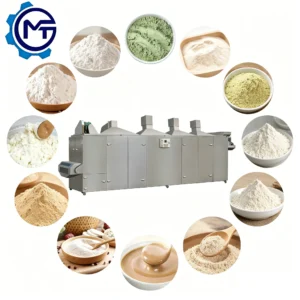
Small Scale MT Brand Automatic Baby Food Nutrition Powder Rice Flour Making Machine with 500kg/h Production Capacity PLC Control
¥9,500.00 Add to cart -
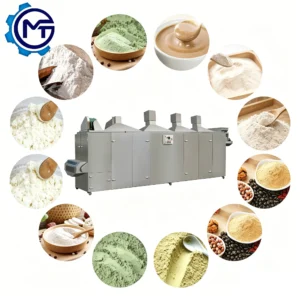
500kg/h Automatic PLC Controlled Nutrition Baby Food Extruder Machine for Rice Cereal Processing
¥9,500.00 Add to cart -

High Quality Automatic PLC Controlled 500kg/h Twin Screw Extruder Machine for Baby Rice Nutrition Powder
¥8,238.27 Add to cart -
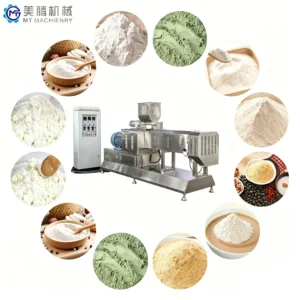
150-500kg/h Twin Screw Extruder Baby Rice Flour Making Machine
¥9,500.00 Select options This product has multiple variants. The options may be chosen on the product page