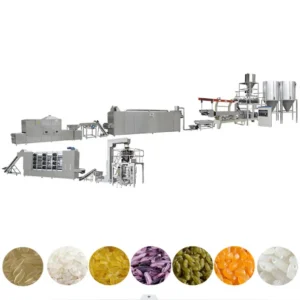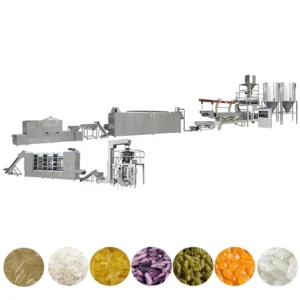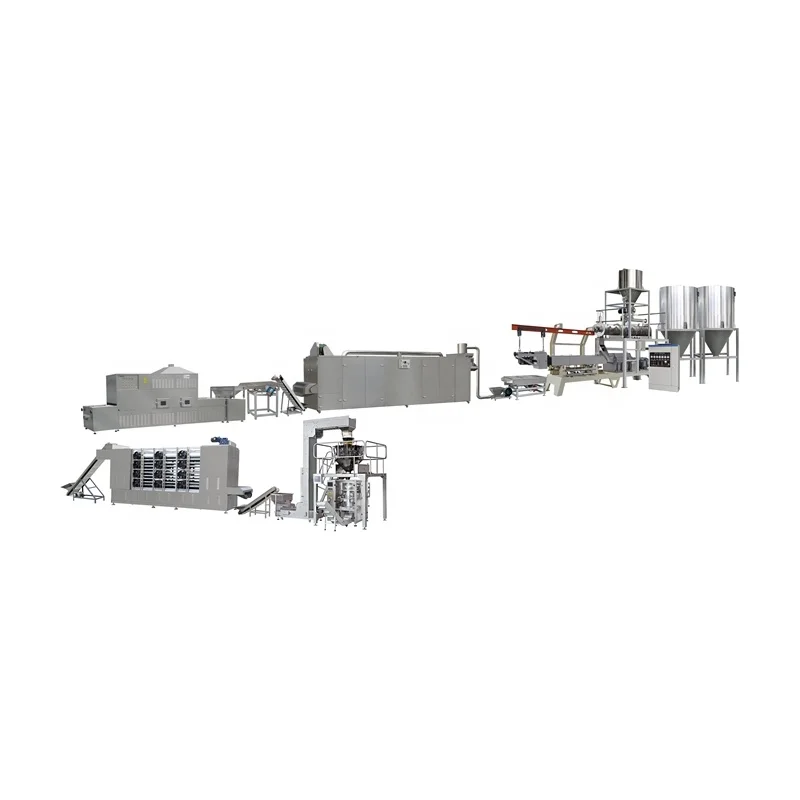
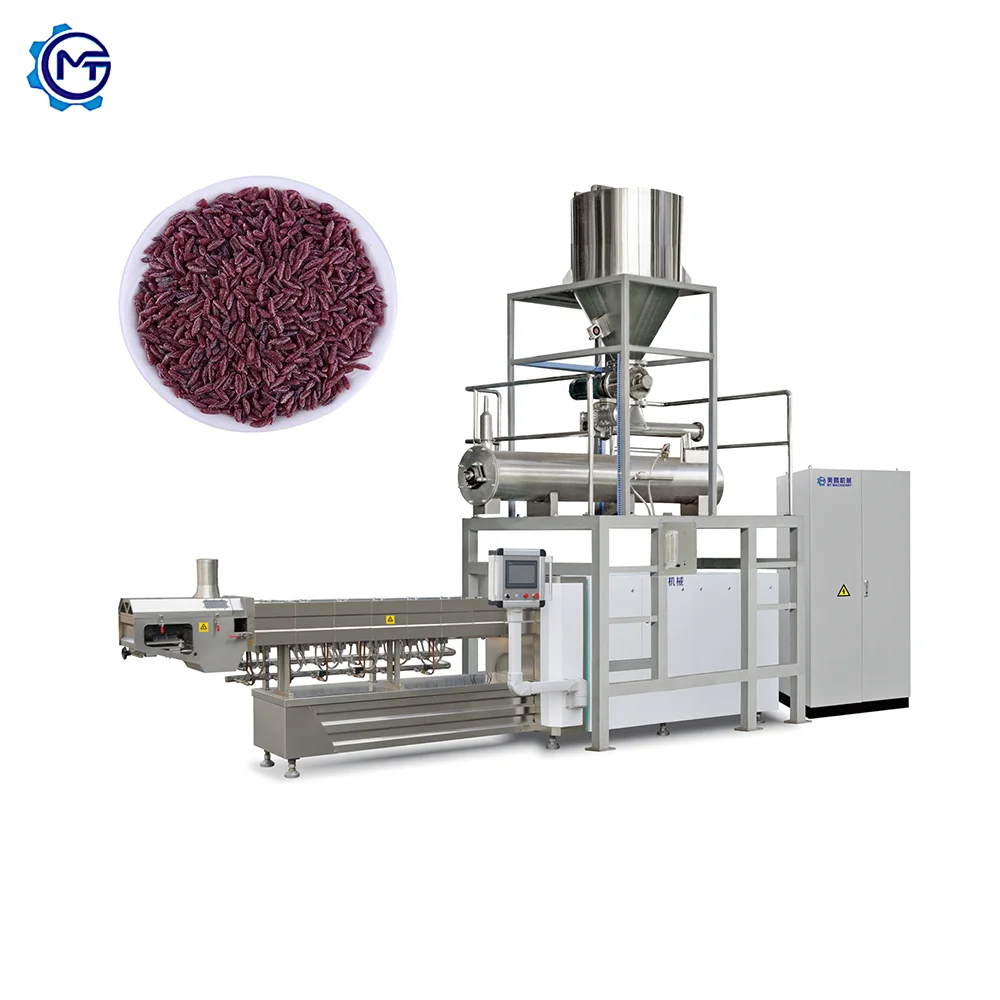


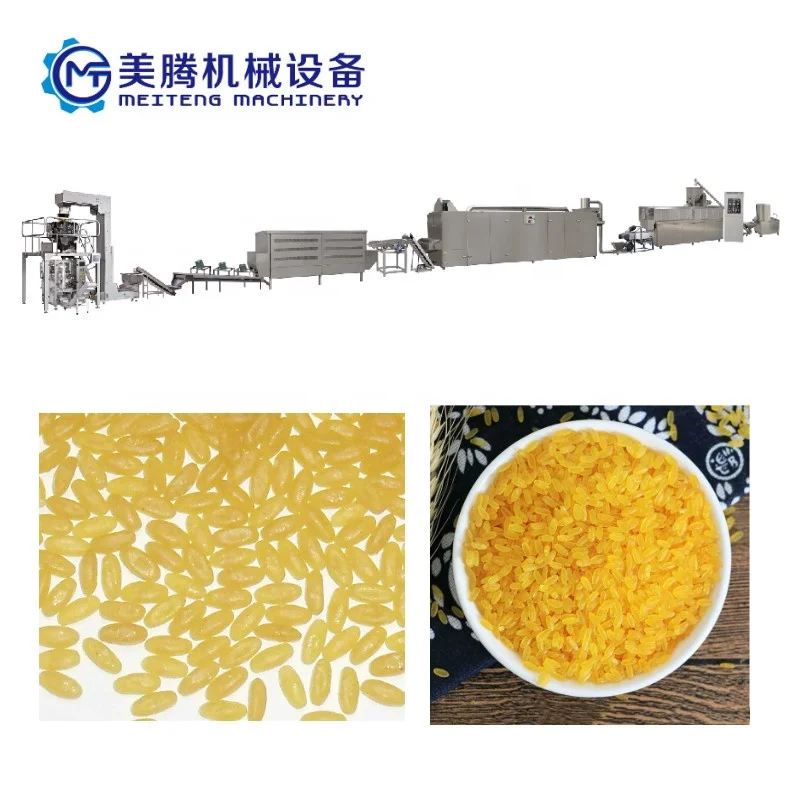

MT65 Fortified Rice Kernel Extrusion Line, Twin-Screw, 85 kW Installed Power — designed for producing micro-nutrient-enriched rice kernels from broken rice, rice bran, and cereal-based raw materials with added vitamins and minerals.
- Full turnkey line layout from batching through extrusion, low-temperature drying, roasting, and packing, with every station throughput-matched to prevent bottlenecks.
- Screw configuration and die design specified to your raw material formulation and target kernel shape, ensuring consistent expansion, density, and retained viscosity.
- PLC and MCC control with frequency speed adjustment across extruder and drying oven for stable, adjustable operation.
- Automatic lubricating and cooling system on the extruder for continuous safe running.
CE certified, with in-house trial run on your raw material before shipment and on-site commissioning included.
Description
Integrated Line Design — every station from batching to packing is throughput-matched under one project plan, eliminating the mismatched capacities that stall nutritional extrusion projects.
Technical Specifications
| Parameter | Value |
|---|---|
| Product Type | Fortified Rice Kernel Extrusion Line |
| Screw Type | Twin-screw |
| Available Models | MT65 / MT70 / MT85 / MT75 / MT95 |
| Installed Power | 85 kW (MT65) / 120 kW (MT70) / 235 kW (MT85) / 180 kW (MT75) / 260 kW (MT95) |
| Power Consumption | 60 kW (MT65) / 85 kW (MT70) / 165 kW (MT85) / 135 kW (MT75) / 195 kW (MT95) |
| Output Capacity | 80–100 kg/h (MT65) / 100–120 kg/h (MT70) / 200–300 kg/h (MT85) / 300–500 kg/h (MT75) / 800–1000 kg/h (MT95) (basis to be confirmed) |
| Overall Dimensions | 28 × 1.2 × 2.2 m (MT65) up to 36 × 3.5 × 4.3 m (MT95) |
| Control System | PLC and MCC with frequency speed control |
| Feeding System | Single or double screw feeding, selectable by material |
| Screw Material | Wear-resistant alloy with grinding-resistant treatment |
| Lubrication | Automatic lubricating and cooling system |
| Drying Oven Heating Source | Electric or gas |
| Drying Oven Feature | Circulation drying with mesh belt speed controlled by frequency motor |
| Line Stations | Mixing, extruding, vibrating, low-temperature drying, cooling, high-temperature roasting, cooling, packing |
| Standards | CE, ISO |
Application Suitability
| Application | Material or Output |
|---|---|
| Fortified rice kernel production | Broken rice, rice bran, and cereal-based raw materials blended with vitamins and minerals |
| Artificial rice manufacturing | Corn, millet, wheat, oats, buckwheat, and bean flours reshaped into rice-like kernels |
| Instant rice processing | Pre-gelatinised starch and rice flour for rapid rehydration products |
| Nutrition programme supply | Micro-nutrient-enriched kernels for food fortification distribution |
Why the Quoted Capacity Rarely Survives Contact with Your Raw Material
A line is only as fast as its slowest matched station, and raw material behaviour dictates the real throughput.
I have stood on factory floors in Southeast Asia watching an extruder push material into a dryer that was never sized for the actual moisture load. The extruder kept running, but wet kernels piled up ahead of the mesh belt, and the packing station sat idle. The line was sold on a nominal hourly figure that assumed a standard starch-to-protein ratio. When the buyer switched to a local broken rice source with different gelatinisation characteristics, the entire production rhythm collapsed. That is why a fortified rice kernel production line turnkey project must start with the material in hand, not a brochure number. [NEED_CITE: starch gelatinisation temperature variation across rice cultivars]
Line Layout as a Project, Not a Parts List
A turnkey nutritional rice facility requires more than stacking machines in sequence. Each station — mixer, feeder, twin-screw extruder, vibrating separator, low-temperature dryer, cooler, high-temperature roaster, second cooler, and packing head — must be selected so its peak throughput overlaps with the actual running rate of its neighbours. When we plan a fortified rice kernel production line turnkey installation, the dryer belt width and residence time are calculated against the extruder’s real output moisture, not its nameplate capacity. This prevents the bottleneck that appears three weeks into commissioning.
Matching Utility Planning to Phased Installation
In greenfield facilities across the region, electrical infrastructure is often finalised before the equipment layout is locked. We coordinate the PLC and MCC cabinet placement, frequency drive allocation, and dedicated circuit requirements during the layout phase so that conduit runs and transformer sizing are resolved before concrete is poured. A phased commissioning schedule lets the mixing and extruding sections go live while the roasting and packing wings are still being fitted out, reducing the dead time between equipment arrival and first production run. [NEED_CITE: industrial utility planning sequence for food processing plants]
Reading the Specs That Actually Shape the Kernel
The twin-screw configuration matters because broken rice flour and micro-nutrient pre-mixes behave differently from pure starch feedstocks. A single-screw design relies on friction to move material forward, which limits the range of moisture and fat content it can handle. The twin-screw setup provides positive conveyance, keeping the blend moving through the barrel zones even when vitamin and mineral additives alter the flow properties. Screw configuration and die design are specified to the buyer’s formulation — the die aperture and land length determine whether the extrudate exits as a firm, rice-shaped kernel or a softer, irregular pellet. The automatic lubricating and cooling system on the gearbox supports continuous operation across long production runs without thermal shutdown. On the drying side, the choice between electric and gas heating and the frequency-controlled mesh belt speed let operators fine-tune moisture removal so kernels reach the roaster at the correct water activity level.
What Happens When the Dryer Is Undersized
The most common hidden cost on a nutritional extrusion line is not the extruder itself — it is the dryer that cannot keep up. Wet kernels accumulate, surface starch turns tacky, and product clumps before it reaches the roaster. Operators slow the extruder to match the dryer, and the quoted capacity becomes irrelevant. This mismatch is rarely visible at the quotation stage because the line is presented as a bundle of individual machines rather than a throughput-balanced system. Buyers end up paying twice: once for the original dryer, and again for the larger replacement unit that should have been specified from the start. [NEED_CITE: moisture removal rate calculation for extruded food products]
Why Project Buyers Source This Line Here
Meiteng engineers design the full line layout — mixing through packing — so every station is capacity-matched to the extruder’s real output on the buyer’s raw material. Screw configuration and die geometry are documented against the specific flour blend and micro-nutrient pre-mix before production begins. An in-house testing workshop runs the buyer’s own formulation on the extruder before shipment, so kernel shape, density, and gelatinisation degree are confirmed in advance. Voltage, frequency, and PLC language are locked during the specification phase, avoiding the commissioning delays that arise when a 50 Hz control cabinet arrives at a 60 Hz site. Pre-sales engineering through on-site installation and operator training is handled by the same project team that designed the layout.
Documentation & Verification
- Line layout and capacity calculation showing throughput matched across every station
- Screw and die configuration record tied to your specific flour and pre-mix formulation
- Trial run report produced on your raw material in the testing workshop before dispatch
- Electrical schematic with voltage, frequency, and control language confirmed for your site
- CE declaration of conformity and ISO certificate included in the shipping dossier
- Operation and maintenance manual with wear parts list for screws, dies, and dryer belt
Installation, Commissioning & Support
- Foundation plan accounts for the full line length from 28 m (MT65) to 36 m (MT95)
- Dedicated circuit sizing based on installed power up to 260 kW for the MT95 extruder
- Equipment arrives in modular sections for phased assembly inside the prepared building envelope
- First-run parameter logging covers barrel temperature zones, screw speed, and dryer belt rate
- Operator training addresses screw changeover, die cleaning, and PLC fault diagnostics
- Wear parts stock list covers screws, dies, and mesh belt segments for the first replacement cycle
- Preventive maintenance schedule aligned to the automatic lubrication system service interval
What We Need to Build Your Layout
To move from inquiry to line proposal, share your target kernel size and shape, the base flour composition including moisture content, and the vitamin or mineral pre-mix ratio. We also need your facility floor plan with ceiling height, local voltage and frequency, preferred control language, and whether an existing packing system will be integrated. If a trial run on your raw material is required before commitment, send a representative batch to the testing workshop.
Frequently Asked Questions
Q: How is line throughput verified, and what raw material formulation is the quoted capacity based on?
A: Quoted output figures are based on specific flour blends and moisture levels. We confirm throughput by running your exact raw material in our testing workshop, recording screw speed, barrel temperature, and die pressure, then matching every downstream station — dryer, roaster, cooler — to that verified rate before the layout is finalised.
Q: How do you match dryer and roaster capacity to the extruder output?
A: The dryer belt length, mesh speed, and heating source are calculated against the moisture load leaving the extruder die. The roaster section is then sized so kernel residence time and temperature profile produce the target colour and water activity without becoming the line bottleneck.
Q: Can you provide a complete line layout with utility planning and phased commissioning schedule?
A: Yes. The project package includes a scaled floor plan, utility connection points for power, water, and compressed air, and a phased installation timeline so foundation work, equipment placement, and commissioning can proceed in logical sequence without trades blocking each other.
Q: Is a trial run on my specific raw material conducted before shipment?
A: We run your formulation in the in-house testing workshop, document kernel shape, density, and gelatinisation degree, and adjust screw configuration and die selection if the results fall outside specification. The trial run report ships with the line documentation.
Q: What voltage, frequency, and control language options are confirmed before production begins?
A: Electrical specifications are locked during the design phase. The PLC and MCC panels are built to match your site voltage and frequency, and the HMI language is set to your operator preference so the control system is fully functional from the first day of commissioning.
Related products
-

High Precision Automatic 500kg/h Baby Food Nutrition Powder Rice Extrusion Processing Line
¥8,238.27 Add to cart -
150-500kg/h Twin Screw Extruder Baby Rice Flour Making Machine
¥9,500.00 Select options This product has multiple variants. The options may be chosen on the product page -
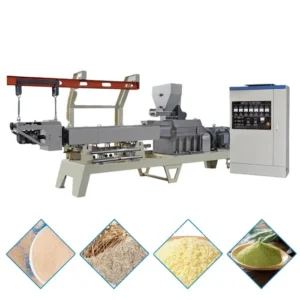
Industrial Instant Corn Paste Production Line Nutritional Powder Processing Equipment Meal Replacement Nutrition Powder Machine
¥65.00 Select options This product has multiple variants. The options may be chosen on the product page -
500kg/h Automatic PLC Controlled Nutrition Baby Food Extruder Machine for Rice Cereal Processing
¥9,500.00 Add to cart