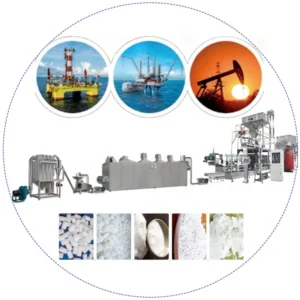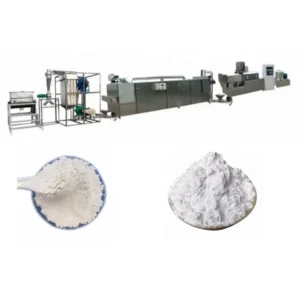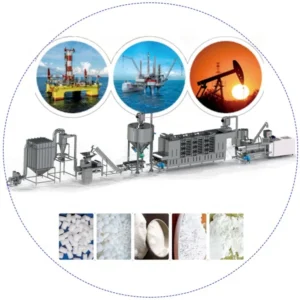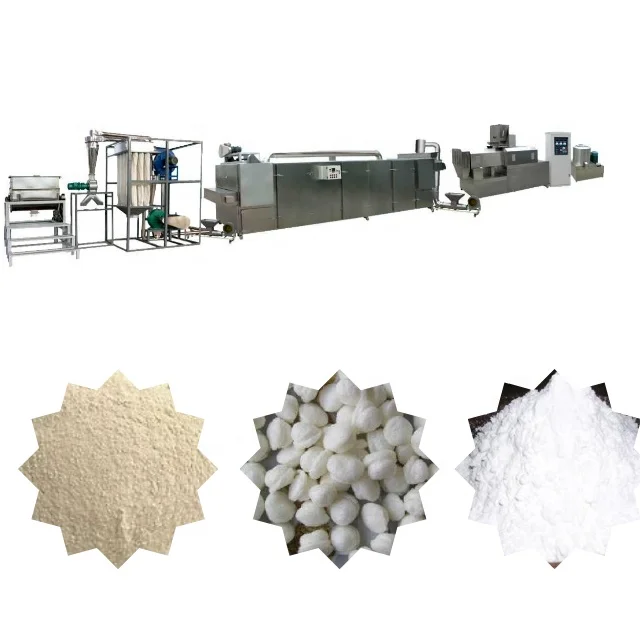


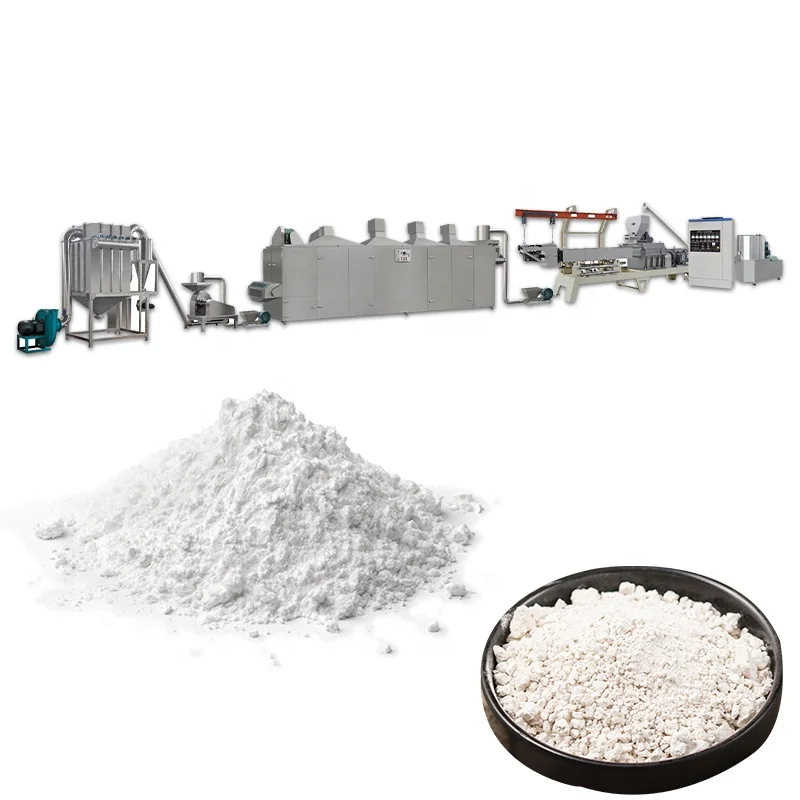

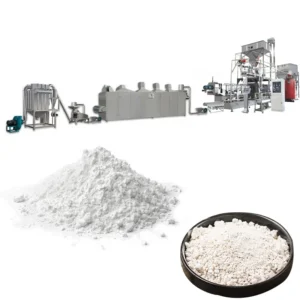
MT65 processing line, Modified Starch Twin Screw Extrusion Production Line, 60kW, CE Certified — engineered as a complete turnkey solution from batching through extrusion, drying, grinding and packing. Screw configuration and barrel temperature profile are matched to your specific starch type — corn, potato, cassava or tapioca — and target modification such as pre-gelatinized or oil drilling grade, ensuring consistent expansion and product density across production runs. PLC and MCC control maintains process repeatability at every station with throughput balanced between mixer, extruder and dryer.
- In-house trial runs on customer raw material verify capacity before shipment
- Line layout and electrical schematics confirmed to site voltage and control language
- CE and ISO certified with full wear parts documentation included
Description
Balanced Throughput Engineering — Every station from the mixer to the packer is calculated against the same wet material flow rate so no single machine bottlenecks the modified starch processing line turnkey.
Technical Specifications
| Parameter | Value |
|---|---|
| Product Type | Modified Starch Twin Screw Extrusion Production Line |
| Model | MT65 processing line |
| Screw Type | Twin-screw |
| Rated Power | 60 kW |
| Output Capacity | 100–150 kg/h (basis not stated in source — confirm raw material / moisture content) |
| Overall Dimensions | 24000 × 1200 × 2200 mm |
| Alternative Model | MT70 processing line (80 kW, 200–250 kg/h, 26000 × 1500 × 2200 mm) |
| Alternative Model 2 | MT85 processing line (145 kW, 300–500 kg/h, 29000 × 3500 × 4300 mm) |
| Mixer Power | 3 kW |
| Mixer Dimensions | 900 × 700 × 1200 mm |
| Extruder Total Power | 22 kW |
| Control System | PLC and MCC |
| Assembly State | Complete turnkey line |
| Certification | CE, ISO |
Application Suitability
| Application | Material or Output |
|---|---|
| Pre-gelatinized starch for food processing | Corn starch, potato starch, tapioca starch |
| Oil drilling grade modified starch | Maize starch, cassava starch |
| Industrial starch for paper making and textiles | Corn starch, cassava starch, potato starch |
| Modified starch for chemical industry | Tapioca starch, maize starch |
Why Nominal Capacity Figures Fail on Real Starch Feedstock
A datasheet rating means nothing until the machine runs your specific starch formulation at your target moisture level.
Starch types behave differently under twin-screw shear — corn starch gelatinizes at a different temperature and moisture threshold than cassava or potato starch. When a modified starch processing line turnkey is quoted on a generic capacity figure, that number often reflects ideal laboratory conditions rather than the actual raw material arriving at your factory door. The result is an extruder that cannot sustain its rated output, or a dryer overwhelmed by wet material discharged faster than it can handle [NEED_CITE: starch gelatinization temperature variation by source material].
Screw Profile and Barrel Zones Matched to Starch Chemistry
The twin-screw configuration on the MT65 processing line is selected based on the buyer’s starch source and the target degree of modification. Corn starch demands a different screw element arrangement and barrel temperature profile compared to potato or tapioca starch, because each has a distinct gelatinization onset and viscosity curve. Getting this wrong means incomplete modification or excessive degradation of the starch granule structure, which directly affects the functional properties your downstream customers expect.
Throughput Balancing Across Every Station
On a modified starch processing line turnkey project I worked on in Iraq, the extruder was pushing out wet material faster than the dryer could process, causing a backup that shut the entire line down within the first week of production. Since then, every line I plan starts with a station-by-station mass balance calculation. The mixer output, extruder discharge rate, dryer evaporation capacity, grinder throughput, and blender cycle time are all verified against each other before the layout is finalized. This prevents the most common cause of commissioning delays — one station running faster or slower than its neighbors.
Reading the Specs That Actually Matter
The MT65 processing line carries a 60 kW total installed power across the full line, while the MT70 steps up to 80 kW and the MT85 reaches 145 kW. These power envelopes correlate directly with the mechanical energy available for starch shearing and gelatinization inside the barrel. The twin-screw extruder itself draws 22 kW on the MT65, leaving the remaining power budget for the mixer, dryer, grinder, and downstream equipment. The 24-meter overall line footprint of the MT65 tells you something important about the dryer length — starch modification requires sufficient residence time at controlled temperatures, and a short dryer cannot deliver that [NEED_CITE: residence time requirements for starch pregelatinization]. The PLC and MCC control system allows operators to set and lock barrel temperature profiles, screw speed, and feed rate for each starch formulation, ensuring batch-to-batch consistency once the correct parameters are established. The 3 kW mixer is sized to prepare raw material at a rate that keeps the extruder fed without allowing premixed starch to sit and absorb ambient moisture unevenly.
The Hidden Cost of Unmatched Station Capacity
When the extruder and dryer are sourced from different vendors, neither party takes responsibility for the interface between them. The extruder vendor delivers a machine that meets its quoted output, and the dryer vendor supplies a unit rated for a certain evaporation rate, but nobody verifies that the actual wet discharge from the extruder matches what the dryer can accept. On starch lines, this mismatch causes wet material to accumulate at the dryer infeed, leading to clumping, uneven drying, and eventually a full line stoppage. The grinder downstream faces a similar problem — if dried starch arrives in surges rather than a steady flow, the grinder motor cycles between overload and idle, shortening bearing life and producing inconsistent particle size [NEED_CITE: effects of surge feeding on industrial grinding equipment].
Why Source the Full Line from One Supplier
The MT65 processing line is supplied as a complete sequence from mixing through packing, meaning every station is specified, built, and tested under one responsibility. The screw configuration and die design are documented against your specific starch type and target modification grade, not copied from a generic build. Before shipment, your raw material runs through the in-house testing workshop so the trial run report reflects actual performance on your starch, not a proxy material. Voltage, frequency, and control language are confirmed during the engineering phase so commissioning starts with the correct electrical parameters and operator interface. The CE and ISO certifications apply to the full line assembly, not just individual machines.
Documentation & Verification
- Line layout drawing showing throughput balance between mixer, extruder, dryer, grinder, and packer
- Screw and die configuration record matched to your starch type and target modification
- Trial run report produced on your raw material in the testing workshop before dispatch
- Electrical schematic with confirmed voltage, frequency, and PLC language for your facility
- CE declaration of conformity covering the complete line assembly
- Wear parts list identifying screws, dies, and barrel sections with recommended spare quantities
Installation, Commissioning & Support
- Foundation plan sized to the MT65 line footprint of 24000 × 1200 × 2200 mm with anchor point locations
- Dedicated electrical circuits planned around the 60 kW total load with voltage and frequency confirmed pre-build
- Line arrives in modular sections for staged assembly matching your facility access and ceiling height
- Commissioning includes barrel temperature profiling and screw speed tuning on your starch formulation
- Operator training covers PLC interface navigation, recipe storage, and emergency stop sequences
- Spare screw elements and die plates identified by part number with recommended first-order quantities
What to Prepare Before Requesting a Quotation
To configure a modified starch processing line turnkey that actually holds its capacity on your material, share the starch source you will be running, the target modification grade, and your daily production requirement. Confirm your facility voltage, frequency, and preferred control language. If you have existing upstream milling or downstream packing equipment, provide the make and model so the new line can be integrated without interface gaps.
Frequently Asked Questions
Q: How is output capacity verified before the line ships?
A: Your starch material is run through the extruder and downstream stations in the testing workshop before dispatch. The trial run report documents actual throughput, modification degree, and moisture reduction achieved on your material, so the capacity figure you receive is tied to your specific formulation rather than a generic benchmark.
Q: How are screw and barrel settings adjusted for different starch sources?
A: Corn, potato, cassava, and tapioca starch each have distinct gelatinization temperatures and shear sensitivity. The screw element arrangement and barrel zone temperatures are configured based on lab trials with your material, and the PLC stores the resulting recipe for consistent reproduction across production batches.
Q: How do you prevent throughput mismatches between the extruder and dryer?
A: Every station is calculated against the same mass flow rate during the layout phase. The extruder discharge rate, dryer evaporation capacity, and grinder intake are verified as a system. This station-by-station balance is documented in the line layout drawing provided with your quotation.
Q: What electrical and control options are confirmed before production?
A: Voltage, frequency, plug type, and PLC operator language are confirmed in writing during the engineering phase. The electrical schematic reflects your facility specifications so the control cabinet arrives ready for connection without on-site rewiring or transformer additions [NEED_CITE: industrial voltage standards by region].
Q: Which spare parts should be stocked from the first order?
A: Screw elements, die plates, and barrel liners experience the most wear during starch extrusion. The wear parts list included with your documentation identifies each component by part number and recommends initial spare quantities based on your planned weekly running hours and the abrasiveness of your starch formulation.
Related products
-
Automatic Modified Starch Making Machine Oil Drilling Starch Processing Production Line
¥30.00 Select options This product has multiple variants. The options may be chosen on the product page -
Automatic Modified Corn Starch Making Machine 304 Stainless Steel Gearbox High Efficiency Starch Processing Production Line
¥30.00 Select options This product has multiple variants. The options may be chosen on the product page -
Modified Starch for Construction Adhesives Production – Custom Built Double Screw Extruder Line
¥65.00 Select options This product has multiple variants. The options may be chosen on the product page -
API Standard Pregelatinized Starch Line for Oilfield Drilling Fluid. High Yield Modified Starch Equipment
¥65.00 Select options This product has multiple variants. The options may be chosen on the product page