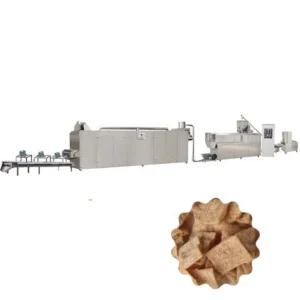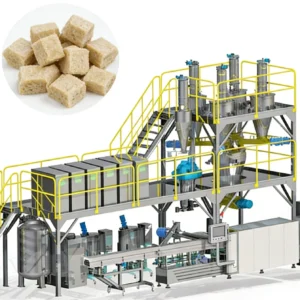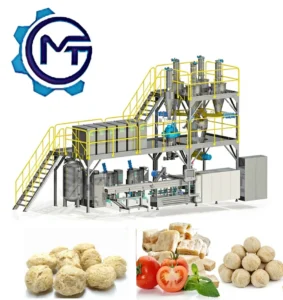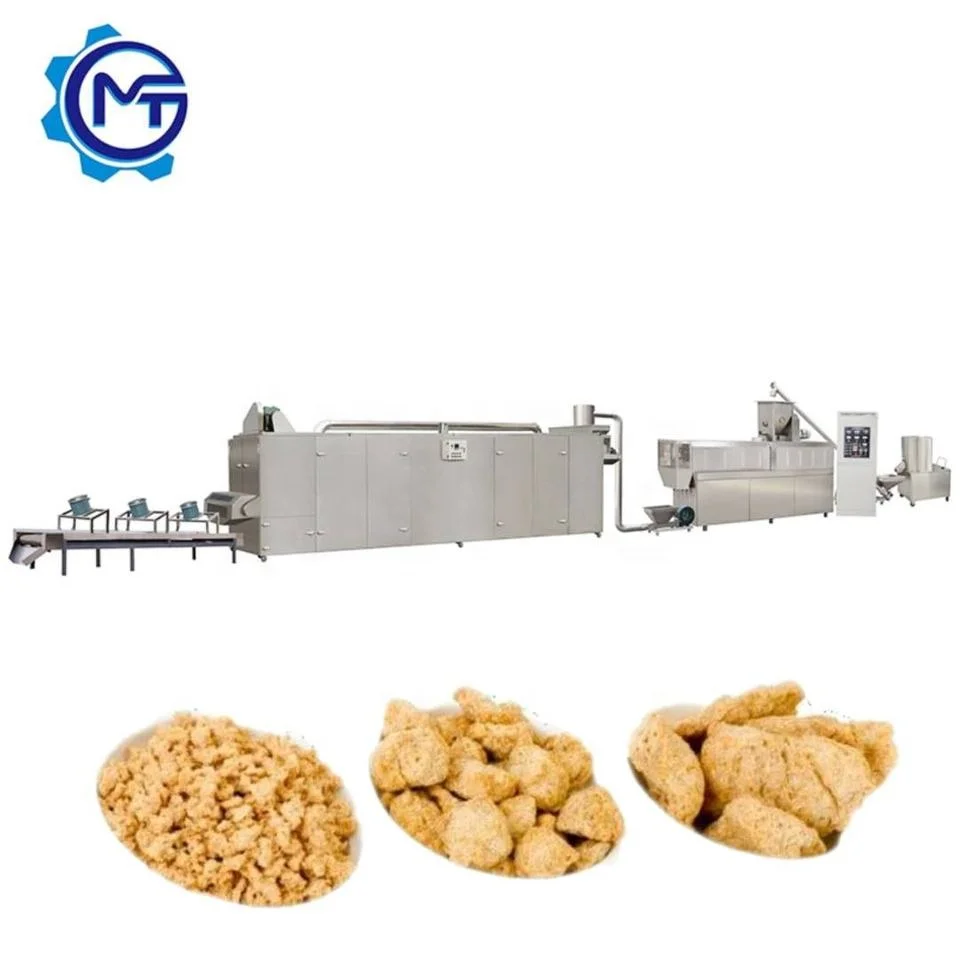

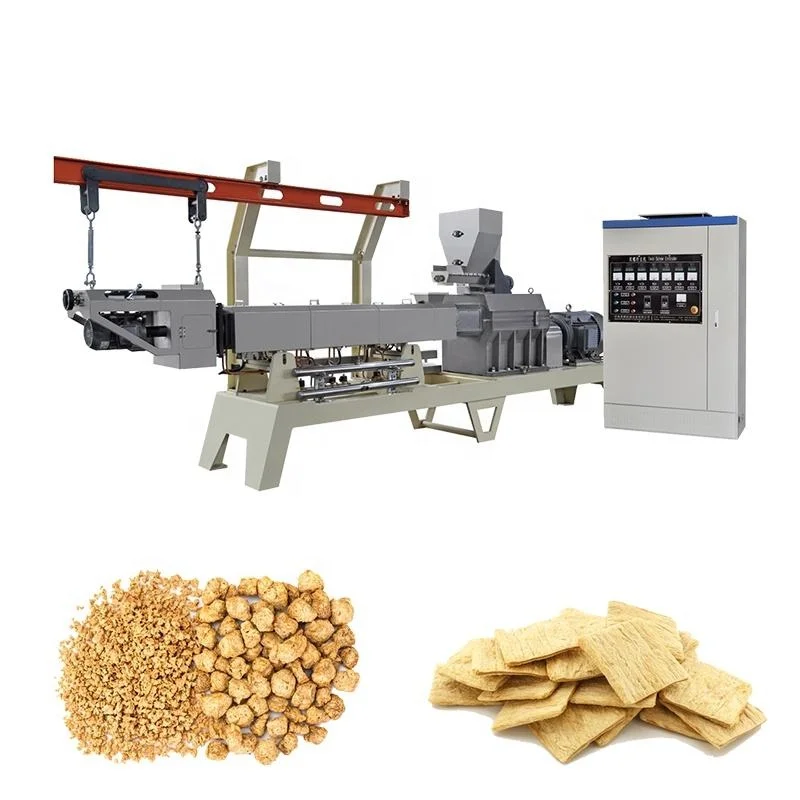

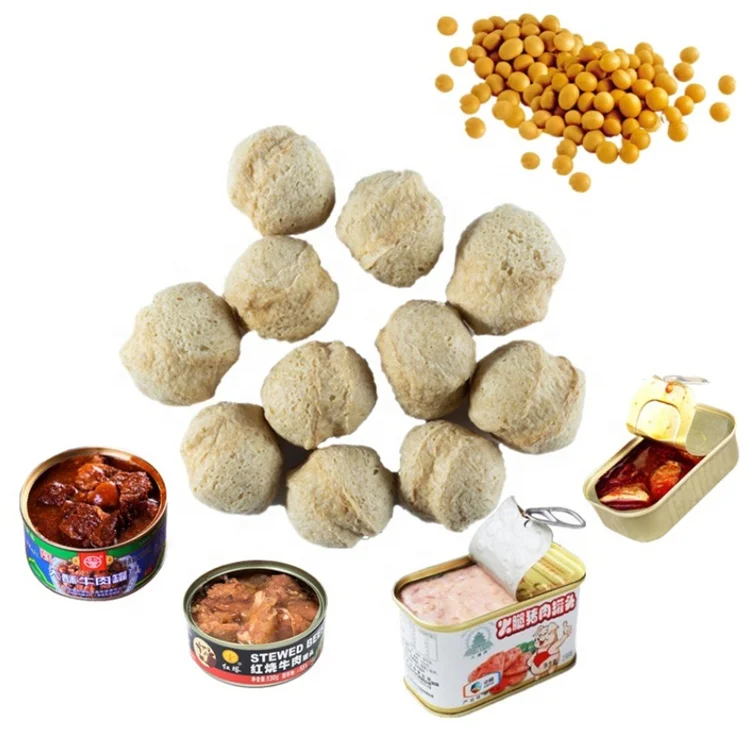
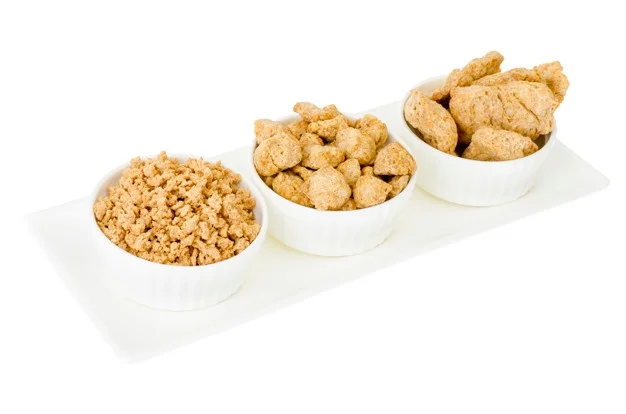
Textured Soy Protein Production Line, Twin-Screw Extrusion, Stainless Steel Construction — engineered for plant-based meat and vegetarian cutlet manufacturing from soybean or peanut meal.
- Screw configuration and die design matched to raw material formulation, controlling barrel temperature, moisture, and shear to achieve target fiber structure
- Complete line throughput balanced across mixing, extrusion, drying, and cooling stations to eliminate bottlenecks
- In-house testing workshop runs trial production on your raw material before shipment, with fiber structure and density documented in the report
Description
Throughput-matched TVP line layout — every station from powder mixer through roaster to cooler is cross-checked against your specific soybean meal formulation, eliminating the bottleneck of assembling machines from separate vendors.
Technical Specifications
| Parameter | Value |
|---|---|
| Product Type | Textured Soy Protein Production Line |
| Extruder Type | Twin-screw (Double Screw Extruder) |
| Available Models | MT65 / MT70 / MT85 |
| MT65 Installed Power | 85 kW |
| MT65 Real Power Consumption | 65 kW |
| MT65 Line Output | 150–200 kg/h (basis not stated in source — confirm raw material / moisture / formulation) |
| MT65 Line Footprint | 18000 × 1300 × 2300 mm |
| MT70 Installed Power | 120 kW |
| MT70 Real Power Consumption | 90 kW |
| MT70 Line Output | 200–300 kg/h (basis not stated in source — confirm raw material / moisture / formulation) |
| MT70 Line Footprint | 20000 × 1500 × 2400 mm |
| MT85 Installed Power | 195 kW |
| MT85 Real Power Consumption | 165 kW |
| MT85 Line Output | 600–800 kg/h (basis not stated in source — confirm raw material / moisture / formulation) |
| MT85 Line Footprint | 24000 × 3500 × 4300 mm |
| Powder Mixer Tank Volume | 150 kg |
| Powder Mixer Rotary Speed | 385 rpm |
| Powder Mixer Power | 4 kW |
| Powder Mixer Output | 300–600 kg/h |
| Roaster Belt Length | 3.5 m |
| Roaster Far Infrared Heater | 3.9 kW × 24 |
| Roaster Gas Consumption | 6.8 m³/h |
| Roaster Output | 300–400 kg/h |
| Roaster Dimension | 4500 × 1500 × 1600 mm |
| Cooling Machine Capacity | 200–300 kg/h |
| Construction Material | Stainless steel (food-grade contact parts) |
| Control System | PLC and MCC integration available |
| Process Technology | High-temperature, high-pressure, high-shear extrusion for protein molecular chain reorganization |
| Warranty | 1 year complete; lifetime maintenance |
Application Suitability
| Application | Material or Output |
|---|---|
| Textured vegetable protein (TVP) production | Low-temperature soybean meal, peanut meal |
| Plant-based meat analogues and vegetarian cutlets | Defatted soy flour blended with pea protein |
| Soy tissue protein for processed meat supply chains | High-protein extrudate for ham, sausage, and canned food |
| Quick-frozen and fast-food meat substitute ingredients | Fibrous protein with oil, water, and flavor absorption |
What "Nominal Capacity" Leaves Out on a Textured Soy Protein Production Line
A line rated on standard soybean meal will underperform the moment your formulation shifts to defatted soy flour or pea protein blends.
I spent four days in our testing workshop with a buyer last year who learned this the hard way. Their turnkey TVP extrusion line had been quoted on standard low-temperature soybean meal, and the trial ran fine. Then they switched to a defatted soy flour and pea protein blend — the expansion collapsed, and the fibrous tissue structure fell apart entirely. The screw combination and barrel temperature profile had to be rebuilt from scratch. When sourcing a textured soy protein production line, the capacity number on the quotation means very little until it is verified against your actual raw material, moisture content, and target fiber density. [NEED_CITE: protein gelatinization behavior under varying extrusion moisture levels]
Screw Configuration Dictates the Fiber Structure
The core of any textured soy protein production line is the twin-screw extruder, where protein molecular chains undergo reorganization under high temperature, high pressure, and high shear. The screw element arrangement — kneading blocks, reverse elements, and conveying sections — must be matched to the specific protein content and particle size of your raw material. A configuration designed for soybean meal will over-shear a delicate pea protein blend, destroying the laminar fiber structure that gives plant-based meat its chew. Die design works in tandem: the aperture geometry and land length determine exit pressure, which controls how the extrudate expands and forms its internal tissue layers.
Barrel Temperature Profile and Moisture Control
Proper fiber formation requires precise temperature staging across the barrel zones. The feed section maintains lower temperatures to prevent premature gelatinization, while the melting and metering zones ramp up to achieve the necessary protein denaturation. Moisture injection points must align with these thermal zones — too much water too early causes slip and reduces shear; too little water in the metering zone leaves the protein under-organized. The roaster downstream then stabilizes the structure by driving off residual moisture at controlled rates, locking in the fibrous texture before the cooling stage sets the final density. [NEED_CITE: staged barrel heating profiles for plant protein texturization]
Reading the Specification Sheet for Your Line
The MT65, MT70, and MT85 models differ primarily in real power consumption and line footprint, which directly determine throughput capacity on your specific formulation. The MT65 draws 65 kW in real operation across an 18-meter footprint, suited for pilot-scale or specialty protein runs. The MT85 pulls 165 kW and occupies 24 meters with a 3.5-meter width, built for continuous production volumes. Powder mixer output at 300–600 kg/h must be balanced against whichever extruder model you select — undersizing the mixer creates batch gaps that starve the extruder. The roaster’s 3.9 kW × 24 far infrared heaters and 6.8 m³/h gas consumption set the drying envelope; if extruder output exceeds roaster capacity, moisture remains trapped and the product degrades during storage.
The Cost of Mismatched Station Capacity
When a textured soy protein production line is assembled from separate vendors, the extruder may run at full output while the cooler cannot keep pace, causing warm product to clump and lose its fiber separation. Buyers who skip the throughput calculation often discover this only after installation, when the roaster belt cannot handle the extrudate volume and wet material backs up into the conveying system. The downstream bottleneck then forces the extruder to idle, burning energy and wearing screw elements without producing saleable product. [NEED_CITE: consequences of unbalanced extrusion line throughput]
Why Source This Line from a Single Supplier
Every station on this textured soy protein production line is throughput-matched before the quotation is issued — the mixer batch cycle, extruder output, roaster belt speed, and cooler capacity are calculated as one system. Screw configuration and die design are specified to your raw material and target fiber density, not copied from a generic build. Our testing workshop runs trial production on your actual soybean meal or pea protein blend before shipment, so the fiber structure and expansion ratio are documented and locked before the line leaves the factory. Stainless steel construction throughout food-contact zones meets sanitary requirements for meat analogue production, and PLC control integration allows you to store and recall recipe parameters for repeatable batches. Pre-sales consultation covers line layout, utility planning, and phased installation scheduling for your facility.
Documentation & Verification
- Line layout and capacity calculation document matched to your soybean meal formulation
- Screw and die configuration record specifying barrel temperature profile and shear parameters
- Trial run report on your raw material with fiber structure and density results documented
- Electrical schematic with voltage, frequency, and control language confirmed before production
- CE declaration of conformity and ISO certificate included with shipment documentation
- Wear parts list covering screws, dies, and mixer blades with replacement intervals
Installation, Commissioning & Support
- Line footprint from 18 to 24 meters requires level concrete floor with drainage for roaster condensate
- Dedicated power circuit sized to extruder installed power (85–195 kW depending on model selected)
- PLC and MCC panels arrive pre-wired; on-site connection to main distribution board required
- First commissioning run includes barrel temperature calibration and screw speed optimization on your material
- Operator training covers recipe storage, screw element inspection, and roaster belt tension adjustment
- Wear parts inventory includes replacement screw sections and die plates matched to your configuration
What We Need to Configure Your Line
To size a textured soy protein production line for your operation, provide the specific protein source and grade (low-temperature soybean meal, defatted soy flour, or pea protein blend), your target daily output, and the fiber density or water absorption ratio your market requires. Include your facility’s available floor length and ceiling height, local voltage and frequency standards, and preferred control language. If you have existing upstream batching or downstream packing equipment, share the interface specifications so the line throughput can be matched accordingly.
Frequently Asked Questions
Q: How is line capacity verified on my specific soybean meal or peanut meal formulation?
A: We run trial production on your actual raw material in our testing workshop before shipment. The screw configuration, barrel temperature profile, and moisture settings are adjusted until the fiber structure and expansion meet your specification. You receive a documented trial run report with measured output and product characteristics before the line ships.
Q: How do you ensure the dryer and cooler capacity matches the extruder output?
A: Every station is calculated as one system during layout design. The roaster belt length, heater output, and gas consumption are sized against the extruder’s verified throughput on your material. The cooler capacity is then matched to the roaster discharge rate so no station bottlenecks the line.
Q: What does the trial run in your testing workshop cover?
A: The trial run covers the complete process from mixing through extrusion, roasting, and cooling using your raw material. We document screw speed, barrel temperature at each zone, moisture injection rate, and the resulting fiber structure. You receive the trial run report with product samples before approving shipment.
Q: How are voltage, frequency, and PLC control language confirmed before production?
A: We request your facility’s electrical specifications and preferred control language during the proposal stage. The electrical schematic, motor ratings, and PLC interface are configured and documented before production begins, so commissioning on-site requires only connection to your main power supply.
Q: What is the installation and commissioning schedule for a complete TVP line?
A: Our engineers arrive on-site for installation, which includes mechanical assembly, electrical connection, and first production run on your material. The schedule covers line leveling, utility hookup, parameter calibration, and operator training. Ongoing maintenance support and wear parts supply continue after commissioning is complete.
Related products
-
High Productivity Single Screw Extruder Machine New Condition Textured Soya Meat & Soy Protein Like Meat Making Machine
Price range: ¥20.00 through ¥30.00 Select options This product has multiple variants. The options may be chosen on the product page -
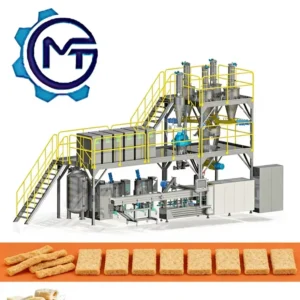
High Capacity Soy Protein Vegetarian Meat Processing Line
¥9,500.00 Select options This product has multiple variants. The options may be chosen on the product page -
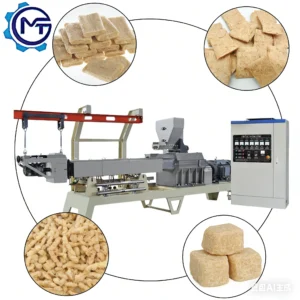
High Moisture Vegetarian Meat Extrusion Machine
¥9,500.00 Select options This product has multiple variants. The options may be chosen on the product page -
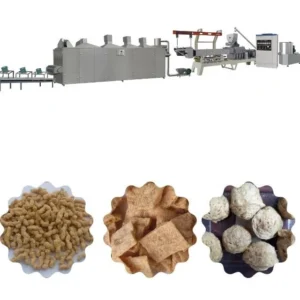
Dry Protein Drawing Equipment – Intelligent Puffing Machine for Cake Protein & Vegetarian Meat
¥65.00 Select options This product has multiple variants. The options may be chosen on the product page