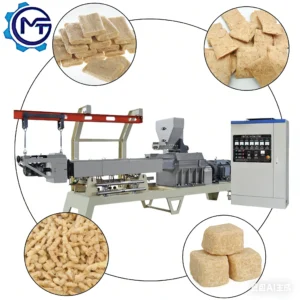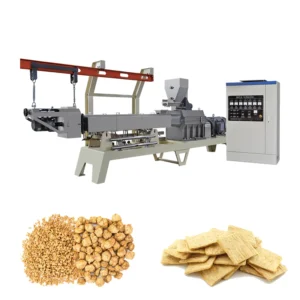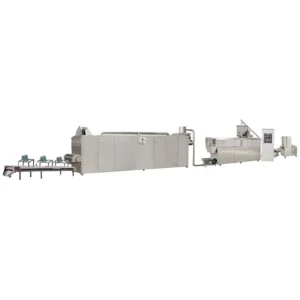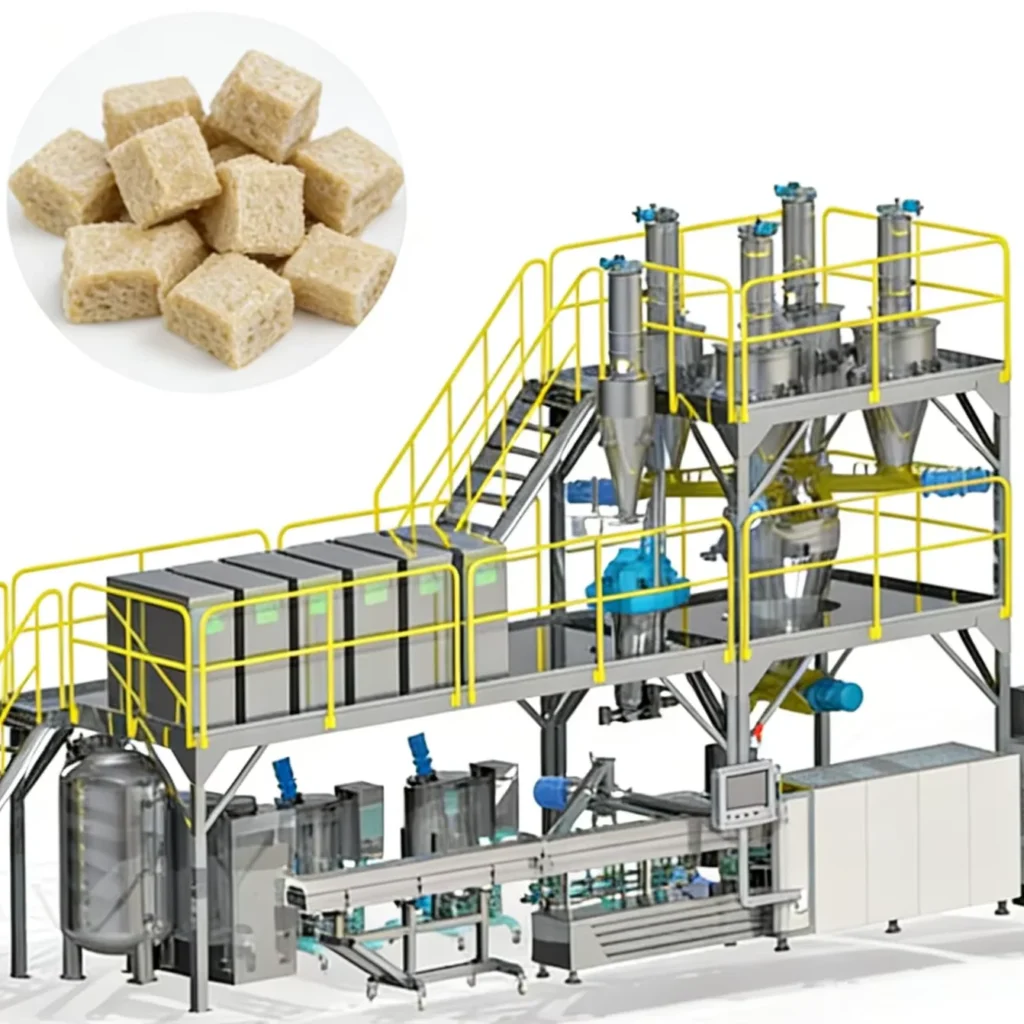
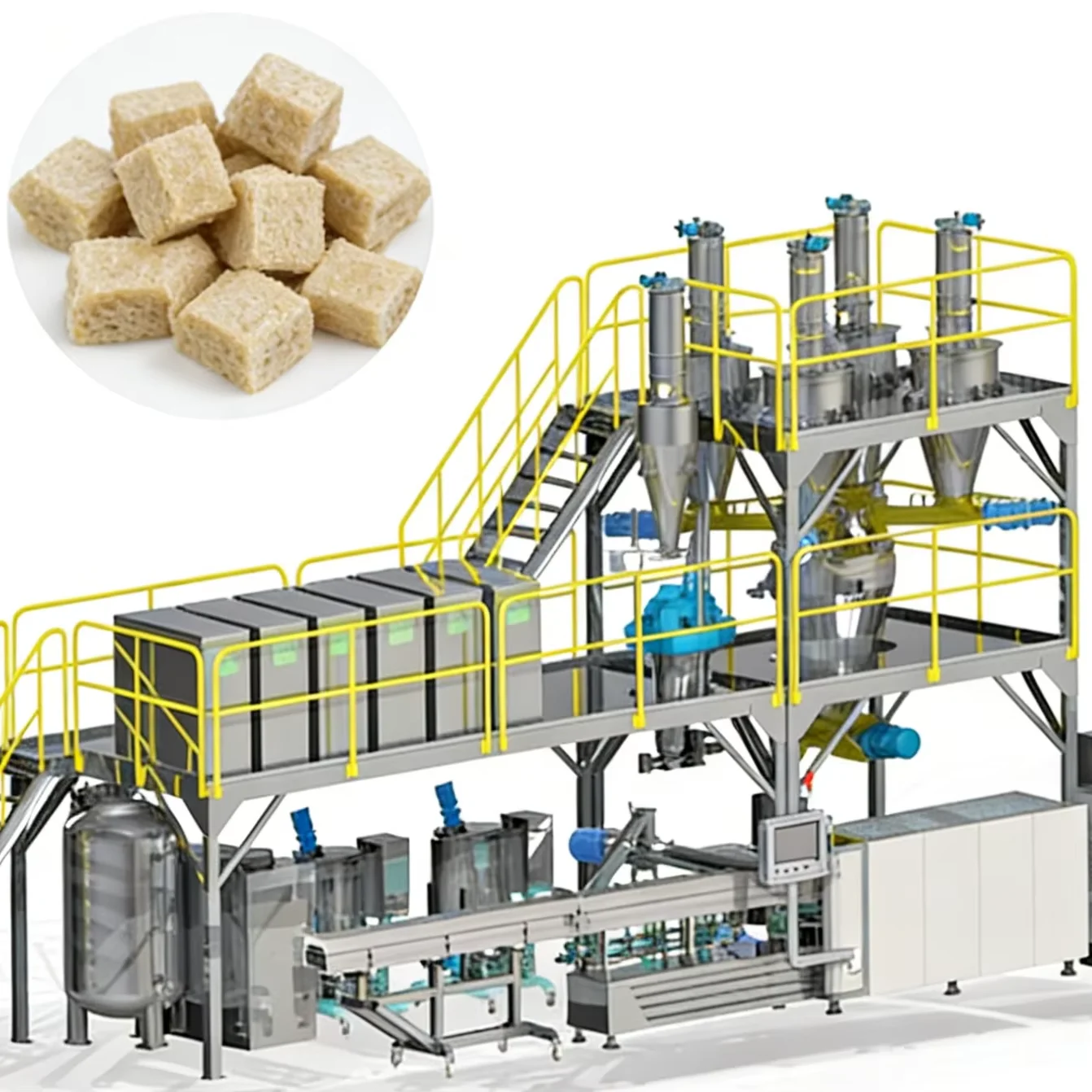
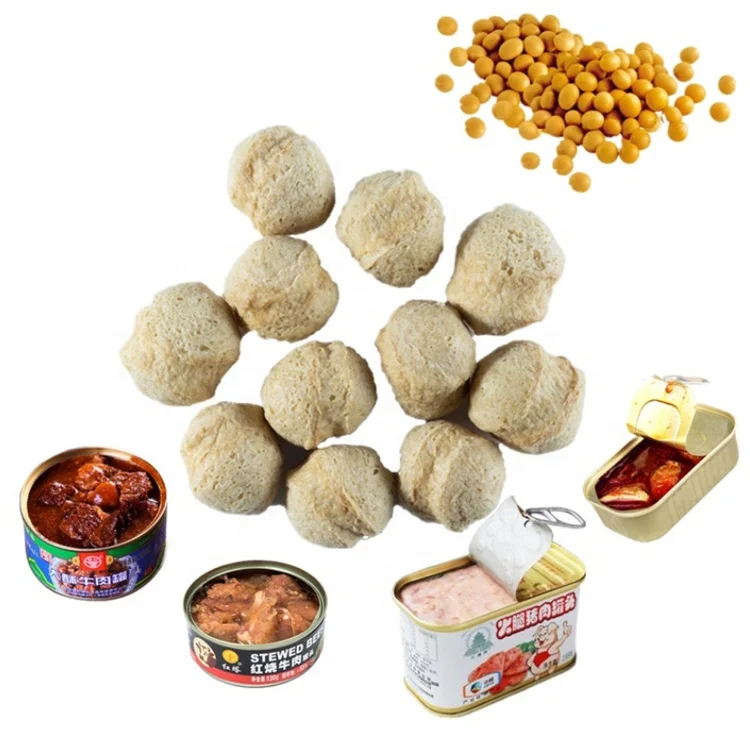
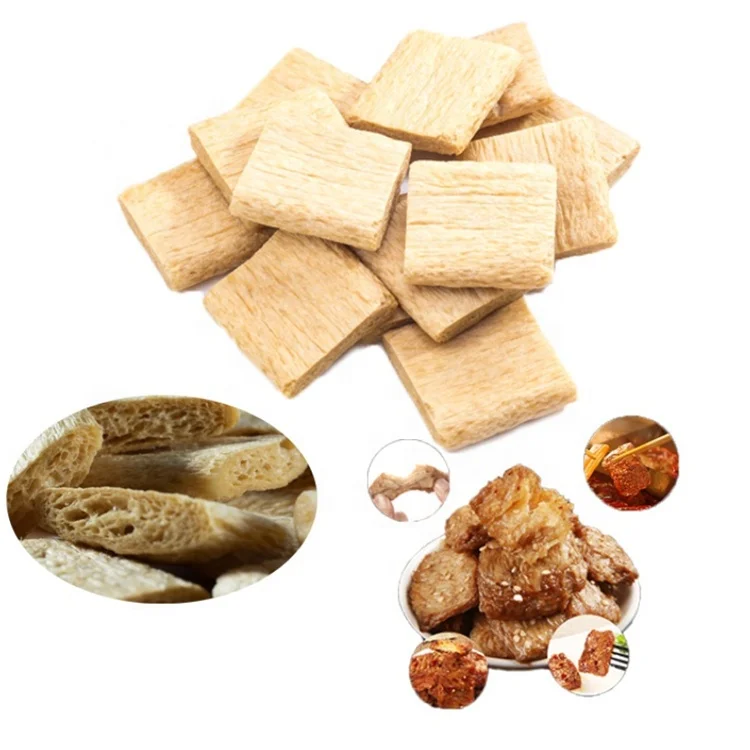

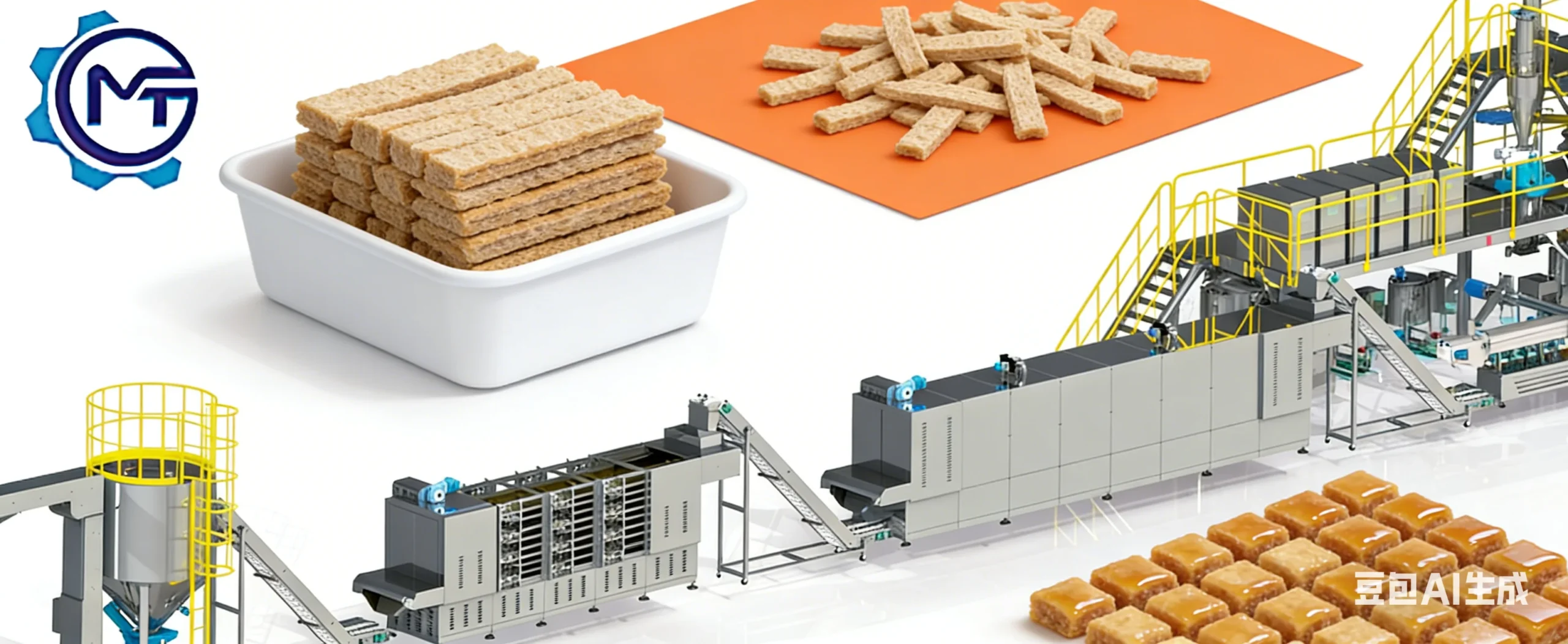
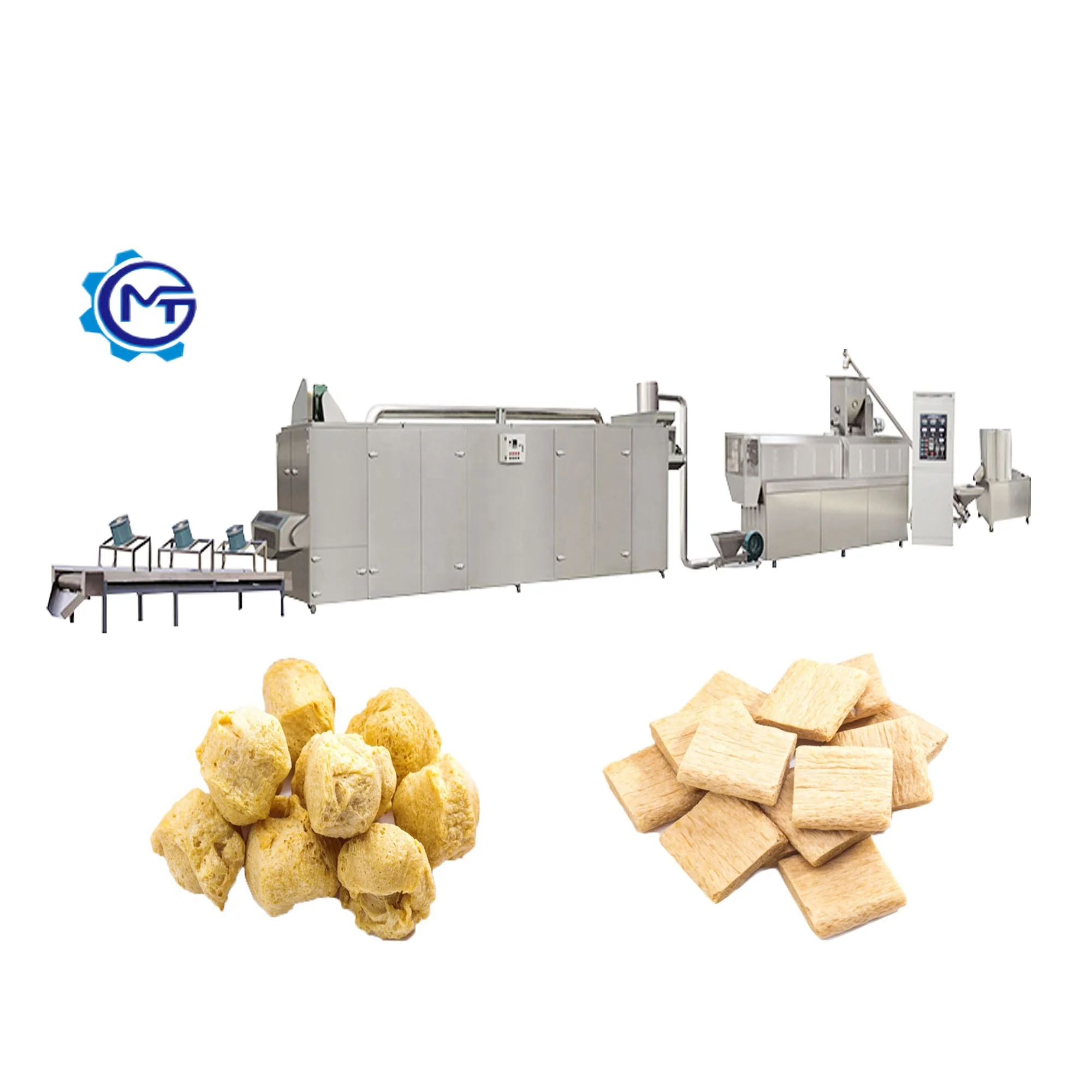
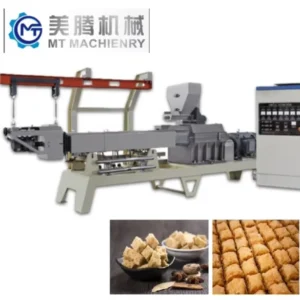
MT65 Plant Based Meat Processing Line, Twin-Screw, 84 kW Installed Power — turnkey TVP extrusion system from batching through drying and cooling, with throughput matched at every station to prevent bottlenecks.
- Screw length 1050 mm / 1520 mm options with die adjustment for soy nuggets, chunks, or TVP fibre structures
- Multi-layer dryer with selectable fuel, gas, or electric heating and adjustable drying time
Screw configuration and die design are specified to your raw material and target product format, with in-house trial runs on your defatted soya flour or flakes before shipment to verify fibre structure and density.
Description
Turnkey Plant Based Meat Processing Line — Every station from batching to cooling is throughput-matched under one supplier so the line runs at rated capacity without bottlenecks, and trial runs on your actual raw material happen before the machine leaves the factory.
Technical Specifications
| Parameter | Value |
|---|---|
| Product Type | Plant Based Meat Processing Line |
| Model | MT65 / MT70 / MT75 / MT85 |
| Screw Type | Twin Screw |
| Installed Power (MT65 / MT70 / MT75 / MT85) | 84 kW / 160 kW / 190 kW / 210 kW |
| Power Consumption (MT65 / MT70 / MT75 / MT85) | 59 kW / 120 kW / 140 kW / 140 kW |
| Output Capacity (MT65 / MT70 / MT75 / MT85) | 100–150 / 150–200 / 150–200 / 250–300 kg/h (basis not stated in source — confirm raw material and moisture content) |
| Overall Dimensions (MT65) | 40000 × 1200 × 2200 mm |
| Overall Dimensions (MT70) | 41000 × 1500 × 2200 mm |
| Overall Dimensions (MT75) | 43000 × 1500 × 3200 mm |
| Overall Dimensions (MT85) | 45000 × 1500 × 3500 mm |
| Extruder Screw Length | 1050 mm / 1520 mm |
| Main Motor Power | 22 kW / 30 kW / 45 kW |
| Rotary Cutting Motor | 0.75 kW |
| Feeding Motor | 0.75 kW |
| Pump Motor | 0.37 kW |
| Heating Power | 10 kW / 14 kW |
| Mixer Type | Vertical with stainless steel 304 mixing ruler |
| Mixer Power | 4 kW / 7.5 kW / 15 kW |
| Mixer Capacity | 20–30 kg / 70–80 kg / 170–180 kg |
| Mixer Shelf Material | Carbon steel |
| Dryer Drive | Double pitch roller chain, round-trip drying |
| Dryer Energy Source | Fuel / Gas / Electricity |
| Dryer Temperature & Time | Adjustable |
| Line Sequence | Mixer → Screw Conveyor → Twin Screw Extruder → Air Conveyor → Multi-layer Dryer → Cooling Machine |
| Standards | CE, ISO |
Application Suitability
| Application | Material or Output |
|---|---|
| Textured soy protein (TVP/TSP) production | Defatted soya flour, low-temperature soya flakes |
| Soy nuggets and soy chunks | High-protein soya meal blends at controlled moisture |
| Plant-based meat analogue ingredients | Protein isolates and concentrates for downstream forming |
| Vegetarian meat strips and shreds | Blended soy and pea protein raw materials |
| Cereal and snack formats (by reconfiguration) | Corn grits, rice flour, and grain blends with adjusted screw and die setup |
What "150 kg/h Output" Actually Means for Your Protein Line
Rated capacity only holds when the screw profile, die geometry, and dryer length all match your specific raw material blend.
A plant based meat processing line turnkey is often quoted on a headline figure that assumes one reference material at one moisture level. In practice, textured protein extrusion shifts dramatically when the buyer switches from pure defatted soya flour to a blend containing pea protein, wheat gluten, or a locally sourced isolate. The fibre alignment changes, expansion behaviour alters, and the product density moves outside the range that downstream formulators expect [NEED_CITE: textured protein extrusion sensitivity to raw material composition].
I spent four days on-site in Southeast Asia adjusting a line because the customer had added pea protein to the recipe after the order was placed. The fibre structure was completely different from the trial we had run on standard soya. That kind of mismatch costs commissioning time, operator confidence, and sometimes a full batch of unsaleable product.
How Screw Configuration Controls Fibre Structure
The twin-screw extruder in this plant based meat processing line turnkey uses interchangeable screw elements and die plates to set the shear profile, residence time, and expansion ratio inside the barrel. A longer screw length of 1520 mm gives the protein matrix more time under controlled heat and mechanical shear, which develops the laminar fibre alignment that meat analogues require. Shorter screw assemblies at 1050 mm suit denser nugget formats where tight cell structure matters more than long-fibre stretching.
Matching Dryer Capacity to Extruder Throughput
The multi-layer dryer uses a double pitch roller chain drive for smooth round-trip conveyance, and its energy source is configurable among fuel, gas, or electricity depending on local utility costs. Drying temperature and retention time are adjustable across the belt length [NEED_CITE: multi-layer dryer retention time and moisture removal in protein extrusion]. When a line is assembled from separate vendors, the dryer is often undersized relative to the extruder output, which forces the operator to slow the extruder down to prevent wet product from reaching the packing stage. Every station on this line is sized together so that rated throughput is sustainable.
Reading the Power and Dimension Data Correctly
Installed power on the MT65 sits at 84 kW with running consumption around 59 kW, meaning the heating barrels, main drive, and auxiliary motors draw roughly 70 percent of nameplate capacity during steady-state extrusion. The larger MT85 draws 140 kW in operation while installed capacity is 210 kW, reflecting the headroom needed for start-up surges and heavier dough viscosity at higher throughputs. Line footprint stretches from 40 metres on the MT65 to 45 metres on the MT85, which buyers need to confirm against their workshop length before the foundation is poured. Main motor options at 22 kW, 30 kW, and 45 kW correspond to the torque demand of different screw configurations and protein concentrations in the feed material.
The Hidden Cost of Skipping a Pre-Shipment Trial
When a texturized protein line ships without a documented trial on the buyer’s actual formulation, all process validation happens during on-site commissioning, under time pressure, with the buyer’s production schedule already committed. Screw and die combinations that should have been adjusted in a testing workshop instead get changed on the factory floor, one attempt at a time. Operators lose confidence in the equipment, the first weeks of production yield inconsistent fibre density, and the buyer’s downstream customers receive product that varies from batch to batch [NEED_CITE: commissioning delays caused by unverified extrusion parameters].
Why Procurement Through This Line Works Differently
Every station is sourced from one supplier, so the mixer capacity, extruder throughput, dryer belt length, and cooling conveyor speed are calculated together rather than patched from independent quotes. Screw and die configurations are specified against the buyer’s raw material formulation and target product format before the order enters production. An in-house testing workshop runs the customer’s actual defatted soya flour or protein blend through the extruder before shipment, producing a documented trial report on fibre structure and density. The line covers the full sequence from batching through cooling under a single layout drawing, which simplifies utility planning and floor-space allocation. Voltage, frequency, and control language are confirmed for the destination market before electrical panels are wired.
Documentation & Verification
- Line layout and capacity calculation showing throughput match across mixer, extruder, dryer, and cooler
- Screw and die configuration record specifying the combination validated for your protein blend
- Trial run report on your actual raw material conducted in the testing workshop before shipment
- Electrical schematic with voltage and frequency confirmed for your destination market
- CE declaration of conformity and ISO certificate covering the complete line assembly
- Operation and maintenance manual with wear parts list for screws, dies, and dryer chain
Installation, Commissioning & Support
- Workshop floor must accommodate up to 45 metres line length with level concrete foundation
- Dedicated power circuit required for 84–210 kW installed load depending on model selected
- Extruder barrel sections and dryer modules ship disassembled for container loading and rejoin on site
- First-run commissioning includes screw profile fine-tuning on your raw material at target moisture
- Operator training covers die changes, temperature zone adjustment, and dryer belt speed settings
- Wear parts inventory including replacement screw elements and die plates supplied with initial shipment
Before You Send an Inquiry
Provide your raw material specification including protein source, fat content, and target moisture level so the screw and die configuration can be scoped correctly. Share your local voltage and frequency standard along with preferred control language to avoid rewiring during commissioning. Confirm your available workshop length and ceiling height against the line dimensions listed above.
Frequently Asked Questions
Q: How is output capacity verified on my specific raw material?
A: The quoted kg/h figures are reference ranges that assume a particular raw material and moisture content. Before shipment, your actual protein blend is run through the extruder in the testing workshop, and the resulting throughput, fibre structure, and product density are recorded in a trial report. This confirms whether the rated output holds or needs adjustment for your formulation.
Q: What screw and die setup is recommended for soy nuggets versus TVP?
A: Soy nuggets typically use a die configuration that produces short, dense pieces with tight internal cell structure, while TVP requires a die and screw profile that generates longer fibre alignment through higher shear. Both formats are achievable on the same twin-screw platform by swapping the screw element arrangement and die plate.
Q: How are the dryer and cooler matched to the extruder output?
A: Each station is sized from a single line calculation so that the dryer belt length and retention time can handle the extruder’s full output without product backing up. The cooling conveyor is then matched to the dryer discharge rate, keeping the entire plant based meat processing line turnkey running at steady throughput.
Q: What voltage and control language will the line ship with?
A: Voltage, frequency, and control interface language are confirmed during the specification stage before electrical panels are built. This ensures the line connects directly to your facility’s power supply and the operators can read all control prompts in their working language without on-site modification.
Q: Can I witness the pre-shipment trial run or receive the full report?
A: Buyers are welcome to attend the trial run at the testing workshop. If on-site attendance is not practical, a complete trial report covering raw material behaviour, screw and die settings, product density, and fibre structure photographs is provided before the line is packed for shipment.
Related products
-
Small Multifunctional Textured Soy Protein Machine – Soy Protein Production Line – Vegetarian Meat Processing Equipment
¥65.00 Select options This product has multiple variants. The options may be chosen on the product page -
High Productivity Single Screw Extruder Machine New Condition Textured Soya Meat & Soy Protein Like Meat Making Machine
Price range: ¥20.00 through ¥30.00 Select options This product has multiple variants. The options may be chosen on the product page -
New High Efficiency Protein Production Line Plant Protein Equipment for Artificial Vegetarian Meat Processing Food Grade
¥65.00 Select options This product has multiple variants. The options may be chosen on the product page -
Vegetarian Beef Substitute Making Machine with Twin Screw Extruder
¥9,500.00 Select options This product has multiple variants. The options may be chosen on the product page