

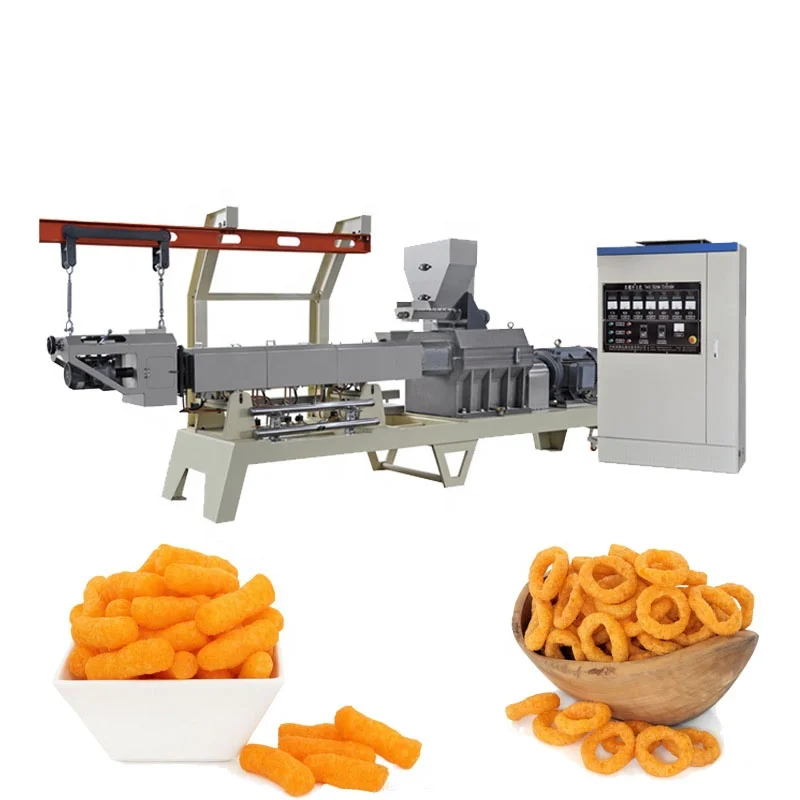
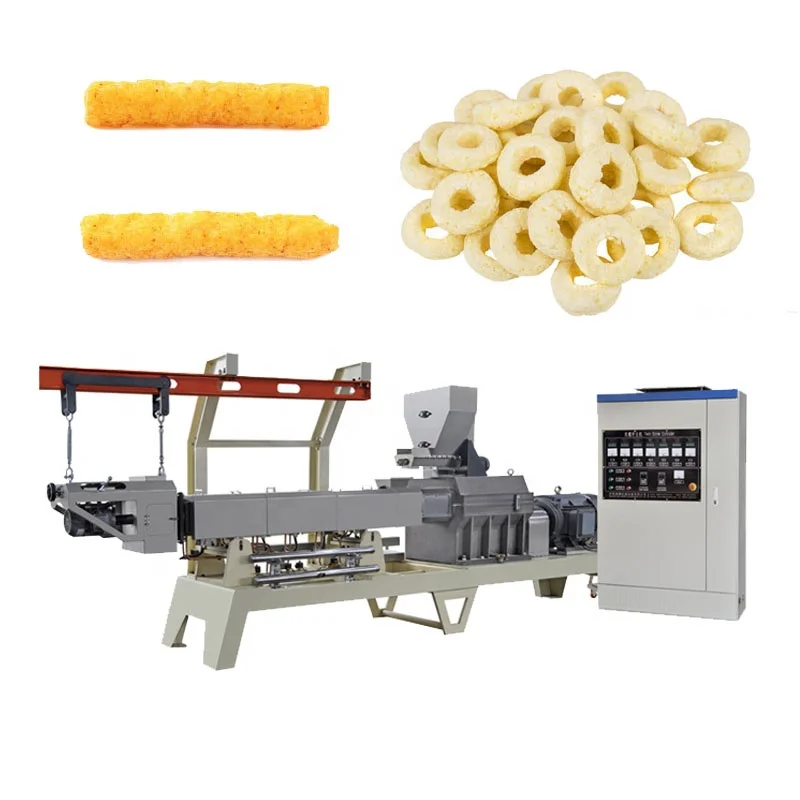
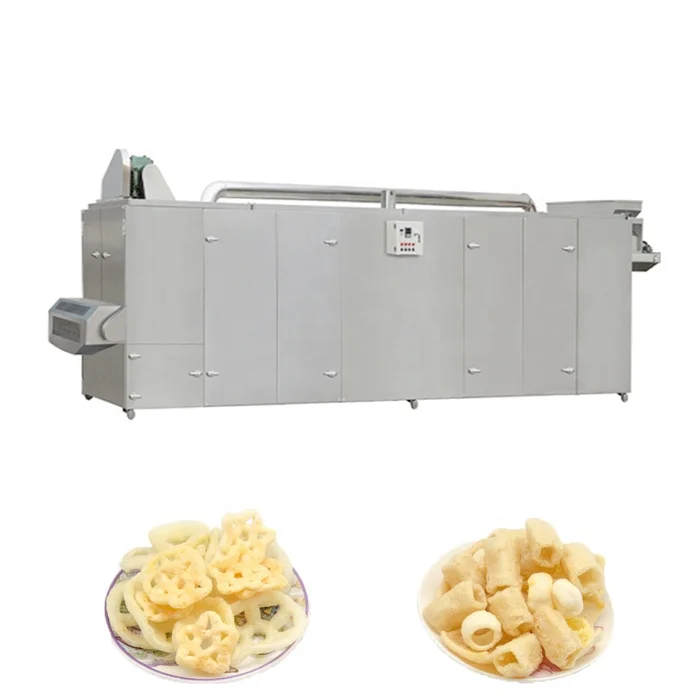
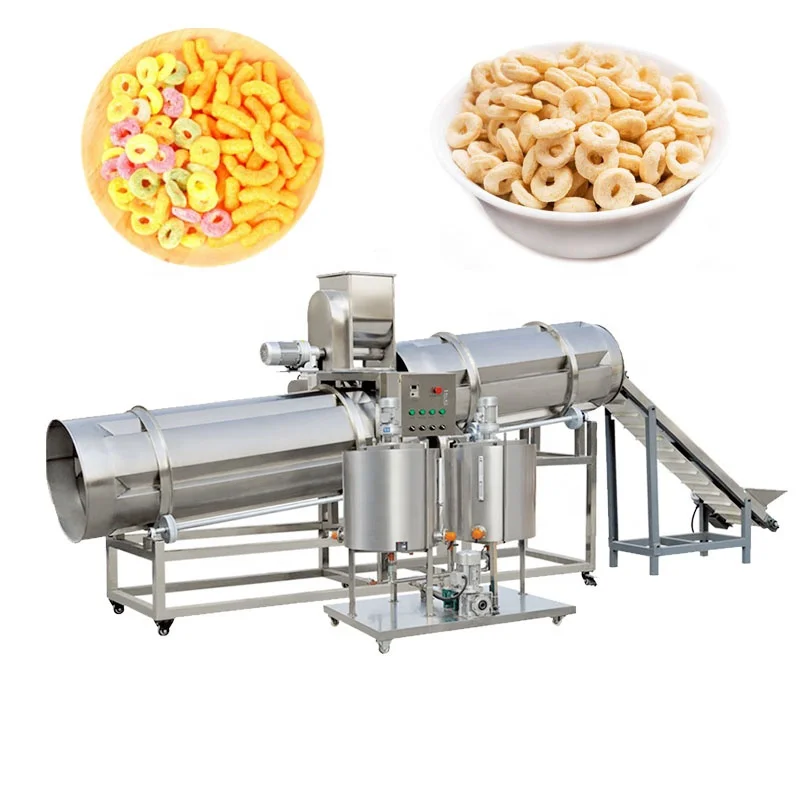
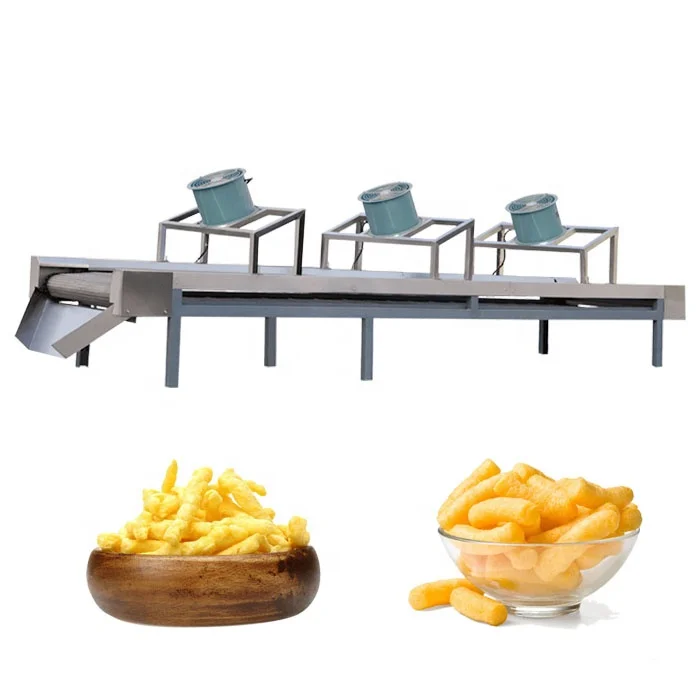
Twin Screw Snack Food Extrusion Line, 380V/50Hz, Food-Grade SS 201/304 — engineered for puffed and core-filled snack production from corn, rice, millet and other cereals. Screw configuration and die design are matched to your raw material and target format, controlling expansion, density and texture through precise barrel temperature and moisture profiles. Multiple energy options for drying and roasting stations keep the line compatible with your factory utilities. Backed by in-house trial runs on your raw material, throughput-matched station layout and on-site commissioning support.
Description
Throughput-Matched Station Design — every unit from mixer to packing is sized as one continuous system, so a snack food extrusion production line turnkey project never bottlenecks at the dryer or roaster.
Technical Specifications
| Parameter | Value |
|---|---|
| Product Type | Twin Screw Snack Food Extrusion Line |
| Machine Type | Double screw extruder machine |
| Screw Configuration | Twin screw |
| Raw Materials | Rice, millet, brown rice, buckwheat, corn, and other cereals |
| Voltage & Frequency | 380V/50Hz (three phase) / 220V/50Hz (single phase), customizable to local voltage |
| Rated Power | ~100 kW (electricity heating) / ~50-60 kW (gas or diesel heating) (basis not stated in source — confirm line configuration and dryer type) |
| Energy Source Options | Electricity / Gas / Diesel / Steam |
| Contact Material | Food grade stainless steel 201/304 |
| Motor Brand | Siemens (China) or equivalent top Chinese brand |
| Inverter | Delixi or Delta |
| Line Station Sequence | Mixer → Extruder → Vibrate cooler machine → Roasting machine → Packing machine |
| Control System | Available with PLC or MCC control (confirm specification) |
| Output Capacity | Confirm kg/h based on raw material and target product (basis to be confirmed) |
| Certification | CE |
Application Suitability
| Application | Material or Output |
|---|---|
| Cheese puffs and corn chips extrusion | Corn grits, rice flour, cereal blends |
| Cheetos-style puffed snack production | Corn meal, millet, brown rice mixtures |
| Core-filled snack bars and pillows | Chocolate, cream, fruit paste fillings with cereal shell |
| Snack ball and pellet forming | Rice, buckwheat, multigrain formulations |
| Rice cake and sheet snack processing | Rice flour, starch-based dough sheets |
| Breakfast cereal and cereal bar lines | Fortified grain blends, oat and wheat bases |
Why Nominal Capacity Quotations Fail on Real Raw Material
A snack food extrusion production line turnkey quoted at a single output figure rarely holds that number once your specific flour blend and moisture content enter the barrel. True line capacity only exists after every station — extruder, cooler, roaster, packing — is verified against your actual formulation.
I have watched lines stall because the extruder pushed product faster than the roaster could handle. The buffer pile grew, moisture climbed, and texture collapsed before the product ever reached the flavouring drum. These mismatches do not show up on a spec sheet; they appear on the factory floor during the first production week. Calculating throughput station by station, with your raw material in the hopper, is the only way to prevent a project-level bottleneck [NEED_CITE: twin-screw extrusion throughput matching principles for snack lines].
Station Sequencing for Continuous Snack Output
The line follows a fixed sequence: mixer, twin-screw extruder, vibratory cooler, roasting machine, and packing station. Each unit is selected so that its maximum throughput sits slightly above the extruder output, preventing accumulation at any transfer point. A snack food extrusion production line turnkey designed this way keeps product moving without manual intervention between stages.
The vibratory cooler sits directly after the extruder die, reducing surface moisture and stabilising the expanded shape before the product enters the roaster. Skipping this stage or undersizing it leads to uneven drying and inconsistent crunch in the finished snack.
Screw and Die Configuration Tied to Your Formulation
Every cereal blend behaves differently inside the barrel. Corn meal requires a different screw pitch and compression ratio than a brown rice and buckwheat mix. The die opening diameter and land length determine expansion rate, cell structure, and final bulk density of the puffed snack.
We specify screw elements and die geometry after reviewing your target product format — whether that is a hollow cheese ball, a dense corn chip, or a cream-filled pillow. Running your raw material through our in-house testing workshop before the line ships confirms that the chosen configuration produces the correct texture and expansion [NEED_CITE: screw configuration impact on extruded snack density and texture].
Reading the Specs That Actually Matter
The twin-screw design gives this line a wider processing window than single-screw extruders, handling high-fat and high-moisture recipes that would cause single-screw units to surge or stall. Barrel sections are individually heated, allowing operators to build a temperature profile that controls starch gelatinisation stage by stage.
Energy source selection — electricity, gas, diesel, or steam — directly affects operating cost and utility planning. A facility with existing steam boilers will see lower roasting energy cost than one relying on electric heating elements. Motor and inverter pairing from Siemens and Delixi or Delta provides variable screw speed control, which is essential when switching between a light rice puff and a dense multigrain snack ball.
Food-grade stainless steel 201 or 304 contact surfaces meet hygiene requirements for direct human-consumption snack lines and simplify wash-down between product changeovers.
The Hidden Cost of Mismatched Downstream Equipment
An extruder running at full output means nothing if the roaster cannot remove moisture fast enough. Product backs up, residence time in the cooler extends beyond what the texture can tolerate, and the snack reaches the packing station with residual moisture that shortens shelf life. These failures are not equipment defects — they are sizing errors made at the quotation stage [NEED_CITE: common causes of throughput mismatch in snack extrusion lines].
Voltage and frequency mismatches create a different category of delay. A line built for 380V/50Hz arriving at a 440V/60Hz facility requires transformer upgrades or motor replacement before commissioning can begin, adding weeks to the project timeline.
Why This Line Is Procured Here
Complete station matching under one supplier eliminates the finger-pointing that occurs when extruder, dryer, and packing machines come from separate vendors with incompatible throughput ratings.
Screw and die configurations are documented against your specific raw material, not copied from a generic build, so the first production run delivers the target product format without weeks of trial and error.
The in-house testing workshop allows your formulation to run on the actual extruder before shipment, producing a trial run report that confirms capacity, texture, and expansion.
Pre-sales engineering covers line layout and utility planning, and on-site installation includes operator training so your team can manage product changeovers independently.
Documentation & Verification
- Line layout drawing with per-station capacity calculation for your snack format
- Screw and die configuration record matched to your cereal blend and target density
- Trial run report on your raw material from the in-house testing workshop
- Electrical schematic confirming voltage, frequency, and control language for your facility
- CE declaration of conformity covering the complete assembled line
- Operation and maintenance manual with wear parts list for screws, dies, and seals
Installation, Commissioning & Support
- Foundation and floor space plan aligned to the full station sequence from mixer to packing machine
- Dedicated power circuit sized to the confirmed rated power, whether electric or thermal heating
- Assembly and alignment of all stations on-site with throughput verification at each transfer point
- First-run parameter setting covering barrel temperatures, screw speed, and die gap for your recipe
- Operator training on product changeover procedures between different snack formats
- Wear parts supply schedule for screws, dies, and barrel liners with recommended replacement intervals
What to Include in Your Inquiry
To size this snack food extrusion production line turnkey accurately, share your target snack format, the cereal or grain blend you plan to run, and the daily output you need. Specify your facility voltage and frequency, available energy sources, and whether you require PLC or MCC control with a particular interface language. If you have existing upstream or downstream equipment, provide details so the new line can integrate cleanly.
Frequently Asked Questions
Q: How is line throughput calculated and verified across every station before shipment?
A: Each station — extruder, vibratory cooler, roaster, and packing machine — is sized based on your raw material and target snack format. We run your formulation through the extruder in our testing workshop, measure actual output, and confirm that every downstream unit can handle that volume continuously. A trial run report documents the results before the line ships.
Q: What screw and die configuration is specified for my raw material and target snack format?
A: Screw pitch, compression ratio, and element arrangement are selected based on your cereal blend composition and moisture content. Die opening diameter and land length are matched to the expansion rate and cell structure your target product requires. The configuration is recorded and can be replicated for future production runs.
Q: How are voltage, frequency, and control language confirmed before production begins?
A: During the specification confirmation stage, we verify your facility power supply and select motors, heaters, and control components accordingly. The electrical schematic is reviewed with your engineering team before manufacturing starts, ensuring the control interface language and safety circuit logic match your operational requirements.
Q: How is the roaster capacity matched to the extruder output?
A: The roasting machine is selected so its moisture removal rate exceeds the extruder output at your target product moisture level. This prevents product accumulation between the vibratory cooler and roaster, maintaining consistent texture and preventing shelf-life issues caused by residual moisture.
Q: What does on-site installation and operator training include?
A: Our team positions and aligns every station, connects utilities, and runs the first production batches with your raw material. Operators are trained on barrel temperature profiles, screw speed adjustment, die changes, and wash-down procedures. A wear parts list with replacement intervals is handed over at commissioning completion.
Related products
-

New Puffed Snack Food Machine Production Line Corn Flake Puff Corn Making Machine Twin Screw Extruder 100-500kg/h Capacity Food
¥8,500.00 Select options This product has multiple variants. The options may be chosen on the product page -

Puff Corn Extruder Machine Puffed Core Filled Snack Food Production Line Machine
¥8,500.00 Select options This product has multiple variants. The options may be chosen on the product page -

Fully automatic puff snack processing line
¥8,500.00 Select options This product has multiple variants. The options may be chosen on the product page -

Stainless Steel Corn Puff Cake Making Machine Corn Snack Food Machines Top Selling Snacks Machine
¥8,560.00 Select options This product has multiple variants. The options may be chosen on the product page

