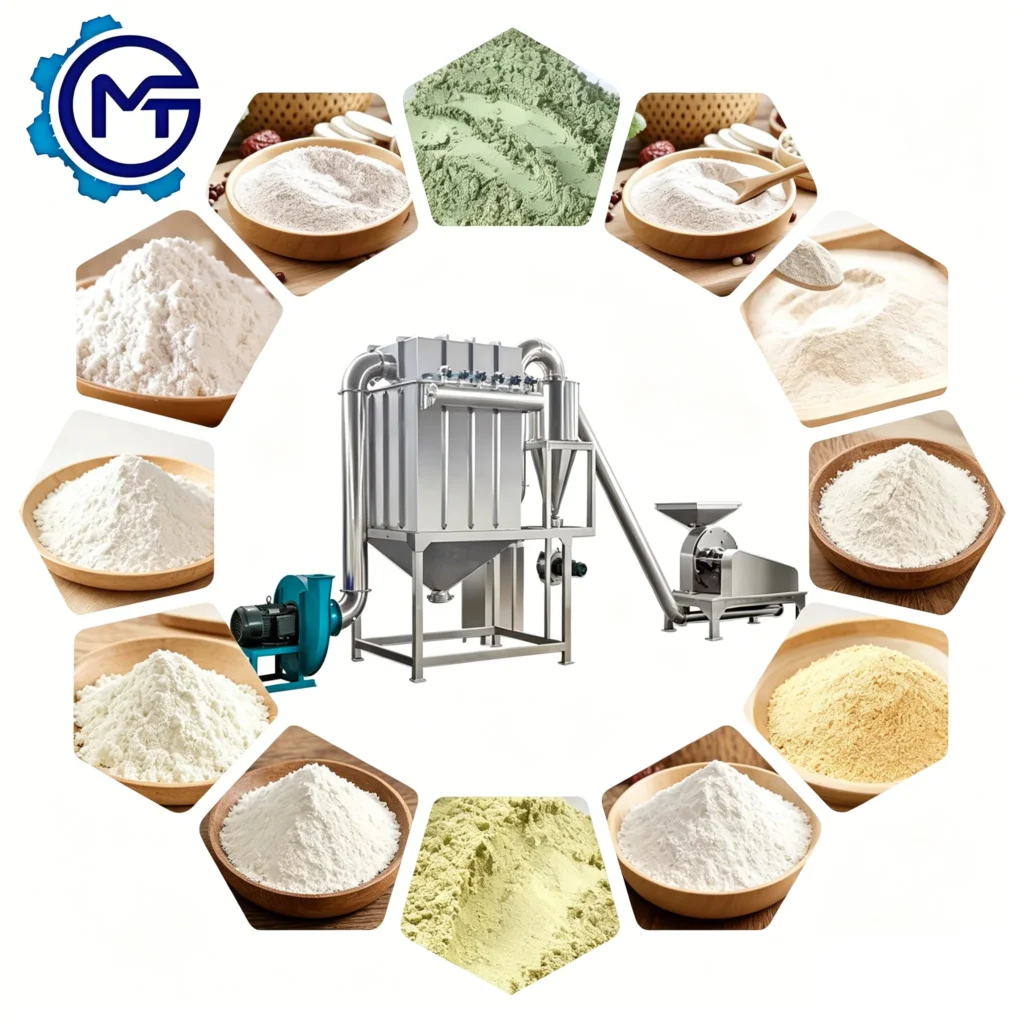
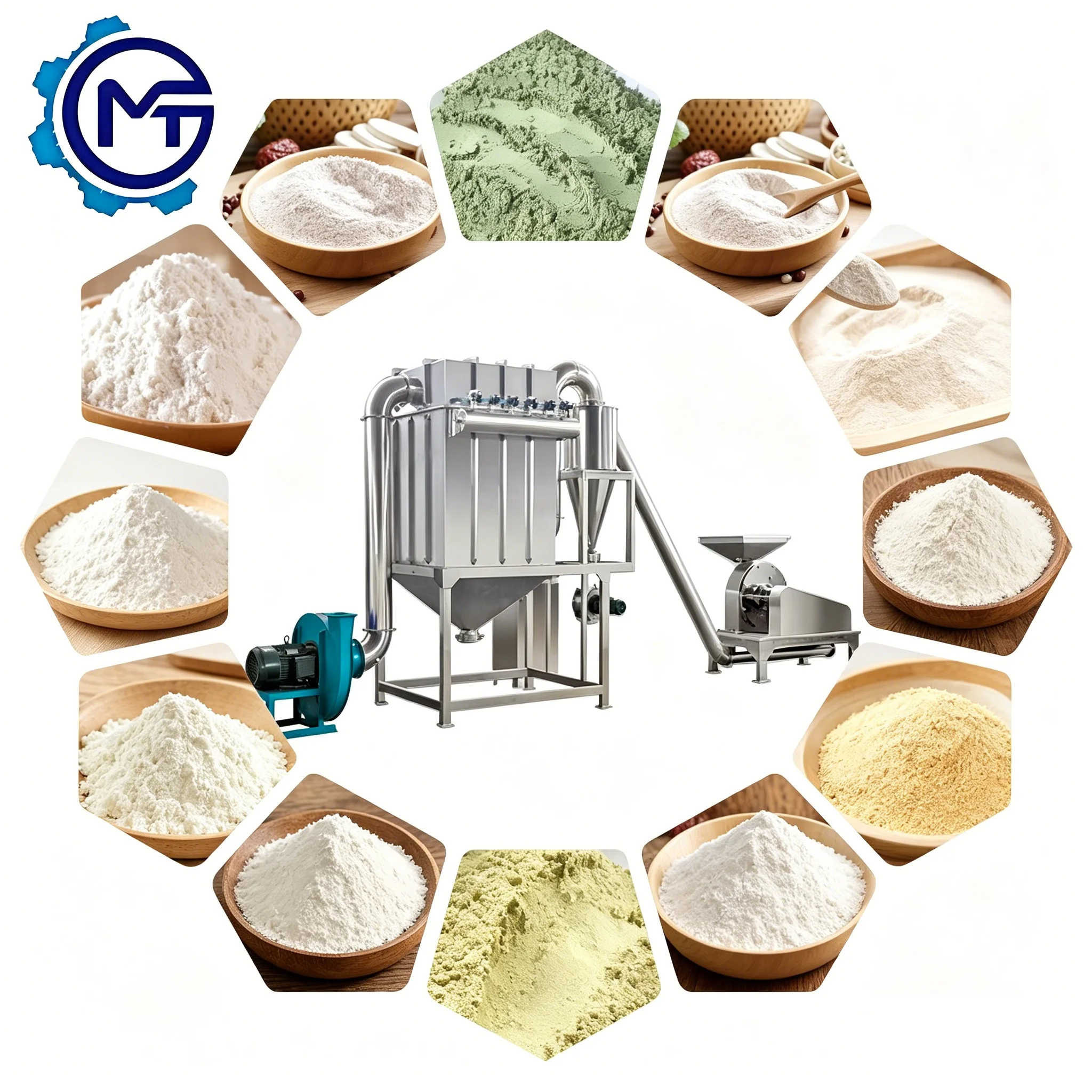


- Trial runs on your actual raw material are completed in our testing workshop before shipment, so screw configuration and die design are validated against your formulation from day one.
Description
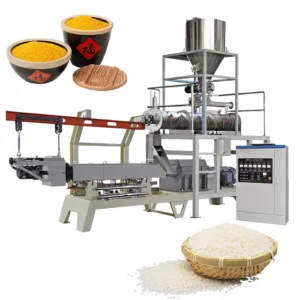
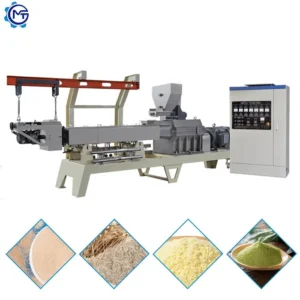
Baby Rice Nutrition Powder Processing Line – Turnkey Solution
Throughput-Matched Engineering — Every station in this nutrition powder processing line is sized against the actual grain formulation rather than catalog figures, so extrusion, drying, milling and packing run at the same pace without bottlenecks.
Technical Specifications
| Parameter | Value |
|---|---|
| Product Type | Nutrition Powder Processing Line |
| Extruder Type | Twin screw |
| Output Capacity | 200–500 kg/h (basis not stated in source — confirm raw material type, moisture content and formulation) |
| Construction Material | Food-grade 304 stainless steel contact surfaces |
| Control System | Automatic PLC with touch control panel and digital system |
| Heat Source Options | Electric / Gas / Steam (configurable to site utility) |
| Line Stations | Baking ovens, mixers (full line composition to be confirmed) |
| Energy Profile | Optimised for low energy consumption with high-speed processing (quantified figures not stated) |
| Warranty | 1 year |
| After-Sales Service | Overseas engineer service available |
| Voltage & Frequency | To be confirmed against target market grid |
| Overall Dimensions | Not stated in source |
| Net Weight | Not stated in source |
| Screw Diameter / L:D Ratio | Not stated in source |
| Barrel Zones | Not stated in source |
| Die Configuration | Not stated in source |
| Standards | To be confirmed — CE / ISO declaration availability |
Application Suitability
| Application | Material or Output |
|---|---|
| Infant and baby nutrition powder | Rice, corn, beans and multi-grain blends |
| Fortified breakfast cereal powder | Grain-based formulations with vitamin and mineral premix |
| Instant porridge and weaning food | Pre-cooked and extruded grain flours |
| Nutritional programme supply | Calorie-dense, shelf-stable powder for institutional distribution |
What "200–500 kg/h" Actually Means for Nutrition Powder
Capacity only holds when the screw profile, barrel temperature and drying time are tuned to the buyer’s specific grain blend and moisture level.
A nominal output figure on a nutrition powder processing line turnkey quotation rarely survives contact with the real formulation. Starch-heavy blends with high amylopectin content behave very differently from rice-dominant recipes inside the barrel — viscosity spikes, residence time shifts and the die pressure climbs. I once watched a line rated at the top of its range drop to roughly half that number the moment the customer switched from a corn-dominant mix to a bean-and-rice blend [NEED_CITE: raw material variability in extrusion output]. Without a trial run on the actual material, the number on the spec sheet is a guess.
Barrel Segmentation and Temperature Staging
The twin-screw platform divides the barrel into independently heated zones, allowing the operator to stage gelatinisation gradually. For infant rice powder, early zones keep moisture high enough to begin starch breakdown while later zones reduce it before the die. This zoning is what separates a smooth, fully cooked flour from one that carries raw spots and inconsistent particle size after milling. The PLC touch panel stores these temperature profiles per recipe, so repeat runs hold the same thermal curve.
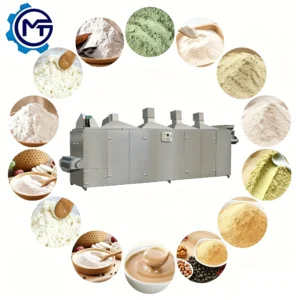
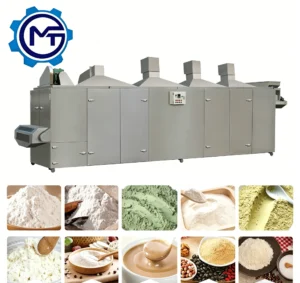
Drying and Milling as Part of the Integrated Flow
Extrusion is only one station. The extrudate must be dried to a precise residual moisture before milling can produce the fine, free-flowing powder that infant food packaging demands. If the dryer is undersized relative to the extruder output, material queues and degrades on the belt [NEED_CITE: moisture target for shelf-stable nutrition powder]. Matching dryer capacity, milling fineness and packing speed to the extruder is what the nutrition powder processing line turnkey concept is really about — one supplier owning every hand-off point so throughput stays balanced.
Reading the Specification Sheet for What Matters
Food-grade 304 stainless steel on all contact surfaces is a baseline requirement for infant food compliance, not an optional extra. The heat source choice — electric, gas or steam — must align with the buyer’s existing factory utility; specifying the wrong option adds weeks of retrofit work. The automatic PLC control with touch panel matters most when the product range spans several formulations, because it lets operators recall saved profiles rather than rebuild parameters from scratch each time. Screw diameter and length-to-diameter ratio, once confirmed, will determine whether the extruder can handle the residence time that high-starch baby food recipes demand.
The Cost of Skipping the Trial Run
Lines that ship without a material-specific trial run force the buyer into weeks of on-site experimentation. Screw configurations copied from a generic build produce powder that is either too coarse for infant palates or too dense to dissolve properly in water. Die selection affects particle shape before milling, and the wrong geometry creates oversize fragments that the mill cannot reduce within its rated pass [NEED_CITE: particle size distribution in extruded nutrition powder]. All of this surfaces after installation, when the supplier’s engineer has already left and the buyer’s production schedule is burning cash every hour the line sits idle.
Why Source This Line Here
Every station — mixing, extrusion, drying, milling, packing — is specified under one supplier, so throughput matching is an engineering calculation, not a hope. Screw configuration and die design are chosen against the buyer’s declared formulation rather than pulled from a standard library. An in-house testing workshop allows trial runs on customer-supplied raw material before the line ships, catching viscosity and expansion issues early. Pre-sales consultation covers layout and utility planning, and the same engineering team handles on-site installation and commissioning. Twin-screw expertise spans infant powder, pet food, aquatic feed and snack applications, so process knowledge transfers across product categories.
Documentation & Verification
- Line layout drawing with throughput calculation across mixing, extrusion, drying, milling and packing stations
- Trial run report generated on your grain formulation in our testing workshop before dispatch
- Machine specification sheet including screw profile and die configuration matched to your recipe
- Electrical schematic with voltage and frequency locked to your installation site grid standard
- Operation and maintenance manual with illustrated wear part replacement procedures
- Packing photographs and customs documentation support for smooth port clearance
Installation, Commissioning & Support
- Foundation plan accounts for extruder vibration and dryer thermal expansion on your factory floor
- Dedicated electrical circuit sized to the confirmed total connected load of all line stations
- Equipment ships in modular sections for container loading, with reassembly supervised on site
- First-run parameter setting covers barrel temperatures, screw speed and dryer belt speed for your formulation
- Operator training includes PLC recipe storage, die changeover and daily cleaning routines
- Wear parts list identifies screws, dies and seals with lead times for first replacement order
What to Share With Your Inquiry
To size a nutrition powder processing line turnkey project correctly, the most useful starting points are your target formulation with approximate moisture content, daily or shift-based production target, and the voltage and frequency standard at the installation site. If you already have upstream mixing or downstream packing equipment, noting the interface points helps avoid duplicated stations. Sharing a sample of the raw material for a workshop trial run is the single most reliable way to lock capacity and product quality before the order is placed.
Frequently Asked Questions
Q: How is line capacity verified against my specific grain formulation and moisture content?
A: We run your actual raw material through the twin-screw extruder in our testing workshop, recording barrel temperatures, screw speed, die pressure and output rate. The trial run report becomes the basis for the final quotation, so the capacity figure you receive already reflects your blend rather than a generic benchmark.
Q: How is throughput balanced between extrusion, drying, milling and packing stations?
A: Each station is sized using the extruder’s confirmed output on your material. Dryer belt length, milling capacity and packing speed are calculated to match, preventing queues or idle gaps. The line layout document shows the throughput at every hand-off point so no station becomes a bottleneck.
Q: What utility planning is required for heat source selection and electrical load?
A: We confirm your site’s available voltage, frequency, steam supply and gas pressure before finalising the heat source option. The electrical schematic then reflects the actual connected load. This step avoids costly retrofits after the line arrives and keeps commissioning on schedule.
Q: What does on-site installation, commissioning and operator training cover?
A: Our engineers supervise reassembly, level the extruder and dryer, connect utilities and run the first production batch on your material. Training covers PLC recipe recall, screw and die changeover, daily sanitation and basic fault diagnosis, ensuring your team can operate independently once the visit ends.
Q: How are spare wear parts and ongoing maintenance supported after handover?
A: The wear parts list shipped with the line identifies every consumable — screws, dies, seals and bearings — with part numbers and recommended stock levels. Replacement parts are manufactured in the same facility, and our service team provides remote troubleshooting or scheduled site visits as needed.
Related products
-

Automatic Instant Powder Production Line Nutritional Powder Extruder Machine
¥10,000.00 Select options This product has multiple variants. The options may be chosen on the product page -

Hygienic Stainless Steel Infant Rice Powder Processing Line Automatic 500kg/h Capacity PLC Controlled
¥9,500.00 Add to cart -
Automatic Nutritional Powder Making Machine Safe Rice Cereal for Babies
¥30.00 Select options This product has multiple variants. The options may be chosen on the product page -
High Productivity New Condition Nutritious Baby Food Meal Replacement Powder Production Line
¥30.00 Select options This product has multiple variants. The options may be chosen on the product page