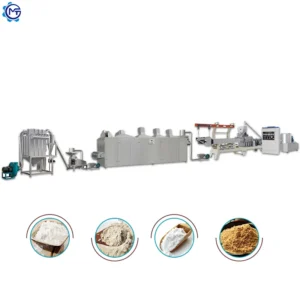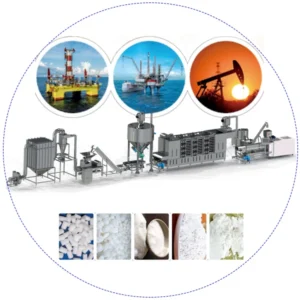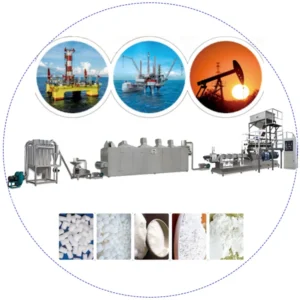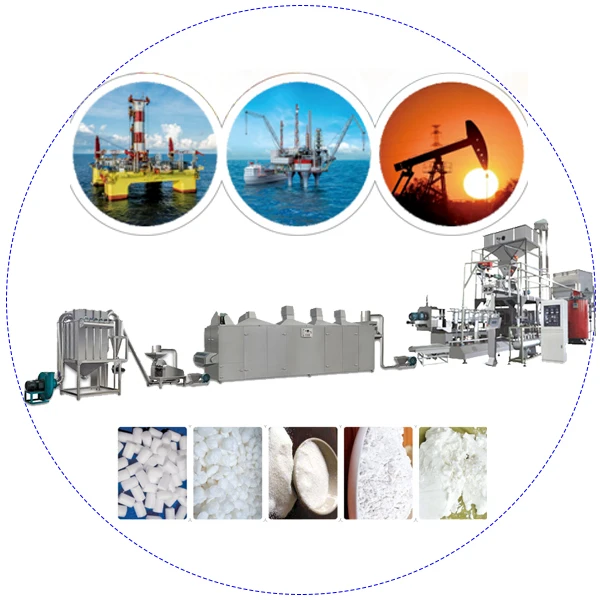
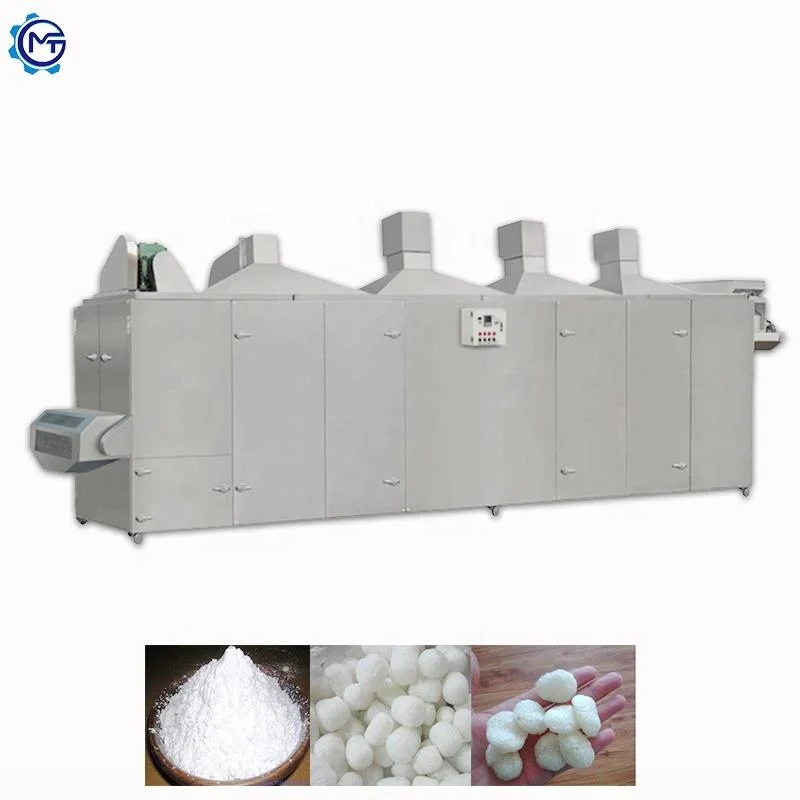
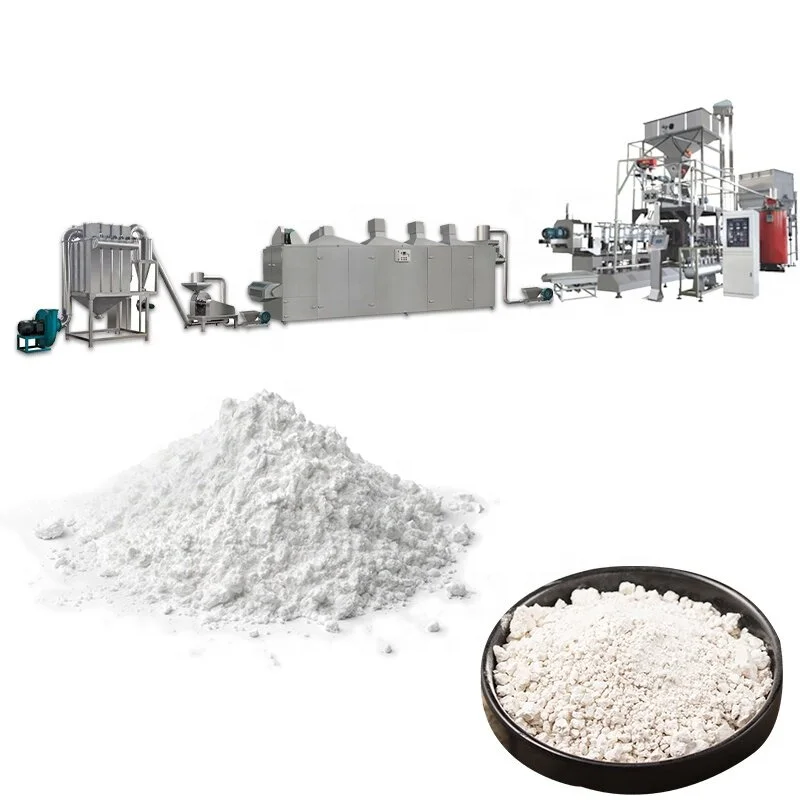


Modified Starch Processing Line, Twin-Screw Extruder, 380V, Food-Grade SS304 — configured for cassava and pregelatinized corn starch from batching through grinding, with throughput-matched stations under single-supplier coordination.
- Twin-screw barrel and screw geometry specified to starch source and target gelatinization degree
- Dryer, conditioning and grinding stations sized to extruder output, preventing line bottlenecks
- Energy options span electricity, gas, diesel and steam to fit local utility conditions
Layout, capacity calculation and on-site commissioning delivered as one turnkey project with trial runs on buyer raw material before shipment.
Description
Integrated Line Throughput Matching — Every station from the batching mixer through the twin-screw extruder to the dryer and grinder is sized to run as one continuous system, preventing the bottlenecks that occur when equipment is sourced from separate vendors.
Technical Specifications
| Parameter | Value |
|---|---|
| Product Type | Modified Starch Processing Line |
| Extruder Type | Twin-screw extruder |
| Capacity Range | 80-500 kg/h (basis not stated in source — confirm raw material type / moisture content / product specification) |
| Raw Materials | Wheat flour, corn starch, potato starch, cassava starch |
| Frame Material | Stainless steel 201 |
| Contact Material | Food grade stainless steel 304 |
| Energy Options | Electricity, gas, diesel, steam |
| Motor Brand | Siemens (China-made) or China top brand |
| Inverter | Delixi or Delta |
| Mixer Motor | 4.0 kW |
| Mixer Output | 3.0-4.0 kg/batch (basis not stated in source — confirm batch cycle time) |
| Mixer Dimensions | 1.2 × 0.9 × 1.4 m |
| Screw Conveyor Motor | 1.1 kW |
| Screw Conveyor Output | 0-150 kg/h (basis not stated in source — confirm material density and moisture) |
| Screw Conveyor Dimensions | 2.5 × 0.6 × 2.3 m |
| Barrel Material | 45 steel |
| Process Flow | Mixer → Screw Conveyor → Twin Screw Extruder → Shifter → Air Conveyor → Dryer → Air Conveyor → Conditioning → Conveyor → Grinder |
| Voltage | Three phases 380V/50Hz, Single phase 220V/50Hz (customizable to local voltage) |
| Power | ~100 kW (electric heating) / 50-60 kW (gas or diesel heating) |
| Standards | CE |
Application Suitability
| Application | Material or Output |
|---|---|
| Cassava-based pregelatinized starch production | Cassava starch with varying amylose content for food and industrial use |
| Corn starch modification and gelatinization | Corn starch processed for paper industry and food additive applications |
| Wheat flour pre-gelatinization | Wheat flour modified for bakery pre-mixes and instant food products |
| Potato starch denaturation | Potato starch adjusted for increased viscosity and gelling properties |
Why the Raw Material Test Must Precede the Line Layout
A modified starch processing line turnkey layout built on assumed starch properties will fail at commissioning.
I learned this the hard way not long ago. A customer in Southeast Asia needed a pregelatinized cassava starch line. The trial runs in our workshop using our standard cassava formulation ran smoothly — steady throughput, proper gelatinization, target viscosity achieved. Then the customer shipped their actual raw material from their local source. The amylose content was noticeably lower than what we had tested with. Viscosity would not climb to specification no matter how we adjusted barrel temperatures. We had to tear down the screw configuration, rework the compression ratios, and spend another two weeks running trials before the output met their market requirements [NEED_CITE: starch gelatinization behavior relative to amylose-to-amylopectin ratio]. That experience changed how I approach every starch line project: no layout gets finalized until the buyer’s own raw material has been extruded, dried, and ground on the shop floor.
Screw Configuration Dictates Your Starch Modification Outcome
The degree of starch gelatinization and molecular modification is controlled directly by the screw element arrangement inside the barrel. Conveying elements, kneading blocks, and reverse screws each impose a different level of shear and residence time on the starch slurry. A configuration designed for corn starch will not produce the same modification result when fed cassava starch with a different granule size and gelatinization temperature. On this modified starch processing line turnkey project, the screw profile is specified only after we identify the buyer’s exact starch source and the target viscosity, molecular weight, and stability parameters the end market demands.
Matching Dryer and Grinder Capacity to the Extruder Output
An extruder running at full output means nothing if the downstream dryer cannot remove moisture fast enough, or if the grinder becomes a choke point producing inconsistent particle size. Each station on the line is calculated against the others so material flows continuously without accumulation or starvation. The shift conveyor, air conveying systems, and conditioning stage all carry the same throughput rating as the extruder discharge. This matching is where a coordinated modified starch processing line turnkey project separates itself from assembling individual machines that technically work but cannot sustain the rated output together [NEED_CITE: throughput bottleneck analysis in continuous food processing lines].
Reading the Specification Sheet for Production Reality
The twin-screw design allows the barrel to be segmented, meaning screw elements can be rearranged without replacing the entire shaft — a practical advantage when you need to fine-tune gelatinization degree after initial commissioning. The barrel material is 45 steel, which provides the mechanical strength to handle the internal pressures of starch extrusion, while food-grade stainless steel 304 on all contact surfaces meets hygiene requirements for food and pharmaceutical starch applications. The energy options span electricity, gas, diesel, and steam, which matters because starch drying is the most energy-intensive stage and the cost difference between electric and steam heating can be substantial depending on local utility rates. The mixer at 4.0 kW with a batch output of 3.0-4.0 kg per cycle feeds the screw conveyor, which meters material into the extruder at a controlled rate to maintain consistent moisture and feed density — variations here directly affect the gelatinization uniformity of the final starch powder.
The Hidden Cost of Skipping the Pre-Shipment Trial
When a starch extrusion line ships without a documented trial run on the buyer’s actual raw material, the real product development starts on the factory floor during commissioning. Screw combinations get swapped, dryer temperatures get adjusted, and grinder screen sizes get changed — all while the line is supposed to be entering production. This extends commissioning from a few days into several weeks, and the buyer absorbs the cost of idle operators, delayed first shipments, and raw material consumed during trial-and-error adjustments [NEED_CITE: industrial equipment commissioning delays and cost overruns]. I have seen this pattern enough times to know that two weeks of pre-shipment testing in our workshop saves far more time and expense than discovering viscosity problems after the machines are bolted to your floor.
Why Source This Line from One Supplier
The entire modified starch processing line turnkey project runs under one supplier, meaning the mixer, extruder, dryer, conditioner, and grinder are engineered as a single system rather than patched together from different manufacturers. Screw and die configurations are specified to the buyer’s starch source — we do not ship a generic screw profile and hope it works on arrival. Our in-house testing workshop runs the buyer’s actual raw material before the line leaves the factory, producing a documented trial report. Electrical schematics confirm voltage and frequency for the destination country before production starts, so there are no rewiring surprises during installation. Pre-sales consultation through on-site installation, commissioning, operator training, and ongoing maintenance are handled by the same engineering team that designed the line.
Documentation & Verification
- Line layout drawing with station-by-station throughput calculation for your starch type
- Screw and die configuration record matched to your raw material sample
- Electrical schematic confirming voltage, frequency, and control language for your facility
- Trial run report on your cassava or corn starch conducted in our testing workshop before dispatch
- CE declaration of conformity covering the complete extrusion and drying line
- Operation and maintenance manual with wear parts list and replacement schedule
Installation, Commissioning & Support
- Foundation and floor space plan provided based on the complete line station footprint and utility connections
- Dedicated power circuit layout accounting for the ~100 kW electric heating or 50-60 kW gas/diesel configuration
- Machines ship in assembly-ready state with numbered components matching the installation drawing sequence
- On-site commissioning includes screw configuration fine-tuning against your local starch batch
- Operator training covers barrel temperature profiling, moisture adjustment, and grinder screen selection
- Wear parts inventory including screws, dies, and dryer belts supplied with the initial shipment
What to Prepare Before Requesting a Quotation
To size this modified starch processing line turnkey project correctly, we need your specific starch source — cassava, corn, wheat, or potato — along with the amylose content or specification sheet from your raw material supplier. Share your target product specification including required viscosity, gelatinization degree, and final particle size. Your local voltage, frequency, and available energy sources determine the heating and motor configuration, and knowing your workshop dimensions and ceiling height lets us plan the dryer and air conveyor routing before the line goes into production.
Frequently Asked Questions
Q: How is line capacity verified against my specific starch raw material and target product specification?
A: We run your actual raw material through the twin-screw extruder and downstream stations in our testing workshop before the line ships. The trial run produces output samples that are tested for gelatinization degree, viscosity, and particle size against your target specification. The documented results confirm whether the screw configuration and dryer settings meet your requirements, and any adjustments are made before dispatch rather than during on-site commissioning.
Q: How are dryer, conditioning, and grinding stations sized to match extruder output without bottlenecking?
A: Each station is calculated against the extruder discharge rate for your specific starch type and moisture profile. The dryer residence time is set so the starch reaches target moisture before the grinder, and the grinder screen area is matched to the conditioned starch flow rate. This throughput matching is documented in the line layout drawing so you can verify that no single station limits the overall output.
Q: What utility planning is required for the complete modified starch processing line turnkey project?
A: The line requires confirmed voltage and frequency for all motors and controls, plus a decision on heating energy — electricity at approximately 100 kW, or gas, diesel, or steam at approximately 50-60 kW. Compressed air is needed for pneumatic conveying, and steam may be required for the conditioning stage depending on your starch modification target. We provide a complete utility connection plan with the line layout so your facility team can prepare all services before equipment arrival.
Q: Is a trial run on my raw material performed before shipment, and what does the report cover?
A: Yes. Your raw material is processed through the configured extruder, dryer, and grinder in our testing workshop. The trial run report documents the screw configuration used, barrel temperature profile at each zone, moisture content before and after drying, and the viscosity, gelatinization degree, and particle size of the finished starch. This report travels with the shipment and serves as the baseline for on-site commissioning.
Q: What is the phased installation and commissioning schedule for a complete turnkey starch line?
A: Installation follows a sequenced plan starting with the mixer and conveyor stations, then the extruder, and finally the dryer, conditioning, and grinding sections. Each phase includes utility connection verification before the next station is positioned. Commissioning begins with single-station testing, progresses to integrated line runs, and concludes with continuous production trials using your raw material. The full schedule is provided during the quotation stage so you can plan operator availability and raw material stock accordingly.
Related products
-
Big Capacity Modified Starch Production Line Making Machine
¥30.00 Select options This product has multiple variants. The options may be chosen on the product page -
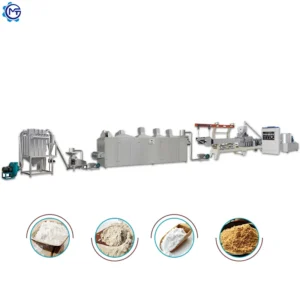
Twin-Screw Extrusion Line for Modified Starch. Producing Pregelatinized Adhesive & Food Grade Powder
¥65.00 Select options This product has multiple variants. The options may be chosen on the product page -
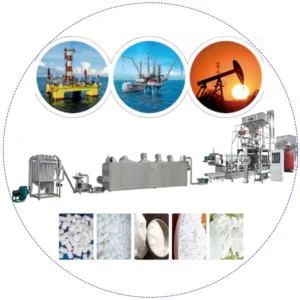
Cassava & Pregelatinized Corn Starch Extrusion Equipment – CE Certified Industrial Twin-Screw Modified Starch Line
¥65.00 Select options This product has multiple variants. The options may be chosen on the product page -
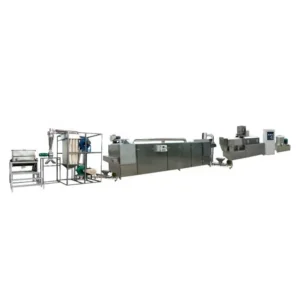
Automatic Modified Corn Starch Making Machine 304 Stainless Steel Gearbox High Efficiency Starch Processing Production Line
¥30.00 Select options This product has multiple variants. The options may be chosen on the product page