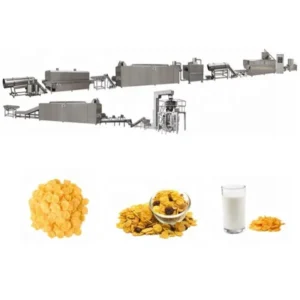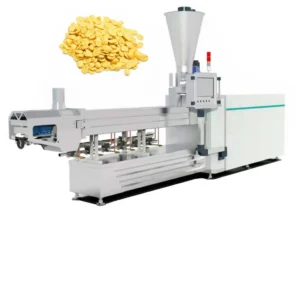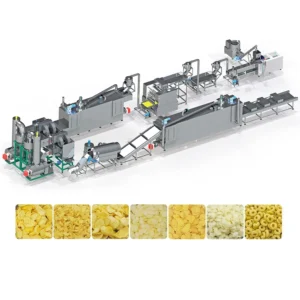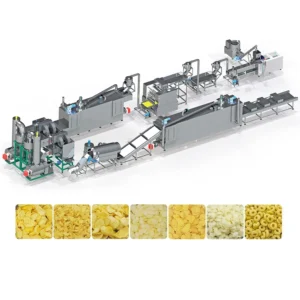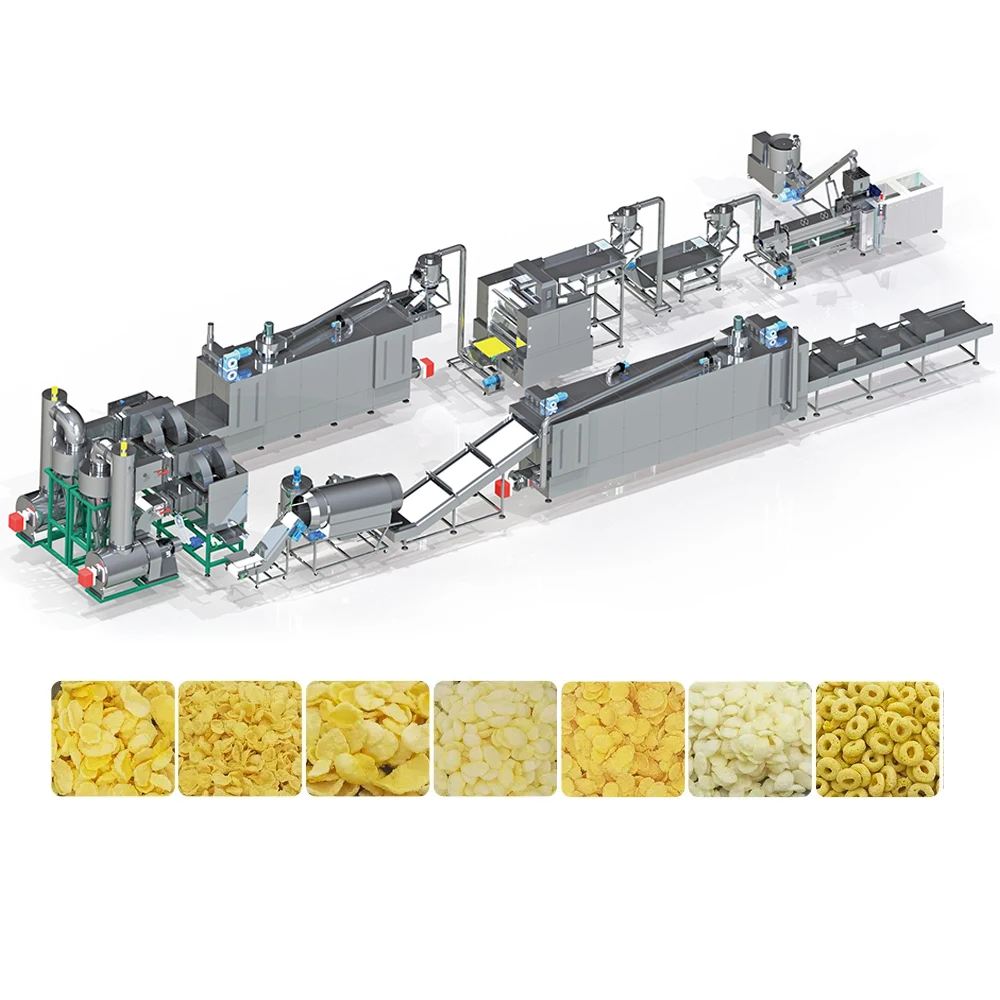
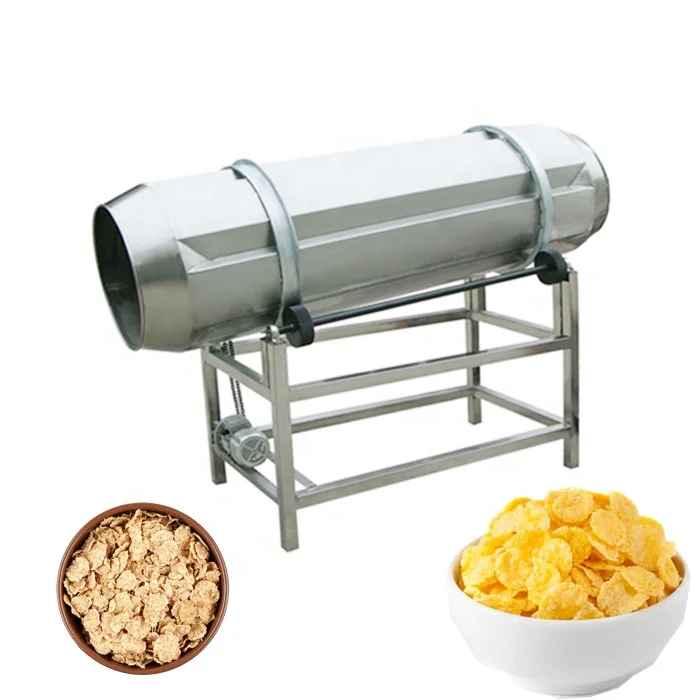
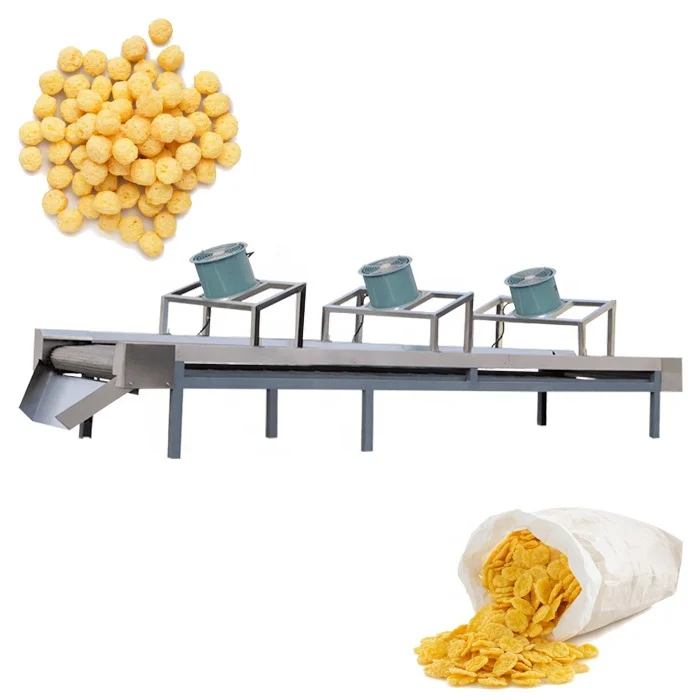
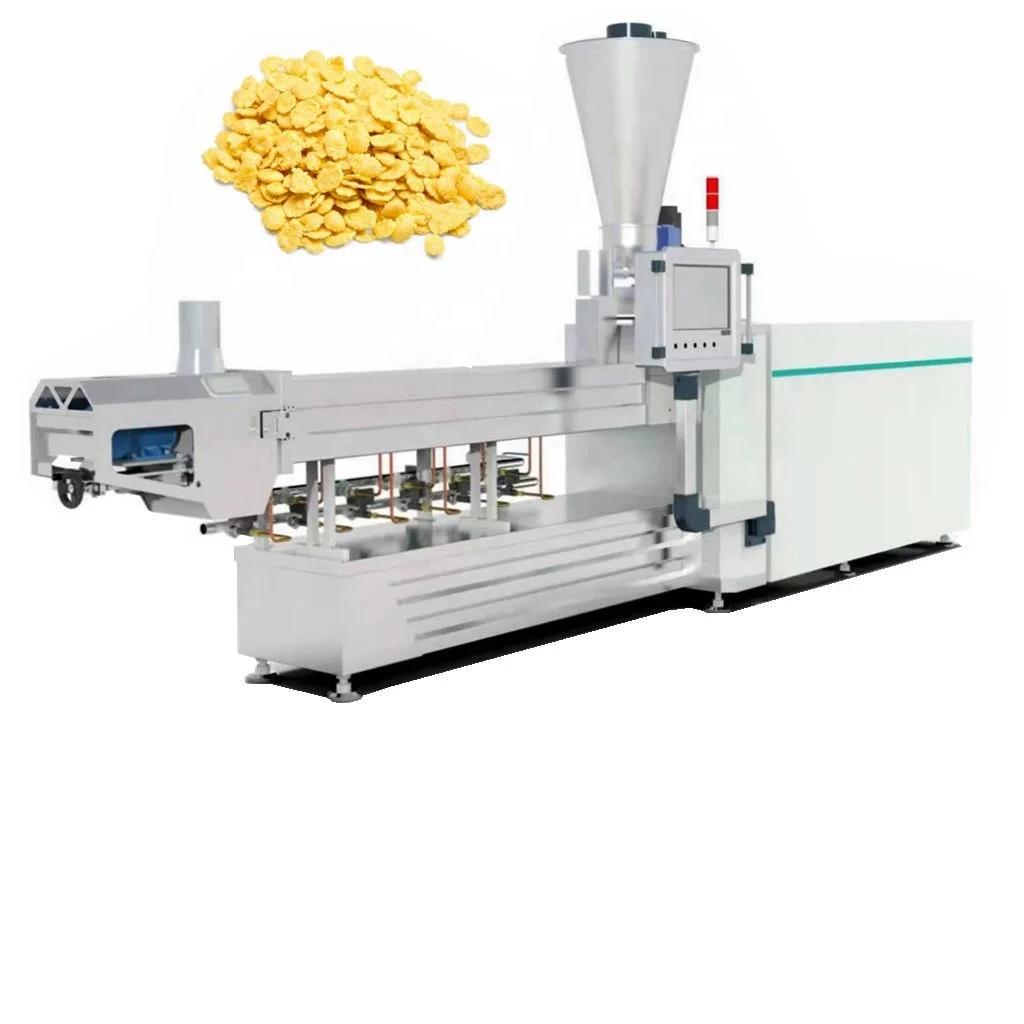
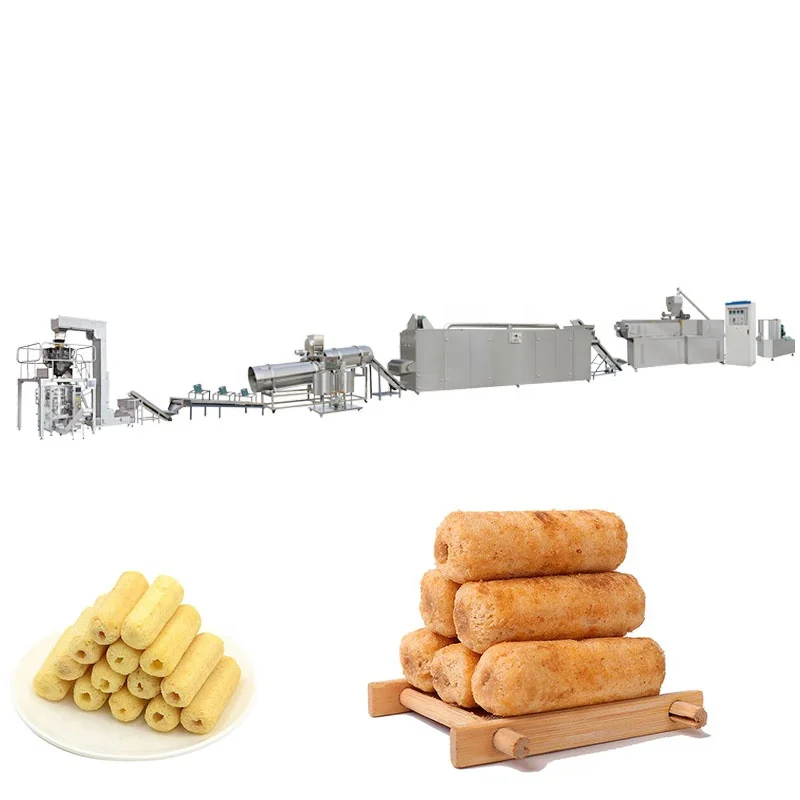
MT70 Corn Flake Production Line, Twin-Screw Extruder, PLC & MCC Control — configured as a turnkey project from batching through extrusion, flaking, hot air roasting and coating to packing.
- Screw configuration and die design matched to your raw material for consistent gelatinisation, flake density and surface blistering
- Hydraulic double-roller flaking station with infrared temperature monitoring ensures uniform thickness across every batch
Layout, throughput matching and pre-shipment trial runs on your actual raw material are documented before dispatch.
Description
Complete throughput-matched line — we configure every station from mixer to packer so your corn flake output holds steady on your actual recipe, not just on paper.
Technical Specifications
| Parameter | Value |
|---|---|
| Model | MT70 / MT85 / MT75 |
| Product Type | Breakfast Cereal Corn Flake Production Line |
| Extruder Type | Twin Screw (MT-75 unit) |
| Installed Power | 160 kW (MT70) / 190 kW (MT85) / 210 kW (MT75) |
| Power Consumption | 120 kW (MT70) / 140 kW (MT85) / 150 kW (MT75) |
| Capacity | 150–200 kg/h (MT70) / 300–400 kg/h (MT85) / 300–500 kg/h (MT75) (basis to be confirmed) |
| Overall Dimensions | 41 × 1.5 × 2.2 m (MT70) / 43 × 1.5 × 3.2 m (MT85) / 45 × 1.5 × 3.5 m (MT75) |
| Flaking Station | Hydraulic double-roller, dual-motor drive, infrared temperature monitoring |
| Roasting Oven | Hot air with vibrating pan, dual circulating fans, cyclone dust removal |
| Coating System | Double tumble for sugar melting, elevator, coating drum, spraying nozzle |
| Control System | Available with PLC and MCC control |
| Dryer Heating Source | Gas / Electric |
| Certifications | CE, ISO |
Application Suitability
| Application | Material or Output |
|---|---|
| Natural corn flake production | Corn, rice, wheat, oat, and barley powder or grits |
| Sugar-coated breakfast cereal | Corn or multi-grain base with sugar or honey coating |
| Shaped cereal formats | Fruit loops, rings, stars, wheels, flowers, hearts via extruder die changes |
| Puffed snack cereal | Same extrusion platform with adjusted die and moisture profile |
What "300 kg/h" Really Means When You Run Your Own Recipe
Line capacity only holds when screw configuration, moisture, and downstream throughput are all matched to your material.
I once watched a European plant lose two full shifts because their corn flake line was rated on a generic corn grits recipe while the buyer wanted a high-fiber oat blend. The extruder choked, flake thickness went uneven, and the roasting oven could not keep up. A corn flakes production line turnkey project lives or dies on whether those numbers were proven on your actual flour mix, not a catalog baseline [NEED_CITE: extrusion throughput dependency on raw material composition]. That is why we run trial batches on your recipe before the line leaves the factory.
How Screw Configuration Controls Flake Texture
The twin-screw extruder in this corn flakes production line turnkey system uses a screw configuration and die design specified to your raw material. Changing the screw pitch, compression ratio, or die geometry alters shear and residence time inside the barrel. For natural corn flakes you need a dense, low-expansion pellet that holds together through the flaking rolls. For fruit loops or rings, you adjust the die to allow more expansion. Getting this wrong at the extruder stage cascades into uneven flake thickness and inconsistent roasting downstream.
Matching Throughput Across Every Station
A common failure point in cereal lines is a bottleneck hiding between stations. The extruder may push material faster than the flaking rollers can flatten it, or the roasting oven may not have enough pan area to handle peak output. In this line, the hydraulic double-roller flaking station with dual-motor drive and the hot air roasting oven with dual circulating fans are each sized to the extruder output. We calculate throughput at every transfer point — from mixer to extruder, extruder to flaker, flaker to dryer, dryer to roaster, roaster to coating drum — so no single station constrains the rest [NEED_CITE: throughput balancing methodology in food extrusion lines].
Reading the Specs That Actually Matter
The installed power range across the MT70, MT85, and MT75 models tells you the thermal and mechanical headroom available for different production scales. Power consumption figures — 120 kW, 140 kW, and 150 kW respectively — reflect real draw under load, which is what you need to size your electrical supply and dedicated circuits. The infrared temperature monitoring on the flaking station matters because corn dough must stay within a narrow thermal window; too cool and it cracks under the rollers, too warm and it smears. The cyclone dust removal on the roasting oven keeps fine particulate from settling back onto the flakes, which directly affects surface quality and shelf appearance.
The Hidden Cost of Skipping Utility Verification
Overspecifying or underspecifying utility connections causes delays that no amount of engineering can fix on site. I once shipped a dryer configured for standard steam pressure to a facility where the boiler output ran lower than expected. The heat-up time stretched, the line rhythm broke, and we had to swap in a different heat exchanger after installation. Before we build your corn flakes production line turnkey system, we confirm your site voltage, frequency, steam pressure, gas supply, and control language. Missing any one of these can stall commissioning for days [NEED_CITE: industrial utility specification standards for food processing equipment].
Why Procurement Starts Here
We design the full line from batching to packing under one supplier, which means throughput calculations are not passed between separate vendors. Every screw and die configuration is documented for your specific recipe, so repeat orders and wear part replacements match the original setup. Our in-house testing workshop runs your raw material through the extruder before shipment, producing a trial run report you can review. Pre-sales consultation covers your factory layout and utility conditions, and our on-site team handles installation and commissioning. This is how a corn flakes production line turnkey project avoids the gaps that appear when equipment is sourced piecemeal.
Documentation & Verification
- Line layout and capacity calculation showing throughput at each station transfer point
- Screw and die configuration record retained for your specific raw material and product format
- Trial run report on your actual corn, oat, or multi-grain recipe before dispatch
- Electrical schematic with confirmed voltage, frequency, and control language
- Factory test record covering all stations from mixer through packing
Installation, Commissioning & Support
- Floor plan layout customized to your factory dimensions, with station spacing for the 41–45 m line length
- Electrical supply sized to 120–150 kW running draw with dedicated circuit breakers per station
- Twin-screw extruder barrel alignment and screw clearance verified during on-site assembly
- PLC and MCC control interface configured to your operator language before power-on
- Flaking roller gap and infrared sensor calibration set during first production run
- Wear parts list including screw segments, die plates, and roller covers supplied at commissioning
Before You Request a Quote
To configure this line properly, we need to know your target product format — natural flake, sugar-coated, or shaped cereal — along with your base flour or grits composition. Share your factory floor dimensions, ceiling height, and available utility specifications including voltage and frequency. Let us know your planned daily output so we can match the right model and confirm throughput across every station.
Frequently Asked Questions
Q: How is line capacity verified on my specific raw material and recipe?
A: We run a trial batch using your actual corn, oat, or multi-grain recipe in our testing workshop before shipment. The extruder screw configuration and die design are adjusted to match your material behavior. You receive a full trial run report documenting throughput, product texture, and flake consistency based on your input.
Q: How do you match throughput between the extruder, flaking rolls, and roasting oven?
A: Each station is calculated against the extruder output so no bottleneck forms. The hydraulic flaking station, dryer, hot air roasting oven with dual fans, and coating drum are all sized to handle peak material flow. We document these calculations in the line layout provided before production begins.
Q: What voltage, frequency, and control language options are confirmed before production?
A: We verify your site electrical supply — voltage and frequency — along with your preferred PLC interface language before the line enters production. The electrical schematic is reviewed and approved by your team. This prevents commissioning delays caused by mismatched power supply or unreadable control screens.
Q: Can the same line produce both natural corn flakes and sugar-coated flakes?
A: Yes. The coating system includes a double tumble for sugar melting, a spraying nozzle, and a coating drum integrated into the line. To switch from natural to coated production, the coating station is activated and the sugar slurry recipe is loaded into the PLC. Extruder die changes are only needed if you also change the cereal shape.
Q: What does the pre-shipment trial run cover and do I receive a test report?
A: The trial run processes your raw material through the extruder and key downstream stations. We document output rate, product density, flake thickness consistency, and any screw or die adjustments made. The complete test report ships with your line so your team has a baseline reference from day one of installation.
Related products
-

Small Scale Breakfast Cereal Manufacturing Machine for Corn Flakes Process Line
¥45,000.00 Select options This product has multiple variants. The options may be chosen on the product page -
1000 Lbs Automatic Corn Flakes Production Line Mixer Breakfast Cereal Corn Flakes Production Line
¥45,000.00 Select options This product has multiple variants. The options may be chosen on the product page -
Intelligent Corn Flakes Production Line Twin Screw Extruder to Make Corn Flakes amd Morning Cereals
¥30.00 Select options This product has multiple variants. The options may be chosen on the product page -

Corn Flakes Production Line Breakfast Cereal Production Machine Line Corn Flake Making Machinery
¥59,800.00 Select options This product has multiple variants. The options may be chosen on the product page