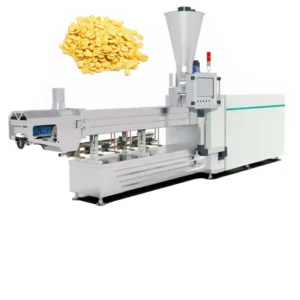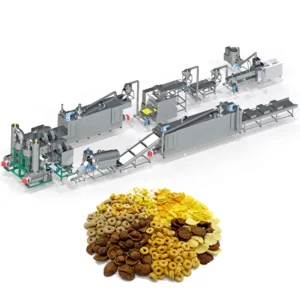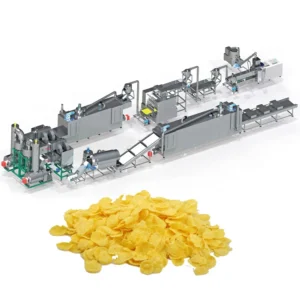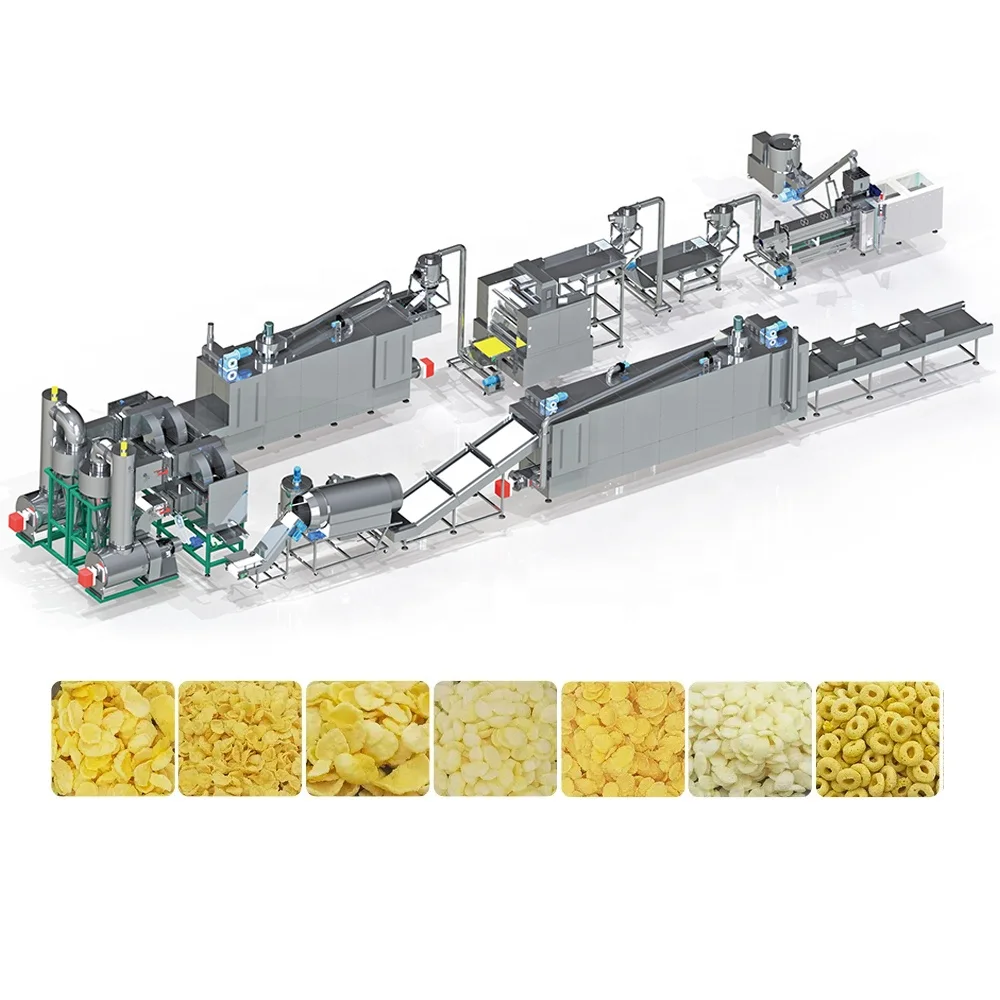


MT-75 Twin-Screw Breakfast Cereal & Corn Flakes Extrusion Line, PLC Control, Gas-Fired Oven — engineered as a complete turnkey project where extruder, flaking press, dryer and coating stations are throughput-matched to eliminate bottlenecks. Sectional co-rotating screw modules deliver precise gelatinisation and forming control across corn flour, rice flour and oat formulations, while the adjustable roller gap press ensures consistent flake thickness. Backed by in-house trial runs on your grain formulation before shipment, single-supplier layout design, and phased commissioning support.
- CE certified for international cereal production markets
- Interchangeable dies for flakes, hoops, rings and ball formats
- Voltage and control language confirmed to your installation site
Description
Turnkey Throughput Matching — Every station on the MT-75 breakfast cereal corn flakes production line turnkey is balanced to your raw material so extruder output never outpaces the flaking press or dryer.
Technical Specifications
| Parameter | Value |
|---|---|
| Product Type | Twin-Screw Breakfast Cereal & Corn Flakes Extrusion Line |
| Model | MT-75 |
| Screw Type | Co-rotating twin-screw with sectional modules |
| Extruder Functions | Forward/backward transport, mixing, de-gassing, cooking, forming |
| Mixer Tank Size | φ600 × 500 mm |
| Mixer Output | 10–30 kg/load |
| Mixer Power | 4 kW |
| Screw Conveyor Power | 0.75 kW |
| Corn Flakes Press Power | 16.12 kW |
| Corn Flakes Press Roller Features | Big roller, integrated cooling system, adjustable gap for flake thickness |
| High-Temperature Oven Heating | Gas-fired, dual-side baking |
| High-Temperature Oven Size | 4.5 × 1.4 × 1.8 m |
| Sugar Spraying System Roller Size | Ø600 × 2700 mm |
| Sugar Spraying System Total Power | 28.75 kW |
| Control System | PLC and MCC (configuration to be confirmed with buyer) |
| Voltage & Frequency | Customizable (e.g., 3ph 380V 50Hz, 3ph 415V 60Hz, 3ph 220V 60Hz) |
| Contact Material | Stainless steel on all food-contact parts |
| Certification | CE |
Application Suitability
| Application | Material or Output |
|---|---|
| Corn flakes production | Corn flour, maize grits with moisture conditioning |
| Chocolate hoop / ring cereal | Rice flour, oat flour, wheat flour, nutritional additives |
| Coated crunchy grain snacks | Grain powder blends with sugar syrup or honey post-coating |
| Fortified breakfast cereals | Vitamin-enriched grain formulations with controlled density |
What "Rated Capacity" Ignores When Extruding Corn Flakes
Nominal output means nothing if your grain blend gelatinises differently than the test flour.
A breakfast cereal corn flakes production line turnkey quoted at a fixed hourly output often fails to maintain that rate once the buyer’s actual corn flour, oat blend, or vitamin-fortified mix enters the barrel. The screw configuration that works on one supplier’s reference material may stall, surge, or produce inconsistent flake density on a formulation with different moisture content and starch composition. That mismatch is what causes the conveyor pile-ups I witnessed last year on a Middle East Choco Hoop project — the extruder was pushing product faster than the flaking press could flatten it and the dryer could cure it [NEED_CITE: common causes of throughput mismatch in cereal extrusion lines]. The result is a line that technically runs but never reaches the output the buyer planned their shift schedule around.
How the MT-75 Extruder Handles Variable Grain Formulations
The MT-75 uses sectional co-rotating twin-screw modules that can be rearranged to adjust shear intensity and residence time inside the barrel. When processing high-protein oat flour versus standard corn grits, the screw pitch and kneading block positions are changed to control the degree of starch gelatinisation before the dough reaches the die. This flexibility matters because a breakfast cereal corn flakes production line turnkey must handle formulation changes — a producer may run plain corn flakes on Monday and vitamin-enriched wheat rings on Wednesday, each requiring different barrel temperature profiles and moisture targets to achieve the correct expansion and density.
Matching Extruder Output to Downstream Flaking and Drying
The bottleneck on any cereal line rarely sits at the extruder. It is usually the flaking press or the high-temperature oven that limits real throughput. The MT-75 line addresses this by sizing the corn flakes press with a large-diameter roller and integrated cooling circuit so the dough sheet does not stick or tear at higher feed rates. The gas-fired oven spans 4.5 metres with dual-side baking to ensure the flake bed dries evenly rather than scorching on top while staying soft underneath. When the sugar spraying system applies syrup at the Ø600 coating roller, the downstream drying and cooling conveyor must absorb the added moisture load without slowing the line — a balance that is calculated during layout design, not discovered during commissioning [NEED_CITE: importance of station throughput matching in turnkey food lines].
Reading the Specs That Actually Matter
The co-rotating twin-screw design with sectional modules is the central specification for a food extrusion engineer to evaluate. Sectional modules allow the screw profile to be rebuilt in the workshop without replacing the entire shaft, which matters when a producer switches from a low-fat corn recipe to a high-fibre bran blend that demands more aggressive mixing zones. The 16.12 kW flaking press motor drives rollers with an adjustable gap — this gap directly sets flake thickness, which in turn controls how the flake behaves in milk, a property cereal buyers specify tightly. The gas-fired oven with dual-side heating is specified rather than electric because thermal mass and recovery rate on a continuous flake bed demand the rapid heat input that gas burners provide. The 28.75 kW sugar spraying system covers the coating roller, syrup pumps, and heating elements together; undersizing this station causes uneven glazing and rejected batches.
What Happens When the Flaking Press Is Undersized
An extruder that delivers product faster than the flaking press can flatten it creates a backlog on the elevator between the two stations. The dough cools unevenly while waiting, producing flakes with inconsistent thickness and surface cracks that shatter during the oven pass. The producer then slows the extruder to match the press, running the entire breakfast cereal corn flakes production line turnkey below the output they paid for. I have seen this happen when a line was assembled from separate vendors who each quoted their own machine’s nominal capacity without calculating the material flow between stations [NEED_CITE: risks of multi-vendor line assembly in food extrusion].
Why Buyers Source This Line from One Supplier
Layout design starts with your target output and grain formulation, not a standard template pulled from a catalogue. The screw configuration record is written against your specific flour blend and target flake thickness before the machines are built. An in-house testing workshop runs your raw material through the extruder and flaking press together, generating a trial report that documents actual output and product quality before shipment. Electrical schematics confirm voltage, frequency, and control language match the installation site so the line powers up without rewiring delays. The station sequence — from flour mixer through screw elevator, extruder, dryer, coating, and cooling conveyor — is engineered as one continuous project rather than stitched from independent quotations.
Documentation & Verification
- Line layout drawing with throughput calculation matched to your grain formulation and target flake output
- Trial run report from the testing workshop on your raw material documenting actual extrusion and flaking results
- Screw and die configuration record specifying module arrangement for your cereal format
- Electrical schematic confirming voltage, frequency, and PLC language for the installation country
- Factory test record with packing photographs before container loading
- CE declaration of conformity for the complete line assembly
Installation, Commissioning & Support
- Foundation plan specifies floor loading for the 4.5-metre oven and flaking press anchoring points
- Dedicated power circuit sized for the combined extruder, 16.12 kW press, and 28.75 kW coating system
- Machines ship in modular assemblies for staged positioning inside existing factory buildings
- Commissioning includes screw profile fine-tuning and oven temperature zoning for your recipe
- Operator training covers die changeover for switching between flakes, hoops, and ring formats
- Wear parts list covers screws, die plates, and press roller bearings with replacement intervals
What to Include with Your Inquiry
Send your grain formulation sheet with moisture content, the cereal formats you plan to produce, and your target daily output so the line layout can be calculated against real material behaviour rather than generic assumptions. Include your factory’s available voltage and frequency, the control language your operators read, and the dimensions of the production hall so the 4.5-metre oven and 4-metre coating system fit the space without repositioning existing equipment.
Frequently Asked Questions
Q: How is line capacity verified against my specific grain raw material and moisture content?
A: Your flour or grit blend is run through the MT-75 extruder and flaking press in the testing workshop before shipment. The trial documents actual throughput, flake thickness, and oven drying behaviour on your material so the breakfast cereal corn flakes production line turnkey is validated against your recipe, not a generic reference flour.
Q: What is the phased installation and commissioning schedule for a complete turnkey cereal line?
A: Equipment arrives in modular sections. The oven and extruder are positioned first, followed by conveyors and the coating system. Electrical connections and PLC configuration are completed before the first grain run. Commissioning includes screw profile adjustment and temperature zone calibration across the full station sequence.
Q: How do you match extruder output with the flaking press and dryer to prevent bottlenecks?
A: Each station’s throughput is calculated from your target output and grain formulation during layout design. The flaking press roller diameter and the 4.5-metre oven length are selected so they absorb the extruder’s delivery rate without product backlog, verified again during the workshop trial run.
Q: Can the line produce multiple cereal formats with quick changeover?
A: The twin-screw extruder accepts interchangeable dies for flakes, hoops, rings, and ball shapes. The flaking press is bypassed for ring and ball formats, and the coating system applies sugar syrup or honey regardless of format. Die swaps take place on the extruder face plate without dismantling the barrel.
Related products
-
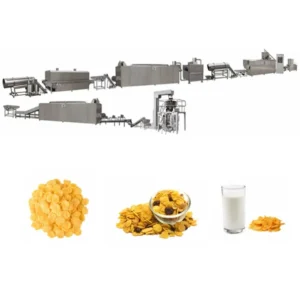
Cereals Corn Flakes with Sugar Corn Flakes Extrusion Food Machine Breakfast Cereal Production Line
¥23,000.00 Select options This product has multiple variants. The options may be chosen on the product page -
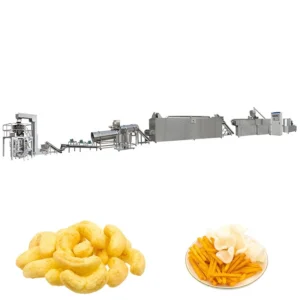
Corn Flake Making Machine Corn Puffs Making Machine Snack Food Production Line
Price range: ¥500.00 through ¥1,200.00 Select options This product has multiple variants. The options may be chosen on the product page -
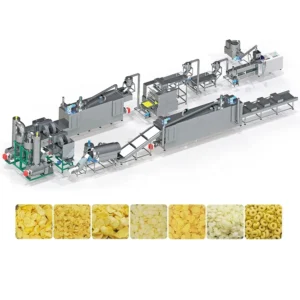
Whole Grain Choco Hoop Crunchy Wheat Cereal Ring Fruit Loops Snacks Extruder Machine /breakfast Cereals Corn Flakes Production
¥48,000.00 Select options This product has multiple variants. The options may be chosen on the product page -
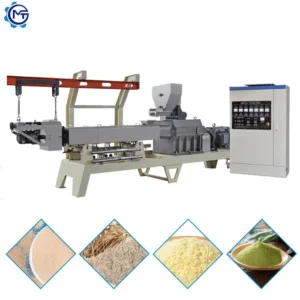
New Technical Automatic Cereal Nutritional Powder Instant Porridge Baby Food Making Machine
¥10,000.00 Select options This product has multiple variants. The options may be chosen on the product page