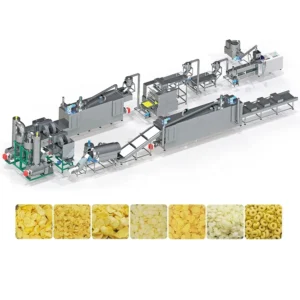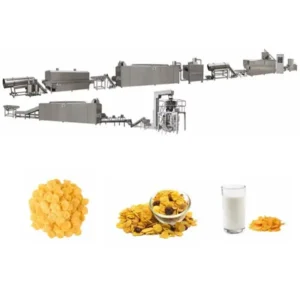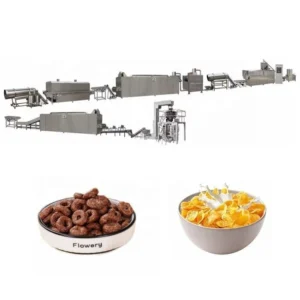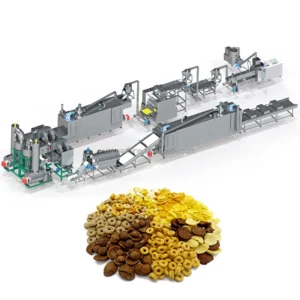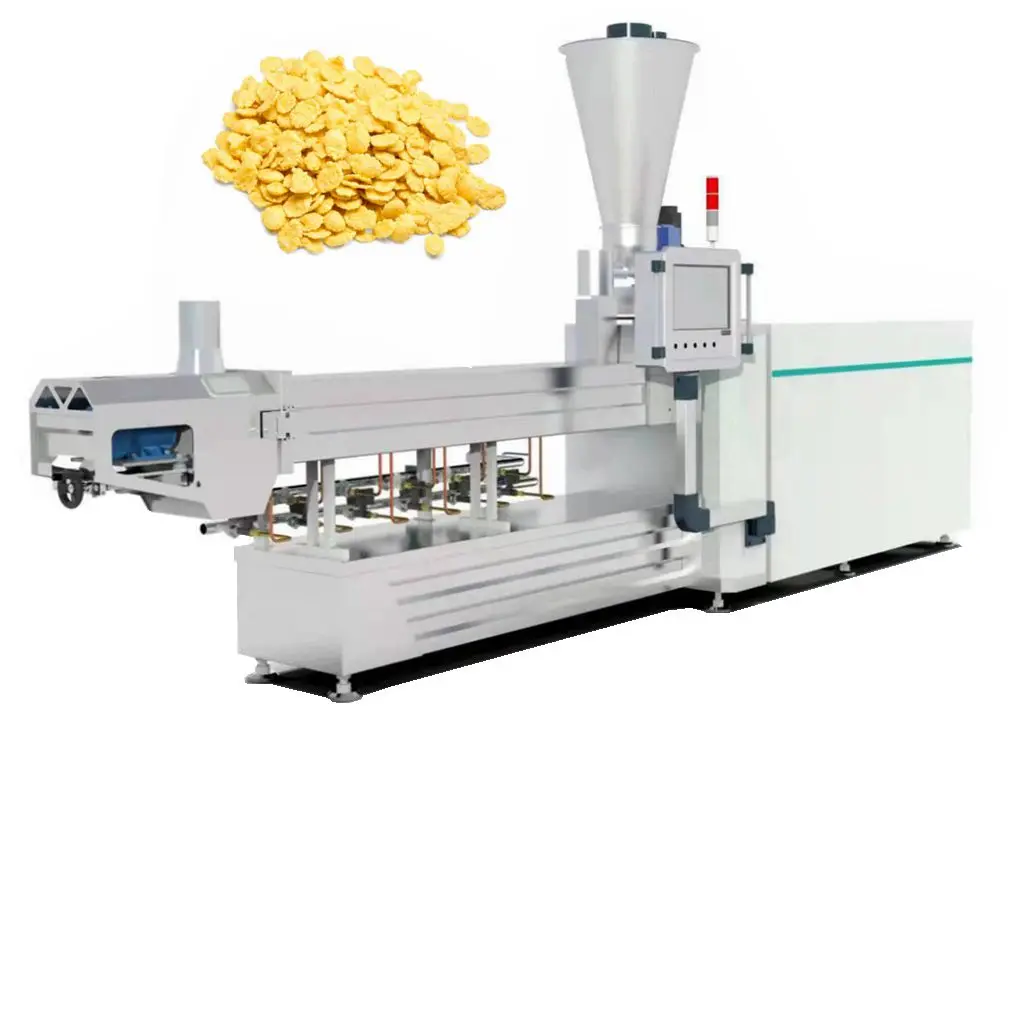


MT-65, MT-70, MT-85, MT-75 Corn Flakes Breakfast Cereal Production Line, Twin-Screw Extruder, PLC Centralized Control — throughput-matched from batching through extrusion, flaking, roasting, coating and packing under one responsible supplier.
- Screw configuration and die design specified to your cereal formulation and target flake density
- Flaking machine with adjustable roller gap and water-cooled cast iron rollers for consistent thickness
- Hot air roaster up to 400°C with high-pressure blower; multi-layer dryer with adjustable belt speed
- Pre-shipment trial runs on your actual raw material verify real output before the line leaves our workshop
Line layout, capacity calculation, and trial run report delivered with every project for single-source accountability from design through commissioning.
Description
Throughput-Matched Stations — every section from batching to packing is calculated against your specific cereal formulation to prevent bottlenecks before the line ships.
Technical Specifications
| Parameter | Value |
|---|---|
| Product Type | Corn Flakes Breakfast Cereal Production Line |
| Models Available | MT-65, MT-70, MT-85, MT-75 |
| Screw Type | Twin-screw extruder |
| Output Capacity (MT-65) | 120-150 kg/h (basis not stated in source — confirm raw material and moisture content) |
| Output Capacity (MT-70) | 200-250 kg/h (basis not stated in source — confirm raw material and moisture content) |
| Output Capacity (MT-85) | 300-400 kg/h (basis not stated in source — confirm raw material and moisture content) |
| Output Capacity (MT-75) | 400-500 kg/h (basis not stated in source — confirm raw material and moisture content) |
| Installed Power (MT-65) | 84 kW |
| Installed Power (MT-70) | 132 kW |
| Installed Power (MT-85) | 239 kW |
| Installed Power (MT-75) | 186 kW |
| Real Power (MT-65) | 59 kW |
| Real Power (MT-70) | 92 kW |
| Real Power (MT-85) | 167 kW |
| Real Power (MT-75) | 140 kW |
| Overall Dimensions (MT-65) | 21000×1200×2200 mm |
| Overall Dimensions (MT-70) | 23000×1500×2200 mm |
| Overall Dimensions (MT-85) | 28000×3500×4300 mm |
| Overall Dimensions (MT-75) | 24000×1500×2800 mm |
| Control System | PLC with centralized control, real-time data storage, monitoring, and alarm |
| Flaking Machine Roller | Cast iron with water cooling, adjustable gap, shaft 45# steel |
| Hot Air Roaster | Up to 400°C, electric or gas heating, high-pressure blower |
| Dryer Layers | Three / five / seven, adjustable mesh belt speed |
| Sugar Spraying System | Total power 28.75 kW, roller Ø600×2700 mm |
| Packing Machine | Vertical automatic with combination weigher (models 420/520/620/720) |
| Standards | CE (since 2014), ISO certified |
Application Suitability
| Application | Material or Output |
|---|---|
| Traditional corn flakes | Corn grits or corn flour, plain or sugar-coated |
| Cocoa and chocolate flakes | Corn or rice base with cocoa powder blending |
| Honey rings and loops | Wheat, oat, or multi-grain flour formulations |
| Multi-grain breakfast flakes | Barley, millet, rice, and oat blends |
| Crunch corn balls and stars | Corn and rice grits for puffed cereal shapes |
| Fortified cereal production | Vitamin and mineral premix blended into grain base |
What "Rated Capacity" Leaves Out About Your Corn Flakes Line
A quoted output figure means nothing if your flaker cannot keep up with the extruder feeding it.
I once watched a line stall because the extruder pushed material faster than the downstream flaking rolls could accept. Corn grits piled up on the conveyor, cooled into a sticky mass, and the operator had to scrape the belt clean every twenty minutes. The rated capacity of that corn flakes production line turnkey was never the problem — the mismatch between stations was. That kind of failure does not show up in a spec sheet [NEED_CITE: throughput matching across sequential processing stations in cereal production]. It only reveals itself when real material is running through real equipment.
Station Sequencing and How Material Flows Through the Line
A complete corn flakes production line turnkey follows a deliberate sequence: batching, extrusion, drying, flaking, roasting, coating, cooling, and packing. Each station must accept the output of the previous one without accumulating surplus or starving the next step. The twin-screw extruder cooks and shapes the cereal dough, which then passes through the dryer to reduce surface moisture before the flaking rolls compress it into thin sheets.
The PLC control system ties these stations together with centralized monitoring. Operators can watch real-time throughput data and adjust belt speeds or roller gaps before a backlog develops. This visibility matters most during product changeovers, when switching from a corn-based recipe to an oat or multi-grain formulation changes the material behavior at every stage.
Why Trial Runs on Your Actual Grain Formula Matter
Corn grits from different regions vary in starch composition and moisture absorption [NEED_CITE: starch gelatinization behavior in cereal extrusion by grain origin]. Running a trial on the buyer’s specific raw material before the line ships reveals whether the extruder screw configuration and die design produce the correct pellet density for flaking. If the pellets are too dense, the flakes crack during roasting. If too porous, they absorb sugar coating unevenly.
An in-house testing workshop allows these adjustments to happen before installation. The screw configuration record is then locked to your formulation, and the trial run report ships with the documentation package. This approach prevents the costly scenario where product development only begins after the equipment is bolted to your factory floor.
Reading the Power and Dimension Data Correctly
The MT-85 carries an installed power of 239 kW but draws approximately 167 kW in real operation — the difference reflects motor start-up peaks, heater cycling, and the fact that not every station runs at maximum draw simultaneously. When planning your electrical supply, the real power figure determines your transformer sizing and breaker specification, not the installed total.
Overall dimensions also demand attention. The MT-85 line stretches 28 meters long, 3.5 meters wide, and 4.3 meters high. That height alone rules out low-ceiling workshops and requires overhead clearance for the air conveyor and hoist sections. The smaller MT-65 at 21 meters long fits tighter spaces but handles lower throughput ranges. Choosing between models means weighing your workshop envelope against your target output on your specific formulation — not just comparing brochure numbers.
The Hidden Cost of Ignoring Voltage Confirmation
A motor rated for 380V/50Hz will overheat and trip breakers on a 440V/60Hz supply [NEED_CITE: voltage and frequency standards by export market]. The damage may not appear on the first day — it accumulates as insulation degradation over weeks, eventually burning out the extruder main drive or the dryer circulation fans. Confirming voltage, frequency, and control panel language before production begins is not paperwork. It is the difference between a line that commissions in days and one that sits idle while replacement motors are shipped overseas.
Why Sourcing the Full Line from One Supplier Changes Accountability
Every station in these corn flakes lines — mixer, extruder, dryer, flaker, roaster, sugar sprayer, cooler, and packer — is specified and matched by the same engineering team. When throughput is calculated across all stations together, the extruder output is deliberately set to what the downstream flaker and roaster can process, not to the extruder’s theoretical maximum.
The screw configuration and die design are selected based on your raw material and target flake density rather than copied from a generic template. Pre-shipment trial runs in the testing workshop verify the formulation before the equipment leaves the factory. Electrical schematics are prepared with your destination voltage confirmed. Documentation includes the line layout with capacity calculations, the trial run report, and the wear parts list so your maintenance team knows which screws, dies, and seals to stock from the first day of production.
Documentation & Verification
- Line layout and capacity calculation matched across extruder, flaker, roaster, and dryer stations
- Trial run report on your specific grain formulation conducted before shipment
- Screw and die configuration record tied to your target flake thickness and density
- Electrical schematic with voltage and frequency confirmed for your destination market
- Operation and maintenance manual with wear parts list for screw and roller replacement intervals
- Packing photographs and customs documentation support for overseas freight
Installation, Commissioning & Support
- MT-85 line requires 28-meter length with 4.3-meter ceiling clearance for hoist and air conveyor routing
- Dedicated power circuit sized to real power draw of 167 kW for MT-85, with breaker matched to local voltage
- Phased assembly begins with extruder and dryer, then flaker alignment and sugar spraying drum installation
- First-run commissioning includes screw speed, barrel temperature profile, and roller gap calibration on your material
- Operator training covers PLC alarm response, mesh belt speed adjustment, and roaster temperature ramp-up
- Wear parts stock includes replacement screws, die plates, and flaker roller seals for scheduled maintenance
What to Prepare Before Requesting a Quotation
To size the correct line and match every station, share your grain formulation — whether corn grits, oat flour, or a multi-grain blend — along with target moisture content and desired flake thickness. Provide your workshop dimensions including ceiling height, and confirm local voltage and frequency. If you have existing packing equipment or upstream milling systems, specify the interface requirements so the line layout accounts for those connections.
Frequently Asked Questions
Q: How is the line capacity verified against my specific cereal formulation and moisture content?
A: Before shipment, your raw material is run through the extruder and downstream stations in the testing workshop. The trial verifies whether the screw configuration produces pellets at the correct density for flaking and whether the dryer and roaster can handle the throughput without accumulation. A trial run report documents the results and ships with your equipment.
Q: What layout and throughput matching is done to prevent bottlenecks between stations?
A: Each station — extruder, flaker, roaster, dryer, and sugar sprayer — is sized so its acceptance rate matches the upstream output. The line layout document shows calculated throughput at every transfer point. This prevents the common failure where material piles up on conveyors because one station runs faster than the next can process.
Q: How are voltage, frequency, and control language confirmed before commissioning?
A: Your destination electrical standards are confirmed during the quotation stage. The electrical schematic is prepared to match, and the PLC interface language is set before the control panel is wired. This avoids motor damage and communication delays that occur when equipment arrives rated for the wrong supply.
Q: How is operator training structured for a complete cereal processing line?
A: Training covers the PLC interface, alarm response, roller gap adjustment on the flaker, roaster temperature profiles, and mesh belt speed control in the dryer. Operators learn to read real-time throughput data and make adjustments during product changeovers. Wear parts replacement procedures for screws, dies, and roller seals are included.
Related products
-
Intelligent Corn Flakes Production Line Twin Screw Extruder to Make Corn Flakes amd Morning Cereals
¥30.00 Select options This product has multiple variants. The options may be chosen on the product page -
Cereals Corn Flakes with Sugar Corn Flakes Extrusion Food Machine Breakfast Cereal Production Line
¥23,000.00 Select options This product has multiple variants. The options may be chosen on the product page -

Hot Selling Automatic Corn Flakes Breakfast Cereal Production Line Making Machine
¥20,000.00 Select options This product has multiple variants. The options may be chosen on the product page -
New Automatic Cornflakes Making Machine Oats Snack Food Chips Extruder Processing Line
¥30.00 Select options This product has multiple variants. The options may be chosen on the product page