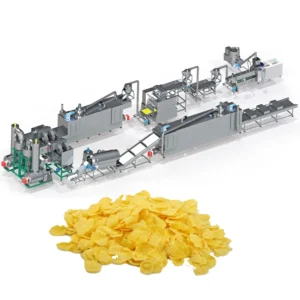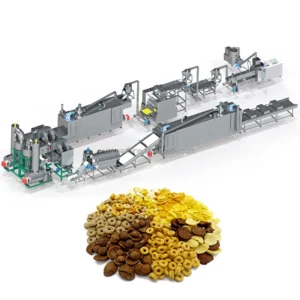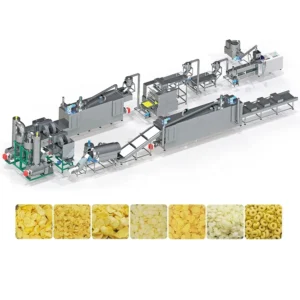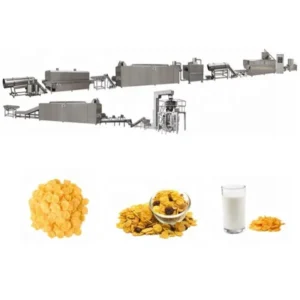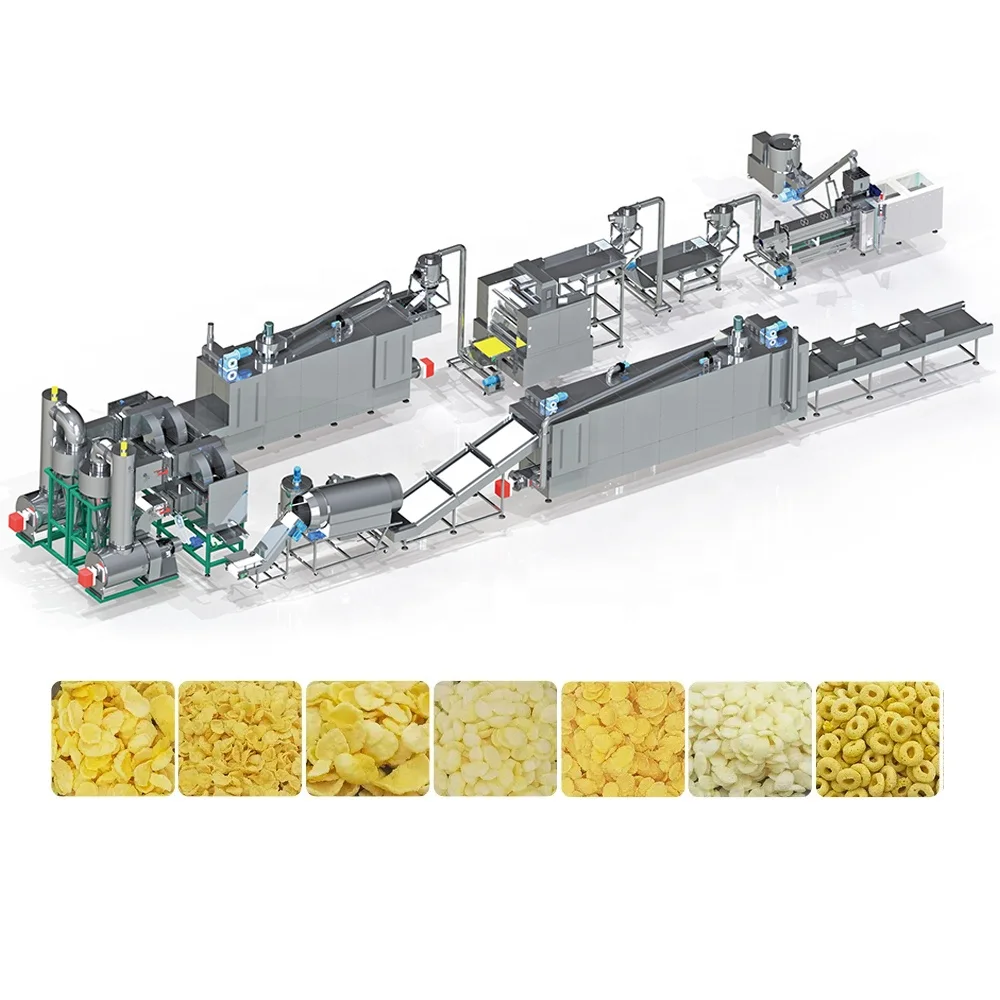


MT-75 Twin-Screw Extruder Breakfast Cereal Production Line, PLC Control, Gas-Fired Oven — engineered as one integrated system from batching to packing, with every station throughput-matched to eliminate downstream bottlenecks. Screw configuration and die profile are specified to your grain formulation and target cereal shape, with dual-stage drying ensuring uniform moisture reduction and final crispness. Voltage and frequency confirmed against your facility before build.
- Full 12-station turnkey layout with pre-planned utility requirements
- In-house trial runs on your raw material before shipment
- Phased installation, commissioning, and operator training included
- CE certified, food-grade stainless steel contact materials
Description
Throughput-Matched Engineering — Every station from the 10–30 kg batch mixer to the gas-fired high-temperature oven is calculated against the extruder’s actual output on your grain blend, preventing the dryer or coating drum from becoming a hidden bottleneck.
Technical Specifications
| Parameter | Value |
|---|---|
| Product Type | Twin-Screw Extruder Breakfast Cereal Production Line |
| Extruder Model | MT-75 |
| Screw Configuration | Twin-screw, co-rotating, sectional modules |
| Extruder Functions | Forward/backward transport, mixing, de-gassing, cooking, forming |
| Mixer Output | 10–30 kg/load |
| Mixer Power | 4 kW |
| Mixer Tank Size | φ600 × 500 mm |
| Screw Conveyor Power | 0.75 kW |
| Corn Flakes Press Machine Power | 16.12 kW |
| Press Machine Roller Size | 510 × 310 × 1050 mm |
| High-Temperature Oven Dimensions | 4500 × 1400 × 1800 mm |
| High-Temperature Oven Heating | Gas-fired, dual-side baking system |
| Sugar Spraying System Total Power | 28.75 kW |
| Sugar Spraying System Roller Size | Ø600 × 2700 mm |
| Control System | PLC and MCC, language configurable |
| Contact Materials | Food-grade stainless steel throughout |
| Voltage & Frequency | Configurable (e.g., 3ph 380V 50Hz, 3ph 415V 60Hz) |
| Output Capacity | (basis to be confirmed based on raw material and moisture) |
| Certifications | CE, ISO |
Application Suitability
| Application | Material or Output |
|---|---|
| Traditional Corn Flakes | Maize grits, corn flour |
| Whole Grain Hoops & Rings | Wheat flour, oat flour, multigrain blends |
| Fortified Breakfast Cereals | Grain powders with added vitamin and mineral premixes |
| Sugar or Honey Coated Cereals | Extruded rings, balls, or stars requiring syrup application |
| Direct Expansion Snacks | Rice flour, corn starch blends for lightweight puffed formats |
What "Nominal Line Capacity" Actually Means for Your Cereal Output
A line rating means nothing if the dryer cannot keep pace with the extruder.
Many breakfast cereals corn flakes production line turnkey proposals quote an extruder output without calculating the residence time required in the drying and cooling stages. When whole wheat or oat-heavy formulations are introduced, the moisture reduction curve changes entirely. I have seen projects where the press and extruder ran fine, but the single-stage dryer left the flakes chewy in the center, forcing a complete halt to re-engineer the thermal profile on the factory floor [NEED_CITE: thermal dynamics of multigrain starch gelatinization].
Engineering the Sequence From Batching to Packing
A complete production line requires more than placing machines in a row. The sequence begins with the flour mixer feeding into a screw elevator, which must deliver a consistent mass flow rate to the MT-75 extruder. If the elevator surges, the twin-screw cooking zone experiences uneven shear, resulting in variable starch gelatinization. This breakfast cereals corn flakes production line turnkey configuration balances the 10–30 kg batch cycles with continuous downstream conveying to stabilize the feed.
Balancing Thermal Loads Across Two Drying Stages
Cereal texture is defined by how moisture is extracted. This layout incorporates a dual-stage drying approach. The first dryer stabilizes the extruded and pressed pellets, while the second dryer, following the sugar spraying system, sets the final glaze and crispness. The 4.5-meter high-temperature oven utilizes a gas-fired dual-side baking system to ensure that heat penetration is uniform across the belt width, which is critical when producing dense whole grain rings that resist rapid moisture loss [NEED_CITE: industrial drying profiles for fortified cereals].
Screw Profile and Die Geometry for Grain Blends
The MT-75 uses sectional screw modules, allowing the compression ratio and kneading block arrangement to be adjusted for specific grain formulations. Corn flour requires a different shear history than a fibrous oat blend. By matching the screw configuration and die design to the buyer’s actual raw material, the extrusion process achieves the target expansion and density. The die geometry directly dictates whether the output is a hoop, ball, star, or stick, and the subsequent press machine rollers can be adjusted to flatten pellets into traditional flakes.
The Hidden Cost of Ignoring Utility Infrastructure
Failing to map the utility requirements before shipment leads to severe commissioning delays. The sugar spraying system alone requires 28.75 kW, and the gas-fired oven demands specific pressure regulators and exhaust ventilation. If a facility lacks the dedicated electrical circuits or gas flow rate, the line cannot reach its thermal operating points. This results in prolonged downtime while local contractors upgrade the infrastructure, turning a planned production launch into a facility renovation project [NEED_CITE: industrial utility planning for food extrusion plants].
Why Single-Source Integration Matters Here
Sourcing the mixer, extruder, and coating drum from different vendors often results in throughput mismatches. We supply the complete line from batching to packing under one responsibility, ensuring the vibrating spreader and cooling conveyor are scaled to handle the maximum output of the MT-75. Our in-house testing workshop runs your specific grain formulation before shipment, verifying the screw profile and drying times. We lock in your facility’s voltage and control language during the design phase, and our documentation includes a complete station-by-station capacity calculation.
Documentation & Verification
- Line layout and throughput calculation matching mixer batch size to extruder output.
- Factory test record on your specific grain formulation and moisture content.
- Electrical schematic confirming voltage, frequency, and PLC language.
- Screw and die configuration record matched to your target cereal shape.
- Operation manual detailing gas oven ignition and dual-stage drying profiles.
Installation, Commissioning & Support
- Foundation planning for the 4.5-meter high-temperature oven and heavy press machine.
- Dedicated electrical circuits mapped for the 28.75 kW sugar spraying system.
- Pre-assembled stations verified against your facility’s 3-phase voltage supply.
- Thermal profile debugging for the gas-fired dual-side baking system.
- Operator training on sectional screw module changes for different cereal shapes.
- Wear parts list covering co-rotating screw elements and press rollers.
Project Scoping and Data Requirements
To finalize the layout and throughput calculations, we require your target product shapes, the exact grain formulation including moisture content, and your daily production targets. Please provide your workshop dimensions and local electrical standards so we can configure the MCC and gas supply requirements accurately.
Frequently Asked Questions
Q: How is total line capacity calculated and what raw material assumptions are used?
A: Capacity is not a fixed number; it depends on your grain blend and moisture content. We calculate throughput by matching the mixer’s batch cycle to the MT-75 extruder’s mass flow, then verify that the dual-stage dryers provide sufficient residence time for your specific formulation to reach the target final crispness without bottlenecking the coating line.
Q: What are the utility requirements for the complete line?
A: The line requires significant electrical and thermal infrastructure. The sugar spraying system demands 28.75 kW, and the high-temperature oven requires a stable gas supply for its dual-side baking system. We provide a detailed utility document mapping the electrical load distribution and gas pressure requirements for your facility contractors before the equipment arrives.
Q: How is the line layout adapted to my workshop dimensions?
A: We draft the layout based on your floor plan, ensuring proper spacing between the flour mixer, extruder, and the 4.5-meter oven. The design accounts for material flow, elevator inclines, and the necessary maintenance access clearance around the press machine and coating drums to allow for routine roller cleaning and screw changes.
Q: Can the line be reconfigured for additional cereal formats later?
A: Yes. The MT-75 extruder uses sectional screw modules and interchangeable dies, allowing you to switch between hoops, stars, and sticks. The corn flakes press machine features adjustable roller distances, so you can modify flake thickness or bypass the press entirely for direct-expanded 3D pellet snacks.
Related products
-

Corn Flakes Production Line Breakfast Cereal Production Machine Line Corn Flake Making Machinery
¥59,800.00 Select options This product has multiple variants. The options may be chosen on the product page -
Complete Corn Flakes Production Line Breakfast Cereal Processing Machine Core Motor Component Cornflakes Processing Equipment
¥19,000.00 Select options This product has multiple variants. The options may be chosen on the product page -

Hot Selling Automatic Corn Flakes Breakfast Cereal Production Line Making Machine
¥20,000.00 Select options This product has multiple variants. The options may be chosen on the product page -
Automatic Instant Breakfast Cereals Snack Food Making Machine
¥10,000.00 Select options This product has multiple variants. The options may be chosen on the product page